

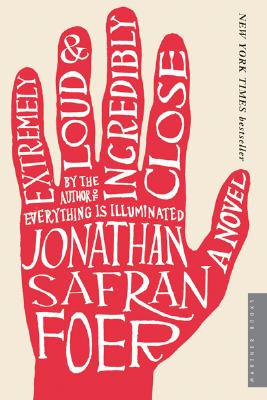
 by Jonathan Safran Foer
ages: adult
First sentence: “What about a teakettle?”
Support your local independent bookstore: buy it there!
Huh. I heard so much good about this book, the people over at the Nook (that’s my online book group) are basically raving about it, and all I can come up with is… huh.
For those of you who don’t know (all five of you), the story revolves around nine-year-old Oskar Schnell whose father, two years before, died in the World Trade Center Bombings. Oskar has become increasingly fearful: of heights, elevators, people that look Arab and more and more neurotic, wearing only white, writing letters obsessively to famous people (mostly asking to be their protégé). Then, in his father’s closet, he finds a key in an envelope marked “Black”, and begins searching New York City for the owner. Somehow, he feels, this will help him learn more about his father and give him some kind of closure. Interspersed with Oskar’s story are letters from his grandparents: ones from his grandfather to his father explaining why he left and wasn’t there while his son was growing up. And ones from his grandmother to Oskar, explaining what happened with her husband and why she is leaving now.
It’s the combination of Oskar’s pretentiousness (and “wise innocence”) and the use of graphics — pictures or red markings or — that give this novel it’s unique feel. Sometimes, that’s a good thing. Sometimes, I thought, all of the novel ideas in this novel actually worked. I enjoyed the photographs; they gave an interesting perspective into Oskar’s world and his journey. It’s a depressing subject, 9/11, and I thought there were moments when Foer got grief, got incompleteness, got searching for closure just right. There were chapters that hit me powerfully — the letter from the grandmother about her reaction when she realized her son had died in the towers, for instance — and the ending is, ultimately, hopeful. Which is a good thing considering the scope of the tragedies in the book. It could have been a horribly depressing book, and it wasn’t.
But, there were also moments when the pretentiousness — of both the novel and of Oskar — drove me absolutely batty. I spent too much time trying to figure out the red editing marks on one of the grandfather’s letters, trying to figure out what it all “meant”. And the letter from the grandfather that began with numbers — he was trying to communicate on the phone without speaking — and ended in pages of black ink drove me batty. (Yes, I did try to figure out what he was saying. Argh.) Perhaps, for once in my life, I was over thinking a book instead of letting it wash over me. But perhaps, also, all the uniqueness and all the pretentiousness negated each other: there was too much of a good thing in this book, and in the end I was left with an empty void of Huh.
 The Book Nut
I've never even heard of this book…
LikeLike
I picked up this book a while ago because the premise seemed interesting. It has since sat on my bookshelf. I keep meaning to pick it up but other things catch my attention. Maybe I'll stop feeling guilty.
LikeLike
My reaction to this book was huh? as well. Never understood was it was so popular for a while there.
LikeLike
I'm sort of with you too. I really wanted to love it. I did. I think maybe the movie adaptations of his books are better? I wonder if they'd try to do this one. I did like the other movie–maybe I should read the book and compare . . . maybe not.
LikeLike
Good review, Melissa. I think you and Updike are of one mind indeed. I did like Everything is Illuminated better. If you can stomach his style again, you might give it a try.
LikeLike
Totally valid comments, all. You know how I feel 🙂
LikeLike