

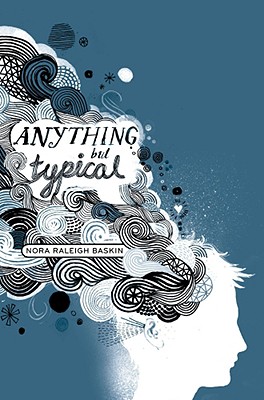
 by Nora Raleigh Baskin
ages: 9-12
First sentence: “Most people like to talk in their own language.”
Support your local independent bookstore: buy it there!
Sherry at Semicolon captured my thoughts on this one just perfectly. This book takes you away, makes you think about your perceptions of people, makes you think about language, actions, reactions, and how we treat others.
It also made me cry. (Which is a rare and unusual thing, and also mildly embarrassing, since I was reading this while sitting in the salon waiting for M to get her hair cut…)
Twelve-year-old Jason is autistic. He’s full of labels and letters — ADOS, LD, HFA, PDD-NOS, NT — and yet, those labels and letters and names don’t define him. Or, at least, he tries not to be defined by them. Yes, getting through the day is difficult, and any little thing can set him off, often beyond his control. But, what he really wants to be seen as, defined by, is his ability to write stories.
(As an aside, I loved this quote:
“But really, if you ask me, there is only one kind of plot.
One.
Stuff happens.
That’s it.”
So true.)
He posts his stories on a fanfiction website, Storyboard, and one of them got a comment from PhoenixBird — who happens to be a girl. Jason and PhoenixBird seem to connect; at one point, he tells people that she’s his “girlfriend”. Then, there’s a Storyboard convention, and it turns out that PhoenixBird will be there. Jason — because of past experiences, because he knows how people react to him when meeting him for the first time — is anxious about going.
I don’t want to give much more than that away. I’ve read books about autistic kids before, but never have I felt so involved in the life of one. Baskin stuck us, as readers, inside Jason’s head — and sometimes he was an unreliable narrator because his interpretation of events didn’t always match up with what “actually” happened — and let us live through his triumphs, pains, anxiety, hopes, fears, love. It’s a beautifully written book; not because the language is poetic, though sometimes it is, but because it’s spare enough, tight enough, there are no wasted words, no wasted pages.
Perfect.
(Just for the record: because this is a Cybils nominee, I’ve been asked to make sure y’all know this is my opinion only, and not that of the panel.)
 The Book Nut
I've seen a couple reviews of this book now and for whatever reason I've been on the fence about adding it to my wishlist. Reading your review has put me right over into the definitely adding it section. In fact I totally did!
I'm looking forward to getting a copy and reading it for myself.
LikeLike
But here's what I keep wondering…can a non-autistic author create an authentic autistic character? And should I even be asking this question, or is it some kind of a racist kind of question? (I loved the book, but still am a little troubled by the idea that this author tries to get inside an autistic experience instead of describing it from the outside, like in RULES…) What think you?
LikeLike
Mary Lee — I'm not exactly the best person to answer the question, not having much experience with autism myself. But, my first instinct is to say that I think there is some similarity to men writing women/girl characters or white authors writing about minorities: can they ever truly get inside a character the way someone with first-hand experience can? No… but that doesn't mean they shouldn't try, does it?
LikeLike
Exactly! And I have no problem with those other scenarios, so I wonder why I'm reluctant to accept a non-autistic writing about the autistic experience…
Maybe no matter HOW a non-autistic person interprets and describes the language barriers, it is valid because it gives the rest of us an idea of what those barriers MIGHT be like. Hmmm…
Thanks for sharing your thinking!
LikeLike