

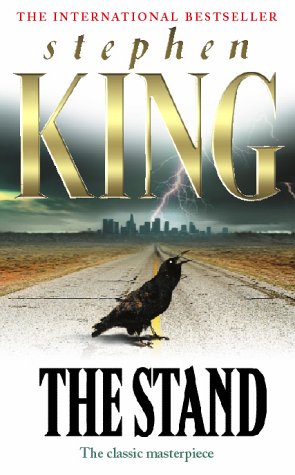
 by Stephen King
ages: adult
First sentence: “Hapscomb’s Texaco sat on US 93 just north of Arnette, a pissant four-street burg about 110 miles from Houston.”
This one definitely takes some doing to wrap your brain around. It’s huge (even though I read the “original” version — the one that was published in 1978 — and not the “definitive” version — the one that King went back and added 200 pages to). It’s sprawling. It’s weird and wild and wacky. It’s dystopian, political, religious, horrific, gross, amazing.
It’s… well… Stephen King.
This was my first experience with King (aside from his Entertainment Weekly reviews, and reading The Lawnmower Man in 6th grade, which I don’t remember at all). And what an experience. I was blown away by the sheer craft of the man: not the plotting (which I felt dragged in spots), but the imagination (warped) and the world building, and the characterization, and just the fact that he. made. this. book. work. Not many people could imagine something so sprawling and huge and you’d be able to say that in the end.
The basic plot (in case you haven’t read the book, or seen the miniseries, which I have to admit I’m curious about now): a superflu (something which threw me for a loop: “Government heath officials emphasize that this is Russian-A flue, not the more dangerous swine flu.”) virus gets out and, because it has a 99.4% mortality rate, wipes out most of the population of the country. How or why you survive isn’t known; you either don’t catch it, or you’re dead. The first part of the book is the horror: watching people die terrible, horrible, gross, pathetic deaths not only is difficult, but incredibly unsettling. Shoot: it’s terrifying, especially with H1N1 floating around. King is brilliant in this part: he gives people names, occupations, dialogue, a history… and then kills them off. It’s brilliant watching the spread of the virus, and terrifying how it affects the world, and the reader.
Then, once everyone who is going to die is dead, the book changes tone. It becomes a political book as the survivors gather — either around Mother Abigail in Boulder, Colorado (the good team) or around Randall Flagg, aka The Dark Man (the bad team), in Las Vegas. There’s a whole section, and this is where the book (for me, at least) lags, about setting up a community, how the Free Zone works, about the human race’s urge to gather and organize and build. There’s this one character, Glen, who is the sociologist (he’s the Hermione of the book) who explains everything. And explains. And explains. Yawn.
Then — because having a horror book and a political commentary isn’t enough — King decided to turn religious on us, and has a showdown — though not in the way I expected — between the good and evil forces. Once the focus switches away from the community in Boulder, once Stu, Glen, Ralph and Larry — they’re the leaders, of sorts, of the Free Zone — begin their quest as commanded by Mother Abagail on her deathbed — and once we see what the Dark Man’s been up to in Vegas, the action picks up again. Perhaps King is only brilliant when he’s twisted? I was fascinated with the downfall of Randall’s society, with twists and turns of the plot, and with the climax.
Then — and why do authors feel a need to do this? — the book went on for 50 more pages. Yeah, sure, I suppose we need some sort of denouement, some sort of resolution, but honestly, 50 pages worth? (I was actually glad I got the 1978 version by this point.)
It was an uneven book: when it was on, it was brilliant; when it was off, it was incredibly boring. But, now that I’ve forayed into the world of Stephen King, I have to admit I’m curious to read more. He’s an amazing writer.
Warped and weird, yes. But definitely amazing.
 The Book Nut
I like some Stephen King, but despite the dystopian aspects of this one, I'm just not interested.
LikeLike
This is one of my favorite books (I've read it twice). I love King when he is “on” and I think this is his masterpiece. Great review of it!
LikeLike
I love Stephen King, but not especially, this one. The first part I liked, the last part, not. I loved the TV miniseries, though.
Great review!
:o)
LikeLike
Wow. What a book to kick off your King reading experience! I've not tackled The Stand yet, but I've enjoyed a few of his other works; my favorites so far are Needful Things and The Shining.
LikeLike
This is one of my fave books. I love it and think that you gave a fair review of it. I do agree that sometimes there is a bit too much talk, talk, talk, but I even found that interesting when I read it. I've read both versions, the “short” one and the long one. The short one has been read numerous times, about once every second year since I read it first which was in 1989.
Great review of a great book!
LikeLike
The Stand is one of my favorite books. I re-read it every few years (the long edition). I actually love the section where they're setting up the community – I find the questions about how to maintain a democracy, how to get people to work, how to deal with lawbreakers, etc., fascinating. I also adore the miniseries – I'll be a Gary Sinese fan forever because of his portrayal of Stu.
I also do love those sections where King takes the time to introduce the characters that he's killing off, too. It's very powerful. Thanks for the review!
LikeLike
I read this book about five years ago, when I was living in Portland, OR after my first year of law school. My experience with it pretty much mirrors yours: it was my first REAL King; I believe I read Firestarter when I was YOUNG and don't remember it; and I was sucked in immediately. I got bored, too, in the community building section, but WOW. Did this book impress me. I have yet to read any more King (life just seems to get in the way), but I'm glad that I am not the only one who had that reaction to this book!
LikeLike
I've come to deeply respect King, in part through his EW columns (which I love) and his book “On Writing,” which is also great (if for the first 96 pages alone).
As an English major in college, I think I was taught to raise my nose at guys like King — if it wasn't incomprehensible, how good could it be? Page-turner was an insult back then. So it's taken me a long lifetime to unlearn some of those lessons. Sad, but true. He's not a guilty pleasure; he's a dedicated writer, a craftsman, a storyteller, an artist.
These days I'm often looking at his books in stores, wondering: Where to begin? Maybe “The Stand” is the right place, just dive right into that deep water. At the same time, sure, I suspect he's not my kind of thing.
Anyway, enough about me! Great review, great site, thanks.
James Preller
LikeLike
A friend recommended Stephen King's THE LONG WALK to me after I read and loved THE HUNGER GAMES. I'd highly recommend it if you're looking for more King. I haven't read THE STAND, but it's on my TBR list… it's so long that it's daunting…
LikeLike
You are one dedicated and diverse reader!! This is one log book, my middle son's very favorite, and to think that you read it along with lots more…. you go, girl!!
Great review!
LikeLike
I read this book in 8th grade and absolutely loved it! To this day, when considering all of King's prose, this one comes out on top.
I just recently picked up a copy of it as a thrift store, anticipating a re-read. I think it might be my December gift to myself!
Nice review.
LikeLike
Okay. I'm going to read it then. Someday 🙂 But you MUST see the mini series. Some parts with Randall are a “bit” disturbing, but I found it fascinating. I'm interested in book vs. movie. This was a really good review, friend!!
LikeLike
This is one of my favorite books of all time. I've read it several times and have read both versions. I watched the mini-series, but wasn't thrilled with it. Isn't the book always better??
LikeLike
Really impressive that you read this book! I haven't read much King. I am not a big fan of horror, but I did actually start this one once. I really should read it in its entirety one day.
LikeLike
Thanks, all, for your thoughts. Yes, it was daunting… and part of the reason I read so many other books along with this one is because I often needed to take breaks from it.
Y'all have all but convinced me to see the miniseries, if only to compare the two.
And, yes, James — I was always “taught” to discount King. Pulp fiction can't be good, can it? But, I'm amazed: he's a fantastic writer.
LikeLike
I've never read a Stephen King book, and this is the first time anyone has made me reconsider that decision. Not sure if I'll ever pick it up, but it does sound intriguing.
LikeLike