

Not enough people got my costume last night, but I figured you bookish types would.
Happy Halloween!
Month: October 2009
October Jacket Flap-a-Thon
October. That wonderful month of changes — at least here — when the world turns from Summer to Fall, when the mind turns to the holidays.
When life gets incredibly busy and there isn’t enough time to sit and read. Though I did get a fair amount read this month, surprisingly.
On to the best of the bunch:
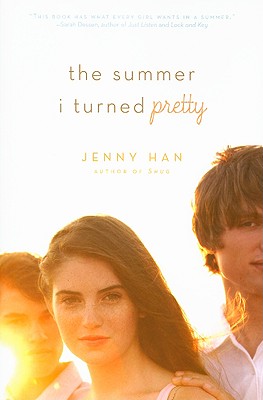 The Summer I Turned Pretty (Simon&Schuster): “Some summers are just destined to be pretty. Belly measures her life in summers. Everything good, everything magical happens between the months of June and August. Winters are simply a time to count the weeks until the next summer, a place away from the beach house, away from Susannah, and most importantly, away from Jeremiah and Conrad. They are the boys that Belly has known since her very first summer — they have been her brother figures, her crushes, and everything in between. But one summer, one wonderful and terrible summer, the more everything changes, the more it all ends up just the way it should have been all along.”
The best of the YA romance books I read this year: short, sweet, and captures the book perfectly.
 Sweetness in the Belly (Penguin Press): “An evocative and richly imagined story of a British-born Muslim woman’s search for love and belonging in two very different worlds. When Lilly is eight years old, her pot-smoking hippie British parents leave her at a Sufi shrine in Morocco and inform her they will be back to collect her in three days. Three weeks later, she learns they’ve been murdered. Lilly fills that haunted hollow in her life with the intense study of the Qur’an under the watchful eye of the saint’s disciple she was entrusted to. Years later, her journey from Morocco to Harar, Ethiopia, is half pilgrimage, half flight. In Harar, even her traditional Muslim head scarves cannot hid her white skin in her strange new surroundings; the world farenji — foreigner — is hissed at her at every turn. She eventually builds a life for herself teaching children the Qur’an, and she finds herself falling in love with an idealistic young doctor.
I often complain about adult blurbs, but I think this one is spot on in capturing the tone and plot without being overlong.
 Liar (Bloomsbury): “Micah will freely admit she’s a compulsive liar, but that may be the one honest thing she’ll ever tell you. Over the years, she’s fooled everyone: her classmates, her teachers, her parents. And she’s always managed to stay one step ahead of her lies. That is, until her boyfriend dies under brutal circumstances and her dishonesty begins to catch up with her. But is it possible to tell the truth when lying comes as easily as breathing? Taking readers deep into the psyche of a young woman who will say just about anything to convince them — and herself — that she’s finally co me clean, Liar is a bone-chilling thriller that will have readers seesawing between truths and lies right up to the end.”
Great! Intriguing, without giving a single. detail. away. Perfect.
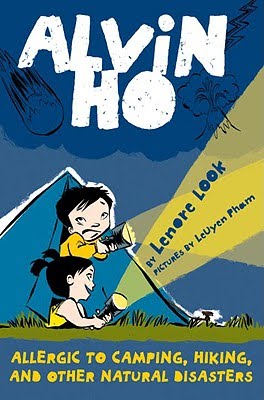 Alvin Ho: Allergic to Camping, Hiking and Other Natural Disasters (schwartz and wade books): “Alvin Ho does not think the great outdoors is great. It is super-duper scary. here are a few reasons why: 1. Flash floods. 2. Meteorites. 3. Lots of creepy trees. 4. Pit toilets! Luckily, when his dad suggests — gulp! — a camping trip, Alvin is prepared. He has: 1. A portable generator. 2. Night-vision goggles. 3. Toilet paper. 4. More toilet paper! So grab your mosquito netting and your heavy-duty flashlight and experience the great outdoors with the one and only Alvin Ho.”
How can you not love Alvin? Really. And I love that the blurb writer loves him, too.
Other books read this month:
The Key to the Golden Firebird
Mission Control, This Is Apollo
Nothing But Ghosts
Ice
A Civil Contract (DNF)
Trail of Crumbs (DNF)
The Brilliant Fall of Gianna Z
The Stand
The Princetta
Emma-Jean Lazarus Fell Out of a Tree
Something, Maybe
Emma-Jean Lazarus Fell in Love
Ninth Grade Slays
The Guernsey Literary and Potato Peel Society
Moxy Maxwell Does Not Love Practicing the Piano
Moxy Maxwell Does Not Love Practicing the Piano
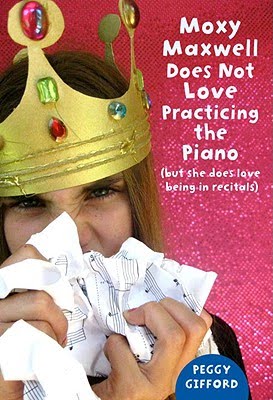 But She Does Love Being in Rectials
by Peggy Gifford
ages: 7-11
First sentence: “It was just after 10:00 a.m. on Saturday, April 7, and Moxy Maxwell was still in bed.”
Support your local independent bookstore: buy it there!
I love Moxy.
I’m not ashamed of this because Moxy is awesome.
Very few books make me laugh, chortle, snort, guffaw, and giggle. Moxy makes me do all of those. Perhaps that’s because my sense of humor is not very sophisticated — I mean why does this chapter crack me up every time:
Chapter 29: In Which We Learn What Was Inside The Envelope. Inside THE ENVELOPE was the note.
That’s it. Entire chapter. Cracks me up every time. As did the dog barking (“barking and barking and barking” written very small over and over… in the shape of a dog.) and Mark’s pictures, especially his titles. (“My Sister Looks Better with a Cape Over Her Face”) Or the other best chapter:
Chapter 7: The Hook. The Hook is the part of a story that makes you, the Reader, want to keep reading to find out what happens next. Ideally, the Hook should come as early as Chapter 1 — Chapter 2 at the latest. Any later, and the author risks “losing the reader.” Which means you, the Reader, might put this book down for just one second to get some gum and never come back. So please hang on — even though it is already Chapter 7, Something Really Big is about to happen.
And, yes, Chapter 8 is called Something Really Big.
There is a plot: Moxy is to be in a piano recital. Playing “Heart and Soul” with her little sister, Pansy. Except there’s two problems: Moxy has a hard time stopping playing when the song’s over (it’s too short… really, if she’s going to Be On Stage, then she ought to make the most of it), and she’s a bit too distracted getting together the Perfect Outfit in order to, um, practice. Yes, there are escapades (this time involving fake ermine trim and an explosion of Green Grass Powder Shake powder) and problems (what happens when it’s actually time to go On Stage??)
It’s so much fun, I was sad when it ended. Hopefully, though, Moxy will have many many more adventures. If only to entertain me, the Reader.
The Guernsey Literary and Potato Peel Society
 by Mary Ann Shaffer and Annie Barrows
ages: adult
First sentence: “Dear Sidney, Susan Scott is a wonder.”
Copy won in a contest sponsored by A High and Hidden Place
Support your local independent bookstore: buy it there!
Sometimes, when I read a book, one word keeps popping in my mind. For this book, the one word I constantly thought was charming. Utterly, unabashedly, and unreservedly charming.
The book reminded me in many ways of 84 Charing Cross Road, and it wasn’t just that it was an epistolary novel. Shaffer and Barrows got a feel for the time (post-war), the place (England), and the people. That, and it’s a book about readers and community and belonging, all of which I totally love. It’s got a bit of everything, too: romance, literary illusions, soaring descriptions, history. It’s a war book, an epistolary novel, a romance, a work of historical fiction.
It’s nearly perfect.
Perhaps the only thing holding it back was the hype. I’m always suspicious of NY Times best-sellers, and while I think this one proved my suspicions wrong, I do think that I wanted more out of it. I wanted it to be more soaring, to be more than it actually was. Perhaps that’s the nature of the book, though: to get so involved in it that you want more at the end. Whatever the reason, I did enjoy the journey: I just wanted something more out of it.
But what I did get was thoroughly captivating.
2009 Challenge #6: RIP
 The good thing about doing one book for many challenges is that you finish them up quicker. I set out to read two books for Carl’s challenge, ended up reading four, and only one of the two I had set out to read.
I had a grand time, though.
The four I read:
1. The Stand, by Stephen King
2. The Moonstone, by Wilkie Collins
3. Great Stories and Poems of Edgar Allan Poe
4. Ninth Grade Slays, by Heather Brewer (I did get a vampire book in!)
My favorite? Toss up between The Moonstone and The Stand, though I’m glad I read some Poe.
Thanks, Carl. It was fabulous, as usual.
Wish me luck!
Ninth Grade Slays
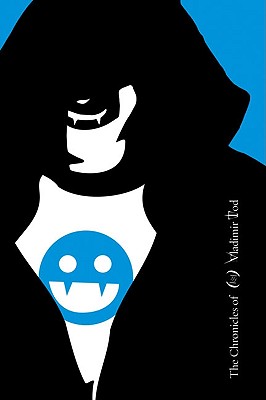 The Chronicles of Vladimir Tod, #2
by Heather Brewer
ages: 10-13
First sentence: “Jasik gripped the photograph in his hand and scanned the face of the boy.”
Support your local independent bookstore: buy it there!
We pick up again with Vlad at the beginning of his freshman year. His one goal over the summer was to call Meredith (the love of his life), but… he chickened out. So, where does that leave our teenage vampire? Depressed. Bummed out.
Must be high school.
Vlad has new challenges this year: there’s the leftover problem the vampire community has with his existence. There’s a vampire slayer kicking around Bathory. There’s the training his uncle wants him to get with a uber-vampire in Russia. There’s the teen angst of not knowing whether or not Meredith likes him.
There’s the problem that the book (still) has too much set up and not enough pay off. That Vlad is annoying, the dialogue stilted and the action uninteresting. Which means, even though I read every single page, there wasn’t much there for me to truly like.
Sigh. That’s what really slays, y’know.
Library Loot #42
 I’m still running around like a crazy person this week, and this time (horror of all horrors!), the library got shortchanged. We popped in to return books and pick up my Cybils holds, and threw in a few picture books (and other books) on our way to the checkout counter.
Next week will be better.
For A/K:
Dora Saves the Snow Princess (Dora the Explorer)
Hug Time, by Patrick McDonnell**
Score One for the Sloths, by Helen Lester/Illus. by Lynn Munsinger**
Batter Up Wombat, by Helen Lester/Illus. by Lynn Munsinger
Read It, Don’t Eat It!, by Ian Schoennherr
Super Duck, by Jez Alborough
For M:
Lizzie Bright and the Buckminster Boy , by Gary Schmidt
The Outlaws of Sherwood, by Robin McKinley*
Rules of the Road, by Joan Bauer
For me (and anyone else who wants to read them):
William S. and the Great Escape, by Zilpha Keatley Snyder
Moxy Maxwell Does Not Love Practicing the Piano: But She Does Love Being in Recitals, by Peggy Gifford (which is NOT a Cybils book, for shame!)*
A Season of Gifts, by Richard Peck
Anything But Typical, by Nora Raleigh Baskin
Also Known As Harper, by Ann Haywood Leal
Models Don’t Eat Chocolate Cookies, by Erin Dionne
The roundup is either at Reading Adventures or A Striped Armchair. Obligatory FTC note: the links are provided through my Amazon Associates account. If you click through and actually purchase one of these books, I’ll get a teeny, tiny payment. But, since no one ever does, and it’s SO much easier using the associates account to put up these links, I’m going to keep doing it.
*Ones that M eventually read.
**Picture books we really liked.
Emma-Jean Lazarus Fell in Love
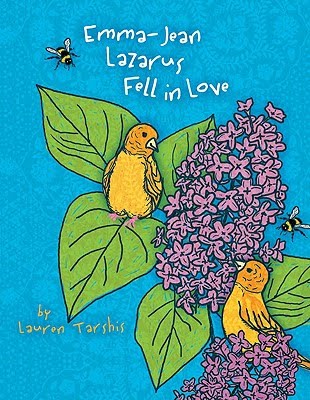 by Lauren Tarshis
ages: 9-13
First sentence: “Emma-Jean Lazarus knew very well that the seventh-grade boys at William Gladstone Middle School behaved like animals at times.”
Support your local independent bookstore: buy it there!
I don’t know, after the events in the first book, if I really, truly expected Emma-Jean to be less quirky. I don’t think I did. Which is good, because she wasn’t.
This time, in Emma-Jean’s life, love abounds. It’s May, it’s time for the spring dance (both of these books revolved around dances). And it’s the girls turn to ask the boys out. Everyone’s pairing off, except Emma-Jean and Colleen. (Colleen wants to; Emma-Jean is considering it, to a certain extent.) And so, when Colleen gets a secret admirer note in her locker, she tasks Emma-Jean to figure out which boy it is. Brilliant deductions, quirky observations — but not over-the-top like in the first book.
Emma-Jean also has her first crush, which she takes on in Emma-Jean-style:
“A crush?” Emma-Jean said. This sounded very serious. She pictured a boa constrictor wrapped around the neck of a lemur.
“An infatuation,” her mother clarified.
“Is it the same as being in love?” asked Emma-Jean warily….
“No,” [her mother] said. “Being in love is one of the most powerful experiences anyone can have. I think that’s why we have crushes when we’re younger. Maybe it’s how we get ready for real love.”
This seemed logical to Emma-Jean. After all, many important life skills — walking, talking, cooking, identifying birds in flight — were learned in stages and honed through practice.
It’s a sweeter book than the first one, funnier, and the plot works better. I found myself actually falling in love with Emma-Jean’s quirkiness in a way I didn’t the first time around. Quite charming.
(Just for the record: because this is a Cybils nominee, I’ve been asked to make sure y’all know this is my opinion only, and not that of the panel.)
2009 Challenge #5: The End of the World II
 Yahoo! I finished another challenge! This one was hosted by the illustrious Becky, and while I didn’t manage to squeak in under the deadline, I did finish it. (Okay, I thought the deadline was the end of October. Sheesh. That one was my fault.)
The books I read:
1. Life As We Knew It, Susan Beth Pfeffer
2. The Stand, Stephen King
3. Extras, Scott Westerfield
4. The Handmaids Tale, Margaret Atwood
My favorite: for pure terror, Life as We Knew It. And for a great introduction to a popular author, The Stand.
Anyway. Thanks, Becky.
The Stand
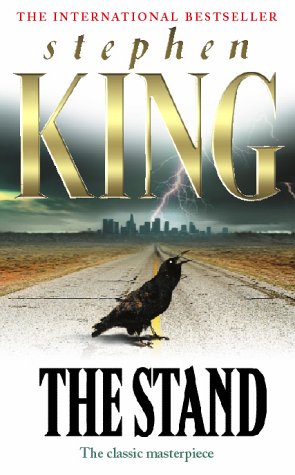 by Stephen King
ages: adult
First sentence: “Hapscomb’s Texaco sat on US 93 just north of Arnette, a pissant four-street burg about 110 miles from Houston.”
This one definitely takes some doing to wrap your brain around. It’s huge (even though I read the “original” version — the one that was published in 1978 — and not the “definitive” version — the one that King went back and added 200 pages to). It’s sprawling. It’s weird and wild and wacky. It’s dystopian, political, religious, horrific, gross, amazing.
It’s… well… Stephen King.
This was my first experience with King (aside from his Entertainment Weekly reviews, and reading The Lawnmower Man in 6th grade, which I don’t remember at all). And what an experience. I was blown away by the sheer craft of the man: not the plotting (which I felt dragged in spots), but the imagination (warped) and the world building, and the characterization, and just the fact that he. made. this. book. work. Not many people could imagine something so sprawling and huge and you’d be able to say that in the end.
The basic plot (in case you haven’t read the book, or seen the miniseries, which I have to admit I’m curious about now): a superflu (something which threw me for a loop: “Government heath officials emphasize that this is Russian-A flue, not the more dangerous swine flu.”) virus gets out and, because it has a 99.4% mortality rate, wipes out most of the population of the country. How or why you survive isn’t known; you either don’t catch it, or you’re dead. The first part of the book is the horror: watching people die terrible, horrible, gross, pathetic deaths not only is difficult, but incredibly unsettling. Shoot: it’s terrifying, especially with H1N1 floating around. King is brilliant in this part: he gives people names, occupations, dialogue, a history… and then kills them off. It’s brilliant watching the spread of the virus, and terrifying how it affects the world, and the reader.
Then, once everyone who is going to die is dead, the book changes tone. It becomes a political book as the survivors gather — either around Mother Abigail in Boulder, Colorado (the good team) or around Randall Flagg, aka The Dark Man (the bad team), in Las Vegas. There’s a whole section, and this is where the book (for me, at least) lags, about setting up a community, how the Free Zone works, about the human race’s urge to gather and organize and build. There’s this one character, Glen, who is the sociologist (he’s the Hermione of the book) who explains everything. And explains. And explains. Yawn.
Then — because having a horror book and a political commentary isn’t enough — King decided to turn religious on us, and has a showdown — though not in the way I expected — between the good and evil forces. Once the focus switches away from the community in Boulder, once Stu, Glen, Ralph and Larry — they’re the leaders, of sorts, of the Free Zone — begin their quest as commanded by Mother Abagail on her deathbed — and once we see what the Dark Man’s been up to in Vegas, the action picks up again. Perhaps King is only brilliant when he’s twisted? I was fascinated with the downfall of Randall’s society, with twists and turns of the plot, and with the climax.
Then — and why do authors feel a need to do this? — the book went on for 50 more pages. Yeah, sure, I suppose we need some sort of denouement, some sort of resolution, but honestly, 50 pages worth? (I was actually glad I got the 1978 version by this point.)
It was an uneven book: when it was on, it was brilliant; when it was off, it was incredibly boring. But, now that I’ve forayed into the world of Stephen King, I have to admit I’m curious to read more. He’s an amazing writer.
Warped and weird, yes. But definitely amazing.
 The Book Nut