 My second
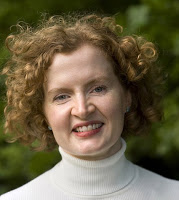
 victim author for the 10 Questions feature is the delightful Julie Berry, whose first book, Amaranth Enchantment — an interesting Cinderella-like fantasy/fairy tale for upper-middle grade readers — I thoroughly enjoyed.
MF: This is your first novel, congrats! Can you tell us a bit about the process of writing it and getting published?
JB: It took me about a year to write it. I was a graduate student at Vermont College’s MFA in Writing for Children and Young Adults when I wrote it, under the direction of advisers Cynthia Leitich Smith, Brent Hartinger, and Tim Wynne-Jones. I learned so much from each of them. I worked on it nearly every day, generally in the evenings after my children were in bed. It took many starts and stops before I figured out Lucinda’s story, as well as the tone and voice of the final piece. It was a lot of work, but I loved writing this story, and loved its characters.
As for getting it published, it won a prize at Vermont College, for which I remain forever grateful. I met an agent at an SCBWI conference and told her about the prize. She asked to see a few chapters, so I sent them. She offered me representation, and after we’d made a few revisions to the manuscript, she sent it out to several publishers, and before long we had a deal with Bloomsbury.
MF: Sounds like it was a charmed experience… Did you set out to write a young adult/middle grade novel, or did you just write the story and let the publishers decide?
JB: It’s always been my hope to write for children and young adults. It’s my genre of choice.
MF: Is being a writer something you’ve “always” wanted to do, or is it something you’ve discovered later in life? Do you have any specific writing influences?
JB: I think I always had deep-down authorial hopes, as I suspect most book lovers do. I majored in communication in college and had done professional writing of all sorts during my career, so I knew I had some capability with words, but I never knew whether or not I had the knack for fiction. It was on my “try before I die,” list. Part of me was afraid to try and learn that I did not have the knack. That, I thought, would be devastating. But after I’d had my fourth son, I began to think more about that dream. I imagined myself rocking on my front porch one day, old and blind, and regretting that I’d never tried. That thought become more scary to me than trying and failing. So I gave it a go, and I’m so glad I did.
MF: I think that’s very admirable. Trying something new, taking a risk, especially when you’ve got a family. Speaking of which: you have four boys (I’ve got four girls, about the same ages…) and a job. How on earth did/do you find time to write? Do you find it difficult juggling everything?
JB:Yes! Yes, yes, yes. I find it incredibly difficult juggling everything. But I am learning how to live with difficulty and juggling. (Incidentally, I can juggle. 🙂 I’ve had to get very creative about when and where I write. I write late at night, and I write early in the morning. I generally never wrote when the children were awake, because they needed my attention, and anyway, they’re far too distracting! Now I sometimes have to. The older my children get, the busier they get, which has its pros and cons. It means our lives are more scheduled, jumping from pillar to post, but it also means they’ve got interests of their own, and I can find 30 minutes here, 50 minutes there in which to make some progress with a scene. My house is fairly chaotic most of the time. My job is part-time, and it gives me a great deal of flexibility. Some times I wish I didn’t wear so many hats, but I recognize that they all make me who I am and keep life interesting.
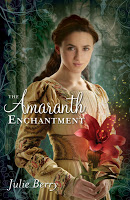 MF: A bit about the book: I really enjoyed the combination of history and religion and fantasy in The Amaranth Enchantment. Can you tell us a bit about how you came up with the idea(s) behind the book?
JB: The first thought I had was about a decaying mansion full of memories. That became Lucinda’s home. The next was about an enigmatic woman who had a connection to the supernatural. At first I thought that might be ghosts. Eventually I figured out she was a trapped and unhappy immortal, stuck in a world full of people who die. It took longer to figure out my main character, Lucinda. It became clear early on that she needed to be an orphan, and that led to developing her backstory. The process of writing forces you to answer so many questions. I come across a question that needs answering, cast about in my mind for possibilities, and go with the one that feels most right.
MF: I totally missed that it was a Cinderella-type story until someone pointed it out after I was done. Did you deliberately pattern it after the fairy tale, or was it something that just happened on its own?
JB:You’re like me — I didn’t realize I was writing a Cinderella story, either, until I was well into it. When I realized that was what I was doing, I had some fun playing with Cinderella motifs, but I never wanted my book to conform to a preexisting story. I wasn’t setting out to do a fairy tale retelling, just a fairy-tale like novel.
MF: I don’t feel so bad about missing that now. 🙂 Is there anything in your background — growing up or currently — that helped in creating this book? In what ways?
JB: Hm, that’s a tough question. In one sense, our stories spring from who we are, from our entire backgrounds and life experiences. If I’d lived a different life, I would have written a different book. But I can’t really draw a many lines between specifics in the book and specifics in my life. I love gemstones, though I’m the un-bling-est person you’ll ever meet. But I’m fascinated by the purity and clarity of stones. One of my favorite places to hang out is the gemstone exhibit at the Smithsonian Museum of Natural History. So I wrote that fascination into the magical gemstone in the store. I grew up on a farm where we had chickens, turkeys, pigs, rabbits, dogs, and cats, but no goats, so I threw in a goat.
MF: Do you have a favorite character or scene?
JB: I really do love all of the characters, but I probably feel the closest to Lucinda. We spent the most time together. My favorite scene is the one where Beryl is helping her get dressed for the ball. I cried when I wrote it. Isn’t that silly?
MF: What are your favorite five books, or five books you think everyone should read?
JB: Oh, I can’t possibly whittle it down to five! Here is a link to a document I’ve made listing favorite books.
MF: What can we expect from you next, if you don’t mind telling us?
JB: I’m working on a second book now for Bloomsbury, another fairy tale-like fantasy. I’m also working on a series of graphic novels for younger boys. My sister is the illustrator. It’s a good thing I can type fast. 🙂
MF: Thanks so much for your time!
JB: My pleasure. 🙂
You can read more of her writing at her blog.


 by Johan Theorin

 The Book Nut