

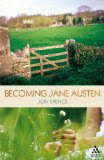
 by Jon Spence
ages: adult (though it could be read by 12+, if they’re interested)
First sentence: “In 1704, the presumed heir to the Austen family fortune, John Austen, lay dying of consumption at the age of thirty-four.”
Shall we start with another confession? (I’m in a confessional mood this week…) I picked up this book because I recently got the movie from Netflix and it made me curious about the book. (I saw the movie in the theater when it came out and had the same reaction, but never followed up on it.) I also recently saw Miss Austen Regrets, too, and between the two, I really wanted to know what was fact, and what was fiction.
Well, in the case of Becoming Jane, a lot was fiction. But that’s getting ahead of myself.
In this biography of Austen’s life, Spence takes a look at how Austen’s life is intimately reflected in her work. I haven’t ever read a biography of Austen before, so I’m not quite sure how it measures up scholarly, and I won’t say it’s a brilliant biography, but it’s a good one. Spence’s writing is accessible and interesting (though I think at times he gets a bit annoying with his perhapses and possiblys, but then since Cassandra burned most of their letters, it’s hard to know much about Jane, and a lot of it is perhaps and possibly…). And a lot of it is because Jane herself (probably much to her chagrin) is an interesting person. Or, at least, has become interesting because of her books.
So. What did I learn? Well, first off, the whole Jane-Tom Lefroy thing is only 15 pages in the book, and it’s all very sketchy. Spence asserts that, at least in Jane’s mind, they were in love (engaged possibly), and that affected her writing. She wrote “First Impressions” (which became Pride and Prejudice) around the time she knew Tom, and Spence writes this:
The energetic intensity of Pride and Prejudice attests to the effect that falling in love had on Jane Austen. It is an irrepressibly happy novel. Between October 1796 and August of the next year Jane wrote “First Impressions”; it was her unique way of thinking about Tom Lefroy and celebrate her delight at being in love — and at being loved. The novel that she later called “my own darling Child” was to be a gift of love for Tom Lefroy.
I have no idea if this is true, but it makes sense.
I also liked that Spence points out Austen’s propensity to switch genders from what she observes to what she writes. Tom — witty and clever — became Elizabeth, while she — reserved with strangers, seemingly haughty, yet loving to family — became Darcy. It happens others. I also enjoyed learning about the ebb and flow of her life and how it affected her work. Aside from P&P, Spence spent the most time on Mansfield Park, since that book had the longest gestation (10 years) of all her novels. He said this (which made me rethink at least my reaction to the novel):
We think we ought to like Fanny Price more than we do the fine, handsome Bertram girls and the warm, lively Mary Crawford. That it is difficult to do so, in our feelings and our reason, is precisely what Austen was determined to show. Our values tell us one thing, our hearts another. Mansfield Park is Austen’s most profound attempt to capture this inevitable confusion of feelings in human life — and her strategy was to make readers themselves confused in their own feelings about the characters in the novel.
And this:
Nothing is fixed and definite, and paradoxically the appearance of everything being so heightens our sense that it is not. Austen creates such a strong, distinct possibility in Mansfield Park that things did not have to turn out as they do that we are left in confusion. What might have happened is as real as what did happen. This disturbs us, makes us angry. We have been arguing vehemently with Jane Austen about the ending of Mansfield Park for two hundred years, exactly as she intended.
Fascinating, no? (Well, maybe not. But I thought so.)
Anyway. He does touch on all her other novels (though not so much on Northanger Abbey; it does tend to get slighted), as well her juvenalia and the fragment of the book she was writing when she died. I felt like the book ended abruptly, but overall I enjoyed the glimpse into Austen’s life; I think reading about her actually does heighten the enjoyment of her books, even if the whole Tom Lefroy thing was a bit blown out of proportion. And this is a good place for those of us without the desire to go and write a thesis on her, to get that knowledge.
 The Book Nut
I’ve watched the movie but I haven’t read this book…yet!! Great review!
LikeLike
Not sure if I’d want to read the book, but I plan to see the movie at some point. Thanks for the review!–Anna< HREF="http://diaryofaneccentric.blogspot.com/" REL="nofollow">Diary of an Eccentric<>
LikeLike