

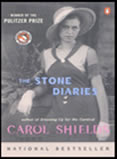
 I’m finally getting around to this one, the September pick for my in-person book group. If I remember right, aside from the person who recommended it, it was generally disliked. I can understand that; it’s not an easy book to read. Rather, it’s one of those lyrical books that spend as much time being about the words as about the plot. Those are often difficult for me to enjoy. Yet, I enjoyed this one, by Carol Shields, on a certain level.
I’m not sure I enjoyed the prose per se (I’m not a word person; evidence my dislike for Dickens), I found myself skimming sections, and not missing anything. But there were time when I was caught up in the lyricalness, the beauty of the words. From the first section, Birth, 1905:
It has never been easy for me to understand the obliteration of time, to accept, as others seem to do, the swelling and corresponding shrinkage of seasons or the conscious acceptance that one year has ended and another begun. There is something here that speaks of our essential helplessness and how the greater substance of our lives is bound up with waste and opacity. Even the sentence parts seize on the tongue, so that to say “Twelve years passed” is to deny the fact of biographical logic. How can so much time hold so little, how can it be taken from us? Months, weeks, days, hours misplaced — and the most precious time of life, too, when our bodies are at their greatest strength, and open, as they never will be again, to the onslaught of sensation.
The story is a very simple one: it’s the life of Daisy Stone Goodwell Flett. Her birth in Manitoba, her teenage years in Indiana, her brief first marriage, her love and marriage to Barker Flett, her life after his death, and her eventual illness of old age and death. Nothing spectacular. I liked this quote, from the interview with Sheilds in the back:
I was interested in the notion of autobiography and, in particular, the idea of women’s life stories. A lot of women are erased from their lives, sometimes as a result of their own actions and attitudes, but mostly for societal reasons. The saddest thing about women like Daisy Goodwill is that they didn’t know what was owed them. They didn’t have the words to say “I want.” Ninety-nine percent of the women of Daisy’s generation never claimed their own lives. Only a few women did — and we have novels about them.
I liked this idea: a novel about an ordinary woman. I liked that it was intimate; I never felt that the intimacy was maudlin. I liked that she just plodded through, trying to be happy in her averageness. My favorite chapter was Work, 1955-1964, but I think that it was mostly because it was the most accessible chapter, being written all in letters. Still, they were revealing letters, humorous and sad, yet normal and every day. I found it difficult to hop between the narratives; sometimes it was Daisy (though rarely in the first person), but often it was her friends, children, father, husband writing about their lives. For pages, there would be information about her husband’s (or father’s or children’s or friends’) childhood, interests and desires, and I couldn’t help but wonder: what does all this have to do with Daisy? Then, I was reminded of Hubby’s grandmother’s funeral: the eulogy was mostly about her (already dead) husband. How her life was defined by the desires and interests of others. Daisy was like that.
Is it a good book? Yes. Is it one that everyone should read? I don’t know. It’s a quiet book, one that doesn’t really make me want to heartily push it on other people. Yet, it’s one of those that stay with you, quietly mulling in your brain, giving you something — someone — to think about.
 The Book Nut
I absolutely love this book! The first time I tried to read it I thought it was really strange and stopped reading before I got through the first chapter. A few months later I decided to try again from the beginning and I’m so glad I did. It’s now one of my all time favorites.
LikeLike
This is a favorite of mine. Very different.
LikeLike
I loved this one!
LikeLike
I love this book; the change in POV you mentioned is one of things I most like about it. I was also intrigued by the photographs (my edition–I assume all of them?–has a few pages of photographs in the middle, much like a biography would). Thanks for reminding me of this book!
LikeLike
I’m glad you liked it, too! When we read it for book group, I was a bit surprised at the overall negative reaction, but in hindsight, I can see that it might not be for everyone. I thought the photos in the book were a great touch, and every time I see old photos at an estate sale or antique store, I try to think of a story that could tie them all together.
LikeLike
anamaria — my edition had the photographs, too. I liked them, though they got me wondering: did Sheilds find the photos first, and then write the text to fit them. Or did she write the text and then find the photos? I kept flipping to them, checking against the text, and they didn’t always fit (like with Daisy’s parents). Sarah — I’m sorry I didn’t get to this before the September book group. I could have helped with the discussion. It’s always good to have at least a couple of minority opinions, isn’t it? 😉
LikeLike
i want to read it and can’t go to the liibrary. I want to be able to read at least one chapter on the internet
LikeLike