

A couple months ago, when that “which author’s fiction are you” quiz was going around, this was my result:
| Which Author’s Fiction are You? |
|
|


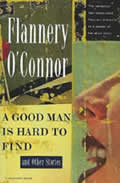 I was highly embarrassed; I had never read Flannery O’Connor, and didn’t want to link to something that I hadn’t read. Now, thanks to the online bookgroup, I can now say: I’m not sure I want Flannery O’Connor writing my story.
I say that mostly because her stories, at first glance, are harsh, violent and, well, depressing. I hope my life isn’t like her Southern characters… they are often banal, pathetic, racist. They grate on the nerves, on the psyche: what on earth is redeeming about any of them?
Yet, I found as I was reading, that I related to and liked several of these stories. The first — A Good Man is Hard to Find — is a horrible way (for me) to start a book: a banal picture of a family taking a vacation, which ends in the violent deaths of said family. I was about ready to give up on O’Connor after that one. (I’m still not sure if I see the “redemption” and “grace” that’s supposed to be in that particular story.) But, feeling a desire to be a part of the discussion, I kept reading. I found I actually liked “A Stroke of Good Fortune”; I identified with the main character’s desire to be something more than the way she was raised, though I thought denying that she was pregnant was a pretty drastic way to do so. I liked “A Late Encounter with the Enemy”: I thought the ending was particularly ironic, which made me smile. The rest of them… well, I have to admit that I didn’t get them. Some of them I didn’t get more than others (“The River”, in particular), but I’m lost as to the whole Christian allegory that she’s supposed to have written about.
I guess she may just be over my head. At the very least, she’ll make for good book group discussion, right? (And maybe I’ll even learn a thing or two in the process.)
 The Book Nut
O’Connor is something of an acquired taste, yes. Her best-known characters are banal–by design. And she is very Catholic (pre-Vatican II in more ways than one), which means that not even a lot of Catholics will appreciate her, let alone the Protestants who populate her stories.I don’t want this comment to turn into a blog post, but I’ll just close by saying I hope you’ll return to “A Good Man . . . “; the Misfit’s arrival and his conversation with the grandmother is (IMHO), quite apart from what it has to say about the nature of faith and how we define goodness, one of the most extraordinary moments in all of American literature. Oh: and look for her story “Good Country People” too.
LikeLike
John — Russell and I have talked about A Good Man at length, and I think I’m beginning to grasp some of what she was getting at. I’m still not sure what I think about it all, though the bookgroup discussion is helping, too.I did read Good Country People. I’m not sure what I think of that one. In some ways, it’s quite powerful, but in others, it was plain annoying. What di you like about it?
LikeLike
Melissa,You ask what I like about “Good Country People.” Um . . . it’s funny. O’Connor turns the tables on her reader, just as they get turned on Joy; she doesn’t see things and people quite as clearly as her PhD in philosophy had led her to believe. That, and Joy falls victim to a vanity she hadn’t known (or admitted to herself) she possessed.
LikeLike