

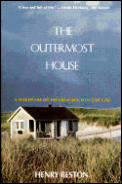
 There are some books that one can sit and read for hours and hours. This book, by Henry Beston, is not one of those books. I tried, I really did. But every time I read more than, oh, 5 pages, I started drifting off. It’s not that this book is boring; it’s far from that. It’s very lyrical, almost poetic (it made me think of Inkling!), but it is a book that, for me, is best handled in small doses.
In 1924, Beston, at the age of 36, decided (on almost a whim) to spend a year living in the beach house he had built as a sometime summer residence on the Atlantic side of Cape Cod. This book, published four years later, is not a true chronology of his year; it’s more like musings in chronological order. It’s a naturalist book; he loves nature, loves to observe and spend time in nature. He writes, early on:
The world to-day is sick to its thin blood for lack of elemental things, for fire before the hands, for water welling from the earth, for air, for the dear earth itself underfoot. In my world of beach and dune these elemental presences lived and had their being and under their arch moved an incomparable pageant of nature and the year.
I had to constantly remind myself that I was reading a book nearly 80 years old, and not some Wendell Berry book. It is a very Berry-esque book, something I could imagine Berry writing if he had grown up by the sea instead of Kentucky. Another quote, that reminded me of Berry:
The sky this afternoon is a harmony of universal blue, bordered with a surf rim of snowiest blue-white. Far out at sea, in the northeast and near the horizon, is a pool of the loveliest blue I have ever seen here — a light blue, a petal blue, a blue of the emperor’s gown in a Chinese fairy tale. If you would see waves at their best, come on such a day, when the ocean reflects a lovely sky, and the wind is light and onshore; plan to arrive in the afternoon so that you will have the sun facing the breakers. Come early, for the glints on the waves are most beautiful and interesting when the light is oblique and high.
It’s also a birding book; he loves birds and spends pages following their migratory, feeding and mating habits. I think I felt a little wistful about this; I’ve never really been interested in birds (birdwatching is probably forever tied to a very difficult and painful birding section of my 7th-grade science class), but I could still sense the reverence and awe Beston had for these creatures. While not a birdwatcher, I could understand the interest birds do have for some people.
The most interesting chapter, to me, was Midwinter, when Beston describes the horrible, difficult, destructive winter of that year. It was the worst winter Cape Cod had seen in decades; Beston writes that many ships were capsized, many lives were lost (I’d write how many ships and lives, but the numbers escape me now). He lived through it, snug in his well-built house. But, he describes the heroic efforts of the guards at the Nauset Station lighthouse; the coping of the seafaring communities — how they would take the ship scrap back to their houses, while mourning the loss of life, and use it as part of their daily lives; the sheer determination of the sailors on the wrecked ship (one lone survivor of one wreck, ended up heading back out to sea because it was “the only thing he knew”).
He writes at the beginning of the chapter: “A year indoors is a journey along a paper calendar; a year in outer nature is the accomplishment of a tremendous ritual.” There are more quotes I could write, about the destructiveness of humans on the ocean, about the sense of smell, about springtime at the beach; but I’ll leave off here. I envy all those who live even remotely near an ocean; I’ve long felt that I’m happiest when I’m near great bodies of water. (I’m not saying that I don’t like Kansas, or that I’m not happy here; I just feel incomplete, on some level.) So, I’m glad I read this book, if only because it let me experience living near the ocean if only for just a little while.
One last quote:
Whatever attitude to human existence you fashion for yourself, know that it is valid only if it be the shadow of an attitude to Nature. A human life, so often likened to a spectacle upon a stage, is more justly a ritual. The ancient values of dignity, beauty and poetry which sustain it are of Nature’s inspiration; they are born of the mystery and beauty of the world. Do no dishonour to the earth lest you dishonour the spirit of man… Touch the earth, love the earth, honour the earth, her plains, her valleys, her hills, and her seas; rest your spirit in her solitary places.
 The Book Nut
Hmm. When I saw the cover, I thought, my kind of book. Then when you mentioned me, I thought, oh boy. Then, when I read the quotes, I realized there were no people. I like books about people. Sounds like Pilgrim on Tinker Creek. I’m reading Eclipse. I probably shouldn’t have read your review beforehand, but I don’t know if it would have mattered much. I’m just reading to find out what happened. The swept away feeling of the first book–just gone.
LikeLike
You know, that is a good point. It’s a very solitary book: one man, alone on a beach. My favorite chapters were those that involved other people… there’s a beautiful passage at the end when he descibes watching a cliff diver…. maybe I like books about people, better, too. 🙂
LikeLike