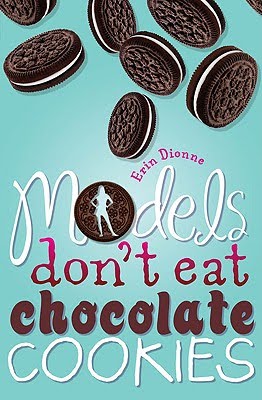
Models Don’t Eat Chocolate Cookies

by Erin Dionne
ages: 10-13
First sentence: “‘No way,’ I hissed through the slatted dressing room door.”
Support your local independent bookstore: buy it there!

Celeste has never really worried about her weight. That’s not to say she was super-skinny: she’s not. But, she’s comfortable in her track pants and hoodie, and she likes her chips, soda and cookies. It’s not bothered her, and she’s never really thought about it.

Until her cousin Kathleen chooses the Peach Monstrosity for her bridesmaids’ dresses (of which Celeste is one). And then her mom and her Aunt Doreen conspire to enter Celeste into a HuskyPeach — that’s a clothing line for “plus sized girls” — modeling competition. Suddenly, the idea of being a HuskyPeach is too much for Celeste. But how to get out of it? By losing the competition, of course: if she’s too thin, she can’t win. So, Celeste makes the life-altering decision to alter her lifestyle. And with it comes some unexpected consequences.

This book has an interesting balance, walking the line between “fat is okay” and “losing weight will get you what you want.” On the one hand, Celeste isn’t really that obsessed with eating, and her parents aren’t really that hard on her eating habits. What bothers her more is that she’s incessantly teased by the (stereotypical) pretty, mean girl at school. Perhaps it’s just Celeste living up to expectations, because even though she has friends, she schlumps through each school day. On the other hand, once she starts the modeling competition, she’s given role models (no pun intended!) of confident, healthy, pretty overweight girls and women, and she can see her potential. She decides to start keeping a food journal, as part of trying to lose the competition, and she realizes that being healthy is better. She gains confidence, in part through the competition and in part from being healthier, and she’s able to conquer her demons and assert herself in ways she didn’t before.

The writing was a bit clunky, and the characters are overly cliched, but overall, a good book.

(Just for the record: because this is a Cybils nominee, I’ve been asked to make sure y’all know this is my opinion only, and not that of the panel.)

Artichoke’s Heart

by Suzanne Supplee
ages: 13+
First sentence: “Mother spent $700 on a treadmill ‘from Santa’ that I will never use.”

Weight is always a tricky subject. Writing about it, talking about it, thinking about it… everyone (read: girls and women) seems to have an opinion on it, obsess over it (or say they don’t obsess over it), or compare themselves to others. It’s a curse of today’s media-saturated age, but that’s a subject for another post.

Rosemary Goode is overweight (she thinks she’s obese, but she’s “only” 200 pounds, which to my mind is not obese, but then again, I’m not a health professional… and it’s mostly about how she thinks of herself anyway… so I tried to go with it). Her problem: food. (Well, duh.) She loves it. Craves it. Eats too much of it. Which is a problem of itself (inner pop psychologist refraining from commenting), but actually (couldn’t contain it. Sorry.) is a symptom of a larger problem: her mom. Rosemary’s mom, Rose Warren Goode, is the owner of Heavenly Hair in Spring Hill, Tennessee. She’s a single mom, getting pregnant with Rosemary when she was 17. She’s worked hard all her life: to be a successful businesswoman, to be a “good” (mom-issues in a YA book. Again.) mom, to be happy. She’s really close to her sister, Mary, and spends most of her free time with her (rather than her kid. No wonder Rosemary turns to food). Rosemary (obviously) resents this. But, because this is the South (I did love the voice in this book; it was very Southern. I felt like was back in Arkansas…), Rosemary just puts a happy face on, and goes through life the best she can. Because that’s what’s expected of her.

Except. She’s not happy. (Duh.)

Then she meets Kyle Cox. Well, “meet” is pretty strong. She reads about him in the school paper — he’s a jock — and he’s in her study hall. And he smiles at her. Which is the first little step she needs to get off her bum and do something about her habits. She goes on a liquid diet (issue: this girl crashed dieted to lose 45 pounds in the end. This bothered me. A LOT.), she starts exercising, she gets counseling (as a “trial experiment”). And when she starts losing weight she starts feeling better about herself… a little at a time. I don’t want to insinuate that it was a sudden, miraculous overnight change, because it wasn’t (something which I did like). But, once the pounds started coming off, she began to come out of her shell. (Are we saying that fat people just need to lose weight to feel good about themselves? That it’s impossible to love your body when your overweight? Rosemary’s target goal is 120 pounds — she’s 5 foot 6 — is that reasonable? See what I mean about weight being a loaded — sorry, no pun intended — subject?)

I did like the characters: Rosemary is a very sweet girl, and Kyle is adorable in his geekiness. But I had issues (being overweight myself) with this book. Not a bad one, but not my ideal fat-girl book either. Then again, I’m not sure there can be a fat-girl book that will please everyone. The issue is just too volatile. Which is too bad. (But that’s a subject for another post.)