Eighth Grade Bites

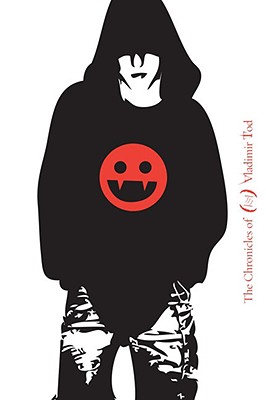
The Chronicles of Vladimir Tod, #1
by Heather Brewer
ages: 11+
First sentence: “A tree branch slapped John Craig across the face, scraping his skin, but he kept on running and ignored the stabbing of pine needles on his bare feet.”
Support your local independent bookstore: buy it there!

Vlad is not your typical eighth grader. Well, he is in many ways: he’s got a massive crush on Meredith, who seems to like his best friend, Henry. He doesn’t do spectacularly well in school, but manages okay. His parents died in a freak accident three years ago, and so he has that to deal with.

Oh, and did I mention? He’s a vampire.

His mom was human, and his dad was a vampire and (without all that messy Twilighty swoony vampirey stuff) Vlad’s been raised as a vampire. Granted, he’s a humane one: aside from biting Henry when they were eight, he’s never actually fed upon a human, but rather eating donated blood (in very creative forms) or raw meat. (This book was written in 2007, before the Twilight phenomenon, so no unfair Breaking Dawn comparisons, please.) As if his life wasn’t complicated enough — it’s no fun being a creature of the night when you’re forced to go to school during the day! — it looks like his substitute English teacher — brought in after his teacher, the Mr. Craig of the opening sentence, disappears — is figuring out Vlad’s secret.

It was billed as “ghoulishly funny”, but I didn’t really find it that. I did find it fascinating, and I liked Brewer’s take on the vampire world from the get-go. But, I guess I wanted more than a sullen eighth-grade boy (do all vampires need to be sullen?) trying to get over his dad’s death. Stick with the book, though: the ending few chapters are quite exciting. Enough so that I’m willing to give the other books in the series a try. Maybe Vlad will perk up a bit.

I do have to note that the library copy I read had pages with dried blood on them. Creepy, yes, but also very annoying. Can we make it a policy to not bleed on vampire books. Please?
Supernatural Graphic Novels

I’m not sure if that’s the right description, but “fantasy” and “paranormal” didn’t quite work for this pairing either.

First up:
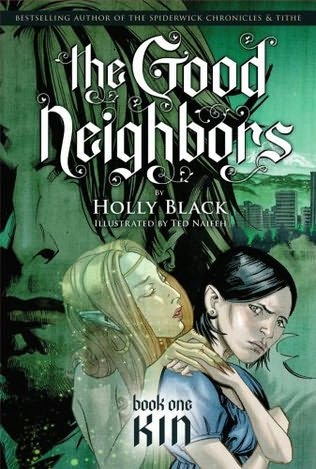
Kin (The Good Neighbors, Book 1)
by HollyBlack and Ted Naifeh
ages: 14+
First sentence: “West City, Thursday evening.”
(First sentences in a graphic novel is almost self-defeating…)

I’m conflicted about this one. I liked it well enough: the basic story is a girl, Rue, whose mother has disappeared after a fight with her father. Soon afterward, Rue starts seeing things she’s not supposed to. Turns out her mother was a faerie, and is slowly dying because Rue’s father had betrayed her. The art was a lush black and white (I think color would have overwhelmed the book, so I appreciated that choice), and I liked the characters okay (especially Tam; even though he doesn’t have a large role, I appreciated that nod). However, while I think it’s a good beginning to a series, it doesn’t really hold up as a stand-alone. It’s all set-up, no action, no resolution. And just leaves you feeling weird. However, I’m going to have to get the next volume, if only because I’m curious what happens to Rue.

Up next:

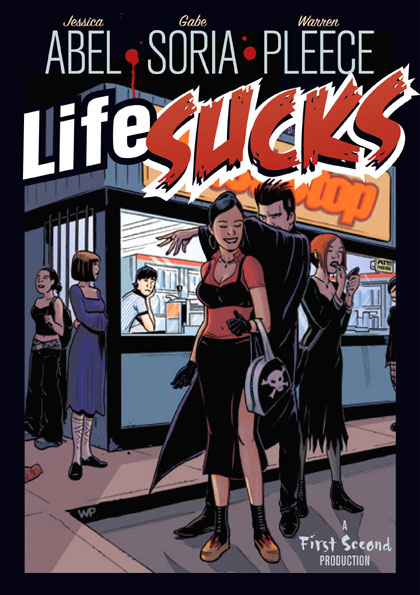
Life Sucks
by Jessica Abel, Gabe Soria, and Warren Pleece
ages: 16+
First sentence: doesn’t really have one. As I said, that’s pretty self-defeating when you’re dealing with a graphic novel.

This one has a fantastic premise: the undead are alive and among us. Dave, a college schlep who needs a job, applies for one at a 24 hour convenience store called Last Stop. Little did he know that applying for the job comes with a catch: being turned into a vampire. Stuck in a dead-end job (ha, no pun intended) working for a vampire master he loathes, Dave figures there’s nothing worth living (ha, again) for. So far, so good. Dave making his way as a vampire is pretty funny, the fact that he’s got a human roommate, and undead friends. His boss, Lord Radu is a great parody of the immigrant entrepreneur.

Then Dave sees Rosa, that is. A goth girl with an obsession with vampires, she would die (ooh, I’m killing myself… whoops, did it again.) to actually know (or be) one. He musters up some courage and strikes up a friendship with Rosa, not revealing that he’s a vampire. Then things start to go south, at least for me. Wes — the evil undead surfer dude (such an oxymoron) — decides Rosa is hot, and he decides that what he really wants to do is bite and bag her. (He’s got three vampire brides and could use one more.) Dave makes a valiant attempt to stop Wes, making in the end a dare out of seeing who Rosa would go for. And that’s when the book tanks. It gets all sex-obsessed (big-boobed, scantily-clad bimbos anyone?), and violent, and just plain weird. It wraps up badly — could they not think of anything better? — and leaves us hanging.

Sigh. I had such hopes for both of these.

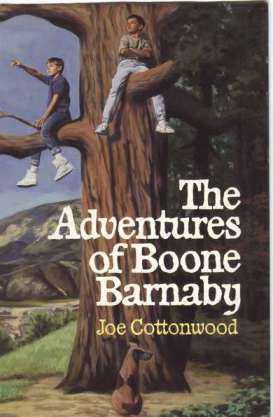
The Adventures of Boone Barnaby

by Joe Cottonwood
ages: 9+
First sentence: “I live in San Puerco, California.”

I picked up this book because the author was so kind to email me, praising my blog (and my “shoot-from-the-hip style” — my immediate was: “Okay? Not something I would think of myself…”) and announcing that he’s re-released his title as a podcast. Here’s what he wrote:

I’ve just re-released my novel Boone Barnaby. What’s new is that this time, it’s a podcast. Scholastic in 1990 published The Adventures of Boone Barnaby as a middle grade novel (for a podcast, I had to shorten the title so it would show up on tiny ipod screens).

Maybe I’m breaking new ground here. Does a podcast qualify for a review? (And if not, shouldn’t we catch up with what kids already accept as normal?) It’s a way to engage kids, especially boys, in a literary story. No vampires, no superheroes. I was going to bring out a new print edition, too, but as long as Amazon is selling old copies for a penny, I can’t compete – and there are probably ten thousand copies still out there in garage sale land. Meanwhile, I’ve made it available as a PDF for a free download.

There’s no money in this for me. The podcast is free (dowloadable from iTunes), the PDF is free (from my website), even the one-penny copies on Amazon earn me no royalties. I’m just reviving a good book – and enjoying the new world of podcasting.

We went back and forth a bit about podcasts… here’s where I confess that we’re a (teeny) bit behind the times around here: when I asked M if she would listen to a podcast of this book, she asked, “What’s a podcast?” Obviously, that wouldn’t work. We don’t have iPods, and as I have mentioned before, listening to a book (if it’s outside of a car during a long drive) just doesn’t work with my lifestyle. So, the compromise I came to was read the book (my library is awesome) and review it, and mention that you can get it as a podcast. (I’ve already done that part.)

It’s a very good book. Boone is a 12ish (I’m not sure if we ever got his age; if we did, it’s not sticking in my brain) kid, living in a small town in California (northern, I guess, because of references to Redwoods). He’s a pretty low-key kid, not really great but not bad either. Then one fall, everything seems to change (it’s called the “Banana Effect”: bad — or good — things always come in bunches). Some of it’s for the better: Babcock moves in, the town’s pathetic soccer team begins winning games, Boone outsmarts the local miser in the Trashathon: an event to raise money for the soccer team to go to Australia for a tournament. But some of it’s for the worse: Boone’s father is arrested on suspicion for arson (the pub is burned down, and his father just happens to have been walking around late at night with a can of gasoline), his friend Danny’s family is going to be evicted, and he has a run-in with the town’s homeless man, Damon Goodey. Sure, everything works out in the end, but it’s not the end that matters in this book, but rather the journey. It’s a coming of age story, where Boone realizes that growing up doesn’t hold all the answers as well as figuring out a few of his own rules. Not to mention how he fits into the grander (well, maybe not grander, but at least larger) scheme of things. It’s a straightforward story; Cottonwood doesn’t write down to his readers, instead just laying out the “facts” and letting the story, and characters, speak for themselves. And although there’s some thoughtful themes in it (segregation, racism, drug use — in the parents’ past — and honesty, among others), it doesn’t harp on them, or beat them into the reader.

So. Find the book (buy it for a penny plus shipping at Amazon!), or download it on your iPod (because I’m assuming that most of you have one…). It really is worth the time.

Dracula

In my quest (though not a very diligent one) to read all things vampire, I figured that I should probably start at the beginning, and read Bram Stoker’s vampire classic. Thankfully, I had the encouragement of the RIP III challenge (and everyone telling me to be excited) to get me off my lazy butt and actually read it. And… well… WOW.

I’m sure everyone’s heard of Dracula — he’s a part of our culture in a way that I don’t think Stoker expected him to become. And vampires, too, especially these days; between Buffy and Twilight they’ve become hip. But, I didn’t know — and I’m not sure how many people who haven’t read the book do — the whole story, the whole mythos. And I found all that fascinating, from the various devices to keep the vampires at bay, to the methods Dracula took not only to access his victims, but to just get around. It was interesting stuff. Even the plot of the book, while a bit simplistic for my taste, still managed to keep things moving enough to hold my interest. I wasn’t expecting that, either.

But what really made the book fabulous (well, as fabulous as a gothic horror tale can be) for me was the mood. Stoker is amazing at setting mood. He has a way with words that just captivated me. The tension and suspense were palpable. I got about 150 pages from the end, at 10 p.m., and realized I’d either have to stop or push through to the end; I was that freaked out by what was going on. There were many occasions, right from the first, when I had to put down the book and walk away because the mood was so intense. Actually, while reading this, I was reminded of why I went on an Edgar Allen Poe kick in 8th grade. We had read The Tell-tale Heart in English class, and I was blown away. Not by the plot, or even by the characters (the ones in Dracula didn’t really do anything for me, either), but because of the mood. While I don’t like to be grossed out (hence my shying away from Stephen King), I don’t mind the occasional fright. And Dracula hit that right on the spot.

Terrific. Creepy, terrifying, and absolutely terrific.

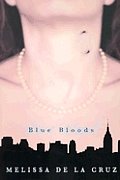
Blue Bloods

I got this book by Melissa de la Cruz because the idea sounded fascinating: vampires masquerading as the New York City elite socialites. One girl — Schyler — who normally doesn’t fit in at her prep school all of a sudden finds herself in the middle of the whole affair; add a murder of a classmate, and you’ve got an interesting book.

Except you don’t.

It was so crowded with litanies of who’s wearing what that there wasn’t any room left for a storyline. Why do I care that Bliss is wearing Prada sling back heels? Or that Schyler’s in a vintage black lace dress and “the skirt blossomed out at the hips like a graceful bell held aloft by a layer of tulle petticoats”? I don’t. I want plot. And characterization. And something interesting to happen. And in the spaces where there weren’t some sort of clothing list, there was tabloid adventure liberally spliced with name dropping. “They were like the Brad Pitt and Angelina Jolie of Duschene.” So freaking what?

I bailed at 110 pages. And that was too much of this book.

Wildwood Dancing

I was supposed to get this one done before June 21st, for the Once Upon a Time challenge, but I didn’t, thanks to the library. But, better late than never, right?

This book, by Juliet Marillier, has gotten mixed reviews across the blogosphere. Some people love it. Some people not so much. I think I fall in the not-so-much category.

It’s not that the book was bad. In fact, it was a quick read. (For plot summaries, you can check out Becky’s and/or Erin’s reviews.) But, for me, it just didn’t sit well. For one, it just seemed too long. Even though it went quickly, I kept checking to see how much more left to go. Usually not a good sign. For two, I have little patience for “true love”. Especially when characters waste away because of it. I’m not terribly romantic (as my hubby often remarks), and I don’t have much tolerance for the heartbreak and heartsickness of true love. So when Tati, the oldest sister, lay dying because she couldn’t see her true love — an almost-Night Person (I totally missed that there were vampires in this book. Vampires are the in thing, aren’t they?) — I just gritted my teeth and plowed through. Please. Girls wasting away because they can’t be with someone they love? Not my idea of a good time. (Maybe having four girls has warped my sense of romance. I wouldn’t want them to think this was an acceptable way of handling disappointment or longing. Eating cake, however….)

And, I have to admit, I didn’t really care for the main character, Jena. I liked her a bit — she was feisty and quite capable, but she was just so practical. So sensible. The opposite of Tati. Which isn’t bad. (Ah! I’ve hit upon it here: Tati and Jena were opposites, both with their loves but not knowing how best to obtain that.) But she had to have EVERYTHING spelled out to her before she was able to act. It seemed for someone as capable as Jena, she ought to be able to do something without waffling about everything. Especially the important things.

The only thing I really enjoyed was loathing Cezar. He was a good villain — one of those that just give you the creeps. Not evil because he’s a monster, but because he’s a man who went wrong. (He didn’t get a good end, though; he just kind of petered out.)

The one redeeming factor is the absolutely beautiful cover. But then, we’re not supposed to judge a book by it’s cover, are we?

Sunshine

Ah, Robin McKinley. I love her writing. And I was reminded during my Twilight/New Moon phase that she had written a vampire novel. So, during the first lull I had (between challenges and Estella books), I popped over to the library and picked it up.

It’s an interesting story, set in an interesting world. Sunshine — Rae — is a baker in a coffee house, specifically the Cinnamon Roll Queen. She has a nice little life, a boyfriend, a time-consuming job, friends, but one night she feels restless. She drives out to the lake, to her father’s cabin (divorced parents, father’s whereabouts is unknown), and proceeds to get kidnapped by vampires. She is taken to be a sacrifice for Constantine, whom a master vampire (Bo), has captured and is keeping prisoner. But, Sunshine manages to escape (by changing a pocket knife into a key; she’s got magic powers, but hasn’t used them) and takes Constantine with her. And their lives will never be the same (ominous music here).

I liked the ethical dilemmas posed by this: if a human is supposed to, by default, have an animosity with vampires then how does one deal with the fact that you let one live? For Sunshine could have just let Constantine die in the beginning and never thought about it again. It was something the character struggled with throughout the book, and one I thought McKinley manages better than Stephenie Meyer does in Twilight (since that same ethical dilemma is present there, too, on some level). There’s a lot of musing and soul-searching in Sunshine, though, and while a lot of it works, sometimes it gets heavy-handed. And it definitely asks more questions than it answers.

I enjoyed the book, though the ending leaves things hanging. And, on one level, it’s okay. Sunshine comes to accept and deal with who she is (and it’s not just the Cinnamon Roll Queen). The big bad guy gets his comeuppance. She has a relationship with Constantine, but it isn’t as unhealthy and obsessive as Bella and Edward’s is. You can’t call it a romance, though it’s something more than a casual alliance or even friendship. It all ends happily, for what it’s worth.

But I really wanted to know what happens next. There were too many questions left unanswered, too many ends left loose. And sometimes that’s just unsatisfying.