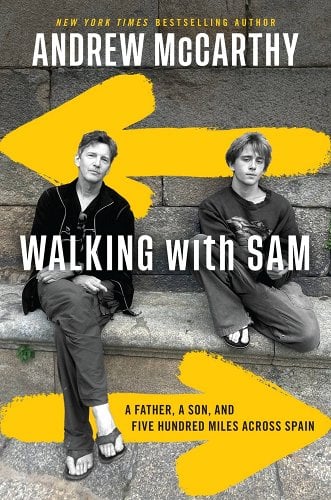
Walking With Sam

by Andrew McCarthy
First sentence: “When I was a very young man and became very successful in the movies very quickly, I harbored a notion that I had not earned my accomplishments, that I hadn’t done the requisite work, that it was all merely a fluke, that I didn’t deserve it.”
Support your local independent bookstore: buy it there!
Content: There is some mention of drug use, several f-bombs,, and other mild swearing. It’s in the Biography section of the bookstore.

I was probably always going to be interested in this book; I love travel books, and I have a friend who has walked the Camino twice. Plus there’s the celebrity factor. But, after finishing The Longest Way Home, I have immense respect for McCarthy as a travel writer. And he delivers in this book.

When he was in his early 30s, McCarthy walked the Camino – inspired by a book – and had a life-changing experience. As his oldest son grew up, McCarthy wanted to share that experience with him. His son wasn’t interested until he was 19 and had just broken off a bad long-term relationship. McCarthy jumped at the chance, and they were off. They walked the northern route – the Camino Frances (or at least that’s what I’m guessing from what he writes) through the Pyrenees and the Meseta, into Santiago. I’m not exactly sure how long it took them – the chapters were labeled with miles until Santiago. But McCarthy is strikingly honest about their walk. The ups and downs, both physically and emotionally, the stresses and joys of their relationship, and yes, you can see the growth in both McCarthy and Sam and between them.

Like the first travel book of his I read, I loved that he gave you a sense of walking the Camino with its own joys and hardships and dull moments, while being introspective. He both compared this walk to the one he took 25 years prior, and reflected on the nature of both his relationship with his son as well as the one he had with his own father. It’s engaging and interesting, as well as being introspective and thoughtful.

I found it an absolute delight to read.
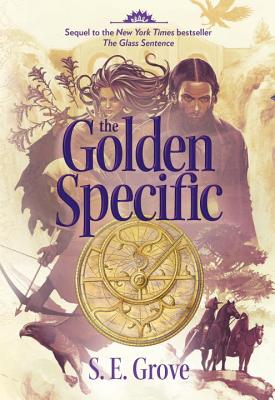
The Golden Specific

by S. E. Grove
First sentence: “Dear Shadrack, You ask me for news of the Eerie, and I can tell you that there is no recent news of them in the Indian Territories.”
Support your local independent bookstore: buy it there!
Others in the series: The Glass Sentence
Review copy provided by the publisher rep.
Content: It’s a long book, and it’s one of those that take some investment. Probably not for the younger end of the middle grade spectrum, even if it’s in the Middle Grade section (grades 3-5) of the bookstore. I’m actually wondering if these might do better in the YA (grades 6-8) section, with the Philip Pullman books…

I’ll be honest: I don’t really remember what happened in the first book. The good thing? You don’t really need to. There’s no real sum-up at the beginning (thank heavens!) but you get the sense, fairly quickly, about what’s going on. And Grove is nice enough to let us know what we need to know as the book progresses.

Which helps, because there are three story lines going here. One is Sophia’s continuing quest to figure out what happened to her parents 10 years ago. This involves going to restricted libraries and ending up across the Atlantic (accidentally by herself) in the Papal States, looking for the lost land of Ausentintia. (I read that Austen-tia every. single. time.) Her adventures there are weird and wild, and the way Grove messes with time, religion, and fantasy are quite mesmerizing. She makes new friends, particularly Errol and Goldenrod, who are fascinating additions to the world Grove has built.

The second story line is related: it’s the diaries that Sophia goes looking  for, the writing of her mother that Sophia was looking for. (This is a second in a trilogy, so there’s a lot of loose ends.) This was the least interesting part to me; yeah, I was curious about Sophia’s parents, but not especially invested in their journey, so to have the story I was interested in interrupted with this one was a bit annoying.

The third — and my favorite this time around — story line was that of Theo, who stays behind in Boston, and attempts to prove that Sophia’s uncle Shadrack didn’t, in fact, kill the prime minister. It’s a fascinating plot line, full of deceptions and intrigue. Additionally, it has the most intriguing characters; Theo’s new friend, Nettie, is the daughter of the police inspector, and absolutely delightful.

I don’t know if it’s as strong as The Glass Sentence was, but I do think that this will be a compelling series once it’s completed.

The Vacationers

by Emma Straub
First sentence: “Leaving always came as a surprise, no matter how long the dates had been looming on the calendar.”
Support your local independent bookstore: buy it there!
Content: There are a dozen (or so) f-bombs, some graphic talk about sex and some actual sex (which isn’t graphic). It’s in the adult fiction section of the library.

The Posts are falling apart. Their marriage is suffering because of Jim’s affair (with a woman younger than his son). Their 28-year-old son, Bobby, is a loser. And their daughter, Sylvia, who has just graduated and is off to college, hates living with her parents. So Frannie does the only thing she knows how: rents a house in Mallorca (an island off of Spain) and forces everyone — including her best friend Charles and his husband, as well as her son’s girlfriend — on vacation for two weeks.

It’s such an adorable fantasy. You know? Life is falling apart, so let’s rent a beach house and miraculously everything will get better. Not real life. Or at least my real life.

It was very voyeuristic, this book. I really didn’t care much about Jim’s inner life, or his lust for the editorial assistant he had an affair with. Or Bobby’s relationship with Carmen (who I liked, in spite of the book’s efforts to make me despise her). Or even Sylvia’s inner angst and obsession with losing her virginity. (Which she does, on the beach, to a beautiful Mallorcan boy.) No: the people I was most interested in were Charles and Lawrence because they were the most stable, the most reasonable, the most… well, likable. They were trying to adopt a baby, and there were some struggles with belonging. But if the whole book had been from their perspective, it would have seemed much less snobby. Annoying.

The thing that really kept me reading, however, was that Straub did a wonderful job capturing place and food. Maybe not perfectly, but enough that I was interested in knowing more about Mallorca and I could almost imagine the food.

It’s too bad that I had to experience such a lovely place and read about such lovely food with such crass characters.