Winger

by Andrew Smith
ages: 14+
First sentence: “I said a silent prayer.”
Support your local independent bookstore: buy it there!
Review copy picked up at ABA Winter institute for me. Yes, I have taken that long to get to it.

Ryan Dean (yes, that’s his whole first name) West has a lot going for him: he’s a junior at Pine Mountain, a boarding school for troubled rich kids (his dad’s a high-powered Boston lawyer) in the Pacific Northwest. He is first string winger (think running back in football, but more intense) for the rugby team. He’s pretty smart.

But there are some downsides: he got transferred into O-Hall this year because he was caught hacking into a cell phone account at the end of last year. And, to top it all off: hes only 14.

And when you’re in O-Hall with all the delinquent football and rugby players? It’s not going to be a stellar year.

Add to that some major girl drama (he’s in love with his best friend, Annie, but snogging his roomate’s girlfriend), late night poker games (let’s just say that Ryan Dean is not a good drunk), and lots and lots of testosterone-induced fights. Let’s just say, I was impressed that Ryan Dean — who was decent human being underneath all the 14-year-old boy nonsense — survived until Thanksgiving.

I’m of two minds about this book. On the one hand, I can sum it up in two words: sex and rugby. Actually, the sex is all in Ryan Dean’s mind: he’s incredibly immature, and objectifies EVERY girl, and EVERY situation becomes about sex. In other words: he’s a normal 14-year-old boy. But unlike Carter’s Unfocused One-Track Mind which I couldn’t get through (and which is the best comparison to this one), I found myself endeared to Ryan Dean. Maybe it was the underdog element. Maybe it was because although he was annoying, he was almost mostly harmless. Maybe it was because he really did mean well, in the end.

Because, I found myself compelled by this. I was invested in Ryan Dean’s drama. I loved the camaraderie of the rugby team. I enjoyed Ryan Dean, dork that he was.

My only real problem was with the ending. See: Ryan Dean becomes good friends with the rugby captain, Joey, who also happens to be gay. Joey’s sexuality isn’t a big deal for Ryan Dean (though he feels the need to comment that he isn’t a lot), but it is for other guys in O-Hall. And in the last 20 pages of the book, it takes a sharp left turn and stops being a fun boarding school drama, and becomes Something More. Not that I minded something more, it was the sharp left turn that threw me. It didn’t work. I didn’t feel pain, or anguish, or anything at all at the end, because I was flabbergasted that a fun and entertaining book so suddenly became Serious. It came off as bad pacing and lack of focus rather than anything more substantial.

It didn’t ruin the book for me, but it did take some of the shine off. Which is too bad, because I was having fun with it before then.

Highland Fling

by Katie Fforde
ages: adult
First sentence: “‘I gave you a home, for goodness’ sake!’ said Henry.”
Support your local independent bookstore: buy it there!

After being laid off when her IT firm went bust, Jenny Porter decided that she’d never work for anyone but herself again. She became a virtual assistant, which is essentially a glorified secretary, even though she rarely meets her clients. Then, one of her clients, M. R. Grant-Dempsey, decides to send her into the wilds of Scotland to check out Dalmain Mills, and see whether or not it’s worth salvaging.

Once up in the wilds of Scotland, away from her increasingly insufferable boyfriend, Henry, (yes, he really is that bad) she discovers that not only does she really like Scotland, enjoys working in a fast food stand, and wants to find a way to salvage the mill, she is really attracted to possibly the least amiable man in the region: Ross Grant. (Yes, it is who you think it is.)

It’s fluff. Really. There’s no way around it. It’s predictable, enjoyable, fluffy romance, where you want the guy to get with the girl, and the stupid, silly boyfriend out of the way. Everything else about the plot is immaterial. There isn’t much sex (just one scene, in a snow cave… cozy…), though Fforde does know how to write a good kiss. And to be gratuitous in my review, this is who Ross Grant looked like in my head:

You’re welcome.

Not a bad way to spend some time, I think.

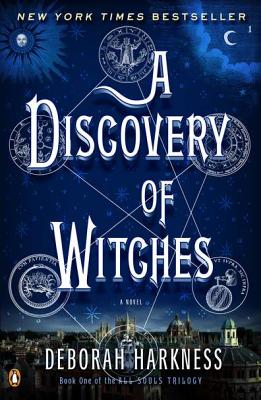
A Discovery of Witches

by Deborah Harkness
ages: adult
First sentence: “The leather-bound volume was nothing remarkable.”
Support your local independent bookstore: buy it there!

Although I liked this one quite a bit — more than I was expecting, actually — by the end of it, I was quite torn. So, let’s just say, up front, that my enjoyment of this one was tempered by some hangups.

The good:
I loved the world that Harkness created. It’s basically our world, except it’s inhabited by vampires, witches, and daemons. They’re generally brilliant, generally long-lived, and generally go unnoticed by humans. Our main character, Diana, is a witch who, ever since her parents’ deaths when she was 7, has shunned her magic. She’s a historian of 17th-century science, which means she dabbles in Alchemy. She’s pretty content with her life. Until she meets Matthew. Who is a vampire.

Which brings me to good point number 2: Harkness has a debt to owe to Stephenie Meyer, but she one-ups her. Matthew is 1500 years old, which makes him incredibly fascinating. (And I suppose it’s kind of creepy that a 1500 year old would fall in love with a 37 year old?) There’s a lot of history in this book, and no accident that Diana, as a historian, is fascinated by Matthew.

The bad:
It’s still True Love, and while it’s not as stifling as Edward and Bella’s love, it’s still pretty sappy. (What is it with vampires and a reluctance to have sex?) There’s also that element of over-protectiveness that drove me batty in the Twilight series. The only difference is that Diana can — and does — hold her own as a witch, though it takes her most of the book to do so. She also struggles against Matthew’s edicts, which helps with the whole damsel-in-distress thing. That, and the fact that she’s in REAL danger as opposed to supposed danger helps temper Matthew’s irritating behavior.

The good:
The plot is intriguing and complex: there’s a lost manuscript that all the “creatures” (as they call themselves) are longing to get their hands on. But, more importantly, there’s the forbidden love (really?) between Diana and Matthew: it seems the creatures aren’t suppose to cross-mate because of an age old (like centuries) covenant that the creatures made with each other. This leads to a lot of things, the most important being an impending “war” between the creatures who are okay with Diana and Matthew’s love and those who are not.

The bad:
On some levels, the idea of anyone being able to love anyone they want is a good story. But my main complaint with this book is that it’s 576 pages, and they don’t get to the point until the last 1/4. The plot pacing is bad as well: it’ll be interesting, then Harkness will divert into pages and pages of wine, food and romancing (M contended that if she cut out all the bits about wine, she would have lost about 75 pages…), none of which had anything to do with the plot. More than once, I nearly lost patience with the book.

That said, I’m invested now, and I’m interested in where Harkness is going to go with the sequel. Hopefully, it won’t be nearly as long. (Then again, she’s a historian, so I’m not really expecting a more tightly written book. Just hoping.)

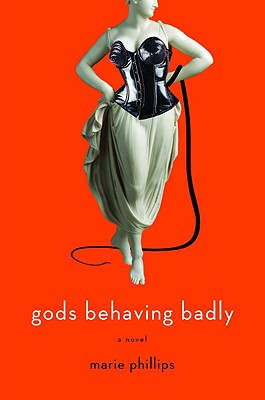
Gods Behaving Badly

by Marie Phillips
ages: adult
First sentence: “One morning, when Artemis was out walking the dogs, she saw a tree where no tree should be.”
Support your local independent bookstore: buy it there!

The gods have a problem. They’ve been stuck in an increasingly run-down house in London for 300 years. They’re bored. They’re losing power. Sure, they’ve tried other occupations — Aphrodite has a bit of a business as a phone sex operator, and Dionysus runs a pretty happening club, not to mention Apollo’s stint as a TV psychic — but it’s just not working for them. Things just aren’t going well.

Enter Alice, the unassuming cleaner and her would-be boyfriend, Neil. She’s pretty shy, as far as mortals go, but after Artemis hires her to clean the absolutely filthy house, she brings some life to the group. (That’s helped along a bit, due to some revenge work by Aphrodite: she gets Eros to hit Apollo with an arrow and he falls for Alice.) This leads to some sticky situations, though, culminating in possibly the end of the world. Interestingly enough, Neil finds a role as a hero, and the gods find a new reason to exists again.

It’s a unique little take on the Greek gods. Sure, I prefer Percy Jackson, but this one deals directly with the gods themselves. They’re dealing with the lack of belief from Mortals (can I say one of my favorite parts was Eros’s devotion to Christianity? Very intriguing.), though they don’t realize that’s what it is until near the end. (Though an observant reader will pick that up, so it’s not really a spoiler.) It’s not as funny or as witty as I would have liked, but it is entertaining. I’m also not sure the overall story is quite what I would have liked it to be: there’s a trip into the Underworld, and the whole “Everyone Believes” at the end seemed a bit forced; but that could just be my devotion to Percy Jackson talking.

There were moments that made me smile, though. And I liked Artemis and Alice and Neil, so there’s at least a couple of characters that I could connect with. So, t’s a not a complete waste of time after all.