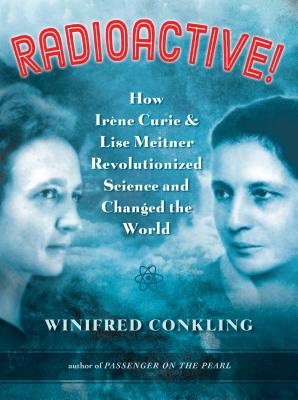
Radioactive!

radioactiveby Winifred Conkling
First sentence: “Their moment had finally arrived.”
Support your local independent bookstore: buy it there!
Review copy provided by the publisher.
Content: There’s some science terms and such in this, but they’re explained pretty well. It’s a bit on a higher grade level, but I think 5th graders and up could handle it.  It’s in the kids’ biography section at the bookstore.

I’m a sucker for biographies highlighting people or things I don’t know much about. And this one definitely fits the bill. Conkling highlights two physicists doing research in the 1920s and 1930s, ones that I didn’t know anything about.

Irene Curie was the daughter of the more-famous Marie, but was a stellar physicist in her own right. Along with her husband, Frederic Joliot, she discovered artificial radiation. This opened up many avenues in the scientific world. And while she got credit, no one (well, not us non-scientists anyway) remember her for this. The other scientist Conkling highlights — and in some ways, the more interesting story — is Leisl Meitner. She, along with several other scientists, discovered nuclear fission. The rub, though, is that because Leisl was considered a Jew in Nazi Germany (her grandparents were Jewish), she had to flee to Sweden. Then her partner (and friend?!), Otto Hahn, completely wrote her out of the research. He said he did this all on his own, mostly because he was afraid of the Nazis.

It’s a fascinating story, and Conkling does a good job of explaining the science (there’s some helpful tables, etc. throughout the book) as well as making both of these fascinating women come to life. There’s a bit about their history, their relationship with the scientific community (which was incredibly sexist, no surprise), as well as a lot on their contributions to the advancement of physics.

It’s fascinating and well worth the read.

The Martian

by Andy Weir
First sentence: “I’m pretty much f***ed.”
Support your local independent bookstore: buy it there!
Content: As you can tell from the first sentence, the big content issue with this book is LANGUAGE. If you have problems with that, then this book isn’t for you. It’s in the science fiction section of the bookstore.

Mark Watney was one of six astronauts sent to Mars as part of an exploratory and scientific mission. He’s a botanist and was trained to be the fix-it guy, and he was expecting to spend 31 days on the planet with his crewmates and then head home. Then, six days in, a storm kicked up, and an accident happened and he was considered dead. So, the captain made the decision to leave him. Turns out, though, that he wasn’t dead.

Thus starts 368 pages of the best problem solving novel I’ve ever read. Seriously. Weir throws all sorts of things — most of them being normal, every day sorts of things; there’s not many super extreme situations here — at Watney and has him figure out how to survive. You wouldn’t think it would make for a fascinating, gripping novel but it does. Part of this is because Watney is a hilarious (if foul) narrator. He’s SO snarky, and laugh-out-loud hilarious, which helps diffuse the tension in the novel. It also makes it a very practical book, which makes me wonder how much of it is actually accurate science. (I gather, from the author notes at the end, quite a lot.) I kept turning the pages (and staying up late) wondering just what the heck was going to happen next.

I don’t usually go in for books that have a lot of hype or even a movie coming out, but this one is definitely worth all the buzz surrounding it.

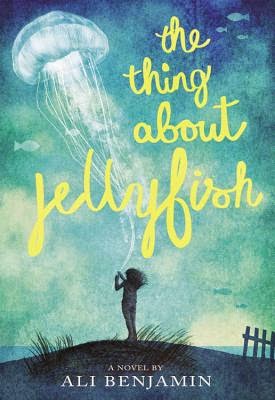
The Thing About Jellyfish

by Ali Benjamin
First sentence: “During the first three weeks of seventh grade, I’d learned one thing above all else: A person can become invisible simply by staying quiet.”
Support your local independent bookstore: buy it there!
Review copy provided by the publisher.
Release date: September 22, 2015
Content: It’s longish, but there’s nothing questionable for younger kids. It is a bit on the depressing side, so maybe super-sensitive ones wouldn’t want to read. That said, the science is pretty cool. It’ll be in the middle grade (grades 3-5) section of the bookstore, though the 6-8th grader would like it as well.

Suzy Swanson knows why Franny Jackson died. Sure, everyone has been telling her that it was “just one of those things” when her former best friend drowned in the ocean, but Suzy is convinced that there Needs to be a Scientific Explanation. And she knows she’s figured out what it is: deadly jellyfish stings. So, Suzy sets out to research that, and even plans a trip to Australia in order to come to terms with her best friends’ death. And Suzy’s guilt about what happened between them before.

There’s a LOT going on in this book: dead friend, grief, friends growing apart, bullying, science, divorce…. it was almost too much for me. I ended up focusing on the science aspect of it, which was really pretty cool. I really liked all the jellyfish facts, and the research that Suzy ended up doing on them. I liked that she had a fantastic science teacher (my girls’ 7th grade science teacher was really pretty awesome too) who inspired kids to want to learn.

But other than that, it was just drama and more Drama. Middle school kids are mean, and Benjamin caught that perfectly. I felt copious amounts of pity for Suzy; such an awkward girl, and no one (hardly) had any compassion for her. No wonder she stopped talking.

That said, while the resolution was done well, I never really wholly enjoyed this book. Too much being made uncomfortable by Suzy’s awkwardness and the bullying of the kids around her.

But then, maybe that was the point?

The Blackthorn Key

by Kevin Sands
First sentence: “I found it.”
Support your local independent bookstore: buy it there!
Review copy provided by the publisher.
Content: There’s some violence, but it’s not grisly and mostly off stage. There’s a lot of white space and fairly large print, so even though it appears long, it goes fast. It’s in the Middle Grade section (grades 3-5) of the bookstore.

Christopher Rowe has a good life, especially considering he was brought up in an orphanage. He’s apprentice to an apothecary, he has a best friend, and he’s given a bit of freedom. Until the Cult of the Archangel strikes, killing off apothecaries one by one. And finally, they reach Christopher’s master.

Suddenly Christopher’s stable life is turned upside down: the Guild, the King’s men, and the Cult are all after him. And he’s got to figure out the cryptic note that his master left in the ledger before they catch up.

It’s a simple premise, and yet it’s SO much fun. Seriously, people: So. Much. Fun. And no magic, which is really refreshing these days. It’s historic fiction — set in 17th century London — and I loved that it didn’t get too bogged down in history. Sands keeps a balance between historical tidbits and action so that it feels like it’s 17th century London, but it moves like a modern book. There’s a mystery of who is in the Cult, and who is behind all the murders. Sure, it’s pretty much white boys (I think there was two female characters, and no people of color), which means it’s same-old in that respect. But, I can forgive it for that because it was SO much fun. (I’m just going to say it again. You want some fun action/adventure/mystery? This is it!)

I couldn’t put it down.

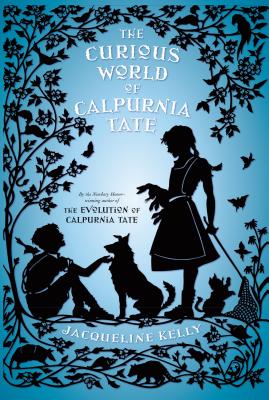
The Curious World of Calpurnia Tate

by Jaqueline Kelly
First sentence: “To my great astonishment, I saw my first snowfall on New Year’s Day of 1900.”
Support your local independent bookstore: buy it there!
Review copy snagged off the ARC shelves at my place of employment.
Content: It’s a bit old-fashioned and there are a lot of scientific words, but if you’ve got that sort of 9 year old reader, it’d be perfect for them. It’s in the middle grade (grades 3-5) section of the library.
Others in the series: The Evolution of Calpurnia Tate

I was super excited to find out that my favorite scientific Texan was back in a second installment. I really adored Calpurnia the first time around, and was very excited to spend more time with her. It’s 1900, and Calpurnia is doing her best to keep up with her scientific studies with her grandpa. It’s hard, especially with pressure from both her parents to be more ladylike. Calpurnia would much rather be tromping around the forests and swamps near their central Texas home, collecting specimens. Or studying the stars and weather.

Then a hurricane hits Galveston (a fact which sent me to Google to find out if it was real. It was.), and Calpurnia’s life changes. In to town blows an older cousin (who is, understandably, distraught) and a veterinarian. All of a sudden, Calpurnia has found a calling. The problem? She has to fight to let people even consider the idea of her wanting to be a vet.

Much like the first one, the charm in this is in the narration. Calpurnia is such a delight to spend a book with. This time, I felt her frustration and pain at being a second-class citizen, in her school, in her house, around the town. It seems that everyone, except grandpa, decided already that girls can’t do anything non-girly, and it was a wall Calpurnia kept banging up against. I admired her perseverance in breaking down barriers.

Also, like the first one, I thoroughly enjoyed all the science and the little historical details that Kelly uses to make Texas in 1900 come alive.

Delightful.

Deadly Design

by Debra Dockter
First sentence: “I was five years old when I found out that my older brother wasn’t just my brother.”
Support your local independent bookstore: buy it there!
Review copy downloaded from Edelweiss.
Content: There was a LOT of swearing in this (including quite a few f-bombs) plus some off-screen sex. That puts this squarely in the Teen section (grades 9+) of the bookstore.

I didn’t quite know what to expect out of this one, when I first picked it up. It’s billed as a sci-fi thriller, but I don’t quite think that fits. It’s not really futuristic, though it is dealing with gene splicing and genetic manipulation. And it wasn’t really thriller-y, except for a bit near the end. So, I came to think of it more as a medical drama, and on that level it worked for me.

Kyle McAdams is the younger son of a couple who had problems conceiving and bearing children. The one they did have died fairly young. So, they went to a doctor who promised them that he could “create” healthy children for them: one egg, one sperm, some genetic manipulation and they’ll have a healthy kid. Except, in the petri dish, the egg splt, and suddenly they had two children. They chose to have one at a time, and so Connor was born two years before Kyle. The catch: they were identical, pretty much in every way.

So, Kyle spent most of his life (in small-town Kansas, outside of Wichita. Yes, the author is local(ish).) in the shadow of his older, perfect brother. Connor was into sports, the Valedictorian, had the perfect girlfriend. Kyle was… not. Even so, when Connor drops dead right before his 18th birthday, Kyle is shaken: they share the same genes, does this mean he’ll die, as well?

When Kyle starts going down the rabbit hole of his origin, what he finds out gets creepier and creepier. He and his brother aren’t the only genetically modified humans out there, and they all seem do die right before their 18th birthday. The question is: why?

I’ll be up front: Kyle is a bit of a moody jerk. (A bit is an understatement.) That makes it hard to connect with him. And so, what kept me reading at the beginning was the novelty factor: I love a good Kansas book that gets Kansas right, as opposed to being just a “nowhere” place. I loved that she got the feel of small town right. Or the visits they made to Wichita. Or the weather. It was lovely. And I loved her ruthlessness: she was killing people off right and left in the first third of the book. It’s always refreshing to have an author write like that.

It also helped that Kyle became less sulky and annoying as the book went on. I began to care about his plight, though I never really felt a sense of urgency about his death. I don’t know why that was; Dockter showed herself willing to kill everyone off, and they told me that Kyle was going to die. Therefore, there should have been tension, but I just didn’t feel it. I came to care about the people Kyle interacted with, and when the twist happened, I was pretty shocked. (No, I didn’t see it coming; then again, I never do.)

That said, I do have one major complaint: Kyle didn’t DO much of anything. He went to doctors who told him stuff, and people helped him, and doctors solved his problems (mostly). But he was more a reactor than an actor in his life. I wanted Kyle to be brilliant and find a solution to save his life, but no. Mostly he had other people do the work while he waited around for them.

But, that said, I did enjoy the science and the drama of it. It’s a solid debut novel and I am interested to see what Dockter writes next.

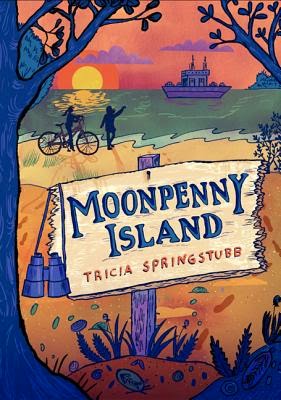
Moonpenny Island

by Tricia Springstubb
First sentence: “Transparent.”
Support your local independent bookstore: buy it there!
Review copy pilfered from the ARC shelves at my place of employment.
Content: It’s pretty basic, language-wise, with short chapters and simpler words. Good for anyone who likes friendship stories. It’s in the Middle Grade (grades 3-5) section of the bookstore.

Flor and Sylvie have been best friends forever. Growing up on a small island in the middle of Lake Erie (it’s doesn’t exist, but it’s possible, though I had to look it up) on the Ohio side, they were pretty much all they had. Which was just find with Flor. Then things change: Sylvie is sent to Cleveland to live with her aunt and go to school there. And Flor’s mother leaves as well, and they don’t know when — or if — she’s coming back.

With her life falling apart, how can Flor cope?

Once I got over my annoyance about the whole there’s an island in Lake Erie by Toledo thing… I found I really liked it. It’s not magical quirky, but it does fit with the whole small-town quirky thing. I liked how Flor knew everyone on the island, and was willing to stick up for the less “acceptable” members of their community. I liked how Springstubb introduced a scientific-minded, homeschooled girl into the mix, and how she wasn’t weird or unusual or super-religious. I felt like Springstubb tackled everything — from problems at Flor’s home to problems with her friends — with an evenness that suited her audience.

The only thing that bothered me, really, about the story was that it had the feel of a first person narration, but it wasn’t. For the most part, I was able to flow with it, but every once in a while, it pulled me out of the story.

But that’s a small quibble in an otherwise good book.

Audiobok: Stiff

by Mary Roach
Read by Shelly Frasier
Support your local independent bookstore: buy it there!
Content: Um, Roach doesn’t mince her words when she talks about scientific stuff, and so some of this is kind of … gross. Fascinating, but gross. There’s a few mild swear words, but if you’re interested in dead bodies, go for it. It’s in the science section of the bookstore.

I picked this one out because I was in between audio books and because I really enjoyed Roach’s writing in Gulp. This time (it’s an earlier book), Roach takes a look into what happens to bodies after people die. From the ones that are donated to science — used in anatomy labs, for surgery practice, for research, etc — to the way the bodies decompose, you have to say that Roach is nothing but thorough.

On the one hand, this wasn’t the best book to listen to. Frasier did a good enough job narrating (though I had to keep reminding myself it wasn’t Roach talking; much of the book is in first person), it’s just that when you read about bodies decomposing, you don’t want to LISTEN to the words. Or at least I don’t. I never got physically ill, but it did make me queasy on a couple of occasions.

On the other hand, though: it was fascinating. Even if the book is 10 years out of date, it’s interesting to think about what can be accomplished through science after one dies. If anything, it got me thinking about what I want done with my body (though Roach pointed out that much of what is done with the body is decided not only by the deceased but by the family members) after I pass on. I think I was most swayed by one of the final chapters where Roach wrote about a woman in Sweden who was advocating for promession, which is a way of composting bodies. For some reason, this really struck a chord with me. I’d much rather be turned into earth and help a tree grow than sit in a graveyard. Shocking, I suppose. But my kids are on board with that (at least right now).

In the end, even though it was gross at times, I really enjoyed this one.

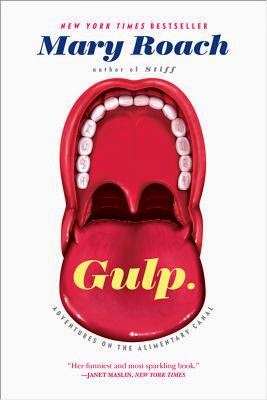
Gulp

by Mary Roach
First sentence: “In 1968, on the Berkley campus of the University of California, six young men undertook an irregular and unprecedented act.”
Support your local independent bookstore: buy it there!
Content: One f-bomb (in the chapter about the rectum as a criminal accomplice) and a bunch of s-words (in the chapters on the colon and intestines). It’s in the science section at the bookstore.

I never would have thought to pick up a book on the Alimentary system (that’s your digestive system for the non-medically minded), except that this was picked for my in-person book group.

I’m so glad it was: it was fantastically fascinating.

She takes apart the digestive system, starting from the nose, working her way down. It sounds like it’d be boring, but it really isn’t. Roach is not only an engrossing and accessible writer, but a hilarious one. Especially the footnotes. All her little asides and historical facts had me laughing out loud.

True, the last few chapters aren’t for those who get queasy talking about bodily functions. But if you can get past that, it’s an excellent book.

The Fourteenth Goldfish

by Jennifer L. Holm
First sentence: “When I was in preschool, I had a teacher named Starlily.”
Support your local independent bookstore: buy it there!
Review copy snagged from the ARC shelves at my place of employment
Release date: August 26, 2014
Content: I think it’s geared towards younger readers: larger font, lots of white space, and everything is pretty much spelled out. It’ll go in the middle grade (grades 3-5) section of the bookstore, but could go for strong younger readers.

Eleven-year-old Ellie has a pretty normal life. Her parents — both Theater People — are divorced, but get along. She is dreading middle school, especially since she and her best friend since Kindergarten seem to be drifting apart. But, mostly, it’s just your normal, every-day life. That is, until her mom gets call to go pick up “Melvin”. Who happens to be her father, Ellie’s grandpa. Except now he’s 13. Turns out, he discovered a new species of jellyfish, one when ingested, gives you back your youth.

But things aren’t all roses and unicorns for Melvin: being 13 is not the same as being in your 70s. There are some upsides: a good digestive system, and the lack of a need to pee in the middle of the night. But the downside is that Melvin has lost access to his lab, which means if he can’t get the jellyfish, he can’t prove his theory, and he won’t win the Nobel Prize.

While Ellie is our narrator, it’s Melvin who drives the action. He’s the one who introduces Ellie to Science; gets Ellie to talk to her new friend, Raj; the one who needs to break into the building. One of my problems with this (aside from being Too Old; I do think younger readers will love it) is that Ellie is not proactive, but rather reactive in her own life. She’s a sweet girl, and a nice person to read about. But the book just wasn’t exciting.

It was, however, charming and informative. Holm managed to put a ton of science in her science fiction book: everyone from Galileo and Newton to Oppenheimer and Einstein make an appearance. And she explains some basic scientific concepts in pretty general — and clever — ways. So, while it wasn’t exciting, it was interesting. It did take me a while to figure out the title, why it was called the 14th goldfish (since goldfish didn’t play much of a role), but I thought the ending was sweet and Holm did explain it.

Not my cup of tea, but I’m glad I read it.