Audiobook: The True Meaning of Smekday

by Adam Rex
Read by Bahni Turpin
ages: 8+ (though my 4 1/2 year old loved it, too)
Support your local independent bookstore: buy it there!

I’ve enjoyed audiobooks in the past, but I think it’s a rare occasion when I listen to an audio book and then realize that I probably would have not liked the book as much if I had read it. (The last time that happened was with The Tale of Despereaux quite a few years ago.) This was one of those books. Although there were a few moments when I wished I had the book to browse through, Bahni Turpin did such an amazing job with the narration, that I know if I had read the book I would not have had as good of an experience with it.

But, the audiobook? I loved it. (As did all the girls, for the record. And they didn’t even hear the whole thing. We need to go on a nine hour roadtrip so they can all hear all of it. Amanda, you want some visitors??)

The story begins with a school assignment. Gratuity Tucci (“my friends call me Tip”) is assigned to write, for the National Time Capsule contest, an essay answering the question: What is the true meaning of Smekday. See, a year earlier, aliens called the Boov invaded Earth, which they renamed Smekland, on Christmas (henceforth known as Smekday). Gratuity has an interesting story: her mother was kidnapped by the Boov, and Gratuity with her cat (named Pig), set off to Florida (where all the humans were being relocated) to find her mom. Along the way, she falls in with a renegade Boov named J.Lo, who has made a bit of a mistake of his own. The long and short of it is that because of J.Lo’s mistake, and because of Gratuity’s determination, it ends up being their job to save the world.

It’s hilarious, especially as read by Turpin. The voices she picks for the Boov, were at first annoying, but by the end of the book became endearing. You could tell the personalities of the people from the voices she chose. And the book was so funny — I wish I had a copy here to pull out one liners — from the pokes at pop culture to the Boov massacring English, it had us all in stitches. But that’s not to say it’s all fun-and-games; Rex pairs the funny with a darker undertone: there’s strains of Manifest Destiny and imperialism going on. Aren’t the Boov doing to us what we did to the Native Americans, or what the British did to so many other countries? I’m sure my younger kids didn’t pick up on that, but I found it interesting. There’s also themes of prejudice and stereotyping, and going beyond first impressions to find the truth of a person, race or species. It’s fascinating.

I also discovered that listening to the story, for me at least, ramped up the suspense. I couldn’t flip to the back of the book to find out how it ended (confession: yes, I do that). I was forced to listen, to wonder where the HECK was he going with the story, and how in Smekland was it all going to turn out?

Highly, highly recommended.

Mare’s War

by Tanita S. Davis
ages: 13+
First sentence: “It’s just a sporty red car parked across our driveway, but when I see it, my stomach plummets.”
Support your local independent bookstore: buy it there!

The last thing fifteen-year-old Octavia wants to do is spend the summer with her older sister, Talitha, and their grandmother, Mare. She’d rather be looking for a job. Or hanging with her friends. Anything but sitting in a car, driving from San Francisco to Alabama for a family reunion. All sorts of boring. Especially since she really doesn’t get along with either Mare or Talitha.

Except as they start driving, Mare starts talking about her past: what made her run away from Bay Slough, Alabama and join up in the Women’s Army Corps near the end of World War II. Her experiences in both a segregated south and a 1940s midwest, not to mention in the army. The chapters alternate between then — Mare’s history — and now — the road trip — and as the book unfolds, we learn more about all three of our characters. It’s an interesting journey, for both the characters as well as the readers. In the course of the book, Davis tackles both womens- and race-issues from rape to segregation to sibling rivalry to parental expectations and everything in between. It would seem like this would be a heavy-handed book, but it’s not. It’s got a lot to think about and talk about, but it’s like a sugar-coated pill: it goes down easy. Mare’s a fascinating character, all bumps and edges with a heart of gold underneath. And while I foiund Talitha and Octavia are less charming, they are certainly not uninteresting.

Which means this is one of those rare breeds of books: entertaining while educational at the same time. Well done.

The Hitchhiker’s Guide to the Galaxy

by Douglas Adams
ages: 12+ (though the older you are, the more likely you’ll get the jokes)
First sentence: “Far out in the uncharted backwaters of the unfashionable end of the Western Spiral arm of the Galaxy lies a small unregarded yellow sun.”

For the Try Something New mini challenge over at Things Mean a Lot, I was paired with Laura of State of Denmark. We went back and forth a bit on what genre to read, and then what book to read, and we finally decided on the cult classic The Hitchhiker’s Guide to the Galaxy. Laura and I sat down to chat about it last night. Be sure to drop by her blog to see her take on the book and our conversation.

me: So, what did you think of it?

Laura: Hmm… well, I definitely found it funny and caught myself chuckling and laughing on several occasions, but I never felt the burning desire to just keep reading. I actually abandoned it for two weeks.

me: You know, me either. I’ve read it before; back when I was in high school, and parts of it have made it into family lore. But, I think it’s much funnier talking about it, than actually reading it. You know it was originally radio scripts, right?

Laura: Yes, I did see that and I can see how it probably was really successful in that way. I would listen to it no problem.

me:
But it just didn’t work as well in novel form for you?
Laura: No, that’s not it at all. I liked it when I was reading it; it just wasn’t one of those “have to keep reading” books. He is really funny… reminds me of Kurt Vonnegut
me: I’ve read Vonnegut, but it’s been a while. In what way?

Laura: I guess just in the sense that he sort of mocks the absurdities of life. The randomness of it all.

me: I can see that. Though I’m not sure Adams was going for any social commentary. I think he was just being silly. I could be wrong… Either that, or he’s poking fun at the superiority people seem to have. The dolphins show up in this book, right? So long and thanks for all the fish and all that? (It’s been a week, and already I can’t remember!)

Laura: Yeah, and the mice who really rule the world but have tricked us all.

me: The mice were funny. I liked the mice… and Arthur’s defensiveness about his brain. Did you have a favorite part, or character?


Laura:
I loved the part when they are talking about all improbabilities and then Arthur makes the comment that there are an infinite number of monkeys outside who want to talk about their Hamlet script they’ve worked out.


me:
That was funny. (I’m giggling thinking about it.)

Laura: I liked the really depressed robot… I can’t think of his name right now

me:
Marvin! He’s the best part of the movie… Alan Rickman’s his voice, and he does a superb job.

Laura: Yes, I loved poor Marvin. I just ordered the movie. How about you?
me: I think my favorite scene was in the end when Marvin hooked himself up to the cop’s ship, and it committed suicide. That made me laugh.

Laura: Absolutely. That’s the next thing I was going to say: about the suicidal ship.

me:
I liked the idea that even though Marvin was so supremely depressed, he still managed to help them. Even though he didn’t care whether they lived or died.
Laura: I also really liked the history of figuring out the meaning of life
me: Yeah. That’s actually one of the things that has made it into family lore. You say to my dad, “I have a question” and he says “42”. Every time.

Laura:
That’s great. I need to use that one with my students.

me:
That would be funny. I wonder if they’d get the reference.

Laura: A select few maybe.


me: Have any of them read Hitchhikers? Or is it really an 80s geeky thing?

Laura: Not that I know of. I think it is more of an 80s thing, but I definitely have some that would get a huge kick out of it. When I was in college it seemed like everyone but me had read it, now, not so much.

me: It feels like a 70s/80s book. I’m not sure I can pinpoint why.

Laura:
It’s very campy.

me: It is campy. And very silly. But generally those things are timeless. Though, I’m not sure I could come up with an example off the top of my head.

Laura: It was originally written in 79.

me: I also harbor a soft spot for Zaphod Beeblebrox. If only because his name is so fun to say.


Laura:
The names were a hoot

me: Found this anecdote… “Slartibartfast: I thought this character should be a dignified, elderly man, weighed down with the burden of a secret sorrow. I wondered what this sorrow should be, and thought perhaps he might be sad about his name. So I decided to give him a name that anybody would be sad to have. I wanted it to sound as gross as it…”
Laura: Nice, I love that. And I would have to agree, Slartibartfast is a pretty gross sounding name…
me: “…possibly could, while still being broadcastable. So I started with something that was clearly completely unbroadcastable, which was PHARTIPHUKBORLZ, and simply played around with the syllables until I arrived at something which sounded rude, but was almost, but not quite, entirely inoffensive.” Sorry, the text box was too small for the quote.
Laura: ha!

me:
It is too funny. There’s also a long note on the sperm whale that dies near the end. But I won’t type that out.

Laura:
Where did you find this? I need to check it out.

me: Hubby has the original radio scripts for Hitchhikers, and it’s from the notes in that. (For the record, I’ve only read the novel, though…) When I pulled out the book, he pulled out the scripts, and read that one out loud to me.

Laura: Ahhh, so has he read the whole series?
me: I think he’s read the first three or four of the trilogy. There’s five in all. The first two — Hitchhikers and The Restaurant at the End of the Universe — are the best.

Laura: I love that it is a trilogy with five books

me:
I know; it cracks me up. I wonder if you could find a copy of the radio scripts now, or if it’s gone completely out of print?

Laura: I work part-time at a bookstore and I can do some research on that one. So overall, how would you rate this book? What did you think of it in terms of science fiction? For me, this is about the extent of my science fiction knowledge I think. I can’t name one other sci-fi book I have read, unless you count Stephen King… which I haven’t read since high school.

me: I don’t actually think it’s properly science fiction. I’ve read Orson Scott Card and Ray Bradbury and Isaac Asimov, all of which I think of as science fiction. Douglas Adams is a comedian in space. Which isn’t a a bad thing… it’s just not properly genre.

Laura: I like that explanation. A comedian in space.

me: I guess it would make him hard to classify in a library or bookstore: where do you shelve his books?

Laura:We have a shelf titled science fiction/fantasy and that’s where he lives.

me:
It works. He’s not really humor, either. Not properly.

Laura: Yeah, sometimes he wanders over to fiction as well

me: So, are you going to find The Restaurant at the End of the Universe?
Laura: not right now. I’m putting that one on hold for a little while, but I wouldn’t say I am not going to read it ever either. How about you? You’ve read that one?

me: When I was a teenager. I only remember one part, and that’s the talking cow (“Hi, I’m your dinner tonight”) at the restaurant. That and the one line: You are so unhip it’s a wonder your bum doesn’t fall off. Aside from that, the book is unmemorable. Or it’s just been too long. My favorite Adams is The Long, Dark Tea-time of the Soul. Dirk Gently’s the main character and he meets the Norse gods. Quite funny.

Laura: I will have to check it out.

me: It might be funnier on audio book, sometime when you’re on a long road trip.

Laura:
Yeah, that was what I was actually thinking about this one. I should listen to it on the way to work each morning.

me:
Well, next time around. It’s been a pleasure chatting with you! :)

Laura: Yes, this was fun and thanks for the little tidbits from the script; they were great.
me: My pleasure. Have a great evening!

Laura: You, too!

Paper Towns

by John Green
ages: 16+
First sentence: “The way I figure it, everyone gets a miracle.”

First thing, I should mention that I got sad Margo from the library. (I said, when I checked out “Oh. It’s sad Margo. I was hoping for happy Margo.” The librarian looked at me funny.) When the book was released, my gut instinct was to go with happy Margo — it’s a much more attractive cover, and I like yellow. But after finishing the book, I think the sad Margo (who doesn’t really look “sad”) is probably the more accurate one.

Quentin has lived next door to Margo Roth Spiegelman since he was two years old. And he has harbored a crush on her for nearly as long. So when Margo pops into his room at midnight, three weeks to graduation, he’s unable to refuse her night of revenge and list-crossing. It’s this experience, fueled by his crush that drives him, when she disappears the next day, to obsessively follow her clues to figure out the mystery that is Margo.

Okay. So that’s the basic plot. But, like any John Green (like Margo Roth Spiegelman, John Green is just the sort of name you kind of have to say together) book, it’s not really about that. It’s one part mystery, one part road trip, and two parts unraveling. I liked the road trip part best, personally, but unlike Looking for Alaska, I actually enjoyed Q’s journey of self- and other-discovery. The book is anchored in Walt Whitman’s “Song of Myself” (which I’ve actually never read, but now kind of want to), and the exploration of the way we interact with each other. The “mirrors and windows” as Green puts it. Q spends a lot of time wandering and sluffing off the last three weeks of school, intially because he wants to find Margo (the physical being), but eventually because he wants to understand Margo (the person). There’s a difference, and I think Green explores that both humorously and poignantly. And what Q discovers is why I said the sad Margo cover fits Margo, the character, better. The ending is both bittersweet and absolutely perfect, which I also appreciated.

Is it his best book? Hmm… probably not. (It’s not my favorite, either, but I did like it.) But it’s a good book. And a good book is always worth reading. Especially if it’s written by John Green.

An Abundance of Katherines

This book, without a doubt, is a book for nerds. I don’t think it matters what kind of nerd — I’m only a book nerd, after all, with a dabbling of music and math nerditry — but I think you might have to be at least a little bit of a nerd to truly enjoy this book. (And since I think most people are at least a little bit of a nerd…)

Colin — former child prodigy and recent high school graduate — has a tendency to not only date girls named Katherine, but to get dumped by them. After the most recent dumping — by Katherine XIX — he and his friend Hassan decide to go on a road trip. They end up in Gutshot, Tennessee, where they learn a little about themselves, about relationships, and about trusting in the unknown.

That’s the basic plot, anyway. What I really liked about the novel, and the reason I think it’s worth it to read, is the footnotes. I’m an obsessive footnote reader, which sometimes gets in the way of the reading experience. But in this case, they made the book for me. They were snide, funny, and oh-so-John Green (at least the way he comes off in his vlog). And the afterword/appendix was fascinating, too (although Green wrote that it was “optional” to read.) The book was pretentious, like Looking for Alaska, but in this case the pretention wasn’t taken so seriously and therefore worked better. Sure, Colin was soul-searching, looking for the Truth and the Meaning of Things. But it wasn’t so weighty, so oppressive a search as Miles’s was. And I think Green’s style works better when he’s not being so Heavy. (A side note about the language: it was cleaner than Looking for Alaska, but only because there’s a wonderful homage — which I didn’t know was one until they spelled it out for me — to Norman Mailer. If you’ve read him — I haven’t — you’ll know what I mean. If you haven’t, well, then, you’ll either have to read some Mailer, or read this book.)

I’m glad Green’s writing books (especially ones where the nerd gets the girl, and it doesn’t come off as forced or contrived); it’s about time nerds got some respect. And Green’s just the person to give it to them.

The Royal Road to Romance

I decided a while ago to abandon my original list for The Armchair Challenge. After reading, and loving, The Embarrassment of Mangoes, I knew there was no returning. So, I hunted for the suggestions that my friend, Amira, gave in the comments of one of my other posts. No luck; I guess my library just isn’t as versed in Central Asia as hers is. But, they did have my Nook friend Cami’s suggestion (well, actually Cami’s mother’s): Richard Halliburton’s The Royal Road to Romance. And I’m so glad I picked it up.

I’ve gotten into BBC’s Jeeves and Wooster (based on the P.G. Wodehouse books, which I really must read). I’ve not only enjoyed the silly (very silly!) story lines, but I’ve loved the whole 1920s aura; the dress, the attitude, the language. So, what does Bertie Wooster have to do with The Royal Road? Well, imagine Bertie as an American tramping about the world, and you’ve basically got the feel of the book. It’s really a whole lotta 1920s fun.

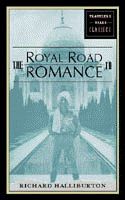
First, a couple of laments: I lamented the lack of a map. I had an idea where many of the places were, but there were several stops I had no clue about. I wanted to know where Andorra was, and whether or not it was still a country. Same with Ladakh. I wanted to know where in India all these cities he popped in and out of were. There was a map in the original publication; Halliburton made reference to it. But, my edition lacked one and there were times when I really missed it. But the greater lament was the lack of photographs. Halliburton’s tromping all over the world with his trusty camera (even getting thrown in jail for taking pictures in Gibraltar) and the only evidence we have is the cover photo of him in front of the Taj Mahal. So sad.

My laments aside — and they really are paltry — I thoroughly enjoyed seeing the world through Halliburton’s eyes. The world was so different then; Halliburton literally bummed around the world, hitching rides on steamers, stealing trips on trains (avoiding train conductors was a common pastime of his: “All day long, it was necessary to fight off collectors, as the news of my default spread by telegram up and down the line. Not only conductors were on hand to hound me, but inspectors, police and station-masters. I was diving out of windows, changing compartments and haggling from morning till night. One particularly obnoxious collector would have pushed me bodily off the train had I not pushed him off first.”), biking, walking… things that very few people these days would even think of doing. Sure, he comes from a certain class of people — for who else, when graduating from college, would shun a career for 600 days of “horizon chasing” — and that affects his view on the world. But, there’s also the fact that so much of the British Empire was still intact, so there was a feeling of compatriotism from the ex-pats he met, people who were more-than-willing to help him on his adventures.

And what adventures he had! He climbed the Matterhorn, without any previous climbing experience (and was mildly disgusted at his friend Irvine’s response: “At last,” he continued in a far-away voice, “after talking about it and dreaming about it all these years, at last, I can actually SPIT A MILE!”). He met the president of Andorra, and bummed around Spain with a fellow American (an architect student; the funniest part was their “contest” in Seville where they tried to get as many girls as they could to smile/flirt with them). He went south to Gibraltar, snuck (sneaked?) into the fort at night, and then got jailed for taking pictures a couple of days later. (I liked this quote: “That same afternoon we approached the Bay of Algeciras, and there before me, rising abruptly across the water, I saw the majestic Rock, entirely devoid, to my great disappointment, of the Prudential Life Insurance advertisement I had always seen emblazoned upon it in picture.” Hubby said, “Wow. Even back then.”) He got out by sheer pluck, and with a fine of 10 pounds, which he did not have, but the guards (for whatever reason; because Halliburton was plucky?) and friends paid the fine for him.

From Gibraltar, he headed to Monte Carlo, where he and another American, Pauline, lost $200 gambling. I really liked this passage:

Finding diamonds very boring, we sat on a bench in the Casino Gardens overlooking the sea, and there surrounded by great banks of flowers we finished our inadequate box of candy, realizing how much better it was to drown our desolation in this form of narcotic than to do the commonplace thing of shooting bullets into our skulls.

And then on to Egypt, where he spent the night on top of one of the pyramids, Kheops, and got caught naked in the Nile (that was a funny adventure!). He decided instead of heading to Greece, that he’d go on to India, spent the night in the Taj Mahal (yes, he snuck — sneaked — in there, too), and bummed around various other places. He climbed the Kyber Pass, visited Kashmir, and was one of only 12 whites to see Ladakh that year. From there, he decided to continue east:

[I] turned my attention to maps, upon which I saw that in my aimless peregrinations I had wandered half-way round the world. It was now as near home eastward as westward so I resolved to return to America via Japan, despite the fact that this move would make me eligible for the dreadful epithet “globe-trotter”.

He saw a cremation festival in Bali, partied in Hong Kong, got robbed by pirates off of Macao, met Russian exiles in Harbin, Bolsheviks in Vladivostok and then managed to secure passage across to Japan (as an “official” mail courier) and climbed Mt. Fuji (in January, in the ice and snow, taking the first-ever picture of the crater in the snowy season) before working his way back home.

It really is a grand adventure, a royal road to romance. And one that’s really worth the time to read. I’ll end with my favorite quote of the book, from after the pirate incident:

As our little ship moved painfully toward her dock I was standing on deck in my shirt-sleeves beside the unfortunate American tourist who had lost most of his two hundred dollars.
“Lord, I’m hungry!” he growled at me.
“Oh, everybody’s hungry,” I replied unsympathetically. “But it’s worth it having such a jolly adventure. “
“Jolly adventure!” he gasped.
“Why, of course. I’ve never had such a good time.”
“Idiot!” he burst out.
“Fossil!” I retorted.

Around the World in 80 Days

Michael Palin is my favorite Monty Python. This is not something I discovered as a teenager — I’d seen Holy Grail, but that’s about it — but as an adult. See, I married a Monty Python Fan. He uses two of their movies in his classes (“They’re full of great philosophical points,” he says). We own not only the entire series on DVD, but also every special that they have come out with. We have books on the Pythons. And, being the loving, devoted wife that I am, I’ve watched it with him (he’s working on getting the girls hooked), and yes, have gotten sucked into it (well, it is funny…). In the process, I’ve come up with my own Beatleesque descriptions of all of them: I don’t get Terry Gilliam, I find Terry Jones often unfunny, Graham Chapman is the straight man (yes, I get the irony), Eric Idle is just smarmy, John Cleese is a great physical comedian, but Michael Palin is my favorite.

So, what does all this have to do with a Jules Verne book?

Well, way back in 1988, when I was 16, and Michael Palin was 45 (I know, he’s older than my dad!), the BBC got him to see if he could do what Phileas Fogg did in the Verne book: travel around the world in 80 days (or less). I’m sure he didn’t know when he started that this would become a second career of sorts for him — he’s done six of these, and is working on a seventh — and that’s how I came to this book. I’ve long wanted to watch these travel documentaries (being a fan of both travel documentaries and Michael Palin), but they were never to be seen in the video stores of Jonesboro and Macomb (same with Bollywood movies, but I digress). Along came Netflix, and I found that they really do carry everything. We’ve watched Sahara — good, but the ending was too abrupt — and are 2/3 of the way through Himalaya (which has been really good so far). And watching those got me curious about the earlier ones.

He’s written a book to accompany each of his travels, and I reserved a copy of the first one. The gimmick was to follow the Verne book as closely as possible, without using airplanes. The book’s basically his diary of the trip — broken up into little segments for each day. And it’s fascinating. He’s an engaging, funny writer (favorite part: the initiation he got for crossing the International Dateline on a merchant ship. At one point, he commented that it was worse than being in a Terry Gilliam film). I loved seeing the world through his eyes. He really is a people person, making friends with whomever will talk to him, searching out the unusual and unspectacular, and he’s genuinely curious about the world. I was saddened by the lack of respect for the earth that many people had in 1988 (but I had to keep reminding myself that it was nearly 20 years ago) — and it made me wonder how much the world has changed, if at all (I doubt he’d do it again, but I’d be to see what it would be like now, 20 years down the road). There was also the constant pressure to keep up with a fictional character. He was lagging way behind Fogg for quite a while — over sea travel isn’t nearly as easy as it was in the 1880s — but caught up from Tokyo to Los Angeles, and across America, so he ended up on time. But only barely. I liked his descriptions of culture shock going from country to country — a realization just how different we really are.

I also realized that there was a lot more information in the book than would or could appear in the BBC series. So, I’m curious and need to get the tape and watch it. And conversely, I should probably get the books to all the other ones, too. And I probably will. Eventually.