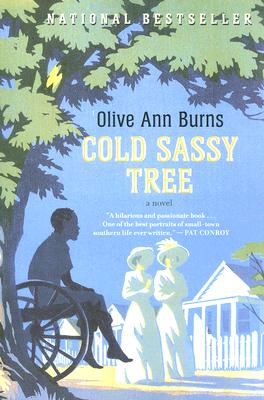
Cold Sassy Tree

by Olive Ann Burns
ages: adult
First sentence: “Three weeks after Granny Blakeslee died, Grandpa came to our house for his early morning snort of whiskey, as usual, and said to me, ‘Will Tweedy? Go find yore mama, then run up to yore Aunt Loma’s and tell her I said git on down here. I got something to say. And I ain’t a-go’n to say it but once’t.'”
Support your local independent bookstore: buy it there!

It’s 1906, in Cold Sassy, Georgia. Everyone knows their place in society, and how to behave. But, the summer Will Tweedy’s grandmother dies, his Grandpa decides to shake everything — including everyone’s expectations — upside down by marrying, a mere three weeks after the death, a woman half his age.

It sounds a bit creepy (everyone I described the plot to said, “Ew” as their first reaction), it’s really not; it’s more a story of second chances. From the Grandpa getting a second chance at a kind of youth; to his wife, Miss Love, getting a second chance at happiness (she has a very sad life story); to Will’s aunt getting a second chance at chasing her dreams. It helps that the story is told from 14-year-old Will’s point of view, which adds to the innocence. Will’s just discovering love and learning to live his life, and he has this wide-eyed naivete towards his grandfather and his beautiful bride.

In addition, it’s nice reading about someone (granted, that someone is white, and fairly well off; black people barely make a presence in the book, except as the cooks and hired help they were during Jim Crow in the South) shake up the entrenched Southern Expectations of the small town from his married daughters on down. It’s not an easy journey: it’s lonely and harsh being different from the norm, as any visionary knows, and Burns doesn’t spare us any of either the spite or the heartache.

Perhaps that’s what makes this simple novel work: the fact that everyone’s emotions and the consequences of their actions are laid open for us to discover. From the treatment of Will’s uneducated Uncle Camp to the desires of Will himself towards a mill girl, someone a “respectable” town boy should never deign to associate himself with. It’s a picture of a time, and not a glossed-over, prettified one, either. There’s racism, classism, xenophobia towards the Yankees. On the other hand, there’s an incredible sense of family, community, loyalty and responsibility. In other words: for good or ill, it’s the South.

Unfortunately, the book peters out in the end, giving Grandpa (and the town) a kind of pathetic, easy way out. I so wanted for them all to work things out, to get along, and for Grandpa and Miss Love to be happy, but it was not to be so. Which, perhaps, it the way it should be. There are no happily-ever-afters in real life, after all.

Very, very good.

The Heart of a Samurai

by Margi Preus
ages: 10+
First sentence: “Manjiro squinted across the expanse of glittering sea at the line of dark clouds forming on the horizon.”
Support your local independent bookstore: buy it there!

I wanted to like this one. The cover is pretty, it won a Newebery Honor this year, and the cover calls it a “novel inspired by a true adventure on the high seas.”

Manjiro is a 14-year-old Japanese boy in the mid-1800s. He’s from a small fishing village, and doesn’t have much chance for a future. He signs on with a fishing boat, which gets lost at sea in a storm. Eventually, they get washed up on an island, and a while later are rescued by an American whaling ship. Manjiro spends the next 10 years away from Japan, most of it on a ship, learning English and experiencing everything from the freedom of the open sea, to new technology, to racism, to the opportunities that America offers that Japan doesn’t. He eventually returns to Japan, to a less-than-amiable reception, but eventually helps the Japanese end 250 years of isolationism.

The story is all fine and good, but the book just fell flat. (At least it was a quick read.) All the things I was interested in: being stranded on an island, experiences on a whaling ship, racism in mid-1800s New England all got glossed over. While there was conflict, there wasn’t enough to keep the story interesting enough. And it was basically just a retelling of the years Manjiro was away from Japan, with an epilogue about his time in the government after his return. It would have worked better as non-fiction, if that’s all the author was going to do.

It could have been an interesting book. Disappointing.

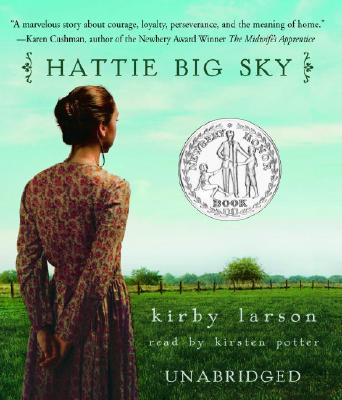
Audiobook: Hattie Big Sky

by Kirby Larson
Read by: Kirsten Potter
ages 12+
Support your local independent bookstore: buy it there!

Hattie is an orphan who, for most of her life, has been shuffled around to distant relatives to live. She’s never felt she’s belonged anywhere, never felt like she had a family. Then, the winter she’s 16, she gets a letter from an estranged uncle leaving her his 320 acre homestead claim in Montana. All she has to do is finish proving up on it, and it’s hers.

So, trying to escape the feeling of being unwanted, Hattie ventures out to the land, three miles northwest of Vida, Montana, and attempts to fill the terms of the claim. In doing so, she discovers things about herself, about people in general, and manages to find a family in the diverse bunch of people out there on the northern prairie.

It is very much a coming of age book: it’s all about Hattie growing and learning and finding a place in her own skin as well as learning that family doesn’t always mean blood relations. But beyond that, it’s an excellent historical novel: Larson manages to give us a picture of homesteading life — shades of Laura Ingalls Wilder — set in the early 20th century, against the backdrop of World War I. The themes that ran through the book, of wartime racism and sacrifice, are (as she mentioned in the author’s note) applicable today. The characters rang true, and the book avoided being too cliche or overly saccharine in the end, which I appreciated.

And the audiobook was quite lovely. Kirsten Potter does a grand job reading the book, capturing the subtleties of the characters. It was a grand way to experience this wonderful little book.

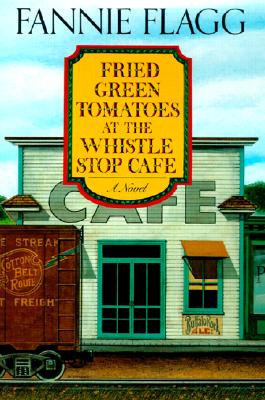
Fried Green Tomatoes at the Whistle Stop Cafe

by Fannie Flagg
ages: adult
First sentence: “The Whistle Stop Cafe opened up last week, right next door to me at the post office, and owners Idgie Threadgoode and Ruth Jamison said business has been good ever since.”
Support your local independent bookstore: buy it there!

I don’t quite know where to start. Perhaps I should say that I saw the movie years and years ago, and while I liked it, I’m not sure it really stuck with me.

But when Cass said the book was one of her favorites, I figured I needed to give the story a second look. And I’m glad I did.

It’s not a book for 20-somethings, though the mystery underlying the vignettes might have some appeal. But that’s not what I got out of the story. In fact, I had a hard time picking out much of a story at all. That’s not to say I didn’t enjoy it. I did. But, it took me a while to realize that the book is a kind of fictionalized oral history. Once I accepted that, then I found I was able to enjoy the book more, taking the stories for what they were: reminiscences of a full life.

That I loved the characters helped as well. I looked as forward to visits with Mrs. Threadgoode as much as Evelyn did. I loved hearing about Whistle Stop, about all the characters — even with all the 1930s area Southern racism — and their antics. It’s a cozy book and a welcoming, homey one, too, one that makes you feel like you are a part of the community. It shows both the positives of small towns (how everyone bonds together in a crisis, the support systems, the community building) and the negatives (nosiness, lack of privacy, prejudice). It doesn’t sugarcoat anything, which, in turn, makes everything resonate more.

And then there’s Evelyn. Ah, the quintessential doormat middle-aged wife and mother. I think I enjoyed her “awakening” most of all. Firstly, because it came through the stories. And secondly, because I think she needed it. To find fire and want and to stop being so dang selfless all the time. Sometimes, it’s okay to do something for yourself, and to be angry at the injustice in the world.

It’s a wonderful book and I’m glad I had a chance to visit with it.

Shooting Kabul

by N. H. Senzai
ages: 10+
First sentence: “It’s a perfect night to run away, thought Fadi, casting a brooding look at the bright sheen of the moon through the cracked backseat window.”
Support your local independent bookstore: buy it there!

The target age group for this book were barely born when 9/11 happened. They missed all the stress (though they live with the aftermath, not having any idea what it was all like before), the tension, the fear. I know C was barely 18 months when the Twin Towers went down, and was blissfully clueless about it all. Even M, who was five, only has a foggy memory of what it was like during those days.

Enter Shooting Kabul. Set in the time right around the attacks, it gives us a peek into what life was like in Afghanistan at that time. Fadi and his family are intellectuals; they had lived in the U.S. while his father got a PhD before returning to Kabul to help the Taliban (yes, you read that right) eradicate the poppy fields and convince farmers to actually plant food to feed the Afghani people. Unfortunately, as the Taliban became more and more extreme, Fadi’s family’s lives were in danger and they managed to escape. Except, in the desperate attempt to get out, somehow the Fadi’s little sister, Miriam, gets separated from the family and lost.

Fadi blames himself (as does the rest of the family), and in San Francisco he keeps trying to concoct ways to get back to Afghanistan and find Miriam. It’s heartbreaking to think about the weight this poor boy is carrying around. As weeks and months go by, it seems less and less likely that they will find her. Especially since his father hasn’t been able to take a teaching job, and is forced to drive taxis, which barely covers rent and food. Things are tough, and get tougher with the racism and fear after 9/11. So, Fadi enters a photography contest with the hopes of winning the grand prize — two tickets to India — so he can do his part to find Miriam.

First off: it does have a happy ending. Miriam is found, and the way it happens is quite surprising and actually very realistic, which I found wonderfully satisfying. As was the rest of the book; I liked the use of photography, how Fadi stood up to the bullies without using violence, and the glimpse into what the lives of Afghanis are like, both in Agfhanistan and in the U.S. It’s a good book to interest kids in the area, to give them a picture of what life was like nearly 10 years ago (and remind them that things aren’t that different now), and give them a good, engaging story on top of all that.

Excellent.

(Just for the record: because this is a Cybils nominee, I’ve been asked to make sure y’all know this is my opinion only, and not that of the panel.)

Skunk Girl

by Sheba Karim
ages: 13+
First sentence: “I’m a giant in the sky flying over crimson-roofed houses, dressed in a wool turtleneck and jeans.”
Support your local independent bookstore: buy it there!

Nina Kahn wants to be something other than what she is: a Pakistani girl in a smallish town in New York during the 1990s, at odds with her culture and with the American society she wants to be a part of. She’s the daughter of immigrants, and even though she’s grown up in America, she still feels like she’s at the fringes of her high school. It’s partially because her parents are fairly strict Muslims: Nina’s not allowed to date, or go to sleepovers, or even wear shorts, or even — perhaps most especially — shave. It doesn’t help that Nina finds the whole traditional Pakistani (or even Muslim) thing a bit off-putting; she doesn’t really speak Urdu that well, her best friends are white, and she likes the new guy at school, Asher, who’s half-Jewish and half-Italian.

The question is: where does she really belong?

It’s an interesting question, one that’s been explored in many venues, especially with children of recent immigrants. I’m not sure I’ve seen it with a Muslim family before, but there’s much that I’m sure could be substituted for East Asian or even Hispanic families: the desire of the parents to keep the language, the culture, and — in this case — the religion from their former country intact. Sometimes it’s successful, sometimes it’s not. There’s an element of racism: of trying and not quite succeeding in fitting in, of not quite being accepted fully by mainstream American society. It’s an interesting portrait; the religious element made it stand out from other first-generation American stories, and Nina was a very likable character.

However, I really wanted something — anything — to happen. It was very much a slice-of-life portrait: here’s Nina in school, here’s Nina obsessing over Asher, here’s Nina’s friends doing teenager things like having sex or getting smashed at parties while she watches TV at home with her parents, here’s Nina not quite fitting in with her parents’ Pakistani friends, here’s Nina learning to accept herself. But there was no real conflict, no real hook to hang the book on, nothing to make me really feel Nina’s discomfort and her inner conflict between what her parents want and what she wants.

There’s also a time disconnect: setting the book in the early 1990s distances it from something that’s still a very real issue for minority teens today. It felt modern enough, and perhaps setting the book 17 years in the past gives it a slightly more timeless feel (or maybe the author really just wanted to write, “Hey, you know that email thing? I think it’s going to be big!” in her book?), but it seemed awkward to me: it could have been just as easily set in current times, and perhaps would have made it more effective.

Which is too bad, because it could have been a really interesting story.

Kaleidoscope Eyes

by Jen Bryant
ages: 10+
First sentence: “I wake up every morning to Janis Joplin.”
Support your local independent bookstore: buy it there!

It’s the summer of 1968, and 13-year-old Lyza Bradley has had enough of death and abandonment. It’s been two years since her mother disappeared, and with the Vietnam War raging, boys in her small South Jersey are coming home in coffins more than she’d like. So, when her Grandpa dies, it’s almost more than she can bear.

Except… Grandpa left something just for Lyza: three maps and a mystery to solve. With her two best friends — Malcom and Carolann — Lyza unravels the mystery of the maps to discover that famed “reluctant pirate” Captain William Kidd possibly buried treasure right in their town. The question is: can they find it?

I have no idea what I expected when I pulled this off the shelf. I was intrigued by the title: what would a book that quotes a phrase from a Beatles song be about? Turns out that it’s much like a kaleidoscope: a lot of little bits and pieces of a lot of things working together to make a patchwork story. There isn’t an issue of the late-1960s that doesn’t make a passing reference: racism — Lyza’s best friend Malcom is African American, and has to deal with racism; the Vietnam War and all that entails from the fighting to the protests to the draft and all that entails; hippies — Lyza’s older sister Denise and her boyfriend Harry certainly qualify; and drugs — at one point, Lyza’s father thinks she’s doing drugs, even though what she’s really doing is digging up buried treasure.

It’s not heavy-handed, though, which, at the beginning I was afraid of. Once the maps come into play, however, the issues fade to the background. They were a part of life in 1968; it would have felt odd not to have mentions of Dr. King’s or Robert Kennedy’s death. But the primary focus of the story was the adventure and discovery of the kids. And because of that, it became also a homage to freer times, when three 13-year-olds could go all over a town (and to other towns) without adults knowing more than just the bare minimum.

The format also helped: it’s a novel in verse, and the way some of the poems reflected the mood of the characters, or the events was clever, but not distracting. And, again, they had a kaliedoscopic effect: a lot of little pieces that came together to make a nice story. Which is really rather neat.

Shine, Coconut Moon

by Neesha Meminger

ages: 14+
First sentence: “There is a man wearing a turban ringing our doorbell.”
Support your local independent bookstore: buy it there!

One would expect, in the aftermath of 9/11, a lot more books dealing with the reactions of teens to that event. Perhaps there are a lot out there, but this one was the first one I’ve read that dealt with the attacks on the World Trade Center and the aftermath — not so much the aftermath of loss, but the aftermath of suspicion and racism that was pretty strong for a while (some would argue still is) immediately following the attacks.

Seventeen-year-old Samar — Sammy as her mom and friends call her — is Indian (her family hails from Punjab), but she doesn’t have any connection with her heritage at all. She was raised by a single mom — her father left when she was two — who has severed connections with her uber-strict Sikh family. Her mother has raised Sammy to be an “American” through and through; your typical white, middle class American, that is, with no real sense of her Indian heritage.

And then, the Saturday after 9/11, a turbaned man shows up at Sammy’s house. He turns out to be Sammy’s Uncle Sandeep — her mother’s younger brother — and he sets off a chain of events that lead to Sammy finally question the way her mother’s brought her up, and awakens a desire for her to learn about her heritage, the religion that goes along with that heritage, and her family.

It was an interesting book, taking the issues of assimilation, family and racism head on. Sometimes too head-on; I felt that it had a tendency to get a bit preachy and over-earnest in parts. But, even with that, it was a good story. Sammy’s journey to discover herself — and the conflict that is created by that– is an intriguing one. There’s quite a bit of material for discussion, as well: from the basic outline of Sikhism (and how to pronounce it!) to the knee-jerk reactions of people when it comes to racial stereotypes. It’s a thought-provoking book, which trumps all complaints of heavy-handedness and lack of compelling characters. Which is not something I found I minded.

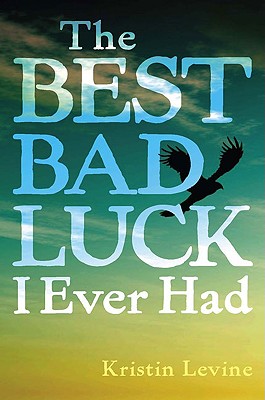
The Best Bad Luck I Ever Had

by Kristin Levine
ages: 10+
First sentence: “I’ve been wrong before.”
Support your local independent bookstore, buy it there!

It’s 1917, Moundville, Alabama and Dit is not quite 13 years old. He’s also the sixth of ten children, and tends to get lost in the crowd. All Dit wants to do is play baseball and earn enough money for the Fourth Hunt and do well at both, so his Daddy will notice him and not think he’s just another one of the kids. Then Emma moves in next door — her father’s the new postmaster — and Dit’s life completely changes. Emma’s the opposite of Dit: smart, bookish, an only child, and African-American. And yet, the two of them form a friendship that will last.

It’s a remarkable book, from the voice — Levine gets the Southern drawl without using dialect, and Dit’s voice is so spot-on I could just picture him in my mind — to the tackling of issues — in this case race and racism in the South during the Jim Crow days — without being heavy handed. The characters were incredibly sympathetic, from Dit’s desire to just be noticed and Emma’s desire to just be accepted in this backwater Southern town. It feels like a series of vignettes, though they are sewn together in a way that works toward a plot. And Levine wrote Dit’s growth and acceptance of Emma as a friend, and the conflict that their friendship makes in this small town, in such a way to keep the reader involved and interested. There’s also a sub-plot, again involving the conflict between black and white, which does get a bit melodramatic towards the end, but not so much that it derails the book. And, I have to admit, the end made me tear up.

Because, in the end, it’s all about friendship and how — no matter how different we seem — friends make our lives better. And what can be better than that?

(Just for the record: because this is a Cybils nominee, I’ve been asked to make sure y’all know this is my opinion only, and not that of the panel.)

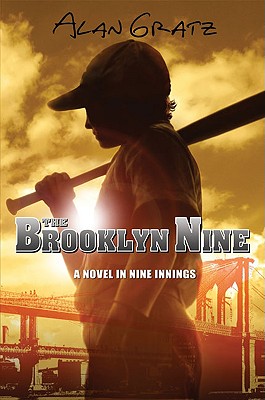
The Brooklyn Nine

by Alan Gratz
ages: 10+
First sentence: “Nine months ago, Felix Schneider was the fastest boy in Bremen, Germany.”
Support your local independent bookstore: buy it there!

This book is one of the more unique ones I’ve read recently. It’s not that it’s tackling something different or controversial. Rather, it’s quite the opposite: it’s a sweeping portrait of a family, a game, a nation. Quiet in its execution, yet grand in its ambition, Gratz pulls off something I didn’t think was possible: this book is a slice of Americana through and through.

The format is clever, too: it’s a series of short stories, told in nine “innings”, that travel through the years. Beginning in 1845, with a German immigrant, Felix Schneider, and going until present, the stories offer up a picture of how baseball — and America — has evolved over the last 160 years. Gratz touches on all the major highlights of Americana: there’s a Civil War soldier, Vaudeville, gangsters, racism and the Negro League, the All-American Girls Baseball league, and the Cold War. As in the case of all short story collections, some of the stories work better than others: in my case, the further back in time, the better the story; the final two more modern stories felt a bit cliched to me. But, even with its unevenness, it’s a fabulous undertaking. This is probably sounding like a sports book, and in some ways it is — I think there are many baseball-minded boys out there who would love the book — but, it’s so grounded in history and in family that baseball becomes more a character in the story than just a game that people played. That, and the stories — and especially the authors notes in the back, which I flipped to and read after every chapter — make the game itself sound quite fascinating.

At one point, I thought that it would have been nice to read these stories backward, beginning with the present day, and working back to 1840s. But, that’s just me being particular. This book really is a wonderful little story.

(Just for the record: because this is a Cybils nominee, I’ve been asked to make sure y’all know this is my opinion only, and not that of the panel.)