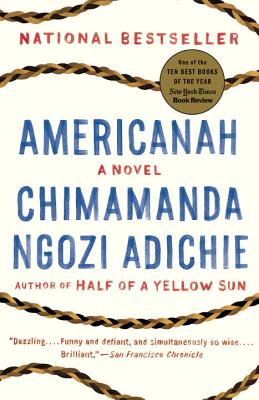
Americanah

by Chimamanda Ngozi Adichie
First sentence: “Princeton, in the summer, smelled of nothing, and although Ifemelu liked the tranquil greenness of the many trees, the clean streets and stately homes, the delicately overpriced shops, and the quiet, abiding air of earned grace, it was this, the lack of smell, that most appealed to her, perhaps because the other American cities she knew well had all smelled distinctly.”
Support your local independent bookstore: buy it there!
Content: There is some on-screen sex, including a rape scene, as well as swearing, including f-bombs. It’s in the adult fiction section of the bookstore.

It’s hard to know where to start on the plot of this one. It’s basically the story of two Nigerians — Ifemelu and Obinze — who met in high school and fell in love, and their distinct paths. They attended college together, but in a political uprising in Nigeria, their education got interrupted. Ifemelu — whose aunt had moved to America years before — got into a college in the US and went there. Obinze was denied a visa to the US and so ended up as an illegal immigrant in the UK. Most of the book is about their experiences — told in flashback, mostly — as immigrants in Western countries.

That part of the book was fascinating, though I found Ifemelu’s story more interesting. Obinze only spent a few years in the UK, working underground, trying to become legal, before he was caught and deported back to Nigeria, where he actually ended up becoming very wealthy. Ifemelu spent a long time in the US — 15 years — and had a myriad of experiences from the terrible to the banal to the good. She ended up writing a blog about being a non-American Black in the US and about race relations. All of which I found a fascinating perspective. Ifemelu had some interesting observations about race in the US and the role immigrants — especially Black immigrants — play in the discussion about race.

In the end, though, this is a story about relationships, how they work and change over time. Not just romantic ones, though it is that, but all interpersonal relationships. There is an ebb and flow to relationships, people who come in and go out of our lives, and I think Adichie captured that quite eloquently. In fact, Adichie is a gorgeous writer, balancing beautiful words with characterization and enough plot to keep me turning pages.

Recommended.

Audiobook: Wandering in Strange Lands

by Morgan Jerkins
Read by the author
Support your local independent bookstore: buy it there!
Or listen at Libro.fm
Release date: August 4, 2020
Content: There is some swearing including a few f-bombs and the use of the n-word. It will be in the biography section of the bookstore.

Morgan Jerkins is a writer, but she’s also the daughter of a New Jersey woman and a North Carolina man. The central question she grapples with in this book is this: how has moving away from her families’ roots in the South (after slavery, but mostly during the Great Migration) affected their connection to the land, to their communities, and to each other? She explores this question by visiting South Carolina and talking with and trying to understand the histories of the Gullah people there. She heads to Louisiana to talk to Creole, and to Oklahoma to explore connections between African American freed slaves and the Cherokee nation. And she finally heads to Los Angeles. Through all this, she unearths her family history and stories, as much as she can, and that it was White Supremacy and Institutional Racism that was the driving force for much of what her ancestors experienced.

A friend once told me that you can talk statistics and data at people, but it’s the stories that really matter. And this book brings that home. Yes, I knew there was (and is) Institutional Racism and white people were (and are) discriminatory and prejudiced against black people to the point that they want to push them out. But, hearing Jerkins’ stories gets that point home in a way data just doesn’t do. It also reminded me of the importance of knowing where you’re from and knowing your family’s stories. (I have been very bad about passing this on to my children.)

It’s an interesting story, and Jerkins is an interesting narrator to guide the story along its path. I’m glad I read it.

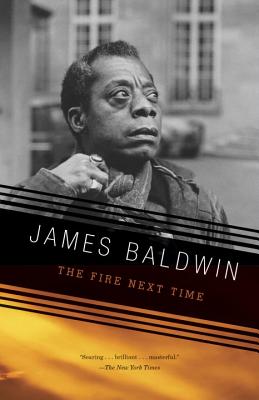
The Fire Next Time

by James Baldwin
First sentence: “Dear James: I have begun this letter five times and torn it up five times.”
Support your local independent bookstore: buy it there!
Content: There is some mild swearing and use of the n-word. It’s in the sociology section of the bookstore.

This is two essays — or one essay and a letter to Baldwin’s nephew — on the state of being Black in America. In 1962. Short version: It wasn’t easy. And it’s a sign of my privilege that I am just now realizing two things: 1) that life for a Black person in the early 1960s was not an easy or enjoyable one and 2) that it’s not changed very much for very many people in nearly 60 years. That’s the thing that stood out to me most about this book: it’s still relevant. And it shouldn’t be. This book should never have had to be written. This book shouldn’t have to be still relevant. And yet, it was and is. And it’s a sign that I am a privileged person that I am just NOW realizing this.

I think I enjoyed this more than If Beale Street Could Talk, because I think Baldwin’s style is more suited to essays and rumination than fiction. He has a very thoughtful, lyrical prose style which I thought suited both the impassioned letter to his nephew (which brought to mind Between the World and Me) and his essay about his youth and experiences with the Nation of Islam.

It’s definitely an excellent book.

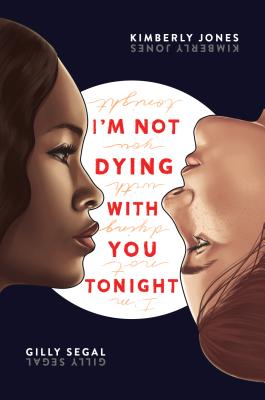
I’m Not Dying with You Tonight

by Kimberly Jones and Gilly Segal
First sentence: “‘Waiting for Black is on your agenda, not mine,’ LaShunda barks as we leave the building.”
Support your local independent bookstore: buy it there!
Review copy provided by the publisher.
Content: There is violence, some swearing and the use of the n-word. It’s in the Teen (grades 9+) section of the bookstore, but I would give it to a 7th/8th grader as well.

All Lena wants to do is hookup with her boyfriend Black after halftime at the football game. All Campbell wants to do is sell concessions and get the heck out of there. But when a fight breaks out at the game, Lena and Campbell are thrown together. And when the fight escalates and turns into a protest which escalates and turns into riots, Lena and Campbell are forced to rely on each other to survive the night.

The book this most reminded me of is All American Boys: two kids — one white and one black — thrown together have to figure out how to relate to each other. So, yeah, this has been done before. That said, one of the things I thought Johnson and Segal did well was show how introducing the police actually made things worse. The fight started at the school, police were called, and it escalated. A protest was happening, police came in full riot gear and the situation escalated. Additionally, I thought that Lena and Campbell’s personal unpacking of biases (more on Campbell’s part, which is a good thing) was a valuable thing.

That said, there are books that do this better. Like All American Boys. Or The Hate U Give. Or Riot Baby.

It’s a valuable book, one that I do hope people (probably mostly white people, who I think this book was aimed at) will read. But, it’s not the best one out there.

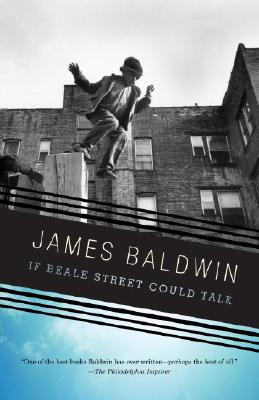
If Beale Street Could Talk

by James Baldwin
First sentence: “I look at myself in the mirror.”
Support your local independent bookstore: buy it there!
Content: There is some swearing, including multiple f-bombs. It’s in the fiction sections of the bookstore.

This is the story of Tish and Fonny, a young Black couple who are looking forward to a life together. Until Fonny is falsely arrested and imprisoned for rape. But Tish, pregnant with Fonny’s baby, and her family and Fonny’s father, are determined to get him out.

It’s a pretty basic plot when you sketch it out, but Baldwin is more about the words and the feel than the plot. He’s a very lyrical writer, which sometimes (for me) got in the way of the characters and the story, but mostly just enhanced it. I do love the way he characterizes the people in the book, fleshing them out so they feel whole. It did feel dated with some of the language, but that’s to be expected for a book written in 1973. But, the themes — of white supremacy and systemic racism in the police force — are still relevant.

I read this for a book group discussion (which I missed… boo on me!) and I’m sad I missed the discussion; there is much to talk about here. At any rate, I’m glad I missed it.

Audio book: Me and White Supremacy

by Layla Saad
Read by the author
Support your local independent bookstore: buy it there!
Or listen at Libro.fm
Content: There is some mild swearing. It is in the Self-Help section (I think?) of the bookstore.

I am going to say this up front: I read this book wrong. It was meant to be an interactive 28-day journey with journaling and extensive deep reflection. However, that just doesn’t work (for me) in audio format. I listen in the car or doing a puzzle, and it’s just not conducive to a lot of serious reflection. So. I am going to purchase this book (when it’s reprinted; it’s on backorder now) and do the actual work.

Some thoughts though:

This book, by a Black woman, centers on how white people are privileged by the system we live in. Saad asks some tough questions, explains some tough concepts (like white privilege and white fragility), and encourages readers to do the work to become anti-racist and more inclusive. She also asks about concrete commitments we (white people!) can make in order to continue the lifelong pursuit of becoming anti-racist. It’s a challenging book to read, if only because she (very calmly and eloquently) challenges the very fabric of the society white people are used to.

And for that, it’s very much worth reading.

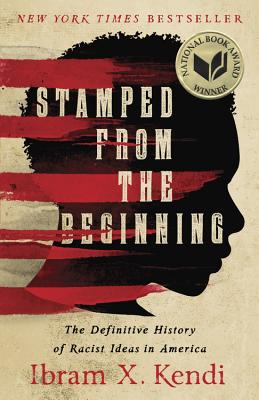
Stamped From the Beginning

by Ibram X. Kendi
First sentence: “Every historian writes in — and is impacted by — a precise historical moment.”
Support your local independent bookstore: buy it there!
Content: There is some swearing, including a few instances of the f-bomb and many of the n-word. It’s in the history section of the bookstore.

I picked this one up after listening to Stamped, which is a remix for younger readers of this history. I didn’t know what to expigect, but what I got was a book that made me rethink my perceptions of race, race relations, and class, and rethink what I was taught in history classes.

The basic idea that Kendi sets out to demonstrate is this: racial discrimination leads to racist ideas which lead to ignorance and hate. It’s the reverse of everything I had been taught which is: ignorance and hate lead to racist ideas which lead to discrimination. It’s a lot to wrap a (racist) brain around at first, but over the course of the 500 pages, Kendi does an excellent job showing how, throughout history, racism starts with racist people being self-interested and creating racist policies. I learned a ton.

I don’t know if there are any solutions to be found in the book. Except for the conclusion that self-sacrifice (of Blacks) and uplift suasion (Black people being “more like White people”, which is a racist idea), and educational persuasion (if white people just had “all the facts” about racism they wouldn’t be racist) don’t work. It will take a concerted effort of White people and Black and Brown people to realize that it’s in the best interest of ALL people to do away with racist policies.

I don’t know what the political and economic solution for this is (except maybe tax the wealthy and refund all the social programs that have been axed over the years). But I do know that it is important for corporate media (!) and White people to stop generalizing and stereotyping Black people.

As for me, this book made me rethink ideas I’ve had in the past, rethink the way I interact with the media and politics, and perhaps made me a little more antiracist. I can only hope.

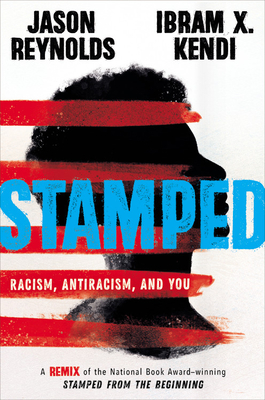
Audio book: Stamped: Racism, Anti-racism, and You

by Jason Reynolds and Ibram X. Kendi
Read by Jason Reynolds
Support your local independent bookstore: buy it there!
Or listen at Libro.fm
Content: There is frank talk of slavery and rape and they use the n-word a couple of times. It will be in the Middle Grade History section of the bookstore.

The publishers — and Reynolds himself — are calling this a “remix” of the National Book Award- winning Stamped, by Kendi, and a brilliant remix it is. Reynolds takes the ideas in Kendi’s book — which is a look at racism from the first recorded instance in the 14th century to the present day — and distills them down so that kids == it’s aimed at the 10 and up crowd — can easily grasp the ideas and the history.

And Reynolds makes it fun. It’s a “not history history book”, one where Reynolds talks about IDEAS and how they fit into the grander scope of history. It’s incredibly engaging to listen to (and read!) — Reynolds is a fabulous narrator — and it made me look at history in a new light. It’s an important book — I’ve checked the original out from the library because I’m interested in what Kendi’s research — especially in this day and age. It’s incredibly helpful as a white person to understand that racism is systemic and built into the framework of our society. And maybe by understanding that, we can all become a bit more aware.

Excellent and highly recommended.

They Called Us Enemy

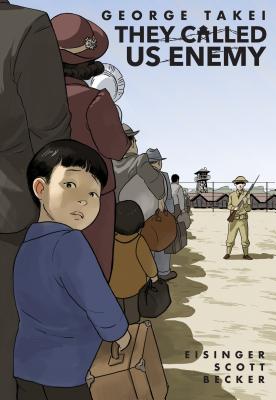
by George Takei, Justin Eisinger, Steven Scott and illustrated by Harmony Becker
Support your local independent bookstore: buy it there!
Content: There is violence, some swearing, and many racist actions. It’s in the graphic novel section of the bookstore.

Everyone knows George Takei as Sulu on Star Trek (and as a side note, Hubby and K and I are working our way through the original series on Netflix — a consolation prize for not paying for CBS all access so we can watch Picard — and are enjoying it immensely). And if you’ve followed Takei on social media at all, you know about his childhood in the Japanese internment camps during World War II. But, since not everyone knows about this (shameful) part of our past, and because his story is relevant today with the ICE camps in California and Texas, he decided to tell it as a graphic novel.

It’s a tough story, but an important one; Takei was about 4 or 5 when his family was shipped off to live in one of the camps in Arkansas. He admits that he doesn’t remember much, and that he is grateful his father was willing to talk about their time in the camps (many of those who were sent felt shame and didn’t talk about it). It reminded me of John Lewis’s March, in that this is framed by a TED talk, by Takei looking back at this time. It’s a mirror to white people, at how harsh and how exclusive and judgmental we can be. And what the government will do — to citizens! — in the name of national security. (War is just awful.) While I’m not entirely sure the storytelling was smooth and the art was good but not brilliant, but the story is important enough to make this one worth reading.

Black Brother, Black Brother

by Jewell Parker Rhodes
First sentence: “I wish I were invisible.”
Support your local independent bookstore: buy it there!
Release date: March 3, 2020
Review copy provided by the publisher.
Content: It’s pretty simply told, and easy enough (and appropriate) for younger readers to understand. It will be in the Middle Grade section (grades 3-5) of the bookstore.

Dante is the black brother in his family. His dad is white, his older brother Trey presents as white, but Donte and his mom present as black. Which wasn’t a problem until the family moved to a (mostly white) suburb of Boston and the boys started attending a (mostly white) prep school.

I’ll stop here and say this book is all about racism. Explicit racism from some of the students at the school — the story’s antagonist and school bully, Alan — but also the implicit racism in the system: Donte, because he is black, is the one who is always in trouble, who the teachers and the headmaster blame for things that go wrong. But it goes broader than that: Rhodes tackles the prison system — Donte is arrested for something he didn’t do at school, and the only reason he gets off is because he doesn’t present as stereo-typically black (and having a white father helped, too). And the overall racism inherent in sports.

It’s a simple book, but that makes sense, considering who its intended audience is. And Rhodes is a remarkable writer, able to simplify without dumbing down for her audience. It’s a good story, and one worth reading.