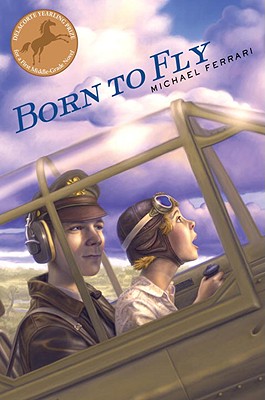
Born To Fly

by Michael Ferrari
ages: 9-12
First sentence: “Just ’cause I was a girl in 1941, don’t think I was some sissy.”
Support your local independent bookstore: buy it there!

Eleven-year-old Bird McGill has always wanted to fly, particularly the P-40 fighter plane. It’s something she and her dad have worked towards ever since she was old enough to reach the pedals. The fact that she’s a girl — and girls in 1941 weren’t supposed to be interested in flying airplanes — never seemed to matter to either her, or her father.

Then, the Japanese bomb Pearl Harbor, and Bird’s life changes. Her father gets shipped away to fight in the war, and a new kid — Kenji — comes to town. He’s Japanese, in Rhode Island to live with an uncle because of the forced internment his family in California is facing. He’s resentful, and — interestingly, realistically — faces much of the same resentment and racism that he’d faced in California.

Both being outcasts, Bird and Kenji form a tentative friendship, which is strained and tested when they inadvertently witness both the murder of a local draft dodger and the sabotage of a engine factory. Kenji’s uncle is framed for both, and found guilty. And it’s up to Bird to set things right.

It’s partly a mystery, partly an adventure story, partly a tale of friendship and ignoring expectations. It tries to do a bit too much, and is a bit over-the-top, but Ferrari succeeded admirably on one account: it’s a story with not only a strong female character, but a middle grade one who makes things happen. Sure, it’s unbelievable that she would actually get to fly a P-40 plane, but by the end, who cares? Bird is awesome. Bird makes things happen. Bird — in spite of, or perhaps because of, her faults, and insecurities — rocks. She’s inspiring.

In addition to a strong heroine, Ferrari unflinchingly tackles things like class and race and patriotism and makes it work in the context of the plot. Kenji is not just a cardboard 1940s Japanese character; he’s got hopes and dreams and frustrations, all of which are quite palpable. Enough so that you cringe when people call him the “Jap” and tell him to go back where he came from. Enough so, that you want Bird to rescue him, to beat down the bad guys, to show up everyone in town.

Again, it’s probably a bit heavy-handed to put so much in one book (I, personally, would have liked it if there was a bit less, and it did come off as a bit moralistic by the end), but overall, it works, and works well.

(Just for the record: because this is a Cybils nominee, I’ve been asked to make sure y’all know this is my opinion only, and not that of the panel.)
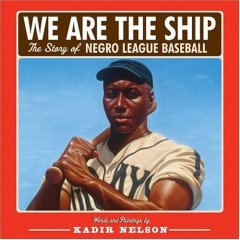
We Are the Ship

The Story of Negro League Baseball
by Kadir Nelson
ages: 8-12
First sentence: “Seems like we’ve been playing baseball for a mighty long time.”

I am not a baseball fan. I did not grow up in a baseball house (which is odd, since my dad played ball when he was a teen). Football and basketball were our sports of choice, with tennis and the Olympics following close behind. That said, I think I’m American enough to appreciate baseball, even if I hardly ever watch it. (I did pick up two things about baseball, though: 1) it’s better in person than on TV and 2) the minors are more entertaining to watch than the majors.)

Given that, I really wasn’t interested in reading a book about the Negro Baseball League. I knew about it, sure (I did watch a bit of the Ken Burns’ documentary, after all), but it didn’t really register on my list of things to read about. Then the Battle of the Books came along and, We Are the Ship won its match, taking down a book that I really enjoyed reading. Well, I thought, there must be something to this book.

And there is something to this book. First of all, it’s a lot more detailed than I expected it to be. From it’s size, and the cover, I figured it was a picture book. I was wrong. It’s a detailed history of the Negro League that just happens to have amazing (really, really amazing) photographs. I liked the layout of the book — because it’s so large, the illustrations become not just an accessory, but an integral part of the book — and that the chapters were titled “innings”. And then there’s the narrator. As judge Rachel Cohn said, the narrator has a folksy charm to it, so much that you can imagine the person telling the story.

And what a story. It narrates the story of the Negro Leagues from its inception through to when Jackie Robinson made the crossover into the minor leagues. It touches on the determination of the men to play the game, and play a good game, in spite of the segregation and racism they encountered. Nelson spares no punches: he tells the good along with the bad. And, in the end, I was left with nothing but admiration for the men who wanted to play a game, and found a way to do so.

Abby pointed out that Nelson left out the women who played for the Negro Leagues (something that I didn’t know until she pointed it out), but I’m not sure that detracted from the charm that this book had. At any rate, maybe Nelson will be inspired to write another book on the women who played ball.

I know I’ll definitely read it.

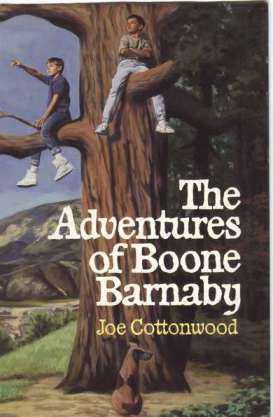
The Adventures of Boone Barnaby

by Joe Cottonwood
ages: 9+
First sentence: “I live in San Puerco, California.”

I picked up this book because the author was so kind to email me, praising my blog (and my “shoot-from-the-hip style” — my immediate was: “Okay? Not something I would think of myself…”) and announcing that he’s re-released his title as a podcast. Here’s what he wrote:

I’ve just re-released my novel Boone Barnaby. What’s new is that this time, it’s a podcast. Scholastic in 1990 published The Adventures of Boone Barnaby as a middle grade novel (for a podcast, I had to shorten the title so it would show up on tiny ipod screens).

Maybe I’m breaking new ground here. Does a podcast qualify for a review? (And if not, shouldn’t we catch up with what kids already accept as normal?) It’s a way to engage kids, especially boys, in a literary story. No vampires, no superheroes. I was going to bring out a new print edition, too, but as long as Amazon is selling old copies for a penny, I can’t compete – and there are probably ten thousand copies still out there in garage sale land. Meanwhile, I’ve made it available as a PDF for a free download.

There’s no money in this for me. The podcast is free (dowloadable from iTunes), the PDF is free (from my website), even the one-penny copies on Amazon earn me no royalties. I’m just reviving a good book – and enjoying the new world of podcasting.

We went back and forth a bit about podcasts… here’s where I confess that we’re a (teeny) bit behind the times around here: when I asked M if she would listen to a podcast of this book, she asked, “What’s a podcast?” Obviously, that wouldn’t work. We don’t have iPods, and as I have mentioned before, listening to a book (if it’s outside of a car during a long drive) just doesn’t work with my lifestyle. So, the compromise I came to was read the book (my library is awesome) and review it, and mention that you can get it as a podcast. (I’ve already done that part.)

It’s a very good book. Boone is a 12ish (I’m not sure if we ever got his age; if we did, it’s not sticking in my brain) kid, living in a small town in California (northern, I guess, because of references to Redwoods). He’s a pretty low-key kid, not really great but not bad either. Then one fall, everything seems to change (it’s called the “Banana Effect”: bad — or good — things always come in bunches). Some of it’s for the better: Babcock moves in, the town’s pathetic soccer team begins winning games, Boone outsmarts the local miser in the Trashathon: an event to raise money for the soccer team to go to Australia for a tournament. But some of it’s for the worse: Boone’s father is arrested on suspicion for arson (the pub is burned down, and his father just happens to have been walking around late at night with a can of gasoline), his friend Danny’s family is going to be evicted, and he has a run-in with the town’s homeless man, Damon Goodey. Sure, everything works out in the end, but it’s not the end that matters in this book, but rather the journey. It’s a coming of age story, where Boone realizes that growing up doesn’t hold all the answers as well as figuring out a few of his own rules. Not to mention how he fits into the grander (well, maybe not grander, but at least larger) scheme of things. It’s a straightforward story; Cottonwood doesn’t write down to his readers, instead just laying out the “facts” and letting the story, and characters, speak for themselves. And although there’s some thoughtful themes in it (segregation, racism, drug use — in the parents’ past — and honesty, among others), it doesn’t harp on them, or beat them into the reader.

So. Find the book (buy it for a penny plus shipping at Amazon!), or download it on your iPod (because I’m assuming that most of you have one…). It really is worth the time.

A Thousand Never Evers

by Shana Burg
ages 12+

Over the years, when I have told people that the year we lived in Mississippi was hell for me, they always ask me what made it so hard. I have struggled to try and find the perfect answer… it’s a combination of moving from a huge city to a smallish rural town combined with the blatant racism of our neighbors that we encountered that made it the worst place on earth for me to live.

Now, when people ask, I’m just going to refer them to this book. Burg — no stranger to the situation, being both Jewish and the daughter of a Civil Rights lawyer — captured, for me at least, the hate that some white people down south had (and have) for African Americans so perfectly that it was both uncanny and disturbing.

It’s the summer of 1963, and Addie Ann just wants to figure out how to survive seventh grade. Then her boss, Old Man Adams, dies, and leaves his six acre garden to all of Kuckachoo — both whites and blacks. Of course, that doesn’t sit well with the mayor or the sheriff, so they conveniently forget to inform the white side of town that Mr. Adams wanted it that way. So, later in the fall, when the garden is discovered to be destroyed, the person that the town decides is at fault is Addie’s Uncle Bump. Being Mississippi, no one expects the trial to come out right, and it’s up to Addie to find the missing pieces in order to set Uncle Bump free.

Actually, this book isn’t that easy to sum up in one paragraph: there’s an awful lot going on. A lot of it centers on the basic conflict between white and black: in employment, in housing, in voter registration, in the administration of justice. Everything negative you’ve ever heard of makes an appearance: the Klu Klux Klan, cross burnings, home bombings. But, I think Addie’s narration has a softening influence — she’s an engaging main character, one who’s vulnerable and tough at the same time. Her voice makes this book worth getting through; without her, it would be too depressing.

It was a very tough book for me to get through at points. But, I think it’s the toughness that comes from a well-written, and honest, book.

(Just for the record: because this is a Cybils nominee, I’ve been asked to make sure y’all know this is my opinion only, and not that of the panel.)