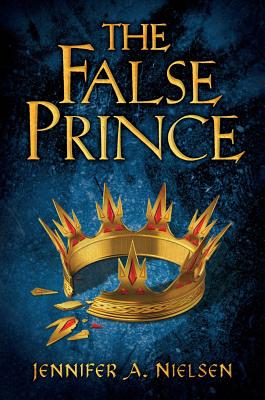
The False Prince

by Jennifer A. Nielsen
ages: 10+
First sentence: “If I had to do it all over again, I would not have chosen this life.”
Support your local independent bookstore: buy it there!

Sage is a 15-year-old orphan in a small Carthyan city. He’s got a reputation for mischievousness, not to mention pickpocketing and general thievery, but generally he tries to fly under the radar.

That is until a minor noble, Bevin Conner, plucks him (along with three other boys) out of the mire and decides that one of them will be the one to put his Grand Plan in motion.

What is that Grand Plan, you say? Well, it turns out that someone has murdered the entire royal family, except for the prince — Jaron — who was killed by pirates four years before. What Conner wants to do is train these boys up and the put one of them on the throne as the False Prince: a puppet to fool the regency just long enough for Conner to be named the grand regent, and essentially take over.

Mwahahahaha.

I felt like doing that a lot while reading the book. It needed a good evil laugh to accompany all of Conner’s posturing. And he postured a LOT. Not that I didn’t enjoy the book well enough; there was much that I found enjoyable. Sage was a good thief/rogue-with-a-heart-of-gold character, one who was both winning and interesting. The plot was an interesting idea, rife with politics, murder, backstabbing, and a wee bit of romance (but not enough to turn off the romance-shy boys.)

The problem is that it’s all been done before, and better. See, it’s a similar plot to Megan Whalen Turner’s The Thief, who did it all richer, grander, and, well, better. Sage is no Gen, and Nielsen doesn’t handle the twists and turns the plot demands nearly as elegantly as Turner does. That said, I think this will be an issue for only MWT fans, because on the surface False Prince is a lot of fun. There’s enough adventure, and the twist really is delightful (if you don’t see it coming), and there’s some nice retribution in the end. In addition, Nielsen wraps up this story quite well, while leaving things open for the sure-to-come sequels. (Which is always the best way to do a series, in my humble opinion.)

Bottom line: if you haven’t read The Thief (or didn’t like it all that much — I’m thinking of C here; she tried and just didn’t like it), then this one will be new and surprising and exciting.

(Just for the record: because this is a Cybils nominee, I’ve been asked to make sure y’all know this is my opinion only, and not that of the panel.) 

Remarkable

by Lizzie K. Foley
ages: 9+
First sentence: “High on the top of a majestic mountain, in a spot where every view of the valley below was more breathtaking than the next, was a small town called Remarkable.”
Support your local independent bookstore: buy it there!
Review copy provided by the publisher.

I have to admit up front that any book with the title “Remarkable” has the decks stacked up against it. Because to be remarkable, you have to be so much better than good, you have to be, well… remarkable.

And so it helps that this one, at least in my opinion, is using the word somewhat ironically. See, in a town full of remarkably talented, amazing, wondrous people, ten-year-old Jane Doe is just average. Plain, not especially talented in anything, she goes through life in the shadow of her remarkably talented architect mother, best-seller novelist father, supremely talented painter (of photorealistic portraits) brother, and math genius sister. That’s not even mentioning her grandmother, the mayor. The only person in town who even comes close to Jane in plainness is her grandpa, who people generally seem to forget is there.

From that premise, however, things get both really weird and yet never quite develop in ways that I wanted them to. There’s something about a bell tower and pirates and the sea monster in the lake and a jam feud with the next town and evil genius twins, but it all kind of just seemed like it was a hamster on a wheel: spinning in circles, but never really going anywhere.

I wanted it to be more ironic, more of a parody (it was, to an extent, but not far enough for my tastes), but most of all, I wanted Jane to do something. I wanted her to be a hero, to discover that she was remarkable, in some little way. (You know have the reverse happen: since everyone is remarkable, only those who aren’t labeled as such really are?) Or maybe for everyone else in the town to discover that being remarkable was overrated, and stop discriminating against unremarkable people. But, it just kind of petered out by the end, which I found disappointing.

That said, C really enjoyed reading this one, so maybe it’s a case of me not being the right audience for the book. Which is not really remarkable at all.

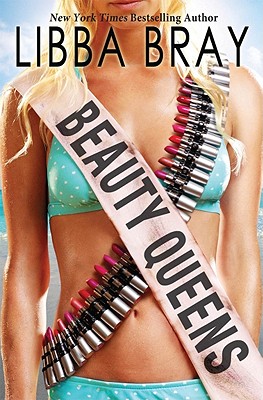
Beauty Queens

by Libba Bray
ages: 15+
First sentence: “This book begins with a plane crash.”
Support your local independent bookstore: buy it there!

I have come to the conclusion that Libba Bray is brilliant, but completely insane. (Or maybe brilliantly insane?)

Ever wonder what you’d get if you mixed Lord of the Flies with the Miss America pageant, tossed in some James Bond, and slathered with a huge helping of satire on pop culture? Me, either. But, thankfully, blessedly, Libba Bray did, and Beauty Queens is the result.

The top 20 girls for the Miss Teen Dream pageant were all on a plane, headed toward the pageant finals when the plane crashes. On a deserted island. Killing everyone, except a handful of girls. What are they — girls who are beauty queens, presumably without any practical resources — to do?

Well… survive.

From here, the plot goes all twisty and turney: the girls make their own camp on the beach, and manage to not only get along (mostly), but thrive on their own merits as they wait to be rescued. However, things are not as pretty as they seem: there’s weird stuff lurking in them thar jungle, and those who go into it don’t always come out. And if they do, they’re not quite sane. There’s also pirates (!), stupid trust fund guys, completely wacked out dictators, and vengeful past beauty queens. This book has it all.

On the surface, the book is terribly shallow and stereotypical. Bray has lumped every single cultural reference and stereotype she could think of in this book: there is a lesbian, transgender, bisexual, stupid Southerner, aggressive Texan, Indian-American, black contestant. (Sure, why not one of each?) There’s a grand poking at everyone naming their kids Caitlin. Honestly: none of the characters are likeable (Miss Texas, I wanted to throttle! And Miss Mississippi just lived up to the low expectations I have of that state.), and the plot was fairly simplistic, which almost made it hard to get through (however, the hilarious footnotes made up for that).

But, when you read it as a satire, the book works brilliantly. In one of the more brilliant moves, there are commercial breaks in the book, in which Bray lampoons every single kind of beauty product, movie, and item that corporations try to sell to women. In the end, the book is not about the characters, or plot development, it’s about girl power: rising above the stereotypes and the product placement, and not only finding one’s true self, but acting on that, embracing the differences we have as women. (And no one is better than the other.)

In fact, I think this would be a blast to deconstruct in a book group or English class; there’s so much meat under the shallow surface, that the discussion could be quite fascinating.

And I’m sure she wrote it that way on purpose.

The Ship of Lost Souls

by Rachelle Delaney
ages: 9+
First sentence: “‘You there!'”
Review copy provided by the publisher.
Support your local independent bookstore, buy it there!

Think of a book that’s one part Treasure Island, one part Pirates of the Caribbean, one part Peter Pan, and you’ve pretty much got an idea of the feel of this book.

Scarlet McCray is the captain of the Margaret’s Hop (the e fell off years ago), a ship haven for lost or abandoned children. Their ship is surrounded and protected with a ghost-ship legend that Scarlet and her crew of 8 to 13 year olds use to their full advantage. They pillage, they raid, they essentially have a grand time out from under the thumb of obnoxious adults.

Jem Fitzgerald, the nephew of a moderately famous botanist, is in the area with siad uncle in search of a treasure. There’s a legend that’s been floating around for years of an island that has a treasure that will bring one who finds it peace. And Jem’s uncle knows where it is. (There’s a map and everything.)

Except Jem and his uncle are kidnapped by dread pirates, who then kill Jem’s uncle. Enter Scarlet and the Lost Souls: they rescue Jem, make him a part of their crew, and go on search for the treasure. There’s growing up, adventures, revelations, and a mutiny attempt in the process of looking for the treasure.

It’s a great world that Delaney has created — safe and predictable, yet with a sense of adventure on the side; realistic, with just the right touch of whimsy. It’s a fun little book.

(Just for the record: because this is a Cybils nominee, I’ve been asked to make sure y’all know this is my opinion only, and not that of the panel.)

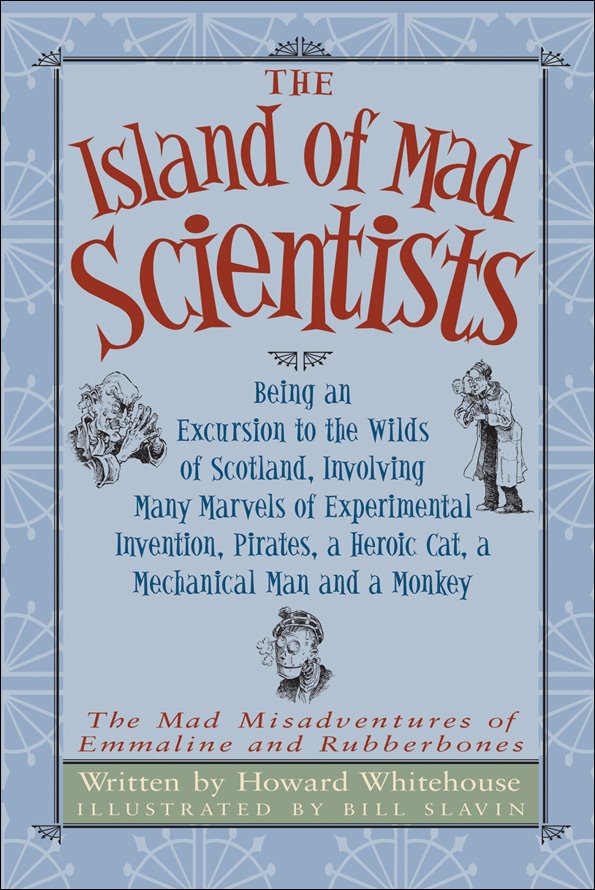
The Island of Mad Scientists

At first glance, this book looks like it’s another one of what I’m calling “The Precocious Kids on an Adventure” books that seem to be all over the place. However, while there are precocious kids (budding scientists, though there is no riddle solving), and adventure, this book is most definately not one of those books.

It’s actually the third in a series that Howard Whitehouse has written. I haven’t ever even heard of the other two, and thankfully (I’m becoming really grateful for this!) it stands on it’s own quite excellently. The plot’s a bit all over the plae, but the fundamentals are: there’s a Collector who collects scientists and wants a boy, Rab, and a girl, Emmaline (who are the budding scientists) to add to his collection. So, he sets thugs after them. In addition, there’s a princess, Purnah, who having escaped (in an earlier book) from an Evil Boarding School, is being pursued by the Authorities in order to put her back where she belongs. So, there’s thugs (and cops) following her. So (of course), they decide to vacation (it’s the middle of November) on an island, called Urgghh (“which means ‘cold and nasty’ in the Scots Gaelic tongue”), off the coast of Scotland, where a colony of Mad Scientists reside.

Clear as mud?

It really doesn’t matter, though, because this book is a grand romp. Hilarious, milk-snorting-through-nose funny, I can’t remember when I’ve had so much fun reading. It’s full of grand asides, amusing language, silly situations… everything a comic novel should have. It practically begs to be read out loud (I’ve already informed C that we’re going to; I can’t wait to do Purnah’s voice!), and thoroughly enjoyed by all, even if one doesn’t get the references to Verne, Stoker, Wells, late-18th-century science and Wodehouse (all of which the author helpfully explains in the note at the end).

Just brilliant. If I do say so myself.

Note #1: Thanks, Betsy, for your short Goodreads review; it gave me the push I needed to read it.

Note #2: Just for the record: because this is a Cybils nominee, I’ve been asked to make sure y’all know this is my opinion only, and not that of the panel.

Bloody Jack

Leila mentioned this book on her blog a while ago, and I stuck it on my list. But, honestly, I completely forgot about it. Then, I was wandering the aisles, looking for books for M, and it jumped out at me. (It was only later that I realized it was one that Leila had recommended…) She loved it, and passed it my way with a “You HAVE to read this!” So, taking a break from middle grade books, I did.

Jacky Faber was orphaned at an early age and grew up with the rest of the orphan scrabble on the streets of 18th-century London. One day, however, when Jacky’s gang leader, Charlie, was brutally murdered, Jacky decides to make a career change. Hiking down the Thames to the sea, Jacky enlists in His Royal Majesty’s Navy, becoming a ship’s boy. The hitch (and you probably figured this one out): Jacky is a girl. She not only has to deal with not being detected, but she — in an incredibly hilarious twist — ends up going through puberty while on the ship, which only complicates things. She does make a bit of a name for herself, battling against pirates, and ends up stranded on an island (but doesn’t get there the usual way), and falls in love. In short, she’s quite busy.

As far as seafaring/piratey/girls-masquerading-as-boys books go, this one’s a winner. A rip-roaring adventure book, it’s not for the faint of heart (boasting battles, fights, an almost-rape-scene, among other things). But it is: humorous, witty, exciting, thrilling… and has something for just about everyone. And, M’s right: you HAVE to read this. (Well, you don’t have to, but you won’t be sorry if you did.)

The Royal Road to Romance

I decided a while ago to abandon my original list for The Armchair Challenge. After reading, and loving, The Embarrassment of Mangoes, I knew there was no returning. So, I hunted for the suggestions that my friend, Amira, gave in the comments of one of my other posts. No luck; I guess my library just isn’t as versed in Central Asia as hers is. But, they did have my Nook friend Cami’s suggestion (well, actually Cami’s mother’s): Richard Halliburton’s The Royal Road to Romance. And I’m so glad I picked it up.

I’ve gotten into BBC’s Jeeves and Wooster (based on the P.G. Wodehouse books, which I really must read). I’ve not only enjoyed the silly (very silly!) story lines, but I’ve loved the whole 1920s aura; the dress, the attitude, the language. So, what does Bertie Wooster have to do with The Royal Road? Well, imagine Bertie as an American tramping about the world, and you’ve basically got the feel of the book. It’s really a whole lotta 1920s fun.

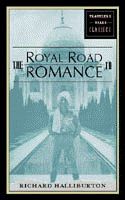
First, a couple of laments: I lamented the lack of a map. I had an idea where many of the places were, but there were several stops I had no clue about. I wanted to know where Andorra was, and whether or not it was still a country. Same with Ladakh. I wanted to know where in India all these cities he popped in and out of were. There was a map in the original publication; Halliburton made reference to it. But, my edition lacked one and there were times when I really missed it. But the greater lament was the lack of photographs. Halliburton’s tromping all over the world with his trusty camera (even getting thrown in jail for taking pictures in Gibraltar) and the only evidence we have is the cover photo of him in front of the Taj Mahal. So sad.

My laments aside — and they really are paltry — I thoroughly enjoyed seeing the world through Halliburton’s eyes. The world was so different then; Halliburton literally bummed around the world, hitching rides on steamers, stealing trips on trains (avoiding train conductors was a common pastime of his: “All day long, it was necessary to fight off collectors, as the news of my default spread by telegram up and down the line. Not only conductors were on hand to hound me, but inspectors, police and station-masters. I was diving out of windows, changing compartments and haggling from morning till night. One particularly obnoxious collector would have pushed me bodily off the train had I not pushed him off first.”), biking, walking… things that very few people these days would even think of doing. Sure, he comes from a certain class of people — for who else, when graduating from college, would shun a career for 600 days of “horizon chasing” — and that affects his view on the world. But, there’s also the fact that so much of the British Empire was still intact, so there was a feeling of compatriotism from the ex-pats he met, people who were more-than-willing to help him on his adventures.

And what adventures he had! He climbed the Matterhorn, without any previous climbing experience (and was mildly disgusted at his friend Irvine’s response: “At last,” he continued in a far-away voice, “after talking about it and dreaming about it all these years, at last, I can actually SPIT A MILE!”). He met the president of Andorra, and bummed around Spain with a fellow American (an architect student; the funniest part was their “contest” in Seville where they tried to get as many girls as they could to smile/flirt with them). He went south to Gibraltar, snuck (sneaked?) into the fort at night, and then got jailed for taking pictures a couple of days later. (I liked this quote: “That same afternoon we approached the Bay of Algeciras, and there before me, rising abruptly across the water, I saw the majestic Rock, entirely devoid, to my great disappointment, of the Prudential Life Insurance advertisement I had always seen emblazoned upon it in picture.” Hubby said, “Wow. Even back then.”) He got out by sheer pluck, and with a fine of 10 pounds, which he did not have, but the guards (for whatever reason; because Halliburton was plucky?) and friends paid the fine for him.

From Gibraltar, he headed to Monte Carlo, where he and another American, Pauline, lost $200 gambling. I really liked this passage:

Finding diamonds very boring, we sat on a bench in the Casino Gardens overlooking the sea, and there surrounded by great banks of flowers we finished our inadequate box of candy, realizing how much better it was to drown our desolation in this form of narcotic than to do the commonplace thing of shooting bullets into our skulls.

And then on to Egypt, where he spent the night on top of one of the pyramids, Kheops, and got caught naked in the Nile (that was a funny adventure!). He decided instead of heading to Greece, that he’d go on to India, spent the night in the Taj Mahal (yes, he snuck — sneaked — in there, too), and bummed around various other places. He climbed the Kyber Pass, visited Kashmir, and was one of only 12 whites to see Ladakh that year. From there, he decided to continue east:

[I] turned my attention to maps, upon which I saw that in my aimless peregrinations I had wandered half-way round the world. It was now as near home eastward as westward so I resolved to return to America via Japan, despite the fact that this move would make me eligible for the dreadful epithet “globe-trotter”.

He saw a cremation festival in Bali, partied in Hong Kong, got robbed by pirates off of Macao, met Russian exiles in Harbin, Bolsheviks in Vladivostok and then managed to secure passage across to Japan (as an “official” mail courier) and climbed Mt. Fuji (in January, in the ice and snow, taking the first-ever picture of the crater in the snowy season) before working his way back home.

It really is a grand adventure, a royal road to romance. And one that’s really worth the time to read. I’ll end with my favorite quote of the book, from after the pirate incident:

As our little ship moved painfully toward her dock I was standing on deck in my shirt-sleeves beside the unfortunate American tourist who had lost most of his two hundred dollars.
“Lord, I’m hungry!” he growled at me.
“Oh, everybody’s hungry,” I replied unsympathetically. “But it’s worth it having such a jolly adventure. “
“Jolly adventure!” he gasped.
“Why, of course. I’ve never had such a good time.”
“Idiot!” he burst out.
“Fossil!” I retorted.

A True and Faithful Narrative

I have a much higher opinion of this book, by Katherine Sturtevant, than I did of it’s prequel. For me, this story was much more interesting, Meg was a much more sympathetic character, the ending had a much better payoff. In short, I thought it was a much more enjoyable book.

Meg’s now 16, so it takes place a few years after At the Sign of the Star ends. She still works in her father’s bookshop, but now everyone’s pressuring her to marry (being the mid 1600s and all). She doesn’t want to, so when Edward (her friend Anne’s brother) comes in before he leaves for Italy on an apprenticeship, and essentially proposes to her, she doesn’t respond well. In fact, when he asks if he could bring her anything, she says, “Why, nothing, unless — yes, I so wish we had a narrative to rival Okeley’s that we might sell at the sign of the Star. Can you not manage to be captured by pirates, and enslaved in North Africa?”

Ouch.

So, when it happens that Edward does get captured by pirates and sold into slavery in North Africa, Meg feels, well, guilty. She still doesn’t want to marry him — in fact she’s smitten with her father’s apprentice, Will Barlow — but she does her best working to raise the ransom money to bring him home. Eventually, they succeed, and Edward comes back.

And from there, I’m going to leave you in the dark. I think it’s best not knowing what happens (I didn’t, and I think I enjoyed it more than if I would have known) to them once Edward comes back.

Some other brief notes. There’s a lot on Muslims and life in Arabic lands in the book. In some respects, it fits okay in the book — Edward is just trying to work against prejudices of the time. But in others, it feels a bit, well, modern. I’m not sure what the prejudices were in the mid-1600s, but it felt a lot like Sturtevant was trying to deal with prejudices against Muslims in our time. (Did that make sense?) Maybe I’m being cynical here: it is a good time to publish a book that has pro-Muslim sentiments in it, trying to deal with false prejudices and stereotypes, and I guess I felt like she was taking advantage of that.

At any rate, it’s a good story. And it’s a good stand-alone book, so you don’t have to read the first one first.

Treasure Island

I read this about three years ago, but since it was in my pre-blogging days (wow, remember those?) my review reads like this: “I never read this as a kid (again, it’s a “boy book”) but I sure had fun with it as an adult. It’s the classic pirate story; it’s a grand adventure! “

Um, not very informative, is it?

Since I was given the opportunity to re-read Treasure Island for an online book group I’m “attending” (seeing as I can’t go to my in-person one for a few months; hubby’s got a night class that’s on Tuesday nights. Sigh.), I thought I’d take the opportunity to be a bit more specific.

I had a great time with it. It’s wonderful when a book reads just as well the second (or third, or tenth) time through. I basically remembered the plot, and I still marvelled at the fact that this book is bascially driven by a 11- to 13-year old boy (anyone know how old Jim is??). If it wasn’t for him befriending Billy Bones, he wouldn’t have gotten the map. If it wasn’t for him, the mutiney wouldn’t have been discovered. If it wasn’t for him, the ship wouldn’t have been secured. Maybe it’s plausable that a 12-year-old boy could have done much of what Jim did, but honestly, I didn’t care.

The one thing I didn’t get was Long John Silver. Was he really a bad guy? Well, yes, and no. He was willing to kill for the treasure, but he was also willing to sell out just about anyone. I liked him, but I also found him annoying. I didn’t get why everyone feared him (maybe because he wasn’t exactly trustworthy), but I never really felt the full force of his temper. He was kind of an amusing aside. I found Billy Bones in the beginning to be more disturbing than Long John Silver.

I wonder about pirate stories, too. What’s the appeal? Why does Pirates of the Carribean do so well (aside from Johnny Depp and Orlando Bloom, of course)? There was nothing romantic, or exciting, or honorable about pirate’s lives. They were vicious, violent, and vengeful. But then, we tend to glamorize all sorts of crime (I can only think of movies here: Oceans 11/12; The Italian Job; Gone in 60 Seconds…). Why is that? Because they’re “bad”? Because the grass is always greener on the other side? Because we want to justify our nice, quiet little lives? Or maybe it’s because we have nice, quiet little lives and we want some excitement?

Whatever it is, this certainly fits the bill.