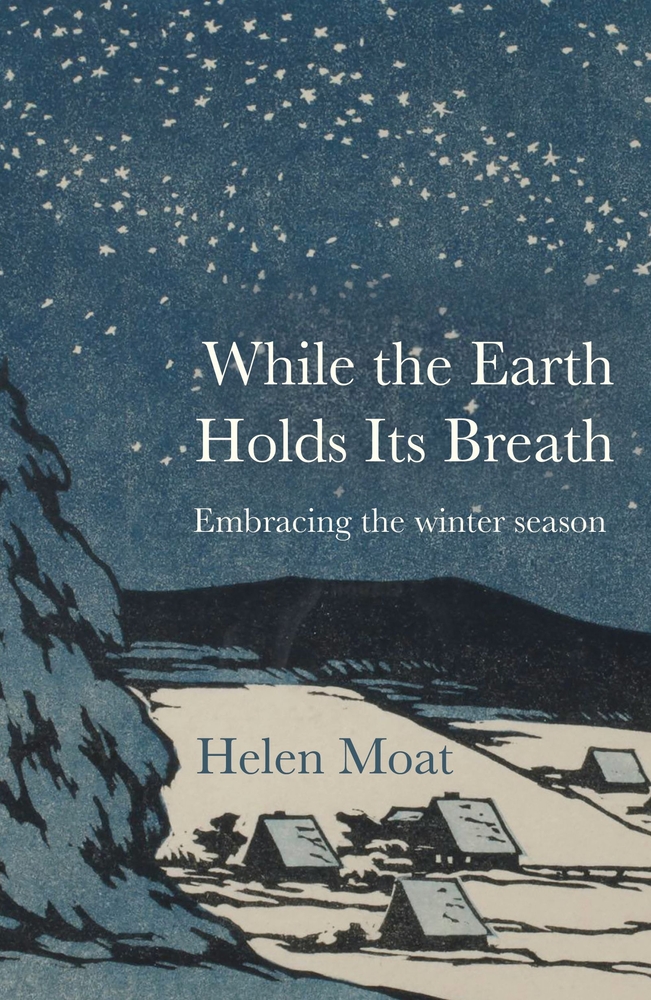
While the Earth Holds Its Breath

by Helen Moat
First sentence: “I’m staring into the dark of the lake – tar black and freezing.”
Support your local independent bookstore: buy it there!
Review copy provided by the publisher.
Release date: October 21, 2025.
Content: It’s short and concise, and will be in the Creative Non-fiction section of the bookstore.

Helen Moat dislikes winter. Every year, as the year turns towards the dark, she feels an oncoming dread and anxiety, and every spring, an immense relief. But, in 2020, when everything was in lockdown, Moat made the decision to try and embrace the dark, the cold, the winter.

The book takes place over three winters, as Moat reflects on her experiences in the winter. She travels to Finland to the Arctic Circle, to Japan, to Spain to experience winter in different areas. She befriends a Ukrainian refugee and in that friendship, learns about Ukrainian winters. She ventures out in her Derbyshire countryside to forest bathe and experience what her backyard has to offer.

It’s a quick read, this book, and when I started it I wondered what it has to offer that Wintering doesn’t. There are many similarities, but I think Moat takes a broader look at winter. I liked her travels – May stays pretty close to her native England, if I remember right – and how she valued other traditions and ideas, and brought them home and incorporated them.

The short version: community and communion with nature and each other are what make winter tolerable. Getting outside, being with people in the warmth, and being mindful about noticing the small things are what help winter be less daunting. And I appreciate Moat’s perspective on it.
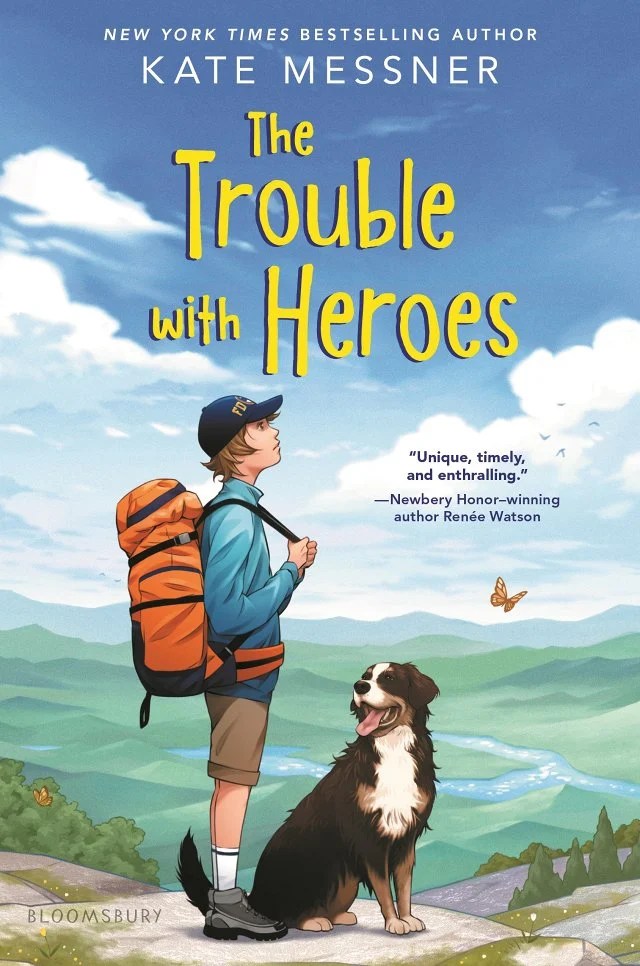
The Trouble with Heroes

by Kate Messner
First sentence: “If I were a better kid, this story would begin with my seventh-grade diploma.”
Support your local independent bookstore: buy it there!
Content: There is PTSD and the death of a parent. (But not the dog.)

Finn Connelly is angry. So angry that he kicked over the tombstone in the local graveyard of his small town. Except, it turns out that the tombstone was the one of a locally famous mountain hiker. And her daughter offers Finn a deal: hike all 46 of the Adirondack HIgh Peaks, taking her mother’s dog, by Labor Day and she’ll dismiss the charges. Finn doesn’t have a choice: he and his mother can’t afford to replace the tombstone. So, it’s off to the mountains for reparations.

At first it’s not fun – he doesn’t like the “nannies” that have been assigned to accompany him on the hikes, he doesn’t want to wear hiking boots, he doesn’t like the dog…. but as the summer goes on, Finn finds out that maybe nature is healing. And he’s got healing to do – his father was a first responder on 9/11 and died couple years ago during the COVID-19 pandemic, and Finn has yet to process that death. And, maybe, hiking the mountains will help.

This one was absolutely stunning. I loved the verse format – it’s partially because Finn needs to finish an ELA assignment to write 20 poems on heroes – and felt that it helped with the emotional impact of the book. Because this book packs an emotional punch. It’s funny and heartwarming, and yet the grief and loss is palpable. I just hope it’s one of those books that kids will actually like.

Because I loved it.

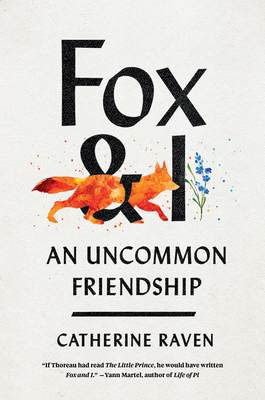
Audio book: Fox and I

by Catherine Raven
Read by Stacey Glemboski
Support your local independent bookstore: buy it there!
Or listen on Libro.fm
Content: There’s some intense moments. It’s in the biography section of the bookstore.

Catherine is a biologist by education, but mostly she’s a naturalist: she enjoys being in nature, having worked as a park ranger and currently lives mostly off the grid outside of Yellowstone National Park in Montana. The book is basically a memoir of her life, but more its more than that: it’s a reflection on our relationship with nature, and whether or not it’s “appropriate” to befriend a wild animal. In her case, a wild fox.

This is an odd book, reminding me very strongly of Lab Girl. Raven struggles with her feelings of friendship towards something that “supposed to” be an object of her study. It’s most interesting when she”s analyzing literature — most notably Frankenstein, Moby Dick, and The Little Prince — or maybe that’s what I found most interesting. Even with it’s oddness, I found the story compelling possibly because the narrator is really good. She kept the book interesting and entertaining in spite of its oddness.

Not my most favorite book this year, but an interesting one.

Lab Girl

by Hope Jahren
First sentence: “People love the ocean.”
Support your local independent bookstore: buy it there!
Content: There is a lot of swearing, including multiple f-bombs. It’s in the biography section of the bookstore.

This was the Big Read for Wichita this year, and I kind of knew what to expect going in. A science-based memoir of a biologist. And that’s pretty much what I got: Hope Jahren grew up in Minnesota, the daughter of a scientist, and she knew she was going to be one when she “grew up”. She went away to Berkley for her PhD in biology, and picked up a lab partner, Bill, and embarked upon a really weird career. Interspersed with facts about trees and plants (they really are very awesome, trees), Jahren tells about her ups and downs of being a research scientist and the odd brother/partner/friend she has in Bill.

It’s a fascinating story — being woman in the research science field in the late-1990s/early-2000s wasn’t easy, and it was made more difficult by Jahren’s eventual bipolar diagnosis — interspersed with interesting science. It did drag a bit in the middle, and I’ll admit to skimming some of the science, which I find interesting but I don’t always understand. But, in the end, she’s had an interesting life, she’s a brilliant scientific mind, and I’m glad I read it.