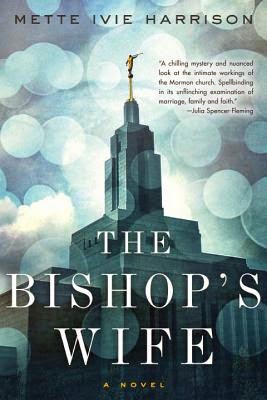
The Bishop’s Wife

by Mette Ivie Harrison
First sentence: “Mormon bishop’s wife isn’t an official calling.”
Support your local independent bookstore: buy it there!
Review copy snagged from the ARC shelves at my place of employment.
Content: There’s a few instances of mild swearing, but it is a murder mystery, and there are some pretty adult situations at the end of the book. It’s in the mystery section of the bookstore.

When this one came into the store, I knew I needed to read it. First, because I have enjoyed Harrison’s fantasies in the past, but mostly because, as the bookstore’s resident Mormon, I was interested in seeing what this one was about.

It’s published by Soho Crime, a division of Penguin/Random House, and it’s being touted as a mystery. Which, on one level, it is.

Our main character is Linda Wallheim, the wife of a bishop of a small Draper, Utah, ward. Her children are mostly grown and gone; her last boy is a senior in high school. She still hasn’t gone back to work, and so one of the tasks her husband gives her is to go visit people he feels need extra help and care. That’s how Linda gets mixed up in not one, but two tricky situations in the ward. One is the disappearance of a woman who left behind a husband and a 5-year-old girl. This is the really messy one, that doesn’t end well at all. The other is support to a woman whose husband is dying, and whose first wife died in what turns out to be a long-hidde murder. Linda is over her head, true, but she perseveres, and manages to solve both.

That’s the simple explanation. But, as mysteries go, this one is pretty pedestrian. I went through a couple of suspects before I settled in on who eventually committed the murder. And so, at the end, I wasn’t surprised, but that’s okay. See, for me, this book was a lot less about the murder and a lot more about Harrison’s portrayal of Mormon women.

Perhaps it’s because I’m the right age, the right target audience, the right sensibilities, but I was thoroughly drawn in by Harrison’s portrait of all the varying opinions, ideas, thoughts, and beliefs of members of the church. She shows that there are good people who are doing good things there are crazy people doing crazy things, there are dangerous people doing evil things. There are people who believe strongly, there are people who are questioning but still want to believe, there are people who don’t believe any more. Harrison also does a fantastic job of putting our religion (she’s LDS too, obviously) out there in a way that’s accessible to people who aren’t familiar with our faith. She’s most interested in the roles women play in the church, and in each other’s lives, and that’s what spoke the most to me.

I’m not quite sure who else would enjoy the book, though,. I tweeted Harrison when I finished, and she admitted she’s been getting a lot of flack for the book, which (unfortunately) doesn’t surprise me. But, I do hope this book finds readers and creates discussion.

Because it’s worth thinking about.
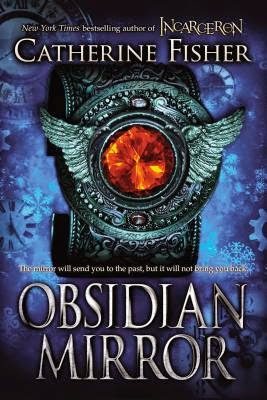
Obsidian Mirror

by Catherine Fisher
First sentence: “The boy put on the mask outside the door.”
Support your local independent bookstore: buy it there!
Content: Nothing objectionable, but it’s slow to start and is a  bit confusing. Not for the reader who gives up easily. It’s in the YA (grades 6-8) section of the bookstore.

This has been on my shelves for a long time. Seriously. I had the ARC, but gave that up, and finally, again, decided that I really needed to read this one. And I was in the mood this past weekend to indulge myself.

I shouldn’t have put it off. (Or maybe I should have: I’ve got the second one waiting to be picked up at the library. Shhhh. I know I said I wasn’t going to. But it’s CATHERINE FISHER.)

There’s three parts to this story. One is Oberon Venn, a very wealthy explorer who has spent the last two years in a depression because he was he cause of the accident that killed his wife, Leah. He will do anything to get her back. Including time travel. He and his trusty slave — there’s more to that than meets the eye — Piers are hidden out at Venn’s estate, trying to do just that: travel through time through the Obsidian Mirror.

The second player in this drama is Jacob, the son of Venn’s best fried. Who is missing and presumed dead. Or at least that’s what Jake thinks. So he’s headed, along with his unsuspecting teacher, Wharton,  to Wintercombe Abbey to force answers from Venn. Little does he know the web he will be tangled in.

The final player is the most complicated one: Sarah is possibly an escapee from an insane asylum. Or perhaps she’s a traveler from the future, a future where the mirror has destroyed the world, in order to destroy the mirror and prevent Venn from bringing his wife back.

There’s so much going on in this one, it’s hard to know where to begin. Yes, it’s slow and incredibly confusing to start with. I kept thinking “HUH?” But, I know Fisher’s work, so I stuck it out, and was richly rewarded. It’s time travel mashed with a mystery mashed with faery stories (yes, the Fey show up, and play a role), and if you give it time, it will begin to play out — it’s the first of a trilogy — in some incredible ways.

I can’t wait to read the next one.

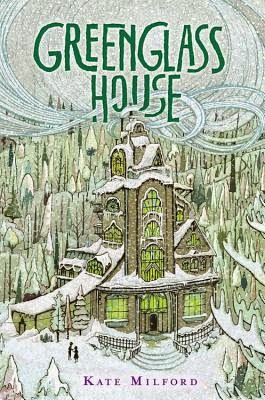
Greenglass House

by Kate Milford
First sentence: “There is a right way to do things and a wrong way if you’re going to run a hotel in a smuggler’s town.”
Support your local independent bookstore: buy it there!
Content: There’s nothing in the usual objectionable categories. However, it’s a slow book, especially at the start, and there’s some confusion sometimes when the characters switch names. That said, a good reader who loves mysteries would really like this one. It would be in the Middle Grade (grades 3-5) section of the bookstore, but I wouldn’t be adverse to putting it in the YA (grades 6-8) section either.

Milo and his parents run an inn at the top of a hill overlooking a river just outside of the fictional town of Nagspeake. The thing that makes their inn special is that it’s a safe having for smugglers. Milo and Mr. and Mrs. Pine know how to keep secrets.

However, it’s winter break, and Milo is looking forward to spending time alone with his parents. Without guests. So, he’s predictably disappointed when four guests, one right after another, show up for the winter.

Soon, they are in full swing, and have to bring up their usual cook, with her daughter, who just happens to be Milo’s age. Soon he and Meddy find themselves embroiled in an adventure and a mystery: figuring out why each of the four guests are there, their connection with the old house that Milo’s parents inherited, and who keeps stealing stuff.

The comparisons to Westing Game that I’ve read are valid. There is a mystery to solve, and it’s a quietly clever one, with a twist that I should have seen coming, but didn’t. (As we all know, I’m not the most careful of readers.) But it’s more than a mystery: it’s a lovely book, full of stories and quiet adventures (Meddy and Milo play a Dungeons & Dragons-like game for most of the book). I’m impressed that Milford wrote such a compelling book on such a small scale; because of the weather, Milo and Meddy hardly ever leave the house. It’s a very bleak landscape (Think The Dark is Rising bleak), but Milford infuses it with both warmth and mystery.

One more thing: Milo is adopted. He’s of Chinese nationality with white parents, and he feels that difference keenly at this point in his life. So, it’s not only a book with a mystery, it’s a book about belonging and family.

I loved it.

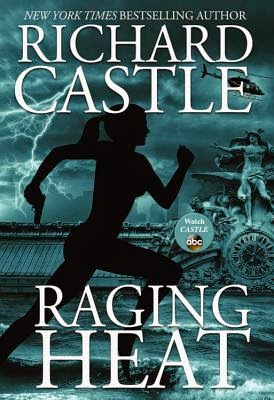
Raging Heat

by Richard Castle
First sentence: “Nikki Heat wondered if her mother hadn’t been murdered what her life would have been.”
Support your local independent bookstore: buy it there!
Others in the series: Heat Wave, Naked Heat, Heat Rises, Frozen Heat, Deadly Heat
Content: These aren’t for the younger fans of the TV show. Grisly murders (though not terribly descriptive), off-screen sex, and lots of f-bombs puts it squarely in the adult mystery section at the bookstore.

I don’t know if I have anything new to say. I still enjoy these books for their own sake; although this one had highlights from both season 5 AND 6, it’s really it’s own beast. The mystery had me guessing, as Heat and Rook wandered the streets of New York and Long Island looking for the murderer of a Haitian immigrant. It was a pretty messy mystery, with lots of characters involved (both on the murdered end — there ended up being 4 or 5, I think — and as the murderers) and while I probably could have figured it out, I didn’t. I just sat back and thoroughly enjoyed the twists and turns.

I also enjoyed the tension between Rook and Heat as they tried to balance life, work, and romance. If you follow the show, you’ll figure out where the book character’s relationship is going, but it’s a satisfyingly bumpy ride. (I especially enjoyed it when Heat lost her cool and dumped a bottle of Tequlia in Rook’s lap. He really did deserve it.)

All I can say is I’m glad the show’s back on, so I can get a preview of the next book.

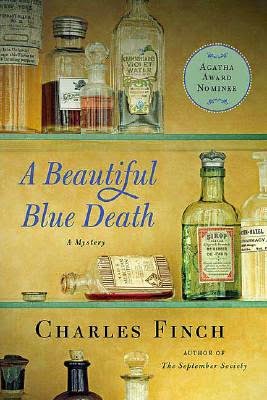
A Beautiful Blue Death

by Charles Finch
First sentence: “The fateful note came just as Lenox was settling into his armchair after a long, tiresome day in the city.”
Support your local independent bookstore: buy it there!
Content: It’s actually quite tame, and not at all difficult to read. It’s in the mystery section at the bookstore, but it’d be good to give to a teen who really likes Sherlock Holmes.

It’s 1865, London, and Charles Lenox is one of those aristocratic men who like dabbling in things. He’s mainly a collector of maps and a bit of an explorer, but his hobby (and possibly passion) is being a detective. And, because it’s that sort of book, he’s much better at it than the bumbling, arrogant, unobservant Exeter, a member of the Scotland Yard.

Sounding familiar? It should. because Charles Lenox is just a much nicer Sherlock Holmes.

The murder in question is that of Prudence Shaw, a former maid of Lenox’s next-door neighbor and BFF, Lady Jane Grey. Scotland Yard (and her current employer) are calling it a suicide, but Lenox knows differently. She’s been poisoned by a rare (and expensive) poison called bella indigo. The question is: who did it, and why. (Well, duh. Isn’t that always the question?)

I thoroughly liked Lenox; as a character, he was charming and intelligent and just a pleasure to be around. I really liked his relationship with Jane, how it wasn’t a romance, but a real honest-to-goodness friendship. What I lost patience with, however, was the mystery. While I didn’t figure it out (I’m not good at those things), I wasn’t surprised at the end (which is probably a good thing). But, by the end, I had lost interest in the whole murder thing. And then it went on for several chapters after the final reveal, chapters I ended up skipping.

It wasn’t a bad mystery, just not one I was super enthused about. Liking Lenox as a Sherlock Holmes knock-off wasn’t enough to make me enthused.

The Whispering Skull

by Jonathan Stroud
First sentence: “‘Don’t look now,’ Lockwood said.”
Support your local independent bookstore: buy it there!
Release date: September 16, 2014
Review copy snagged out of the box sent by our Hachette rep.
Others in the series: The Screaming Staircase
Content: There’s lots of ghosts, obviously, and some scary situations. Also a couple of deaths and a couple of instances of mild swearing. It’s in the middle grade (grades 3-5) section of the bookstore, but I’d be wary about giving it to an overly sensitive child.

It’s not very often, I think, that the second book in a series is as good (if not better) than the first one. This is one of those rare instances.

First off, it was wonderful to be back with Lockwood, George, and Lucy. Lockwood was as reckless and charming as ever; Lucy was still the glue that held the company together. But George was really the focus of this story. He got his moment in the spotlight, and was something more than the bookish, slightly overweight Other Guy.

The mystery this time is centered around a body Lockwood, Lucy, and George are hired to help secure.  A couple of grave excavators have found a grave site that wasn’t supposed to be there, the body of one Edmund Bickerstaff, who was a leading paranormal and psychic experimenter in Victorian times. It turns out that he was experimenting with things he shouldn’t have been, creating a Bone Glass which was supposed to give you a view into the afterlife, but instead kills anyone who looks at it.

Soon after the excavation, however, the Bone Glass is stolen, and Lockwood & Co are in a fierce competition with their rivals at Fittes to solve the mystery.

Oh, and yes, the whispering skull of the title (and the cover; love it!) does play a fairly major role.

There are so many brilliant things about this book. From the pacing (I couldn’t put it down!) to the hilarious asides, to the action-adventure feel.  It’s wonderful that you don’t really have to read The Screaming Staircase to enjoy this one. There are a few references to the previous book, but nothing happened in it that you Have to know before picking this one up. Additionally, even though there are teasers for the next book (which can’t come out soon enough) the story in this one wraps completely up. I love it when series books are like this.

I can’t wait for the next one.

Audiobook: Randi Rhodes Ninja Detective: The Case of the Time Capsule Bandit

by Octavia Spencer
Read by the author.
Support your local independent bookstore: buy it there!
Content: There wasn’t anything objectionable. I don’t know how it’d be reading it, but my 8-year-old followed the story pretty well while listening to it. We did have to stop the audio a few times to explain some things, however. It’s in the middle grade (grades 3-5) section of the bookstore.

I threw this in the audiobook pile mostly because I’ve seen it at the store and wondered if it was any good. (I know: celebrity authors. Ugh. But, sometimes they surprise me. Not often, though.)

Randi Rhodes is a die-hard city girl. She’s grown up in Brooklyn and loved every minute of it. Her family summers in Deer Creek, Tennessee, which is just about the right length of time for a city girl to spend in a boring, dull, small town. But the year after her mother dies (I called that pretty early on; I do get so tired of dead parents), her father, a mystery writer, packs the two of them up to live full-time in Deer Creek. Randi is not happy about this.

But, once there, she falls head-first into a mystery: the 200-year-old time capsule for the town’s Founder’s Day has been stolen. And they have 72 hours to get it back. Much against her over-protective father’s wishes, Randi (and her two new friends, D. C. and Pudge) decide that they are the only ones to solve the mystery.

It’s a pretty run-of-the-mill middle grade mystery book. Nothing too fantastic or brilliant; in fact, as an adult, I’ve seen all the tropes before. The banker is a Bad Guy, as is the power-grabbing Mayor. There’s a grumpy old man with a heart of gold, and a woman sheriff who’s a bit bumbling. (Though — spoiler — this isn’t a true middle grade novel, because by the end, you discover that the sheriff isn’t bumbling at all, but has instead figured out the mystery WAY before the kids ever did.) The best parts of the book are when Randi and her friends are out being detectives; the worst are the angsty tensions between her and her overprotective dad. I got extremely tired of the rants Randi went on about not being “understood.” (But that’s a parent speaking. I did appreciate that Randi was a non-girly girl; she was often ranting about how she wasn’t a princess and didn’t need protection. She’s a black belt in Tae Kwon Do, after all.)

In the end, it wasn’t anything special, though A and K enjoyed listening to it. But, it wasn’t absolutely horrible, either, and Spencer did an admirable job of narrating her book (which I would expect, with her being an actress and all).

Audiobook: The Cuckoo’s Calling

by Robert Galbraith
read by Robert Glenister
Support your local independent bookstore: buy it there!
Content: None of the murders are grisly — they’re all alluded to — and there’s some talk of sex, but none actual on screen. However, the language is very adult (including many, many f-bombs), and for that reason, it’s in the mystery section (well, also because it’s a mystery) of the bookstore.

Cormoran Strike is hard up on his luck. Retired from the military due to an accident in which he lost part of his leg, and recently broken up with his posh, upper class girlfriend, the only thing Strike has is his private detective practice. And even that’s not doing terribly well. He can’t afford the temporary secretary that’s shown up, and he’s pretty sure he’s going to default on the loan his estranged (but famous) father gave him.

Things are looking pretty down when John Bristow, adopted brother of supermodel Lula Landry walks in Strike’s office with an incredible story. Bristow claims that the police have it wrong: that Landry’s death was not a suicide as originally thought, but rather murder. Someone pushed her off her third floor balcony to her death. The question is: who?

I really didn’t have expectations going into this one. I knew it was J. K. Rowling but I don’t really read many mysteries, so I wasn’t dying to get to this one. But, when I saw the audio book, I figured it was worth a try. I didn’t love it, but I was intrigued by it.

Perhaps it was because I knew it was Rowling before I went in, but I could tell that it was Rowling’s work. The way she described things (and because it’s audio, I don’t have a handy example) felt similar to the Harry Potter books. That, and she really does have a gift for names. The plotting was good as well; she kept up a good pace, and even though there were some bits that weren’t vitally necessary, it wasn’t under-edited. And the twist at the end didn’t come out of nowhere; something which was incredibly important to me.

I did feel like she under-utilized the administrative assistant, Robin. She gave us background on her, and made her a sympathetic character, but really didn’t have her do much of anything. I kept waiting for a grand Robin Moment that never quite came. The narration was excellent; I was impressed with the range of accents and voices that Glenister could do; perhaps one of the reasons I stayed interested in the book was because his narration was so compelling.

That said, it was a good, solid mystery. Nothing too spectacular, but nothing mundane or pedantic. Which means it’s just about right.

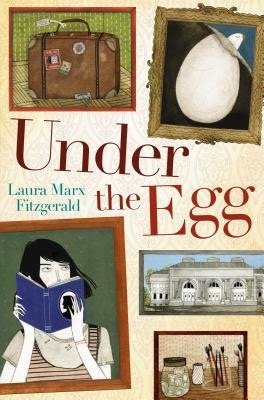
Under the Egg

by Laura Marx Fitzgerald
First sentence: “It was the find of the century.”
Support your local independent bookstore: buy it there!
Content: There some descriptions of horrible events, but nothing graphic. I think younger readers might have problems with the languages — there’s French and Latin, though translations are provided — and some of the names, but it’s in the middle grade (grades 3-5) of the bookstore, and I think it fits there.

Theodora (call her Theo) Tenpenny is the granddaughter of an artist and the daughter of an extreme introvert. She lives in what was once a grand old New York City house, but over the years has become neglected. Her grandpa Jack has kept everything reasonably in shape over the years and has managed to keep the family afloat by being mostly self-reliant. But since he was hit by a car and died (which seems overly gruesome for a guy in his mid-80s), Theo’s been in charge. And she’s struggling.

That is, until she takes her grandfather’s last words — “Look under the egg” — literally, and discovers that he’s been hiding a very old painting underneath the one of an egg that’s been hanging over their mantelpiece for years. Because she’s spent her life in her grandfather’s shadow, going to the Met and other art museums, Theo has a good eye, and realizes at once that this painting is something special. Something, perhaps, worth a lot of money.

However, as she and her new friend, Bodhi, find out, declaring a painting a lost work by a master is easy. Proving it is another matter. Especially when it turns out that this could be looted Nazi treasure.

On the one hand, there’s a lot of information to be had in this slim book. Both art history as well as WWII history play a major role in the plot. But I think that Fitzgerald handles it well, even if all the information and history might make it harder for younger readers to get into the book. But, she gave us a couple of great characters in Bodhi and Theo; they really are a team that works well together. I enjoyed the old-fashioned sleuthing to solve the mystery of the painting, and I liked how the history fit into the larger picture. I did find the ending to be a bit convenient, but even that was explained in a reasonable (if somewhat implausible) manner.

In the end, a highly enjoyable book.

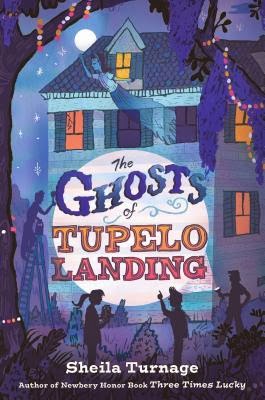
Ghosts of Tupelo Landing

by Sheila Turnage
First sentence: “Desperado Detective Agency’s second big case snuck up on Dale and me at the end of summer, dressed in the happy-go-lucky colors and excitement of an auction.”
Support your local independent bookstore: buy it there!
Others in the series: Three Times Lucky
Content: There may be a few instances of mild swearing (but I really don’t think so), and some talk of abuse, and another (potential) murder. But it really is innocent and happily belongs in the middle grade (3-5th grade) section of the bookstore.

Every once in a while, a series of books captures my fancy so completely that I fall head-over-heels in love with the characters. The Casson family books are that way. As is My Most Excellent Year. I’m adding the Tupelo Landing books to that list. I adore the town, even with all its quirks, and the people in it. I want to live next door and enjoy them every day.

This installment picks up as the school year is starting, and Mo and Dale are about to enter sixth grade. This is a good time as any: one of the amazing things about this book is that while it is a sequel, it really does stand on its own. Turnage works in the story from Three Times Lucky as you go along, in ways — like press releases or newspaper clippings or just dropped comments — that don’t stop the narration of the current story. It was lovely to get a refresher while being immediately immersed in the new story.

The case that the Desperado Detective Agency is working on this time is a good old-fashioned Haunting. Miss Lana and Grandmother Miss Lacy bought the old inn at an auction, mostly because they didn’t like the look of the “city” woman (whom Mo less-than-affectionately calls “Rat Face”) who was bidding on the property. They didn’t want her to come in, tear the dilapidated inn down, and put up condos in place. Unfortunately, buying an inn to renovate and then renovating it — especially when there’s a bona fide ghost lurking about — are two different things.

Mo and Dale get involved because of a history assignment. They’re supposed to interview one of the town “elders”, and Mo’s nemesis, Anna (whom Mo less-than-affectionately calls “Attila”) nabs Grandmother Miss Lacy first. So, Mo — in a fit of pique — says they’re going to interview the inn’s ghost. That sets them to unraveling a 60-year-old mystery of how a girl — one of Grandmother Miss Lacy’s best friends — met her death.

The only real criticism I have of this book is that all the conflict seems a little contrived. The outside city girl just lurks in the background being uptight, and the new character, Harm Cremshaw, turns out to have more bark than bite.  Even the resident town grump, Red Baker, turns out to be mostly harmless. That said, I’m not reading these books for the conflict. Or even for the mystery. (Or the ghost story in this case, though it’s so slight, I’m not really considering this as a “speculative fiction” though it probably is.) No, I read this because I love the characters — Mo’s spunk and observations; Dale’s adorable cluelessness, Miss Lana’s optimism, the Colonel’s stoic nature — and I love the way Turnage writes them.

And that’s why you should be reading these as well.