Sunday Salon: Catcher in the Rye Read-a-long

This past Thursday, J. D. Salinger, the author of The Catcher in the Rye, passed away. As I was watching people’s reactions on Twitter, I realized something: I’ve never read Catcher in the Rye. Somehow, for some reason (actually many reasons, some of which I can actually recall but won’t go into here), I managed to completely miss this book.
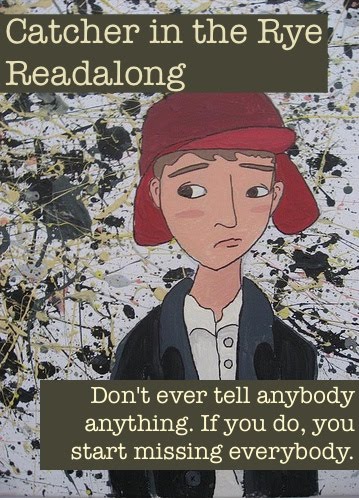
Which is why Amanda, Heather and Jackie at Farmlanebooks put our heads together (metaphorically, of course), and came up with an idea to have a Catcher in the Rye read-a-long. It’s going to be pretty easy-going. We’re planning on starting Sunday, February 14th and wrapping up around the end of the month. I’ll make sure there are posts after February 14th where you can leave your spoiler comments, questions, and discussion points.



I’m not going to do anything formal with signing up and all that, but if you’re interested in reading along with us — either for the first time or the 20th — please leave a comment and let us know!

I’m quite curious to see what all the fuss is about.

(Oh, and many thanks to Amanda and Jason for the lovely button.)

Sunday Salon: Unsung YA Books

I’m a little late to this party, but since Kelly at YAnnabe made the suggestion that I throw my hat into the ring, I haven’t been able to stop thinking about it. So, my two cents about the best YA books you’ve probably never read.

The Order of the Odd-Fish, James Kennedy: I keep plugging James’s book, but you aren’t reading it. Why? Seriously, people, read this book.

Nothing But Ghosts or House of Dance, Beth Kephart: if you haven’t experienced the lyricism that is Kephart’s writing, you really ought to.

Flygirl, Sherri L. Smith: a quietly feminist book, one that makes you want to stand up and cheer!

Secret Keeper, Mitali Perkins: a book about love, a book about India, a book about sisters. Almost perfect.

Two Parties, One Tux, and a Very Short Film about the Grapes of Wrath, Steven Goldman: Clever, snarky, and geeky extraordinaire. Can’t go wrong with that.

Saving Juliet, Suzanne Selfors: Yeah, it’s fluff. But it’s fun fluff, and it’s fun to see how it works with the Shakespeare.

Fly By Night, Frances Hardinge: Fuse #8 loves Hardinge, and for good reason: she’s a fabulous writer.

There you have it: my thoughts. What’s the best unsung YA book that you’ve read recently?

Sunday Salon: Writer’s Block

I have found, since probably sometime in January, that writing reviews aren’t coming as easily as they have in the past. (Or at least I remember them coming in the past.) I can safely exclude the idea of blog burnout in this problem; I’m still like blogging, and I want to write the reviews. It’s just that when I sit down to type up my thoughts, I find that I either 1) can’t gather them up sufficiently (maybe they’re on hiatus?) or 2) find myself typing the same old limpid platitudes (Oh, I have wanted to use that phrase for a while now. Who’d of thunk it’d be in reference to my own reviews?!) over and over again. Yes, we all know the book was compelling, engaging, thrilling, exciting, fantastic, fabulous, boring, . Find some new words, Melissa.

So, I ask you, my fellow book bloggy friends, what do you do when you have writer’s/reviewer’s block? Keep writing, even if the reviews come out sounding blah (at least to you)? Give up? Go on hiatus? Use the thesaurus more?

An an additional question: how do you go about writing your reviews? Is there something you do to make sure they end up sounding as good as they possibly can?

Sunday Salon: 2010 Reading/Blogging Goals

Those of you who’ve been following my blog for a while know that I don’t really go in for blogging goals, let alone reading goals. I tend to just let things flow the way they do, not really worrying about “achieving” something. But, as I was sitting here, thinking about the end of the year (my best-of post will be up on Thursday, if you’re interested), thinking about the several requests I’ve had to host a challenge again, and thinking maybe I should actually set some goals for 2010. It is a new decade, after all.

So Reading Goals:

  • I am going to clear off my TBR shelf of ARCs, gifts, and past Cybils books (from this year and last!) that I want to read.
  • I’m going to pace myself better than I did last year. I think I read *too* much (for me), and I’ve been feeling like I need to diversify my life a bit more. Perhaps stop double-booking?
  • I will not buy any new books. Exception: the two that I need to buy for the 2010 challenge (probably the Hunger Games sequel and one other).
  • I’m going to try and diversify my reading more: more books by people of color (I’ve been trying to do this for three years, now!), books set in and about places I know little about (Africa comes to mind), more books in genres I haven’t tried. The GLBT challenge will help with this.
  • I think I will indulge myself and reread books (which is why I joined the Flashback Challenge) this year. Only caveat: they can’t have a (substantial) review on the blog.

And Blogging Goals:

  • I will try to interview one author per month. It may not post on the first, though I would like it too, but there will be an author interview each month.
  • I don’t want to do blog tours anymore. I know they increase blog traffic, but I’m not sure I like being a part of them.
  • I will try to resurrect Books-to-Movies. Which requires I see more movies, which means I ought to read less…
  • And, yes, I think I will host another challenge. Perhaps I’ll do another Well-Seasoned Reader, or maybe I’ll take over the Armchair Challenge this year. Either way, nothing is going to happen until January, so stay tuned.

What are some of your reading/blogging goals for the coming year?

Happy Blogoversary to Me

Five years.

When I started this blog, I had no idea that it’d develop into something I enjoy doing so much.

When I started this blog, I had no idea that I’d write more than 1,000 posts.

When I started this blog, I had no idea that I’d make as many friends and read as many books as I have.

Then again, five years is a long time! And as I am feeling generous, and because I want to thank y’all for reading my blatherings over the last five years, I’m doing a a drawing for a $25 gift certificate to a book store of your choice on November 30th. To enter, leave a comment with your favorite book (from the pastfive years). I’ll give you an extra entry for tweeting the post, too (if Twitter is your thing…).

And, because it’s been a project of mine this year, I’m also going to give you a full 100 things about me. It’s mostly cobbled together from the posts I’ve done over the course of the year, but with 25 new things in there. Since, after five years, you really deserve to get to know me a little bit better.

1. I like to read.
2. Check that: I love to read.
3. I read on average four books a week.
4. Which breaks down to between 2 and 4 hours a day.
5. I don’t watch much TV anymore. (30 Rock is about it. Though sometimes I watch Glee.)
6. Though there’s a lot of TV I’d love to watch. (Mad Men, House, True Blood…)
7. I do watch So You Think You Can Dance pretty regularly now, thanks to Corinne.
8. I use the excuse that I love to watch dancing.
9. I do love to dance, too, though it embarrasses my girls.
10. And I took all forms of dance in college — folk, modern, ballet.
11. My favorite was ballroom dance, though.
12. The best part of ballroom dancing is the competitions. (I was even in one, once! Got 5th place.)
13. And, yes, I love Strictly Ballroom.
14. Though it’s not my favorite movie of all time.
15. That’s probably one of the Jane Austen adaptations, though don’t make me choose which one.
16. Because I love nearly all of them.
17. My opinion of the movies reflects my opinion of the books. Mansfield Park = bleh. The rest are good.
18. My favorites, if I had to choose, are the big two — Persuasion, Pride and Prejudice — and Emma.
19. Because I love the Austen Men: Colin Firth (Mr. Darcey), Jeremy Northam (Mr. Knightley) and Ciaran Hines (Captain Wentworth). And to a lesser extent Alan Rickman (Colonel Brandon… but he doesn’t count since I’ve liked him since the horrid Kevin Costner Robin Hood.)
20. I appreciate them like I appreciate art (or dance!). I admire them. I enjoy looking at them. Watching movies they are in make me happy.
21. I am not a stalker. (Yet?)
22. I pretty much watch everything the Austen Men are in, because I’m that sort of person. Which means I’ve watched some pretty bad movies. (And have thought to myself: hey, Ciaran Hines/Jeremy Northam is in that; I should see it!)
23. Colin Firth makes the best case for himself out of period clothes.
24. In other words: no matter how bad the movie is, I still like him. The others, I seem to only like in period dress.
25. I have liked other actors — most notably Viggo Mortenson (Aragorn), Orlando Bloom (Will Turner, not Legolas) or Richard Armitage (heck, I’ll take him as both Guy Gisborne and John Thornton) — but nowhere near as much as my Austen Men.
26. All this begs the question: what is it about dark-haired British men in period clothing?
27. Actually, if you REALLY want to make my day, what you need to do is get a dark-haired British actor to dress up in period clothing, have him drive me around in a minicooper (red, of course), and feed me cake.
28. Mmm… cake.
29. Love the stuff, but can’t make it terribly well. Which is probably for the best.
30. Frosting, on the other hand, I do quite well.
31. I love decorating cakes. My girls love that I do, too. Makes birthdays fun.
32. In fact, I’m looking forward to doing their wedding cakes (if they’ll let me).
33. I’m so taken with the whole period-clothing thing, that if I could go back and re-do my wedding, I’d make everyone wear period (preferably Regency, but I’d go for Renaissance, too) clothing.
34. Thankfully, I’m married to a guy who’d go for that. And who doesn’t mind my actor-obsessions.
35. He laughs at me a lot, though.
36. I don’t mind. I laugh at me a lot, too.
37. There is one exception to the British Rule: Brendan Fraser. He is dark-haired, but he’s not British. He’s not even a terribly brilliant actor. But he is imminently watchable, even in the really stupid movies he’s been in.
38. And I think he’s cute when he’s dirty and sweaty and smiles that goofy smile of his.
39. Sometimes, I wonder if I ought to act my age.
40. I think that, too, when I tell people I love reading books for children and young adults.
41. Especially since I don’t read them because I’m pre-screening them for my girls.
42. Or because I’m a children’s librarian or a bookseller (though I have aspirations in those directions).
43. I read them because I like stories and good storytelling.
44. And I think they’re fun to read.
45. I do read adult books, just not as many.
46. Mostly because I can’t find as many that I like.
47. And I’m always surprised when I find one that I do like.
48. I find I’m impatient with the writing.
49. I have a better track record with non-fiction, though. Especially travel and food books.
50. Travel books are best in January. I hate January.
51. Food books are best all the time.
52. Especially if they’re written so that you can almost taste or smell the food.
53. Because lately, my real passion (outside of books and blogging, of course) is food.
54. I’m not a gourmet or a foodie, and I’m no good at inventing recipes, but I love to cook.
55. I’m a weird that way: making dinner is one of my favorite things to do.
56. Maybe it’s because my first job was working in the kitchen of a bar/restaurant. I started as a dishwasher and worked my way up to line chef.
57. Whatever it is, I find something calming and creative in the throwing together of ingredients to create something delicious.
58. Bad mom moment: even though I need to teach them to cook, I actually DON’T like it when my kids want to help.
59. It throws me off my groove. Don’t mess with my groove.
60. My new hero is Julia Child. She totally rocks.
61. In fact, when I was in DC for KidlitCon, I made sure I I had time to go to the American History Smithsonian and see her kitchen. In a word: awesome.
62. General cooking is great, but what I really really love is baking.
63. Bread, rolls, cake, cookies, doughnuts, sweetbreads… if it goes in the oven, I’m SO there.
64. I used to say that there was no way I could do the Atkin’s diet because I. Live. For. Bread.
65. I bake bread every week for the family to use.
66. I started doing this because there’s high-fructose corn syrup in the store-bought loaves, and I’m anti-high-fructose-corn syrup as much as possible.
67. Which came about from reading a book.
68. But now I do it because I love baking bread.
69. Someday, I’ll even own a baking stone and learn how to bake artisan bread.
70. Until then, I’ll just keep frequenting Panera when I can.
71. I have had other hobbies: sewing (briefly), decorating (briefly), gardening (on and off), playing the piano (do it quite a bit still), and photography (not as good as I’d like to be).
72. And I did, once, fancy myself a writer of novels.
73. If I did write a book, it’d probably be some sort of travel book/memoir.
74. But that means I’d have to travel. Which we don’t. Not really.
75. We do go places — I do what my parents did: throw the kids in the car and drive to see stuff.

76. Mostly educational/historical stuff: I’ve never been to Disneyworld or Disneyland.
77. But my my childhood really was too ordinary to make a good memoir.

78. The most interesting thing I did was have a tumultuous teenage romance.

79. I’ve thought, in the years since it fell apart, that that relationship would probably make a good novel.

80. As an aside, the teenage romance is why I have problems with True Love and Love At First Sight and Pining After My True Love tropes in novels.
81. And it’s also why I’ll encourage my girls to make sure they marry someone who is a friend first. (Bah on Edward.)
82. Someone else will have to write that novel, though. (Someone probably has.)
83. The drafts I wrote are pretty painful to read, and not just because it’s my past on the page.
84. I’m just not that good at fiction. Even though I took a class and everything.
85. I do think I’m creative. It’s just that my creativity doesn’t run in that direction.

86. I really am much better at writing my opinions about what other people write.

87. Which is what I went to school for in the first place: Journalism, with an emphasis in arts critique.

88. Instead of a newspaper, my outlet is my blog.

89. Actually, I started the blog because I have a bad memory and can’t remember what I’ve read a week after I’ve read it.
90. I like to blame it on four pregnancies.
91. Though I think I’ve always been a bit scatterbrained.
92. Which is something my friends have teased me about over the years.
93. Maybe it’s the blond in me coming out?
94. I was pale blond as a kid — Scandinavian (Danish, mostly, with some Swedish and Norweigan) heritage (I have blue eyes, too). Though my hair is best described as “dishwater blond”.
95. It still is that color, when I haven’t dyed it some other color out of boredom.
96. Though I have an aversion to doing anything permanent to my body.
97. Hence, no tattoos, unless they’re henna.
98. I was offended at the guy who called my hair dishwater blond.
99. But, I don’t stay offended for very long. I’m actually a very forgiving person.
100. I find endings very difficult to write. So, sometimes, I just don’t.

If I Had Me A Time Machine

When I saw this post at Fuse #8, I knew it was TOO much fun to pass up.

The premise: You have a time machine. In this time machine
you may take seven books. Your mission is to visit yourself, in the past, and to give yourself the books you wish you would have read as a kid. They can be old books or new books, it doesn’t matter. But they must be books you’ve run across as an adult, loved, and you know would have appealed to (or been good for) little you.

Ages 2 to 5:

Knuffle Bunny Too
by Mo Willems
Really, anything by Mo would work. I would have adored his books. Really. I loved to laugh, and I was a precocious little kid. I totally would have identified with Trixie. And I’m sure my parents would have rather read Mo to me instead of those Golden Book books (though The Monster at the End of the Book is a good one) or the Berenstain Bears. (Ugh.)

Ages 6 to 9:

Moxy Maxwell Does Not Love Stuart Little, by Peggy Gifford
Yeah, I’m still young enough to be read to, but (as I said) I was a precocious kid. What I was into: Little House on the Prairie. What I really needed was a good dose of the humor and wit and practicalness of Moxy Maxwell. I would have gone around imitating her (instead of Laura Ingalls). On second thought, maybe that would be a bad idea?

Ages 10 to 12:

Just Ella
, by Margaret Peterson Haddix

I LOVED princesses. (I am a girl, after all.) I remember dreaming about being a princess, being well-off, having everything I wanted in life. I would have handed my little self this book just to remind me that sometimes happily ever afters don’t work out, and it’s not the Prince that always sweeps you off your feet.

Ages 13 through 15:

The Graveyard Book
and Coraline, by Neil Gaiman

This was my dark period: I loved Edgar Allen Poe, Ray Bradbury, Piers Anthony. I would have LOVED Neil Gaiman (who was writing when I was 13… how did I miss Sandman?). He totally fits in with my interests at the time: dark, creepy, slightly weird, and yet ultimately hopeful. I was an odd teenager. (I did eventually ditch the nerd look, and get contacts, too…)

Wee Free Men, by Terry Pratchett
Can’t have Gaiman without Pratchett, can we? I would have picked up on the humor, I could have used Tiffany’s strong will and determination in my life, and I would have loved the hint of romance in the later books.

Ages 17 or 18:

Graceling
, Kristin Cashore

What I needed at this point in my life: a kick-butt heroine, who didn’t let men decide her fate (or break her heart), who gets out there and challenges the world and the social norms, who finds herself on her own and celebrates that.

And, yeah, she falls in love, but that’s beside the point.

And to balance that out, give me…

Girl at Sea, by Maureen Johnson
Because what every 17-year-old girl really wants is to fall in love with a hot college guy. And MJ gives it to us with humor instead of drama.

There you have it. What would your books be?

Sunday Salon: the Zen of Blogging

For the first session last Saturday at KidlitCon, MotherReader took us through a series of introspective questions about blogging and our fundamental purpose. I thought it’d be interesting to share the questions, as well as some of my thoughts (from my jotted notes) on them.

1. Why are you blogging? Initially — and it’s still my main purpose — I started blogging as a way to keep track of what I read. But, in the (nearly) five years since I started, some of my reasons why have changed. This is what I wrote down: because I love the community and the friendships; because — honestly — I like free books (well, I do); because I like to write about books; because it’s fun!; because I want to share my love of books, and spread the word about books I love; and because I love it when there’s a good discussion, a give and take of ideas.

2. What do you have to share in your blogging that is unique to you? I had a harder time with this one; I really don’t see much of what I do as “unique”: there are other bloggers out there doing exactly what I do, and are much better (and more “popular”) at it. But, I realized over the course of the weekend that I need to just embrace my unique traits — that I’m a mom of four girls and that I live in Kansas! — even if they’re not what I would have chosen for myself. The other things I think I have to offer are my honesty, and just being a fan of what everyone else does.

3. Who are you blogging for; who is your audience? I’m selfish: I am bloggging for ME, first and foremost. After myself, I am blogging for other readers, whether or not they are parents looking for books for their kids, or other lovers of whatever it is I love. And then, I’m just looking to spread the word about the fabulous writing in middle grade and YA books out there, to whomever will listen.

4. Where do you see your blog among the other blogs? Again, I had a hard time with this one. From the start, I’ve never quite fit in a particular “category”. Mine is a review blog, definitely. But of what? I read too much adult fiction to be truly kidlit, and I read too much kidlit to be a truly adult blogger. I’m too eclectic to fit in anywhere, and while that’s frustrating sometimes, I don’t think I’d have it any other way.

5. When are you going to revisit your mission? Um, it would actually help, I think, if I had a mission. I do seem to revisit why I blog about once a year or so, when I catch the blogging “flu”. I have been seriously rethinking things (it’s a work in process), including the idea of quitting altogether, as I’ve approached my 5-year anniversary. Bear with me as I try to figure things out. MotherReader did stress that it’s important to keep in mind not only why you’re blogging, but to revisit that regularly, to make sure that it’s still a fitting reason, and to see if you’re achieving what you’ve set out to do.

6. How are you going to change or support your blogging mission? Again, I think what I need to do here is perhaps come up with something specific. I don’t know. I am going to go through and refine my blogging policies and procedures (something that’s not only a side effect of the conference, but of the FTC guidelines) — as soon as my life settles down! I do need to be more specific about what books I am willing to accept from publishers/blog tours/authors, for sure. Other than that, I’m still thinking.

So, any general thoughts? What would your answers be to these questions?

Childhood and A Love of Reading

This ran in Estella’s Revenge back in August 2007. I thought I’d reprint it here for National Day on Writing and post it to the gallery A Lifetime of Reading. Enjoy.

It’s no secret that I enjoy — no, love — middle-grade and young adult fiction.

This is not a passion that I have always had. It’s not that I didn’t read as a child; I did. A lot. But after I got through the usuals — Little House on the Prairie, Harriet the Spy, Anne of Green Gables, the Ramona books, Tales of Fourth Grade Nothing, and probably others I can’t remember — I read a lot of junk. Or, what I would now consider junk.

Then, by the time I hit 7th grade, I’d left YA fiction behind for Piers Anthony, Ray Bradbury and Edgar Allen Poe (my morbid phase). From there, it was the Agatha Christie obsession that lasted for several years. And by the time high school hit, it was mostly reading for English classes; I’m not sure I read for fun between 10th grade and sometime in college.

It wasn’t until about 12 years ago that I discovered all that I had missed.

It started innocently enough, in a conversation with a friend who asked if I’d ever read Beauty by Robin McKinley. No, I replied, I hadn’t. She loaned me that, along with Susan Cooper’s The Dark is Rising series, and I was hooked. Soon, I was picking up children’s books from the library (my oldest at the time was still a baby) and the bookstore and devouring them. Because I realized something: these books, these kid’s books, were good.

I think somewhere along the line, I was convinced that books for young adults, for children, were considered immature, and if you were an adult (or wanted to be), then you needed to get out of the kids section. I think this is a common perception; I have been asked numerous times if I read middle-grade and young-adult fiction because I’m “prescreening” books for my kids. My blog has been dismissed by some because I read too many kids books. (Ironically, it’s also not that respected in the kidlit world because I review adult books, too. There’s no winning.) The assumption is that there just can’t be anything in these books that I, as an adult woman, would enjoy or be satisfied by.

Yet, I have often found that it is the adult books are less than satisfying. Authors that write for adults–or at least, those that want to get noticed by big-name reviewers–tend to either get lost in the words of the book, rather than developing characters or storylines; or, they heap on so much “adult” stuff (sex, language, violence), that in the end I’m left wondering where the story was. For me, for the type of reader I am, the story and the characters are critical to the success of a book. I enjoy a beautifully written book, but the words themselves rarely draw me in (perhaps this is partly a result of my education in journalism rather than English). However, it’s all about the story.

And the truth is, some of the best stories out there are being written for children and young adults. There’s the obvious examples of J.K. Rowling or Philip Pullman or Roald Dahl. But it goes deeper than that. Ann Rinaldi spins convincing and interesting historical tales, usually featuring some strong and admirable heroine. Christopher Paul Curtis tells stories of being black in America that are engaging and challenging at the same time. Rick Riordan has come up with a brilliant idea of bringing the Greek myths to life (even though his series has the obvious Harry Potter comparisons). And Francis Hardinge’s debut book, Fly By Night, had me hanging on every word until the end.

In addition to the stories that are being told by current authors, I’ve managed to discover jewels that I passed over as a child. I never read The Hobbit or Treasure Island (I was too judgmental; they were “boy books”). I rediscovered All-of-a-Kind-Family and The Westing Game. I found out what choice opportunities reading The Mixed of Files of Mrs. Basil E. Frankweiler, Tuck Everlasting and Railway Children were. Or the challenge in reading The Devil’s Arithmatic.

Yes, my life wouldn’t have ended if I’d never read any of those books. But, my life wouldn’t have ended if I’d never read How Green Was My Valley or Zorro either. The point is that my life was enriched by reading those books. They brought me something that I, in turn, wanted to share with my family and friends. They had the power of a good story, well told.

And in the end, that’s what has brought us together as people since the beginning of time: the ability to tell stories and learn from them. Whether or not they’re supposed to be for kids.

On Comments and Commenting, Part 2

This has been on my mind ever since Mother Reader asked me (along with Tricia at The Miss Rumphius Effect, Mary Lee at A Year of Reading, and Jennifer at BiblioFile) to be on a panel for the KidlitCon, and then asked “How can I get people to comment on my blog? Or link to my blog? Or notice I have a blog?” Honestly, the first thing that came to mind was commenting.

You want people to know you’re out here in the bloggy world? You want people to read what you write? Comment on blogs. All sorts of blogs. Follow links from your favorite blogs and comment on those blogs. Follow the links of the people who comment on your blogs and comment there. The only way people will know you’re out there is if you tell them you are. And the best way to tell them you’re out there is by comment love.

And I admit: I love comments. I feel bad when a post of mine doesn’t get any — it looks so neglected and ignored without any. And, to be really honest, I do wonder if what I wrote wasn’t “good” enough or “interesting” enough to merit any comments. Then I get all self-conscious: am I just shouting into the void? Is there anyone out there reading what I’m writing?

Yet, I find that I’m really bad at leaving comments. It’s not that I’m not reading what you write: I am (mostly). It’s just that I have — we all do — a limited amount of time in the day, and dividing it up between running a family, reading books, blogging about those books, and reading other’s blogs, the thing that gets pushed to the bottom every time is reading other’s blogs. I could spend all day wading through my feed reader, commenting on every blog, and I’m sure it’d make me hugely popular (well, I’m actually NOT sure about that) and I’d get a ton of comments (then again, maybe not). But, I don’t have that kind of time, and that’s not where my priorities lie.

And so to bring these two blogging poles into balance, I have developed a battle plan: comment on the posts and the blogs that aren’t getting much love. I find that if a post has more than 20 comments, or a blog that I read consistently gets 30, 60, 100 comments, I don’t feel a need or a desire to comment. What I probably wanted to say was probably already said by someone else (I hardly ever read through comments when they get over 25, anyway). It’s at that point that I don’t feel like I’m really contributing to the conversation, instead becoming just another yay– or nay-sayer in the crowd.

But on the smaller blogs and smaller posts, I feel I can make some sort of difference. Add that one comment that will make the post author’s day. (Because, believe me, I know how it feels.) Even if it’s just a “good review!” comment.

Which brings me to “good review” comments: do leave them. I know that my reviews get read, but I feel bad for the ones that don’t get any comment love. I don’t know why — like somehow my reviews are my babies, and I feel bad that they’re being rejected because no one liked it enough to say “Hey, great review.” Or even, “That sounds terrible/interesting/unique/stupid.”

Commenting is one way to get involved in the wider community — and leaving comments will most likely make someone else’s day. But, we do realize: we all have a limited amount of time, and not every post will get a comment from everyone. It’s just nice when it happens.

So, leave a comment: do you live for comments, or are you more like Liz: you know there are readers out there, and it really doesn’t matter if they comment?

An Argument for Bias: An Open Letter to the FTC

To Richard Cleland, Federal Trade Commission:

As I’m sure you’re aware, a lot of book bloggers have reacted strongly to the inclusion of book blogging in the “Guides Concerning the Use of Endorsements and Testimonials in Advertising” which have recently been released by the FTC. They, like me, are wondering how it will apply to the work we do. We are also somewhat frustrated at your apparent lack of understanding regarding how book reviewing and book blogging works. It is these latter concerns — with which I mostly agree — that has prompted this letter.

As I understand the guides, the FTC is concerned about the consumer’s perceptions of individual reviews of “products”. I can understand this concern, especially when it comes to utilitarian products.

When I am reading “reviews” (though as one book blogger, Mother Reader, observed, “how does how one ‘review’ a bookshelf or swingset or tungsten rings?”) of clothing, shoes, strollers, computers, cameras, or cars, I want to know how well they work. I want to know which brand or item is going to give me the most for my money. It’s reasonable that such things are “reviewed” on the basis of their form and function, because their value comes from how well they perform those functions. Reviews of those products need to be clear about any bias which might have come into the review, because being biased or dishonest about the performance of a product will diminish the value of those products in the hands of consumers. In short, it makes sense to regulate and oversee reviews of these kinds of commercial products: they have a definite utilitarian value which can be easily compared.

But books are different. Sure, they can be perceived as a product: they are physical in ways that, say, movies are not. There are publishers and authors who benefit from their production and sale. However, this is not what book reviewers are reviewing. You will not read a review of a book that says, in essence: “This book is about 6 by 8 inches, with 288 pages. There’s a nice smell about it, and the pages turn excellently. It also makes a great doorstop.” There is usually no (or very little) mention of the physical or utilitarian aspect of the actual book. There is also almost never any mention of which “brand” of book — be it Bloomsbury, or LittleBrown, or HarperCollins — is better than the other.

Rather, what we are reviewing are the ideas, the outpourings of a person’s imagination, in the book’s story. And for that, we often want bias. When it comes to books — or movies, music or art — biases (of some sorts anyway) can be helpful. It can mean that you’ve read a lot of other books (some of which you got for free, some of which you bought on your own, some of which you checked out from the local library), that you’re familiar with the author, that you understand what the publisher is trying to accomplish. This will enable you to be more sympathetic (and thus give potential readers a chance to learn something new) or more critical (and thus warn potential readers away when a book is really just more of this or more of that, and not as good).

Ultimately, a book review involves a question of taste. We book reviewers are reacting to the book in ways that a stroller reviewer doesn’t react to a stroller. Sure, you can look at the “construction” of a book — Are all the words spelled right? Does the sentence structure make sense? Is it cleverly or beautifully assembled? — but, ultimately, what a review really boils down to is the reviewer’s taste in stories. And taste cannot be regulated or influenced by free products.

Ask yourself what the consumers of book reviews–which include book bloggers themselves–are looking for. As readers of books, we actively search out not only multiple opinions on each and every book (if we’re so inclined), and we look for opinions of people whose taste (which we have determined over time) closely matches our own. It doesn’t matter if the review they find is in The Washington Post, the Wichita Eagle, Bookslut, or on an individual’s blog. Generally speaking, all readers want to know is whether they will have a positive experience with the story the book contains. So, we find people with like-tastes and read and come to trust (or, in some cases, distrust) their reviews, searching out (or avoiding) the books they recommend. It doesn’t matter if they got the book for free from Random House, or through a blog book tour, or because an author emailed them out of the blue; what matters is how they reacted to the story, and how we as consumers of book reviews are able to measure their taste against ours. As commenter Nicole said on this post in response to a comment about the bias inherent in blogs, “There is no tradition of ‘unbiased’ blogs, and any reader would know, going into a blog, that it is just a biased person giving an opinion. Sounds like the consumer has all the knowledge he needs.”

Although the print media has a reputation for being “unbiased” in their reviews, in all actuality they are not any more unbiased than individual bloggers. In my role as book editor for Dialogue: A Journal of Mormon Thought, I receive books — many unsolicited — from publishers for review in the journal. I consciously seek out reviewers who are knowledgeable about and are involved in the issues surrounding the topic of any given book, which increases the likelihood of their giving a “biased” review. This happens in ways both “positive”–in that they see the author has agreed with the reviewer’s own or work or has added something to the discussion which the reviewer thinks to be valuable–and “negative”–when the reviewer sees the author approaching a topic or area of study in a manner they think is ignorant, irresponsible, or counter-productive. I do not think this bias hurts the journal, and I do not think getting a free book biases a reviewer in favor of the book, whether that book comes from me, as an editor, or directly from the publisher. In fact, I think that if we actively discourage people from reviewing — or receiving — books they have a vested interest in, there would be far fewer reviews — and far worse ones.

After all this, I do know that it’s not really bias itself which you’re attempting to regulate. In terms of the regulations, it doesn’t matter if a particular blogger likes John Grisham or John Green. What does matter is if that blogger got the books directly from Grisham’s or Green’s publishers (or agents or publicists) instead of walking to the bookstore and buying a copy. But I’m here to say 1) that the variety of biases available throughout the book blogger world makes for a better and broader marketplace for those books (to say nothing of the “marketplace of ideas” which that variety contributes to), and 2) that the practice of obtaining getting free books needn’t affect that variety — on the contrary, it probably expands it. The reviewer who likes John Green will like his work whether or not the book was free. Same goes for the reviewer who dislikes his work. Because, unlike cameras or cars or strollers, books don’t have a set physical value. Sure, a book may sell for $19.95, and the publisher, author, and agent each get a cut. But, honestly, that’s not the real value of a book.

The real value to all readers of books is the ideas, and the experience of reading stories which contain those ideas. I’d like to think that the consumers of our blogs — our fellow readers — understand that concept. It’s not the possession of the physical book that ultimately determines what I think of it, it’s the reading experience. And, honestly, can one put a monetary value on or regulate an experience?

Sincerely,
Melissa Fox