Ultraviolet

by Aida Salazar
First sentence: “Who invented love, anyway?”
Support your local independent bookstore: buy it there!
Content: There is some sexual objectification of middle-school girls by middle-school boys. It’s in the YA section (grades 6-8) of the bookstore.

At the start of eighth grade Elio Selis starts noticing changes. Specifically girls. There are other changes too, with his body and with his friends, but all of a sudden girls are on his radar. Camellia in particular. He most definitely likes her, and she likes him back. Things are perfect for a while – ultraviolet, Elio things – but then things go south. Camellia takes up with a guy that Elio thinks is trash, and his heart is broken. He discovers he has an undetected heart problem that needs to be fixed. His parents decide that he and his dad need to join a Circle as a way to express and learn about masculinity. It’s all very confusing.

In the afterword, Salazar says she wrote this for her son, once she realized that there weren’t many books out there depicting what it’s like for boys to go through puberty, to feel their feels, to explore what it means, and how to be a man, and she wanted to write one. Which she nails. I didn’t particularly like puberty or being 13 or eighth grade, but I think Salazar gets all the big emotions and the big feelings and the confusion that goes along with that time in one’s life. She handles it all with grace and with compassion: Both Elio and Camellia make mistakes as they try to figure out what “relationships” and “liking” and just what feeling feelings mean. And it’s wonderfully age-appropriate. It’s an excellent book to hand kids in the 11- to 12-year-old range, on the cusp of all of this, to help them navigate it. I’m not sure there are many adults who would buy this for their boys, but honestly: they should. It’s an excellent book about growing up, learning to be a compassionate and kind person, and how to navigate an incredibly confusing and difficult time of life.

What Happened to Rachel Riley?

by Claire Swinarski
First sentence: “Ms. O’Dell, I hope that you’re having a good winter break.”
Support your local independent bookstore: buy it there!
Content: There is harassment by middle school boys. It’s in the Middle Grade (grades 3-5) section of the bookstore. I read this book for the Cybils, and this reflects my opinion and not that of the whole panel.

Anna Hunt is the new girl at her middle school in Madison, Wisconsin, and she’s noticed something odd: no one talks to Rachel Riley. Not a word. This is weird because Anna’s discovered – through the miracle of social media – that Rachel used to be popular. So, Anna – nominally as part of an application to a podcasting camp – decides to get to the bottom of why no one will talk to Rachel anymore.

Everyone seems reluctant to talk about what happened at the end of 7th grade. But as Anna digs deeper, what she finds might just shake up their 8th-grade year as well.

I love a good story told through found documents, and this one was fun. There were some prose sections, so it wasn’t entirely found documents, but much lot of it was. And it’s a smart story as well. I liked how Anna had to piece things together, and how the reader was never too far ahead, so I never felt like I was waiting for Anna to catch up. I loved the dynamic of Anna’s family, and how she slowly made friends at her school – moving right before 8th grade is hard, and I liked how Swinarski portrayed that.

When I finished, my takeaway to my kids was “Middle school boys are the worst”, to which they said, “You just now figured that out?” Which is sad in its own right. Still, I like a good book where girls stand up to the harassment that is ignored in middle schools and hopefully, make their school a better place.

A good story.

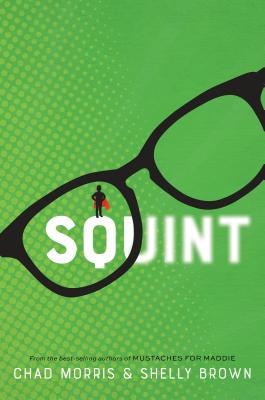
Squint

by Chad Morris and Shelly Brown
First sentence: “Double vision stinks.”
Support your local independent bookstore: buy it there!
Content: It’s not terribly long, but there are some more mature themes. It’s in the middle grade (grades 3-5) section of the bookstore.

Flint is a seventh grader, but because of his degenerative eye disease, everyone calls him Squint. Which he doesn’t really like. So, he’s channeling it into a graphic novel he’s drawing for a competition, because his grandmother has always said that he’s good at drawing. But, since he can’t really see, he doesn’t really know.

Yes (of course) he’s bullied by the popular kids at school, because middle school is a horrible place. But McKell, a new girl at school who’s joined the popular clique, isn’t feeling it. Her brother has a terminal illness, and so she reaches out to Flint, in order to do her brother’s “challenges” (via his YouTube channel). They have a rocky start, but eventually Fint and McKell learn that taking chances are a good thing, that a real friendship is the best thing, and maybe making good experiences is what life is really all about.

This was a super charming little book. My only real complaint was that the comic book sections were actually prose. I think it would have been MUCH better if the comic book sections were, well, actually comics. I think that would have increased the readability for kids (I skimmed those sections, too!) but would have added overall. But aside from that, it really was a sweet little story.

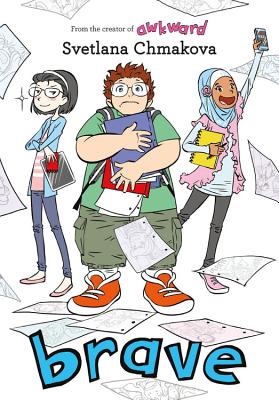
Brave

by Svetlana Chmakova
Support your local independent bookstore: buy it there!
Review copy provided by the publisher.
Content: There’s some bullying, but it’s really appropriate for 4th-6th graders. It’s in the Middle Grade graphic novel section.

I really don’t know what inspired me to pick this up; perhaps it was lack of time, and a graphic novel is easy to get through… I’ve not read Awkward, but that didn’t stop me from enjoying this one.

Jason is a 6th grader, and in his dreams he’s got big plans to be an astronaut at NASA and help figure out sunspots. In real life, however, he’s not so great. He’s bad at math, his friends (such as they are) are constantly poking fun at him, he’s often left out of groups, and he’s got two bullies on his tail. But, as the story progresses, things start to look up for Jason. Because he’s left out of the art club planning, he gets to help out at the newspaper. He makes a friend in Jorge, with whom he has nothing in common, but who is kind and interested in what Jason has to say. And, perhaps most importantly, he realizes he’s being bullied (not just by the kids on his tail, but also by his “friends”), and stands up for himself.

It’s that last thing that made this book so good for me. It’s easy for adults to say “stand up to bullies”, but honestly, not many kids realize they’re being bullied. (I sure didn’t, when I was in middle and high school. Neither did C when she was bullied in middle school) A lot of people brush it off as “jokes” or “criticism” but, honestly, it’s just plain bullying. I loved that Chmakova addressed that, that Jason had to REALIZE he was being bullied in order for him to take ownership of his own world. It makes me want to give it to all kids — because maybe those who are doing the bullying don’t realize they are hurting other people — just to get a conversation going.

I really enjoyed this one.

Posted

by John David Anderson
First sentence: “I push my way through the buzzing mom and freeze.”
Support your local independent bookstore: buy it there!
Review copy provided by the publisher.
Content: There’s some bullying and some mild swearing. It’s in the Middle Grade section (grades 3-5) of the bookstore, though it’s probably better for the upper end of that age range.

Eric Voss has found his “tribe”, the people in middle school that he would literally die for. There’s four of them, all of them with nicknames — Wolf, the piano prodigy whose nickname comes from Mozart; DeeDee, an Indian fantasy nerd, whose nickname comes from (you guessed it) D&D; and Bench, who gets his nickname from, well, sitting on the bench on all the sports teams he’s on. Eric himself is Frost, because he wrote an award-wining poem in 5th grade. He doesn’t mind. Frost (he goes by his nickname mostly in the book; they all do) thinks everything is good, until three things happen: 1) the school administration bans cell phones; 2) sticking post-it notes on lockers/walls/people becomes a Thing; and 3) Rose moves in and joins Frost’s “tribe”, at the invitation of Wolf and over the protestations of Bench. Then everything comes to a head, and Frost is left wondering who his real friends are.

It sounds like a simple plot, but it’s an engrossing one. I loved that Anderson caught the angst of middle school, the challenge it is to be the New Kid in the school, and the real desire to, well, fit in with everyone. I liked that the post-it phenomena when viral, and then turned negative, as many things often do. I liked that it was, ultimately, about friendship and fitting in, but there were also side issues like dealing with conflicts at home and how we perceive each other.

I’ve really liked both of  Anderson’s realistic fiction books; he’s got some chops. Definitely worth reading.

All’s Faire in Middle School

by Victoria Jamieson
Support your local independent bookstore: buy it there!
Release date: September 5th, 2017
Content: There’s some mild bullying and some kissing by background adult characters. It will be in the Middle Grade Graphic Novel section of the bookstore.
Review copy provided by the publisher.

Imogene has grown up in the Florida Renaissance Faire. Literally: her father is an actor in the permanent troupe, and her mother runs a shop. Imogene has been homeschooled up until now, but has decided that she wants to give middle school a try for sixth grade.

Possibly predictably, Imogene finds out that middle school isn’t a nice place. She’s teased for being homeschooled, for wearing her hand-made leather boots every day. She starts to make friends, but it’s with the “in” group. Which means (also predictably) that there will be conflicts when their desires conflict with the values Imogene has been taught.

Back at the Faire, Imogene has been promoted to be a squire, which means that she’s part of the “show”. Sure, it’s just to scoop poop in the joust and to wander around interacting with the guests, but Imogene loves it. And it seems that she’s making a friend of one of her classmates who comes every weekend.

Sure, the plot is predictable — I’ve read this same story a hundred times before — but that’s not to say that it isn’t enjoyable. Jamieson has a way with art and words and I cared very much about Imogene and her story. (Though I think I liked the minor characters — her parents and younger brother especially — better.) It was fun to read, and fun to see a little inside the workings of a permanent Renaissance Faire.

Falling Over Sideways

fallingoversidewaysby Jordan Sonnenblick
First sentence: “I’m waiting in the wings, watching all the fathers dancing onstage.”
Support your local independent bookstore: buy it there!
Content: There’s no swearing, drinking, or drugs. There is some talk of crushes. It’s a pretty skinny book, too. It’s in the YA section (grades 6-8) of the bookstore, but I’d give it to a 5th grader who was interested.

Claire is managing 8th grade okay so far. Sure, she’s no longer in the same dance class as her best friends. Sure, the boy at school who’s been mean to her for two years is still there. Sure, she’s still being compared to (and found failing) her Perfect Older Brother. And, sure her science teacher is kind of crazy. But it’s all manageable.

That is, until her father has a serious stroke. And she’s the only one home. She does what she’s supposed to do: calls her mom, calls 911. But it’s left her shaken. And it’s left her dad as a shell of himself. And that means her life has changed, whether she wants it to or not.

And while it’s a tough year for Claire, there are some bright spots. Sonnenblick captures the ordinary incredibly well, finding the joy and heartbreak in the little moments. Claire has a really heartwarming growth arc, as she goes from being afraid of her father in his new condition to being his biggest champion. And she grows with her friendships as well, discovering friends where she didn’t think there were. It’s a heartwarming tale overall (even if the mom starts out as annoyingly perfect and positive), one that will not only resonate with kids whose parents have been ill, but pretty much everyone who’s struggled a bit in their life.

A very, very good read.