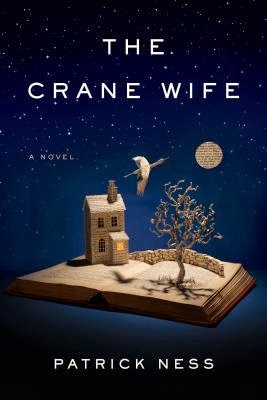
The Crane Wife

by Patrick Ness
First sentence: “
Support your local independent bookstore: buy it there!
Review copy given me by the Penguin rep.
Content: Multiple f-bombs and other language, some off-screen sex. Rightly sits with the adult fiction at the bookstore.

George is your very typical kind-of-loser guy. He’s divorced (nine years) with a child (who’s in her 20s) and can’t seem to keep a relationship (he’s too nice; they always break it off, but he’s always friends with them after). Even though he’s the owner of a print shop, he’s a bit of a pushover, letting his one employee, Mehmet, push him around. But, because he’s nice, because he’s George, when a crane with an arrow piercing its wing unexpectedly lands in his suburban London backyard in the middle of the night, he helps it out.

The next day, a woman named Kumiko shows up in George’s print shop. And suddenly, George’s life — and the life of his daughter, Amanda — are irrevocably changed.

Yes, this is a fairy tale. A very charming, sweet, wonderful fairy tale. Ness divides its time between George, Amanda, and Kumiko’s tales, but does so in a way that doesn’t feel awkward or forced. But it’s not just a fairy tale — or at least not just a one-dimensional fairy tale — art (in this case, paper cuttings) and a slight Japanese-inspired tale within a tale play major roles, which gives the book depth and substance.

But what I enjoyed most with this one was Ness’s use of the language. The fact that one of his characters, Rachel (who is very confused and not at all nice), speaks entirely in questions. Or the way he uses “…” to represent silence. Or the way George and Amanda think of themselves. And descriptive sentences like “He loved physical books with the same avidity other people loved horses or wine or prog rock.” (60) or “Stories do not explain. They seem to, but all they provide is a starting point. A story never ends at the end.” (141-142) or “She stopped, her face scrunching up in some really, really unattractive crying.” (161) There were others, but those are the ones that I marked.

It did all the things I want a book to do: it gave me characters to care about, and transported me away from the dreary winter months. It delighted me, and made me wish I was even a tiny bit artistic.

Delightful.

The Rosie Project

by Graeme Simsion
First sentence: “
Support your local independent bookstore: buy it there!
Review copy snagged off the ARC shelves at work.
Content: A ton of f-bombs, a character who has multiple one-night stands (because he wants to have sex with women from every country of the world), a lot of alcohol consumption (granted, all the characters are in their 30s). Thematically, I could see this having older-teen appeal, but it sits in the adult fiction section at the store.

Someone at work — my boss, perhaps — described this to me as a “romantic comedy.” Nothing of substance, really, but generally enjoyable. But because of the way the characters are, I kind of came to think of this as Sheldon gets a makeover.

Don Tillman is a genetics professor at an unspecified university in Melbourne, Australia. He’s got a brilliant mind, but his life revolves around… routines designed for efficiency. He wears Gortex shirts because they work for both regular life and exercise. He has a designated meal plan — lobster every Tuesday, for example — that enables him to both 1) minimize shopping and 2) free his mind to think instead of having to focus on cooking.

Granted, his idiosyncrasies — I liked that even though in the first chapter Don gives a speech to an Aspergers conference, it’s never stated outright that he’s been diagnosed on the autism spectrum — have made it difficult for him to have a relationship. As in: he’s never had one. He’s never had a second date. At age 38, he’s decided that it’s not only his inability to figure out social situations, but also his inability to find someone he’s compatible with.  So, he initiates the Wife Project: a survey designated to weed out unacceptable potential partners.

Then Don’s best friend Gene (who’s a real jerk, on so many levels) sends Rosie in. Don initially thinks Rosie is a candidate for the Wife Project, but it turns out it’s something more. She’s looking for her biological father, and wants Don’s help. Thus begins the Father Project, to which Don happily agrees. And although Rosie is far from “acceptable” as a prospective partner, Don finds that… well… opposites attract.

So, did it live up to the book talk? In some ways, yes. It was a very sweet book. Don was likable in the same way Sheldon is: you like them, but they drive you nuts. For the record: Don is much less abrasive than Sheldon. But since that’s the extent of my experience with Aspergers, I’m not even going to venture to comment on how Simsion treats it. That said: I get the feeling we’re supposed to be laughing at Sheldon, but I never felt like we were supposed to laugh at Don. It felt more inclusive than that.

I was disappointed that it wasn’t snort-milk-out-your-nose funny. There was only one scene — when Don and Rosie take over making cocktails at an event — that made me actually laugh out loud. But I did smile a lot. And I did like the dynamic between Don and Rosie, which offset the fact that Gene is a complete jerk. (And that’s being nice.) And I did think the ending was endearing.

So, yeah: it’s worth your time.

What We Found in the Sofa and How it Saved the World

by Henry Clark
First Sentence: “The sofa wasn’t there on Monday but it was there on Tuesday.”
Support your local independent bookstore: buy it there!
Content: There was a bunch of bookish and cultural references that I don’t think a younger reader would “get”, but there isn’t anything content-wise (well, an angry dictator turning into a werewolf, maybe) that would be unsuitable for a younger reader. It’s in the middle grade (3-5th grade) section of the bookstore.

Friends River (he’s a guy; I wondered at first, too), Freak (not his real name), and Fiona all live at the edge of a huge underground fire that the town has nicknamed Hellsboro. If that’s not odd enough, one day when they’re waiting for the school bus, they discover a couch waitng for them. With a zucchini-colored crayon in between the cushions. Thus begins their adventure which includes an eccentric neighbor, a planet on the inside of a basketball (sort of), a computer/entity called Guernica, and a plot to enslave the human race.

And it seems that River, Freak, and Fiona are the only ones who can stop this from happening.

The best way to describe this book is an acid trip for kids. I know that sounds odd, but honestly, it’s the best description. This was jam-packed with odd TV and culture references (which, being an adult, I got), but it was more than that. I think it was meant to be funny — and it was, sometimes (the toilet hot-air balloon got a guffaw out of me) — but what started out as an awesome premise (a tessering couch that eats dust bunnies for fuel is pretty awesome) just kind of petered out. I  kept reading it because it was SO unbelievable: what weird, trippy, insane thing was going to happen to the friends next. So, I guess on one level it succeeded: it kept me reading.

But in the end, it left me unsatisfied and shaking my head. It was quite the trip, though.

(Just for the record: because this is a Cybils nominee, I’ve been asked to make sure y’all know this is my opinion only, and not that of the panel.)

Blue Plate Special

by Kate Christensen
First Sentence: “Often, whenever I come up against anything painful or difficult, my mind escapes to food.”
Support your local independent bookstore: buy it there!
Content: There are other issues, but mostly, lots of f-bombs (didn’t count).

I’m going to spare you this review and tell you what I think straight up: much like Vizzini, this book is not what Christensen (or I) thought it was. It says, right there on the cover, “An Autobiography of My Appetites.” And I thought: “Oh good! Food book!” Even though Christensen threw me a bone in the form of a recipe every once in a while (though honestly: BEAN BURRITOS), this had none of the hallmarks of a food book (except said recipes): luxurious, descriptive, evocative passages about the food and the eating experience.

What it was, however, was a very long, very involved, very sordid, very blunt telling of Christensen’s very messed-up life. It’s the epitome of tell-all: she Told it ALL, from her father’s abuse of her mother to her very horrid first marriage. I read the whole thing, though I often wondered why. (Actually, I knew why: it was one of those books that I kept hoping would get around to being what I Wanted It To Be, but never did. Those are the WORST KIND.) I wondered what the point was, because even though Christensen led an adventurous life, the book version of it was anything but interesting. I don’t know what her purpose was: to make us feel sorry that she never appreciated anything? To purge all her secrets so that she can make a fresh start? Whatever it was, all I got was annoyed: annoyed that she was going amazing places and not Taking Advantage. Annoyed that she spent her 30s drunk and unhappy. Annoyed that I picked up this stupid book in the first place.

The writing wasn’t even lyrical, or evocative. It was boring on a sentence level. Which makes me wonder about her novels, which I’ve never read. But then again, a person may be able to write a novel, but not manage to be evocative about a picnic in Italy. I think I’ll go find some Frances Mayes as a counter balance.