EMGSF Smallish Books

The Lonely Lake Monster
by Suzanne Selfors
First sentence: “Pearl smacked the alarm clock until the loud beeping stopped.”
Content: Nothing objectionable or difficult at all. My only problem is deciding whether or not it’s happiest in the middle grade (3-5) section or the beginning chapter book (grade 1-2) section. It could go either way.
Others in the series: The Sasquatch Escape

I really liked the first one of the series; and this was more of the same. It wasn’t bad; Pearly got to shine as her own heroine, saving her friend Ben from a lonely lake monster. She came up with and executed a solution on her own, which I was very proud of and grateful for. It just lacked substance, which is just me as an adult talking. It’s perfect for the target age group.

The Ghost Prison
by Joseph Delaney/Illustrated by Scott M. Fisher
First sentence: “For pity’s sake, get up, lad.”
Content: Lots of ghosts. Would sit in the middle grade (3-5) section of the bookstore.

This is a ghost story. For kids. It’s got (duh) ghosts, and kid-eating monsters, and atmosphere coming out the wazoo. Except, it wasn’t scary. At all. Even the twist at the end wasn’t a surprise. Perhaps it was because I am an adult, and it’d be terrifying to a 7-year-old. But, honestly? You want something scary? Read Coraline.

Mickey Price: Journey to Oblivion
by John P. Stanley
First sentence: “Every great adventure starts with a moment.”
Review copy sent to me for the Cybils.
Content: Seventh-graders being put in dangerous situations. But other than that, nothing. Would reside in the middle grade (3-5) section of the bookstore.

Mickey Price — confusingly telling this story to his kids when he’s older — is a seventh grader who gets chosen to be a part of a super-secret astronaut program in 1977. They get sent to the moon and Save The World. There’s science and math because, you know, they’re Useful. And I spent the entire book alternately wondering WHY this was in the Speculative Fiction category — was it because it’s unrealistic to send seventh graders into space — and wishing Stanley had gotten a better editor. Good idea, lousy execution.

(Just for the record: because this is a Cybils nominee, I’ve been asked to make sure y’all know this is my opinion only, and not that of the panel.)
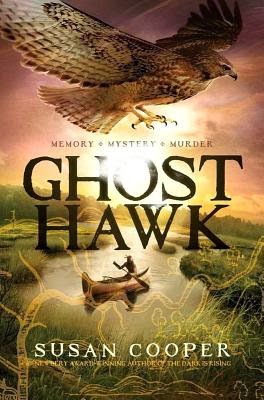
Ghost Hawk

by Susan Cooper
ages: 11+
First sentence: “He had left his canoe in the river, tied to a branch of a low-growing cherry tree.”
Support your local independent bookstore: buy it there!

I should start with this: the woman can write. A random passage: “John went off to their allotted acre of land beyond the houses, where corn and pumpkins were growing. He did not point out to Daniel Smith that the swelling ears of corn were more at risk from night-prowling raccoon than from daytime birds.”  Or: “We gutted the deer, and tied their forelegs together and then their hind legs, and we carried them home, each one hanging by the legs form a pole carried by two strong men. It took all night and half the net day, but it was a triumphal procession, and our return was greed with cries of praise and delight.” It’s one of the things I’ve always enjoyed about Cooper’s writing: she knows how to evoke a place, and with the simplest of words, create a mood.

But.

I knew about the inaccuracies and controversy surrounding this one before starting it. In some ways, I think it was inevitable: a book about a Wampanoag young man (especially a children’s book, it seems; was there the same sort of backlash around Caleb’s Crossing? If so, I missed it.) written by a white person is bound to create backlash. And to be fair, I understand that. But I have to admit that that’s not my primary problem with the novel. No: for me, it was because it was boring.

Cooper went into detail about the life of both Little Hawk as well as a Puritan boy, John Wakeley, and even though there were a couple of surprises (let me just say, I found out a third of the way through why it’s a SFEMG nominee), I was bored. I could care less about the characters, the story. I wanted to care. I wanted to see people like Daniel Smith and William Kelly — who were in favor of exterminating the Native Americans because they were savages (which always brought to mind the savages song from Pocahontas) — I just didn’t. It’s not because I didn’t recognize that their views were wrong. I just didn’t feel it.

And the last third? (The epilogue and post-epilogue as I think of them.) I basically skimmed them. Because once both Little Hawk and John stopped being kids, I lost interest. It’s a middle-grade book, for heaven’s sake. Have we forgotten what that means??

I wanted this to be better, just because it’s Susan Cooper. And I was disappointed that it wasn’t.

(Just for the record: because this is a Cybils nominee, I’ve been asked to make sure y’all know this is my opinion only, and not that of the panel.)

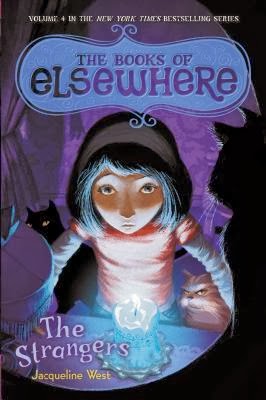
The Books of Elsewhere: The Strangers

by Jacqueline West
ages: 9+
First sentence: “Houses are good at keeping secrets.”
Support your local independent bookstore: buy it there!
Others in the series:The Shadows, Spellbound, The Second Spy

I’m going to be honest. At this point in the series, if it hadn’t been nominated for the Cybils panel I’m on, I wouldn’t have read it. Because I feel like the series is kind of dragging on. Just how many more times can Olive go up against Annabelle McMartin in order to save the house? How many threads can not be wrapped up by the end of a book? Why can’t they find Morton’s parents? And how completely dense are Olive’s?

In this one, some neighbors show up: a Brilliant Professor married to a Slightly Batty Medium (it’s too bad she wasn’t a Small Medium at Large), and an Incompetent Apprentice. They weasel their way into Olive’s life when her parents get kidnapped on Halloween. The main focus of this one is figuring out where Olive’s parents are and getting them back, while still protecting the house from Nasty Annabelle.  As far as that goes, I called who the Bad (or Misguided) Guys were early on, and so it was just a matter of time until Olive caught up to what I already knew.

It’s not that it was a poorly written book — it wasn’t. It’s just that the premise is getting old by book 4, and even the talking cats that were so much fun in book one aren’t making me laugh. And to be totally, completely honest: I skimmed this one, mostly, because I just wasn’t interested in Olive anymore.

(Just for the record: because this is a Cybils nominee, I’ve been asked to make sure y’all know this is my opinion only, and not that of the panel.)