Finally Heard

by Kelly Yang
First sentence: “‘Mom!’ Millie, my sister, protests, banging on the door.”
Support your local independent bookstore: buy it there!
Others in the series: Finally Seen
Content: There is talk of puberty, crushes, and social media. It’s in the Middle Grade (grades 3-5) section of the bookstore, but I’d give it to the older end of the age range.

Lina’s mom’s business making bath bombs has stalled, and the thing that they need to save it? Social media. It’s also taken over the 5th grade- everyone in Lina’s class seemed to have gotten phones over spring break, and there’s no stopping the posting, looking at the phones, and worst of all: the bullying in the Discord chats. And Lina’s no exception. She, her sister, and her friends discover that they’re good at making content for people, and her mom becomes obsessed with answering every comment posted. On top of that, Lina’s starting to go through puberty and has no idea how to deal with her changing body. It’s all spiraling out of control.

Yes, it’s a treatise against 10- and 11-year-olds having phones and access to social media, but Yang has woven a good story here. I like Lina’s confusion both with puberty and with social media. It felt honest and real: kids don’t know what they’re getting into at that age. Yang touches on all aspects of social media: the addiction, the bullying, the misrepresentation, and does it in a way that’s very accessible for kids.

I liked the first book in the series better, but this one was a solid story.

The Apartment House on Poppy Hill

by Nina La Cour
illustrated by Sonia Albert
Support your local independent bookstore: buy it there!
First sentence: “1106 Wildflower Place was what many considered to be a perfect building, plunked right in the middle of Poppy Hill, a not entirely perfect hill but a good one all the same.”
Content: There are three sections of short chapters. It’s in the Middle Grade (grades 3-5) section of the bookstore, but I’m considering suggesting it move down to the Beginning Chapter (grades 1-2) section instead. I think it fits better there.

Ella has lived at the apartments at Poppy Hill her whole life, and she knows almost everything about her neighbors and the building. So, when newcomers Leo and Cleo move in, Ella is there to show them the ropes. The only thing she doesn’t know: much of anything about the Robinsons, the older couple who live in the topmost apartment.

Much like most beginning chapter books, this one is light on plot but leans heavily into charm and character. You meet all the neighbors through our very competent main character, Ella, and there is a very charming assortment of quirky neighbors. Eventually, in the third section, you meet the Robinsons, who are equally charming and delightful.

That’s all there is, which is fine when you’re 7. In fact, I think many seven-year-olds will really like this one.

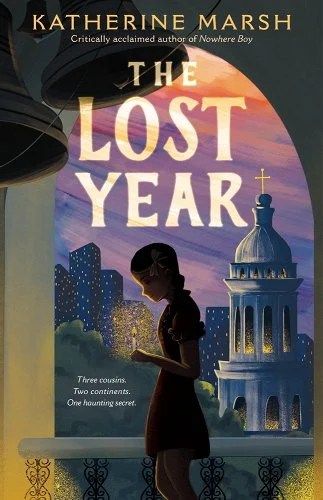
The Lost Year

by Katherine Marsh
First sentence: “Dark Beast Ganon charged.”
Support your local independent bookstore: buy it there!
Content: There is talk of starvation and the deaths of children. It’s in the YA section (grades 6-8) of the bookstore. I read this book for the Cybils, and this reflects my opinion and not that of the whole panel.

It’s spring of 2020, which means that Matthew is trapped in his home due to the COVID-19 pandemic. He’s bored out of his mind, mostly because his great-grandmother – whom they call GG – has come to live with them and his mom is super strict about not interacting with anyone because of the pandemic. He has his Switch, until his mom decides that he needs more to do than sit playing games, and tasks him with helping GG go through her stuff.

When he finds a black and white picture of her and another girl, he slowly gets GG to open up about her childhood in Ukraine and the famine that plagued the country in the early 1930s. Told in alternating voices – we hear Matthew’s story as well as Helen’s, a first-generation American immigrant – and Mila’s – the daughter of a Communist official – stories.

I really liked this one. I liked the parallels between the early days of the pandemic and the Ukranian famine of 1932/1933. I liked how Marsh made each of the three characters come alive on the page, and made the historical parts relevant to today. And even though there is conflict, as a a reader, you can see all the various perspectives. In the end, after all, we’re all just trying to survive somehow.

It’s a good story, and one I think kids who like Jennifer Nielsen or Alan Gratz will enjoy.

Lasagna Means I Love You

by Kate O’Shaughnessy
First sentence: “Dear Nan, You died on a Tuesday.”
Support your local independent bookstore: buy it there!
Content: There is talk of death and dying, and the main character is processing grief. it’s in the middle grade (grades 3-5) section of the bookstore.

Mo has lived with her grandma, Nan, all her life. And since Mo’s mom passed when she was six, Nan has been her guardian and basically only family. So, when Nan suddenly dies, Mo is a bit unmoored. Even more so when her mom’s brother, Billy, refuses to take Mo in, and she ends up in the foster care system. Nan’s last advice to Mo was to get a hobby. By chance, Mo stumbles across a cookbook full of family recipes, which gives her an idea: she’s going to collect family recipes, learn to cook them, and hopefully find a family recipe (and a family) of her own.

I appreciate that this book is aware of its privilege: Mo is a white kid and gets taken into a pretty well-off white home. She does recognize that this gives her privileges she might not have had otherwise (or that her friends from her old neighborhood in Brooklyn don’t have). But, at its heart, it’s a story of found family. And that’s always heart-warming. I thought O’Shaughnessy was good at portraying grief in both a way that seemed accessible as well as believable. And I liked the characters that surrounded Mo. Sure, a kid opening a one-night-only flash restaurant on New Year’s Eve is probably pretty unrealistic, but hey: I liked the thought and the spirit and the community that it built. A solid read.

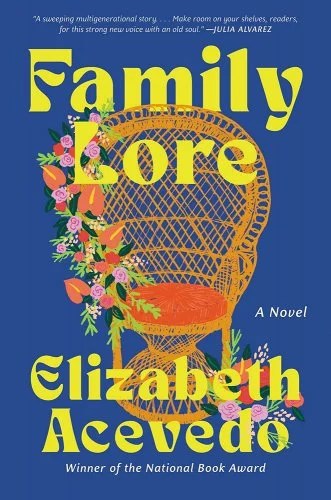
Audiobook: Family Lore

by Elizabeth Acevedo
Read by the author, Sixta Morel & Danyeli Rodriguez del Orbe
Support your local independent bookstore: buy it there!
Or listen at Libro.fm
Release date: August 1, 2023
Content: There was a lot of swearing, including multiple f-bombs, talk of sex and p0rn, and abuse by adults towards children. It will be in the Fiction section of the bookstore.

I have a tumultuous history with magic realism. A lot of the time, it doesn’t sit well; if there’s going to be magic, my brain reasons, then why don’t we have it be magic. Give me someone pulling cars out of their dreams, if you want to set it in the real world. But the idea that someone’s “magic” can predict death, or tell if you were lying, or – heaven help me – have a magical vagina, you lose me. 

On the one hand: I have really loved Acevedo’s books in the past. I think she’s a brilliant writer and I’ve really enjoyed the tales she’s had to tell. I was excited by this one: the stories of sisters who have immigrated from the Dominican Republic, and their reflections on their lives and loves as they lead up to the living wake of the oldest sister. Sounds good, right? 

But, the narrator is Ona, an anthropologist, and the book’s framework is her collecting and telling these stories. I was fine when it was the stories, but Ona? Ona – she of the magic vagina – I intensely disliked. That’s an understatement. I loathed it when she was around when she interrupted the story with her own observations and her own narrative. I wished I could have skipped it – I was listening to it on audio; I suppose I could have, but it’s not the same as skipping pages in a book – and moved on with the part of the story I was interested in. 

I finished it. But, in the end, my dislike of Ona and magical realism trumped whatever good the book had.

Audiobook: Before the Coffee Gets Cold

by Toshikazu Kawaguchi
Read by Anna Li
Support your local independent bookstore: buy it there!
Or listen at Libro.fm
Content: There’s not much objectionable. it’s in the Fiction section of the bookstore.

In a small, underground cafe in Tokyo, there is a chair that will take you back in time. There are rules, of course, but if you follow the rules you can go back and meet someone. Perhaps it’s a husband who has now forgotten you because of Alzheimer’s; or a boyfriend you had a bad conversation with; or a sister, who is now dead. Or maybe, you are brave enough to go into the future to meet the daughter you birthed but then died shortly after. Whoever you meet, while you can’t change the present, maybe you can just set your heart at peace. 

I was at first charmed by this short book – the narrator is good, and the translation (it was originally written and published in Japanese) isn’t bad. But honestly: as the book went on, I became more impatient with it. They repeated things – do I really need the Rules for Traveling every time someone new sits in the seat? – and while I didn’t dislike the characters, I didn’t really like them either. I feel like there was so much more Telling than Showing – let me tell you all about this character or this situation, rather than just letting it unfold naturally. I usually listen to my audiobooks at 1.0 speed, because I liked to hear the narrator and the story unfold at a natural pace. But I got fed up with this one, and sped through the last quarter because I was just Done with this book (but too close to the end to bail). 

I don’t get why people love it, or why it sold so many copies. But that’s just probably me.

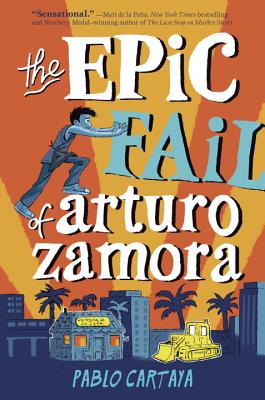
The Epic Fail of Arturo Zamora

by Pablo Cartaya
First sentence: “I’m officially resigning from love.”
Support your local independent bookstore: buy it there!
Content: It’s a bit more, well, mushy than your usual middle grade fare, but it doesn’t smack of YA quite yet. While it’s in that nice spot for 10-12-year-olds, it’s in the Middle Grade section (grades 3-5) of the bookstore. I may change that and put it in the YA. We’ll see.

It’s the summer after 7th grade, and Arturo Zamora is ready to have a good one. He’s working at his family’s restaurant, hanging out with friends in his Miami neighborhood. That all changes, however, when a big developer decides to make a bid for the lot next door to the restaurant, the one which the Zamora’s were hoping to purchase from the city for their expansion, and has plans to put in a fancy new “exclusive” building. All of a sudden Arutro’s summer has turned into fighting this developer, and figuring out his place in the family. Not to mention his burgeoning feelings for his mother’s goddaughter, Carmen. It’s going to be quite the summer.

This was a really fun book. I enjoyed Arturo’s attempts to figure himself out. I loved the Cubano culture that threaded itself through the book. I loved Arturo’s relationship with his grandmother and mother. Even the slight romance wasn’t overdone. I loved that the Spanish was woven seamlessly in the book, often without English translation. It felt more authentic that way. And I also thoroughly enjoyed getting to know the Zamora’s and cheering the little guy in the fight against Big Man. Definitely one to check out.

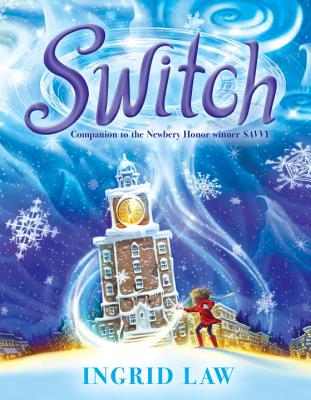
Switch

by Ingrid Law
First sentence: “Please, Mrs. Foster– I’ve seen your future, and you really don’t want to buy this soap.”
Support your local independent bookstore: buy it there!
Review copy provided by the publisher rep.
Others in the series: Savvy, Scumble
Content: It’s pretty basic for younger kids (though I think it might be a handful for some 3rd graders), and though there’s some kissing and a little bullying and some scary driving in the snow, it’s mostly harmless. It’s in the Middle Grade (grades 3-5) section of the bookstore.

One of the things I like best about Law’s books is that even though they’re a trilogy, they’re also three stand-alones. Sure, it helps if you know what a savvy is and what scumbling means, but other than that, the whole story is basically self-contained. And that’s wonderful.

This one is Gypsy’s story (who was a wee babe in the first book). It’s a couple months after Gypsy gets her savvy, which is seeing a person’s future (or past) when she looks at them. It’s a tough one to scumble, but she’s trying. Then comes the news that her Grandma Pat (her dad’s mom, one without a savvy and who doesn’t really like the Beaumont kids) is deteriorating and needs to come live with them. This is not something that Gypsy is happy about; she and her grandma don’t really get along. But, she doesn’t have much say in the matter, so she’s dragged along to Colorado when her mom takes her and her brothers Samson and Tucker off to Colorado to fetch Grandma Pat.

And that’s when things get interesting: somehow their savvys are switched. Mom is no longer perfect, Samson went from being invisible to being the Lord of the Fire, and Tucker, who is only eight, got his savvy five years early. And Gypsy discovers she can stop time. Then Grandma escapes the house (she has Alzheimer’s and is determined to go to a school dance) in the middle of a blizzard and it’s up to Gypsy, Samson, Tucker, and their new friend Nola to bring her back.

It had very much the same feel as Law’s other books: sweet, family-centric, with a bit of unbelievableness thrown in. I had a hard time suspending my disbelief: why on EARTH were they wandering around in Denver during a BLIZZARD? But, aside from that I loved Gypsy and Samson (and Tucker was adorable, though acted a bit young for an eight-year-old; he felt more like five). I liked the story, I liked that most of the book was over one night, and I liked that Gypsy learned to understand and accept her grandmother for who she was, not who Gypsy wanted her to be.

I’m not sure it’s my favorite of the series, but it’s a solid addition.