The Year of Shadows

by Claire Legrand
First sentence: “The year the ghost came started like this:”
Support your local independent bookstore: buy it there!
Review copy provided by the publisher for the Cybils.
Content: There are ghosts and shades and it gets pretty scary. There’s also a lot of pre-teen Angst and a little bit of romance. For those reasons, even though it’s in the middle grade (3-5th grade) section of the bookstore, I’d probably hand it to the older end of the spectrum. But that’s just me.

Olivia hates her life. Her father — whom she less-than-affectionately calls the Maestro — is wholly absorbed with being the conductor of their town’s struggling orchestra. So involved that Olivia’s mother left. So involved that they sold their house and auctioned off their belongings and moved into the back rooms of the concert hall in order to keep the orchestra afloat. And for 13-year-old Olivia, this does not sit well. In fact, she loathes it. (Understatement of the century.)

She’s miserable, she’s basically homeless, and then… she discovers there are ghosts in the concert hall. Not just ghosts, but shades — ghosts that have given up the search for the chance to move on and given into Limbo — as well. And it’s the shades that are Dangerous. And it’s up to Olivia and her new friend Henry to help the ghosts move on and defeat the shades. And, perhaps, in the process maybe they can figure out how to save the concert hall and the orchestra.

I adored this book for lots of reasons. Olivia was dark and grumpy and prickly and perfect for a ghost story. I loved the musical setting for this — the concert hall, the strains of orchestral music (it needs a soundtrack!) running through the story; in the endnote, Legrand talks about choosing pieces to fit the mood of Olivia’s life, and being familiar with many of the pieces, I think she did fabulously. (I don’t know how non-musical readers would react to it, though. Would it make them want to go look up the pieces?) I enjoyed Henry and some of the other minor characters, with their New-Agey feel and their support of Olivia. Because the Maestro? He’s firmly in the bad parent camp. He’s not a “abusive/horrible/evil” dad, but rather the “neglectful/unobservant” dad. And I can understand Olivia’s anger towards him.

There is one quibble: there’s a plot twist near the end of the book that I didn’t feel was absolutely necessary. (And which added to the Maestro’s bad parent-ness.) I think Legrand needed it for plot purposes, but it felt like it was out of left field, and didn’t quite fit with the rest of the book.

Other than that, though, it was highly enjoyable.

(Just for the record: because this is a Cybils nominee, I’ve been asked to make sure y’all know this is my opinion only, and not that of the panel.)
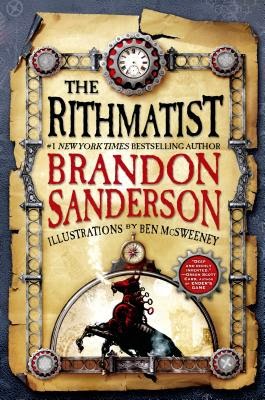
The Rithmatist

by Brandon Sanderson
First sentence: “Lilly’s lamp blew out as she bolted down the hallway.”
Support your local independent bookstore: buy it there!
Content: It’s pretty mild; there is some talk of murders, and some intense situations by the end and a mild romance. It’s only upper middle grade because of the length. I’d give it to my 10 year old, if she showed interest. It’s shelved in the YA section (grades 6-8) at the bookstore because of the length. That, and the publisher’s recommendation was 15+, which I disagree with.

Imagine a future where some unforseen disaster splits the US into several island country/states. Imagine a future where there are people — Rithmatists — who can draw with chalk and make it come… alive. Imagine a future where wild chalkings — two-dimensional chalk drawings that are sentient, somehow — can attack and kill a person. It’s in this world that Joel, a chalkmaker’s son, exists. His father used to be the chalkmaker for a prestigious Rithmatist training school, before he died. Now, Joel and his mom are scraping by. Joel would love to be a Rithmatist, but they’re chosen at age 8, in a mystical/religious ceremony, and Joel wasn’t Chosen. That hasn’t stopped his passion for Rithmacy and the history. He’s pretty much shunned until one of the top professors, Fitch, is toppled from tenure by a young upstart. And then, top students start disappearing. With another not-so-great student, Melody, Joel works at figuring out just what is threatening the students.

This was slow-going at first. I didn’t quite grasp the idea of the world, or the importance of the illustrations. Which, in many ways, is a drawback: if you can’t grab a kid in the first chapter or two, then in many ways you’ve failed as a book. But this one is worth the slog in the first couple of chapters. It takes a while, but as the mystery develops, and things become more intense, and more about the Rithmastist world is explained, Joel — and especially Melody — come into their own. The final couple of battles are quite intense and very much worth the while. And even though I kind of called the mystery, there is a bit of a twist that I didn’t see coming, which was very satisfying. And as I came to understand the illustrations — which admittedly were off-putting at first — I found them at least as fascinating as the story. If Sanderson wants to write a guidebook for the Rithmatist world, I’m sure there’d be a market for it.

I do wish — and I know that I’ve said this before — that people would stop writing series books. This one worked quite well as a stand-alone, even with a few threads hanging. I do appreciate that (even though the last three words are “To Be Continued.” ARGH). But overall, it was a fascinating world to immerse myself in.

(Just for the record: because this is a Cybils nominee, I’ve been asked to make sure y’all know this is my opinion only, and not that of the panel.)

Stupid Fast

by Geoff Herbach
ages: 14+
First sentence: “This could be a dark tale!”
Support your local independent bookstore: buy it there!

I will say this up front: in spite of what you might think judging from the title and the cover, this is not a football book. Sure, the main character, Felton Reinstein, gets drafted to play football (which he hasn’t the first clue about), football actually plays a real minor role.

It is, however, a guy book. In fact, that’s the best thing about this book. Herbach knows guys, and gets the voice down: his sweatyness, awkwardness, quirks, confusion, lusts, and cluelessness scream 15-year-old Guy. Additionally, it works because Felton is so dang likeable. Even in his guyness, you want to know this kid.

It’s the summer before Felton’s junior year. He’s about to turn 16, and his growth spurt (starting around Thanksgiving) has finally hit him: he can’t keep up with his body. That said, he’s, well, stupid fast. Which means he can actually do things in the sports arena, something which he never could do before. He almost beat the track star before nerves got to him. And so, he gets recruited to play for the football team. He has no idea what he’s doing, but it feels good to get out and work his body out. Especially since his home life has been falling apart at the seems.

See, his dad killed himself when Felton was five (Felton had the unfortunate experience of finding him), and his mother, Jerri, has been holding it together. Until this summer: now she’s slowly falling apart. Well, maybe not so slowly. She went from loving mom to calling Felton a jerk and a f-bomb-er, and spending her days in a dark room watching TV and sleeping. Felton has a way out, but his younger brother Andrew is suffering.

It sounds dark, but trust the first sentence: while it’s tackling some tough issues, it never becomes an issue book. It’s really just about Felton and his ability (or lack thereof) to deal with all the changes in his life. The ending does wrap things up a bit nicely, but instead of being happy, it’s more hopeful: that maybe Felton, in spite of all the crap around him — because, after all, he’s a nice guy — will will make everything work out for the best.