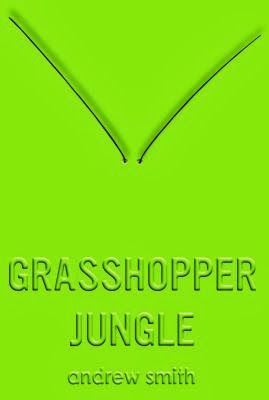
Grasshopper Jungle

by Andrew Smith
First sentence: “I read somewhere that human beings are genetically predisposed to record history.”
Support your local independent bookstore: buy it there!
Review copy highly recommended by our publisher rep.
Content: Weeelll….. sh*t is Austin’s favorite word, and all grasshoppers do is “f**k and eat”. Which gives you a pretty good idea of the language. And Austin and Robby smoke. There is some drinking and one very unsexy sex scene (and talk of masturbating and erections and sex). It’s in the teen section of the bookstore, but I know I’m going to find it difficult to find a parent willing to buy this one for their kid. (That’s not to say the kids won’t like it. They might.)

The short version, the one I’ve been pitching at work (after I realized it was more than “grasshoppers and sex” — though it is that), is that it’s what would happen if Holden Caulfield found himself in a Stephen King novel. Austin — he’s the 16-year-old, sex-obsessed boy whose head we’re living in — is confused and lonely (even though he has a best friend and a girlfriend) and angsty and more than a little self-absorbed, much like Holden. And yet, the setting is so utterly antithetical to our character: a strain of mutant bacteria gets out and starts changing people into six-foot-tall praying mantises whose sole purpose in life is to eat — everything, including each other — and procreate.

Who dreams up these sorts of things? (Well, Stephen King and Andrew Smith, obviously.)

At any rate, it’s nothing like what I expected. I think with all the advance buzz — not just from our rep, but also Publisher’s Weekly, and just the reviews on Goodreads — I expected something, well, amazing. And I got… well, a sex-obsessed, selfish, confused 16-year-old boy. I can deal with that, for the most part (I did make it through Winger after all), and I appreciated Smith for giving us a confused sex-obsessed boy; Austin’s not only confused about life, but also about his own sexuality: how can a person be in love with — and desire — both of his best friends at once?

But, reading through the Goodreads reviews, I stumbled upon one from Kellie at Stacked that made points that I think had been at the back of my mind while reading this book. Nominally, it boils down to this: a woman couldn’t have written a book like this about a girl talking so frankly about sex or her vagina and have it receive the same amount of buzz and acclaim that this one is getting. And secondly: Austin treats girls and women as objects.

The first point, I can see and understand and am a little bit miffed about. It really does go back to this “boy books” and “girl books” thing we (publishers/sellers/parents) have gotten into. We “need” this book because boys “need” this book (because they’re not reading anything else). But that least me to point number two, which is what was bothering me while I read the book. I had chalked it up to being inside a 16-year-old boy’s mind, which is not a comfortable place. But, looking back, it’s really because, to Austin, all women (well, perhaps all people) are a means to an end: sex. He says he “loves” his girlfriend, but honestly, he just wants to jump her. And this — at my very core — bothered me. (In fact, when Robby finally confronts Austin and tells him he’s selfish, I cheered. More of that, please.)

I was talking to a friend at work about this and she pointed out that maybe, just maybe, it was meant to be satirical or ironic. That perhaps we, as readers, were meant to see that Austin is a complete jerk, and find humor in that. Or at the very least, self-reflection.  Perhaps. All I found was discomfort.

There were other things I was disappointed in: Austin’s circular telling of his own personal history, his constant repeating of people’s names (yes, I know Shann’s name is Shann Collins and her stepfather is Johnny McKeon, can you PLEASE stop already?), and just the general uneven pace of the narrative. That said, there were things to admire: actual sentences that made me laugh aloud. Or the fact that Austin’s (and Robby’s for that matter) sexuality was just a thing, and not an “issue”. Or six-foot-tall unstoppable praying mantises.

But I don’t think the positives outweigh the negatives on this one.

Better Nate Than Ever

by Tim Federle
First sentence: “I’d rather not start with any backstory.”
Support your local independent bookstore: buy it there!
Content: There is some bullying, a bit of swearing, and some frank talk about sexuality and alcoholism. I probably wouldn’t give it to a third grader (it just feels more mature than an 8-year-old, but you know your kid), but a 4th or 5th grader would be fine with it. It’s in the middle grade (3-5th grade) section of the bookstore, though the library has it in the teen section (which surprised me).

Nate Foster is a 13-year-old kid living in the blue collar town of Jankburg, PA (just outside of Pittsburg). His dad is a “maintenance engineer” and his mom runs a slowly dying flower shop. They have put all their hopes, dreams, and expectations on Nate’s older brother, Alex, the sports star. Which leaves Nate as the… well… outcast. It doesn’t help that he’s a Broadway musical fanatic, knowing them all, singing away, quoting incessantly. Which leaves his family (and the town) baffled.

Of course, Federle is playing off of stereotypes here: people in blue-collar towns are (obviously) backward and don’t understand Culture. People — boys especially — who like musicals are (obviously) gay. (There is much too much discussion about Nate’s sexuality here. And while his position is “I’m 13, how would I know if I were gay?” it bothered me that musicals are, necessarily, lumped in with being gay. Can we just get over that, now, please?) Boys who are short, overweight, and awkward are (obviously) bullied at school (and by his — jerk is not a strong enough word — older brother).

When Nate finds out about open auditions for a new musical based on the movie E. T. he jumps at the chance. And because he knows his backward parents would never let him, he takes the opportunity (with the help of his friend Libby) to run away to the auditions. He was supposed to go there and back again in a day, but (of course) things don’t quite work out. Which brings us to another cliche here — the kid from the backward blue-collar town has NO IDEA how to make it in New York City. (Which may be true, having never run away to the big city when I was 13.)

Even with all the cliches and stereotypes, this wasn’t a terrible book. And I think what saved it, for me at least, was Nate himself. Federle caught the voice of an awkward, insecure, hopeful kid someone who has been beaten down his whole life, and yet still remains optimistic about everything. He’s adorable, and heart-warming, and just plain fun. It was this that kept me reading, and when I finished, it was this that made the book a good one for me.

Additionally, it’s one of those books that’s good to have out there, if only because it addresses stereotypes. There aren’t that many books out there where the male main character gets to be something other than stereotypically male. Hopefully, boys will pick this up and give it a shot. If only to increase their empathy.

There’s a sequel — Five, Six, Seven, Nate — which just came out. I may even like Nate enough to give that one a shot.

Beholding Bee

by Kimberly Newton Fusco
First sentence: “The way I got the diamond on my face happened like this.”
Support your local independent bookstore: buy it there!
Content: There’s some bullying, both by (insensitive and stupid) adults and mean girls. But there’s no language, and the language isn’t difficult at all. It sits quite happily in the middle grade (3-5th grade) section of the bookstore.

It’s in the middle of World War II, and things are tough for those who work at the carnival. Especially for Bee, who works the hot dog stand with her makeshift guardian, Pauline. It’s difficult for Bee not only because she’s an orphan and the carnival owner, Ellis, is a world-class creep, but because she’s got a birthmark in the shape of a diamond on her face that everyone (EVERYONE!) stares at and/or makes fun of.

So, when Ellis takes Pauline away from her and threatens to put her on display as a sideshow attraction, Bee decides to run away. She makes it to a town with a perfect house, and finds a couple of women whom she ends up calling “aunts” there. The catch? Only Bee can see her aunts.

Of course life in her new town isn’t easy: there are busybodies who want to know who Bee’s caregivers are. There are mean girls who are dealing with Issues themselves. But there’s also good people who reach out to Bee and make her feel at home.

In so many ways, this was just a plain, regular middle grade fiction book. And it’s a good one at that. Fusco writes lyrical, short chapters; ones that make you want to keep turning pages. There’s the backdrop of hardship with the war, there’s bullying, there’s Bee’s “disfigurement” and shyness that places her in the special-needs class. It really is quite a lovely little novel about Overcoming, finding family, and creating a home.

The question I had, though, while reading this book is this: why the ghosts? It was a great novel without them, and I didn’t feel that the ghosts added anything to the story. They felt, well, contrived. And I wished that Fusco had found another way to get Bee into the town and the house that didn’t involve the supernatural. That way the book would have had a broader appeal, more power, and been absolutely perfect.

But, I guess, you can’t win them all.

(Just for the record: because this is a Cybils nominee, I’ve been asked to make sure y’all know this is my opinion only, and not that of the panel.)

Hoot

by Carl Hiaasen
First sentence: “Roy would not have noticed the strange boy if it weren’t for Dana Matherson, because Roy ordinarily didn’t look out the window of the school bus.”
Support your local independent bookstore: buy it there!
Content: There were a few mild swear words (which A found amusing), and some instances of bullying and domestic violence. It feels like a genuine middle grade book, with real middle grade heroes (yay!) and happily sits in the middle grade (grades 3-5) section of the bookstore.

Ah, Florida. The air is hot and humid, it rains a ton, and Roy Eberhardt hates it. With a burning passion. He most recently lived in Montana, the land of the huge vistas and great snowboarding, but because of his dad’s job, he’s stuck in boring Florida. Until the day he notices a strange boy with dirty feet running away from the bus stop. His curiosity piqued, Roy follows the boy and discovers Something To Care About. See: Mother Paula’s Pancake House is building a new restaurant. On top of some burrowing owl dens, and the boy is bound and determined to stop the company. And Roy, for better or for worse, finds that he Cares enough to get involved.

I remember reading this ages ago — probably when it first came out — and liking it. Though, I seem to remember it being funnier than I found it this time. It was amusing, sure, especially when Bully Dana Matherson gets his come-uppance at the hands of Beatrice Leep, Tough Girl Extraordinaire. But, mostly, it’s a quiet book about Making A Difference. I like how Roy finds out that while vandalism is one way to get a corporation’s attention, there are other — possibly more effective — ways of handling it. It’s not only a fun book, it’s a lesson in civics and awareness. There are layers of complexity; Roy is bullied (a lot) and there’s some domestic issues with Beatrice. But Hiaasen did it without being preachy; this is NOT an issue book.

Which, honestly, is a mark of a talented writer. And for that reason alone more than worth the time it takes to read it.