The Bermudez Triangle

by Maureen Johnson
ages: 14+
First sentence: “The host stood at his podium under the pink-and-yellow neon arch and surveyed the three girls who had just come through the door.”

Things you need to know: Nina, Mel and Avery are best friends. Have been forever, or at least since they were five. The summer before their senior year, Nina heads off to Stanford to attend a conference. And Mel and Avery, left at home working dead-end jobs at a local restaurant, realize that they’re in love. Or at least think they are. And when Nina comes home, everything changes.

Why this is controversial: Mel and Avery are girls. Yup. There’re gay characters. Well, only one of them ends up being “really” gay (is that such a thing?); the other’s just wondering and questioning and trying to figure herself out. Obviously, this is disturbing to (many) people.

Why this is silly: They’re just people, kids trying to figure things out. And Johnson’s exploring whether or not a friendship could handle the stress of two of them dating (and hiding it; I think the hiding it was the most stressful part), and how these individual characters, who think they have known all about each other, would deal with something as monumental as one of them coming out of the closet.

My favorite thing: the guys. Actually, just Parker. He’s a guy the girls pick up as a friend… and he’s just awesome. There when they need him, willing to lend a smile or a shoulder. He was great comic relief, as well as just being an all-around good guy. Is it bad that in a book full of girls, I like the guy best? The girls, themselves, seemed a bit cardboard for my case (the overachiever, the aggressive one, the shy one), but I found that over the course of the book they kind of grew on me, especially Mel. In the end, she was my favorite. But, I still like Parker best.

It’s a good book — not my favorite of Johnson’s — but a good, solid story, one where friends stick it out through thick and thin, and realize that sometimes being friends — just being friends — and having friends is the most important thing.

Library Loot #6

The roundup is over at A Striped Armchair.

Small haul yesterday. I tried to keep it light so I can catch up on the large pile by my bed…

For A/K:
Dora’s Day at the Beach
Gabriella’s Song, by Candace Fleming/Illus. Giselle Potter
Valentine’s Day, by Gail Gibbons**
Arthur’s Valentine, by Marc Brown**
Kitty Cat, Kitty Cat, Are You Waking Up?, by Bill Martin Jr. and Michael Sampson/Illus. Laura J. Bryant
Pirates, Ho!, by Sarah L. Thomson/Illus. Stephen Gilpin**
Twelve Terrible Things, by Marty Kelley
What To Do About Alice?, by Barbara Kerley/Illus. Edwin Fotheringham**
There’s a Wolf at the Door: Five Classic Tales, by Zoe B. Alley/Illus. R.W. Alley**

For M:
The Magician, by Michael Scott*

For me:
Graceling, by Kristin Shore*

*Ones M read.
**Picture books we really liked.

The Four Agreements

by Don Miguel Ruiz
ages: any
First sentence: “Thousands of years ago, the Toltec were know throughout southern Mexico as ‘women and men of knowledge.'”

This begins with a confession: yesterday I completely and utterly lost it with the kids. It was over something ridiculous — they had eaten some cookies that I had set aside for a dinner I was taking to someone else yesterday evening — but I totally and completely wigged out. (No one was hurt, though all were scared.)

In the course of trying to calm down, my eyes fell upon this book, and I picked it up to flip through. And ended up reading the whole thing. I’m not saying it changed my life, but it did calm me down, give me a handle on what had just happened, and helped me focus on fixing what had just happened in a positive manner.

The basic premise is the Toltec principles of four agreements, things that can help you change your perspective and attitude toward others by changing how you react to others. Through these principles, if you apply them in your life, you will find a peace, a happiness, that alludes most people. Granted, I found a lot of the book a bit hokey and overly new-agey for my tastes, and the writing style was chatty and felt a bit off. I’m also not sure it should be taken as a “cure all” for everything. But. It did help calm me down. And the four agreements — being impeccable (careful) with your word, not taking anything personally, not making assumptions and doing one’s best — are good things to live by. And maybe, if everyone picked this up and read through it, if only to find out just exactly what Ruiz means, then maybe the world would be a happier place. (Though, I suppose I shouldn’t wish for world happiness, just personal.)

At any rate, it was food for thought.

The Adventures of Boone Barnaby

by Joe Cottonwood
ages: 9+
First sentence: “I live in San Puerco, California.”

I picked up this book because the author was so kind to email me, praising my blog (and my “shoot-from-the-hip style” — my immediate was: “Okay? Not something I would think of myself…”) and announcing that he’s re-released his title as a podcast. Here’s what he wrote:

I’ve just re-released my novel Boone Barnaby. What’s new is that this time, it’s a podcast. Scholastic in 1990 published The Adventures of Boone Barnaby as a middle grade novel (for a podcast, I had to shorten the title so it would show up on tiny ipod screens).

Maybe I’m breaking new ground here. Does a podcast qualify for a review? (And if not, shouldn’t we catch up with what kids already accept as normal?) It’s a way to engage kids, especially boys, in a literary story. No vampires, no superheroes. I was going to bring out a new print edition, too, but as long as Amazon is selling old copies for a penny, I can’t compete – and there are probably ten thousand copies still out there in garage sale land. Meanwhile, I’ve made it available as a PDF for a free download.

There’s no money in this for me. The podcast is free (dowloadable from iTunes), the PDF is free (from my website), even the one-penny copies on Amazon earn me no royalties. I’m just reviving a good book – and enjoying the new world of podcasting.

We went back and forth a bit about podcasts… here’s where I confess that we’re a (teeny) bit behind the times around here: when I asked M if she would listen to a podcast of this book, she asked, “What’s a podcast?” Obviously, that wouldn’t work. We don’t have iPods, and as I have mentioned before, listening to a book (if it’s outside of a car during a long drive) just doesn’t work with my lifestyle. So, the compromise I came to was read the book (my library is awesome) and review it, and mention that you can get it as a podcast. (I’ve already done that part.)

It’s a very good book. Boone is a 12ish (I’m not sure if we ever got his age; if we did, it’s not sticking in my brain) kid, living in a small town in California (northern, I guess, because of references to Redwoods). He’s a pretty low-key kid, not really great but not bad either. Then one fall, everything seems to change (it’s called the “Banana Effect”: bad — or good — things always come in bunches). Some of it’s for the better: Babcock moves in, the town’s pathetic soccer team begins winning games, Boone outsmarts the local miser in the Trashathon: an event to raise money for the soccer team to go to Australia for a tournament. But some of it’s for the worse: Boone’s father is arrested on suspicion for arson (the pub is burned down, and his father just happens to have been walking around late at night with a can of gasoline), his friend Danny’s family is going to be evicted, and he has a run-in with the town’s homeless man, Damon Goodey. Sure, everything works out in the end, but it’s not the end that matters in this book, but rather the journey. It’s a coming of age story, where Boone realizes that growing up doesn’t hold all the answers as well as figuring out a few of his own rules. Not to mention how he fits into the grander (well, maybe not grander, but at least larger) scheme of things. It’s a straightforward story; Cottonwood doesn’t write down to his readers, instead just laying out the “facts” and letting the story, and characters, speak for themselves. And although there’s some thoughtful themes in it (segregation, racism, drug use — in the parents’ past — and honesty, among others), it doesn’t harp on them, or beat them into the reader.

So. Find the book (buy it for a penny plus shipping at Amazon!), or download it on your iPod (because I’m assuming that most of you have one…). It really is worth the time.

(Another) Matrimony Giveaway

(This is a sticky post; scroll down for newer posts…)

There is a review coming, I promise, but I feel like CRAP today, and can’t think straight. I still wanted to get this up though. Joshua Henkin has been darling enough to 1) work with (and be patient with) me — he first offered me this book back in November, and 2) offer up a SIGNED copy of the book for one wonderful reader of my blog. I know reviews of this one are floating around; if you’re even remotely interested in the book, or would like to give it to a friend/spouse/significant other for Valentine’s Day, enter away. I’m too tired to think of anything special; just leave a comment with a contact email. If you spread the word on your blog, I’ll enter you twice; just be sure to come back and let me know that you’ve done that.

I’ll leave the post up until Feburary 10th at midnight; I’ll have one of the girls pick a winner the morning of the 11th; that way, you should be able to get your book by Valentine’s Day.

Good luck!

Madame Pamplemousse and Her Incredible Edibles

by Rupert Kingfisher
ages: 8-12
First sentence: “In the city of Paris, on the banks of the river, tucked away from the main street down a narrow winding alley, there is a shop.”
ARC sent by the publisher.

Madeline is the niece of Monsieur Lard, the owner of The Squealing Pig, a (not-so-respected) restaurant in Paris. Lard would love to be a world-renowned chef, famous for his delicacies. Unfortunately, his cooking is, well… bad. Horrible. Awful. And, on top (since it has to be this way), he’s a horrible, awful, bad person as well, treating his dear, sweet niece as a servant in his restaurant. She’s the dishwasher, one that’s often forgotten and much abused. Except, she (in her heart of hearts) would love to be a chef, too.

One day, the restaurant runs out of Monsieur Lard’s favorite (albeit horrible) pâté, Madeline is the only person free to go to the market to get new pâté. She doesn’t go to the market, though; she ends up at Madame Pampelmousse’s shop, a dark, dingy, out-of-the-way place that somehow holds the key to all edible delights. Madeline brings back some new pâté, which infuriates her uncle, until it’s served. It immediately becomes a sensation, and The Squealing Pig the hottest spot in Paris. Except Lard is unhappy with this turn of events, and he’s determined to get the recipe, so he sends Madeline in as a (unwilling) spy. What she discovers, there, is a whole new world, as well as a new way of cooking.

It’s a very cute story and a very cute book — from the way the story is told as well as the illustrations. I loved the touch of magical realism, how the food is magic, but only just-so, and only for those who truly deserve it. It was fun to read; funny in some parts, but mostly just smile-inducing. The book made me happy.

I kept wondering, though, who would read this. I’m not sure it would appeal to an eight year old — there are difficult words (how many third graders know pâté?), as well as the occasional “damn” that might put parents off, not to mention an odd (if cute) sort of storyline. But, it’s too spare and simple for an older reader; M had no interest in reading it, and not just because she goes in for food books. And it’s almost too bad that it has no built-in audience. Because it’s truly a little gem.

Teaser Tuesday, February 10

  • Grab your current read.
  • Let the book fall open to a random page.
  • Share with us two (2) “teaser” sentences from that page, somewhere between lines 7 and 12.
  • You also need to share the title of the book that you’re getting your “teaser” from … that way people can have some great book recommendations if they like the teaser you’ve given!
  • Please avoid spoilers!
  • From Becoming Jane Austen, by Jon Spence, (which I’m reading in little bits at a time) p. 111:

    Jane must have made excuses for him to herself — his studies, his difficult uncle. But the fact remained that he did not come.

    The roundup is at Should be Reading.

    The Dragonfly Pool

    by Eva Ibbotson
    ages: 10+
    First sentence: “I don’t think you ought to be crying at your age.”

    This was a great sick day read (even though it took me two, since that’s the way my life ran this weekend). Light, fun, and terribly cute (with dark overtones), it was the perfect thing for my addled brain to handle. (I’m also feeling slightly uninspired as I write; my brain isn’t quite un-addled just yet.)

    It’s 1939 London, and Tally is happy living with her two aunts and her father. Except the prospect of war is looming, and her father is concerned for her safety, so he sends Tally away to Delderton, a boarding school in the west of England. Tally doesn’t want to go, but once there, finds it an absolute heaven. Teachers that engage the students (rather than lecture), a loving, nurturing environment, and, of course, bosom friends. Then a letter comes inviting Delderton to a folk dance festival in the country of Bergania, and Tally basically bullies everyone into going. There, they meet the crown prince, and become involved in saving his life after the assassination of his father.

    It goes on from there, but that’s basically the major plot points. I suppose some would say that she glossed over the war (it kind of just happens), but I don’t think this is a war book; rather, it’s more about friendship and duty and class and choosing one’s own path than adventure and romance (though there is adventure; romance is pretty understated). Ibbotson’s writing drew me into the book and held me there (even though I did the pickup-putdown dance quite a bit); I thoroughly enjoyed the alternate world, as well as the delightful characters, that she created.

    I think I’m going to stop there. For more coherent thoughts (and why I picked the book up in the first place), read Fuse’s review. Or, just go read the book. It really is quite lovely.

    Matrimony

    by Joshua Henkin
    age: adult
    First sentence: “Out! Out! Out!”
    Review copy from the author.

    This is a quiet novel. I think that’s the best way to describe it. A sweeping portrait of everyday life, focusing on the ebb and flow of the relationship of Julian and Mia from the time they met as freshmen in college through to the birth of their first baby nearly 20 years later. There’s drama — divorce, infidelity, deaths — but, the novel doesn’t focus on the drama, but rather how that drama affects everyday life.

    That’s not to say that the book was boring. It wasn’t. Rather, it was often just ordinary. Julian and Mia meet, live together, go to grad school, have a falling out, get back together, move to the Big City, and have a kid. Every day things — dealing with who’s going to wash the dishes or the stress of graduate school — took the forefront. But I think that was the purpose; to find the elegant in the every day. Sometimes, though, I thought that the scenery — Ann Arbor for much of the book — took the forefront. Like Julie, I found it difficult to get past the descriptions of the cafes, streets, or everyday workings of Ann Arbor in the book. The Fab Five? (You’re really from Ann Arbor if you know who they are.) The Art Fair? The Arboretum? The Diag? Zingermans? Caribou Coffee? It’s all there. I think the only thing he didn’t mention was The Rock at the corner of Hill and Washtenaw. I don’t know why this got in the way for me; perhaps it’s because I’m from the Ann Arbor area, though it’s been nearly 20 years since I lived there. But in a sense, I felt like Henkin was trying to showcase the town, which is all fine and good, but it seemed to get in the way of the story.

    In general, though, I liked the book, the quietness of the book. I liked that the characters were all generally likable, even if they weren’t always doing likable things. I liked Julian’s struggles as a writer — how it was a struggle for him to find the novel that was waiting inside him (though I have to admit I often found it a bit pretentious, I felt like telling him to just do it already). And, as the title suggests, there’s much about the give and take in a relationship — being committed to each other, supporting each other’s dreams. I liked that it wasn’t perfect, that there were times when Julian and Mia had problems and fights and couldn’t seem to get things quite right. But, on the other hand, they weren’t horribly messed up with horribly messed up families, dealing with back-biting and dischord in their lives. It was refreshingly… well… normal.

    In the end, while there was nothing really to shout about, nothing really that bowled me over enough to say “Wow, this book is great,” it was a good read.

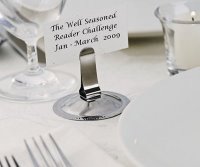
    WSR Roundup Challenge #5

    You get another one of my quotes this week, from The Geography of Bliss, by Eric Weiner:

    Travel, at its best, transforms us in ways that aren’t always apparent until we’re back home. Sometimes we do leave our baggage behind, or, even better, it’s misrouted to Cleveland and is never heard from again.

    Oh — the one thing that stood out this week was that no one “visited” China. 🙂

    On to the reviews:

    Cafeshree read Buttertea at Sunrise by Britta Das, about the author’s experiences in Bhutan. She writes, “Britta loves the beauty of the country, and the friendliness of the people, yet she is miserable with the rain, the fleas, the unreliable electricity and lack of facilities to help the locals. I enjoyed Britta’s descriptions, though sometimes felt she was a bit simplistic in her view of the people, but it’s a nice introduction.” She also read Into a Paris Quartier, by Diane Johnson, and caputred what good travel book should do with this sentence: “I enjoyed this book, a bit of history, culture and now I want to pack my bags and go explore St.-Germain.”

    Kristina read La Cucina by Lily Prior, about which she writes, “Lily Prior really does a great job in this novel. Although romance is not for me, this had some elements of mystery and surprise and shock even.”

    Veronica read another chick-litty/romance book, The Teahouse on Mulberry Street by Sharon Owens, although she didn’t like it, commenting: “At least FIVE different story lines centered around people committing or seriously contemplating adultery. And that just seems like too much. Is no one in Belfast, Ireland happily married?”

    Becky read Beneath My Mother’s Feet, by Amjed Qamar, about a girl in Pakistan who’s father is injured and she and her mother are forced to take over earning money for the family. Becky writes, “The world we see in the novel is one where women work–slave over their work even–to provide for the lazy men in their lives. It’s an unpleasant world, one where happiness isn’t even considered possible in marriage.”

    And Amira‘s contributions were Foreign Correspondence, by Geraldine Brooks and Tender at the Bone, by Ruth Reichel. Amira describes Foreign Correspondence: “This one is a memoir of her growing up in Australia and especially her pen pals. Like all of Brooks’ writing, this book is interesting and well written, which I really think is a unique combination in a journalist.”