Library Loot #15

Pretty normal week. I’m getting a big pile of library books on my dresser, though…

For A/K:
Save the Elephants! (Go, Diego, Go! Ready-to-Read)
The Jellybeans and the Big Dance, by Laura Numeroff and Nate Evans/Illus by Lynn Musinger**
Jibberwillies At Night, by Rachel Vail/Illus, by Yumi Heo
How to Be a Good Dog, by Gail Page
The Wizard, by Jack Prelutsky/Illus. by Brandon Dorman**
Myrtle, by Tracey Campbell Pearson
Oh, Look!, by Patricia Polacco

For M:
Bones of Faerie, by Janni Lee Simner*
Heroes of the Valley, by Jonathan Stroud
The Lab, by Jack Heath*
Vampirates: Demons of the Ocean, by Justin Somper*
Vampirates: Tide of Terror, by Justin Somper

For me:
The Oxford Book of Ballads, selected and edited by James Kinsley
Atonement, by Ian McEwan

The roundup is either at Out of the Blue or A Striped Armchair.

*Ones that M eventually read.
**Picture books we really liked.

We Are the Ship

The Story of Negro League Baseball
by Kadir Nelson
ages: 8-12
First sentence: “Seems like we’ve been playing baseball for a mighty long time.”

I am not a baseball fan. I did not grow up in a baseball house (which is odd, since my dad played ball when he was a teen). Football and basketball were our sports of choice, with tennis and the Olympics following close behind. That said, I think I’m American enough to appreciate baseball, even if I hardly ever watch it. (I did pick up two things about baseball, though: 1) it’s better in person than on TV and 2) the minors are more entertaining to watch than the majors.)

Given that, I really wasn’t interested in reading a book about the Negro Baseball League. I knew about it, sure (I did watch a bit of the Ken Burns’ documentary, after all), but it didn’t really register on my list of things to read about. Then the Battle of the Books came along and, We Are the Ship won its match, taking down a book that I really enjoyed reading. Well, I thought, there must be something to this book.

And there is something to this book. First of all, it’s a lot more detailed than I expected it to be. From it’s size, and the cover, I figured it was a picture book. I was wrong. It’s a detailed history of the Negro League that just happens to have amazing (really, really amazing) photographs. I liked the layout of the book — because it’s so large, the illustrations become not just an accessory, but an integral part of the book — and that the chapters were titled “innings”. And then there’s the narrator. As judge Rachel Cohn said, the narrator has a folksy charm to it, so much that you can imagine the person telling the story.

And what a story. It narrates the story of the Negro Leagues from its inception through to when Jackie Robinson made the crossover into the minor leagues. It touches on the determination of the men to play the game, and play a good game, in spite of the segregation and racism they encountered. Nelson spares no punches: he tells the good along with the bad. And, in the end, I was left with nothing but admiration for the men who wanted to play a game, and found a way to do so.

Abby pointed out that Nelson left out the women who played for the Negro Leagues (something that I didn’t know until she pointed it out), but I’m not sure that detracted from the charm that this book had. At any rate, maybe Nelson will be inspired to write another book on the women who played ball.

I know I’ll definitely read it.

Why Keep It Up?

I have to admit that I’ve been thinking about why I blog quite a bit lately. Some of it was spurred on by extraneous events a couple months ago, some of it by this post by Becky, and some of it by my attempt to label all my old posts (not an easy task) in order to have some sort of organization in my little bloggy fiefdom.

I also have to admit that I’ve contemplated not writing this post, mostly because I’ll probably end up sounding insecure and whiny (both descriptions can be accurate at times). But, I figured that I used to air grievances and insecurities and dreams more often in the past (part of the interesting things that have surfaced as I’ve gone through my archives), and that my blog has been (lately) nothing but reviews and weekly memes, and that maybe, just maybe, someone wouldn’t mind knowing what goes on in this head of mine.

So. Why do I blog? When I started, nearly five years ago, answering that question was easy. I blogged because I needed a place to put what I think about the books I read. I discovered the wonderful side-effects of blogging: comments, recommendations, blogs by other readers who became friends. I was happy.

Two years ago, I took that up another notch, and entered the world of ARCs and blog-tours and reviewing and attempted in some small way to be on the cutting edge of publishing. All of which I enjoy; there’s something rewarding about hearing about a book you like and being able to contact a publisher requesting it and have it arrive in the mail. Or, sometimes, books I want and have been idly hoping for just arrive unasked for. (Like the other day, when Blackbringer and Silksinger showed up. We were all SUPER excited.) Yeah, there are the duds, and the horrid books that I’ve felt compelled to read because someone sent them to me, but mostly it’s been a positive experience.

But that leaves me as to why I still do this. Especially with Goodreads and Facebook, which whittle away at my reasons to keep blogging — Goodreads fills my original bloggy purpose, and in some respects does it better than I can do it with Blogger. And Facebook provides a community of hand-picked (mostly) friends that I can connect with. (Bonus: no anonymous teenagers telling me I suck because I hated Eragon. I still get those comments, even four years later!) Especially because some of my original bloggy friends have packed it up and quit blogging, or at the very least scaled back. Especially because there are people out there who do what I do much better than I could ever dream of doing it (and are more popular, too).

In the end, I have to admit that I might be at a loss to answer this question. Is it community? (Partially; I adore the book blogging and kidlit communities I fancy myself part of, if only in a small way.) Is it the comments? (Partially; I enjoy reading every one I get, even if I’m absolutely horrid about leaving and responding to comments.) Is it the recommendations? (Yes, but I’m beginning to feel overwhelmed by the sheer number of books that I really want to read.) Is it the challenges? (Yes, they help me knock books off my TBR list, and I enjoy them though I’m not great about reading what everyone else things about the books they are reading.) Is it rewarding? (Sometimes. But I think I’m wondering if it’s just not as rewarding as it once was… I don’t think I’ll quit, just yet, but I do have to say that there are days when I lean in that direction.)

Why do you blog? Does it matter if you feel that no one reads your posts because you don’t get comments on them? Does it take up a huge chunk of your time? How do you feel about the community? What do you get out of the whole blogging thing?

The Farwalker’s Quest

by Joni Sensel
ages: 10+
Review copy received from the publisher
First sentence: “Zeke’s tree wouldn’t speak to him.”

I knew a bit of what to expect with this book, thanks to Charlotte and Becky, but I didn’t expect to be unable to put the book down. I was thoroughly captivated by the world that Sensel built — part fantasy, part dystopian — and the story which, although it’s a coming-of-age/adventure story, took me to places and in directions that I never quite expected.

It’s three days before the Naming festival, when 13 year olds pick a trade and thereby receive a surname. Ariel has always figured that she’d follow her mother into healing and become a Healtouch. But that’s before she and Zeke, her best friend, discover a relic from the ancient days before the Blind War: a telling dart. They have only an inkling of what a telling dart is, or even what it’s meant for (though somehow they both feel it’s for Ariel), but when two strangers — men called Finders — show up in town looking for the dart, both Ariel and Zeke know their lives are going to change. They just have no idea how, or even how much.

I don’t want to go into any more detail than that, since part of the enjoyment of the book is having no idea what’s coming around the corner. There’s adventure and suspense and action and mysteries. There’s “good” guys and “bad” guys, but the whole book isn’t black and white, something which I appreciated. I think I liked the world, best, though. I liked that it felt like it could have been our world that fell into chaos and evolved in this particular way. I liked that the magic was mostly organic, things which conceivably evolve if everyone in the world were blinded by some biological warfare. It made it seem more plausible (not that I have anything against implausible fantasy; I just thought that plausiblity lent some weight to this story). And the characters were not only likable but cheerable, too. Especially Ariel, who not only finds her true calling, but strength inside her that she never thought she had.

So, yes. All the things everyone has said about it and more. It’s a fabulous story.

BoB Round 1 Commentary

I was going to wait until Sunday to put this up, but I figured why not get it out there in time for Friday’s Peanut Gallery posts? Here’s my take on the matches this week:

Match 1, Octavian Nothing, Vol. II vs. Ways to Live Forever. Winner: Octavian Nothing. I really have no opinions on this one, mostly because I haven’t read either one. I know I should read the Octavian Nothing books, but I can’t seem to bring myself to want to. However, after reading Roger Sutton’s commentary, I want to read Ways to Live Forever. I’m not sure that was the intention of the game, but there it is.

Match 2, The Graveyard Book vs. The Trouble Begins at 8. Winner: Trouble Begins at 8. I’m SO excited about this one. I liked The Graveyard Book, but it’s had enough accolades, and I thought (hoped, wished) that Trouble would get more. And so it has. Granted, it’s not the Newbery, but at the very least, it knocked the “champion” off. YAY! (And see: if I had predicted this, it wouldn’t have happened.)

Match 3, Chains vs. Washington at Valley Forge. Winner: Chains. So, I figured Chains would win this round, but I was fascinated by what judge Elizabeth Partridge had to say:

So read ‘em both. You’ll be glad you did, and your mind will zigzag back and forth across the big gap between the general and the slave girl. But since, in a painful moment of triage, I have to chose one, I pick Chains. Why? Because I’m more interested in a scrappy underdog heroine than a war hero.”

Fascinating. And Washington at Valley Forge is now on my TBR list.

Match 4, Here Lies Arthur vs. Tender Morsels. Winner: Tender Morsels. I don’t have much to say about this one, either. I haven’t read either of these, and had little desire to read Tender Morsels up until this point, incest, gang rape and all. But… but… but… I don’t know. I may change my mind.

Match 5, Disreputable History of Frankie Landau-Banks vs. We Are the Ship. Winner: We are the Ship. I wasn’t expecting this one, mostly because I’ve never been a big baseball fan, and had no interest in We are the Ship. However, how can you ignore a comment like this one, by judge Rachel Cohn:Simply put, We Are the Ship is an exquisite marriage of art to words (terrific story, well told), but also down-home enjoyable, visually stunning but accessible, and never succumbing to coffee table book pretentiousness.” The answer is: you can’t. Another one for my TBR list.

Match 6, Hunger Games vs. Porcupine Year. Winner: Hunger Games. I have one thing to say: of course. I didn’t expect anything different. (Not really.)

Match 7: Graceling vs. The Underneath. Winner: Graceling. This, next to The Graveyard Book-Trouble Begins at 8, was the most interesting match for me. But I shouldn’t have fretted: judge Tamora Pierce (yeah, that Tamora Pierce) chose the fantasy over the dark animal book. Good for her. And I like what commentator Jonathan Hunt said (he said this about Hunger Games, but I think it works here): “As plucky and resourceful as Omakayas is, she wouldn’t stand a chance against Katniss. Come to think of it, neither would Octavian Nothing, Frankie Landau-Banks, Nobody Owens, or most of the characters from this past year. Maybe Katsa from Graceling? Now there’s a cage match I’d pay to see! Grrrl Power! “ There’s the match I want to see.

Match 8: The Lincolns vs. Nation. Winner:
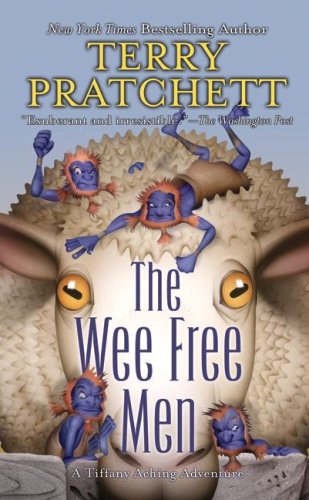
The Lincolns. Nonfiction has done well in this battle, taking down entertaining, and popular, fiction titles. Who knows: maybe a nonficiton title will go home champion?? (Oh, and another two for my TBR pile. I really ought to read Terry Pratchett… soon.)

So, for round two we have:
Octavian Nothing II vs. Trouble Begins at 8, judged by Tim Wynne-Jones
Chains vs. Tender Morsels, judged by Coe Booth
We are the Ship vs. Hunger Games, judged by John Green
Graceling vs. The Lincolns , judged by Nancy Werlin

Sticking to my assurance that if I predict anything it won’t come true, I’ll refrain from making any calls. I’ll just say that this is going to be interesting….

The Spirit Catches You and You Fall Down

by Anne Fadiman
ages: adult
First sentence: “If Lia Lee had been born in the highlands of northwest Laos, where her parents and twelve of her brothers and sisters were born, her mother would have squatted on the floor of the house that her father had build from ax-hewn planks attached with bamboo and grass.”

This book is incredibly complex, which makes it a difficult book to write about. It’s a medical tome — I now know more than I ever thought I would (not having any kids with epilepsy) about seizures and medical procedures of the early- to mid-80s. But it’s also a work of cultural observation — I now know more than I ever thought I would about Hmong history, religion, and culture. But what this book is, more than either of those things, is a testament to what happens when good intentions go bad because of cultural differences.

Lia Lee, daughter of Hmong immigrants, was eight months old when she first started seizing. Her parents (somewhat unusually for Hmong, who notoriously don’t trust American doctors), took her to the hospital. And there, her saga starts. There is time after time of misunderstanding, miscommunication (lack of interpreters only played a role in that), and tragedy after tragedy in the life of this little girl. What impressed me most (and this is something that I’ve heard often associated with this book) is that Friedman does an admirable job of portraying both sides — both the doctors’ and the parents’ attempts and efforts at helping Lia get better. I did feel, fairly often, that Friedman was more sympathetic to the Lees’s side of the story, but she does give the doctors (who often come off as arrogant jerks) equal time — both of her own in doing the research as well as in the book.

I often thought while reading it, too, that I was a bit of an outsider. That the people who really ought to be reading this are not lay readers, but rather doctors, social workers, adminstrators: people who could learn from the lessons that Friedman puts out in this book (not that I can’t learn about the Hmong — granted, I don’t know if there are any here in Wichita — but I’m not in a position to put that knowledge to use). It is a fascinating read, though (even if it was one of those dip in-dip out books — read a chapter or two, read a whole other book — types), and the lessons about respect for others’ culture, beliefs and traditions is a valid one.

The Winston Breen Puzzle Party Tour (with Giveaways!)

I don’t often go in for these — press release announcements, yes, but solving puzzles (I’m terrible at it) even more — but I thought it’d be fun to pass along the party invite for those of you who are better at puzzles than I am. 🙂

From the email:

The new Winston Breen book, “The Potato Chip Puzzles,” hits stands this week, and to celebrate, Winston and I are throwing a puzzle party. From April 16th to April 22nd, visit the following great kidlit blogs and you’ll find a puzzle waiting for you. Solve all the puzzles, submit your answers, and you might win a signed copy of the new book — or possibly even every single book in G.P. Putnam’s Spring 2009 children’s and YA catalog.

Here’s the lineup for the party:
April 16th: A Patchwork of Books
April 17th: Fuse #8
April 18th: Shelf Elf
April 19th: Books Together
April 20th: Bookshelves of Doom
April 21st: Chicken Spaghetti
April 22nd: Oz and Ends
I hope to see you there!
All the best,
Eric Berlin

Library Loot #14

So, I only picked up the holds… but, man, it was a HUGE pile. 🙂 I apologized to the librarian, and she said, “Don’t worry. It’s my pleasure.” I wondered what she thought when she actually saw the pile.

For A/K:
Monkey and Me, Emily Gravett
Cinderella, Paul Galdone
Just in Case, Yuyi Morales
Dream Dancer, Jill Newsome/Claudio Munoz
Traction Man Meets TurboDog, Mini Grey**
Simms Taback’s Great Big Book of Spacey, Snakey, Buggy Riddles, Riddles by Katy Hall and Lisa Eisenberg
Hansel and Gretel, Cynthia Rylant/Illus. by Jen Corace
Blueberry Girl, Neil Gaiman/Illus. by Charles Vess**
The Snow Princess (obligatory Dora book)

For C:
Gregor and the Code of Claw, Suzanne Collins

For M:
Poison Study*
Fire Study*
Magic Study,
all by Maria V. Snyder*

For me:
Aurelia, Anne Osterland*
Extras, Scott Westerfield
We are the Ship, Kadir Nelson

The roundup is either at Out of the Blue or A Striped Armchair.

*Ones that M eventually read.
**Picture books we really liked.