My Life in Pink and Green

by Lisa Greenwald
ages: 10+
First sentence: “Things can always be worse.”

This looks like a very girly book. Pink background, face mask (or is it masque?), cucumber slices: you think it’s going to be frills and parties and giggles.

Except, it’s not.

Sure, Lucy Desberg loves makeup, and wants to be the next Laura Mercier (who, thanks to Google, I found out is a real person), but she’s no girly girl. She’s a smart 12-year-old who loves to help out at her family’s pharmacy — which is slowly failing due to a myriad of factors — and who becomes interested in going green. Sure, there’s seventh grade stuff: her best friend develops a crush on a boy and gets all weird about it, but really it’s about Lucy’s business sense and the fact that kids can Do Things To.

If only the stupid grownups will stop shouting at each other and listen to her.

It’s a cute enough plot, and Lucy and her friends are a likable enough characters (the book falls into the “parents are idiots” trap, which was distracting). Combining saving a business and saving the earth with makeup and beauty tips is a unique idea, though it kind of screamed: “Hey girls! You can be environmentally aware AND cute at the same time! See how easy it is?!” Overlying message: you CAN be smart, aware, AND be into makeup. They are not mutually exclusive. Which, I suppose, is a halfway decent message.

However, one does have to wonder how good a book really is if the favorite thing, when all is said and done, are the beauty and business tips at the beginning of each chapter. Those, I really liked (found myself wanting to write a couple down; what does this say about me?). Even though there wasn’t anything that really grabbed me about the book, it was a good debut novel. And I’m sure there are smart girls out there who are just dying to know that its okay to like makeup. (And vice versa.)

Okay, then. Off to paint my toenails.

The Conch Bearer

by Chitra Banerjee Divakaruni
ages: 10+
First sentence: ” Anand shivered as he carried a heavy load of dirty dishes from the tea stall to the roadside tap for washing.”

Once, Anand had everything he thought his heart could desire. He went to school, his family was happy living in Kolkata, India. Then his father lost his job, and headed to Dubai to get work. Eventually, the money stopped coming, and Anand and his mother were forced to take work. His sister slowly retreated into herself, until all three were just barely scraping by.

Then one day, Anand, in a fit of desperation, silently pleaded for someone — anyone! — to help him, and an old man showed up. Being the kind-hearted person he is, Anand helped the old man, and in return the old man — who is a Master in the mysterious Brotherhood — offered Anand the chance of a lifetime: to aid him in carrying the sacred conch shell back to the Silver Valley. There would, of course, be dangers along the way — a corrupt Healer named Surabhanu is after the shell’s power — and, of course, Anand would be tried and tested in ways he could never imagine.

There’s fantasy, and then there’s epic fantasy: the journey against incredible odds that our hero has to take, succumbing to temptations and betrayals, passing tests and trials, learning and growing until he becomes something greater than himself. Sure there’s magic (not the least of which is a “talking” conch shell) — though of a more mystical sort — and danger — natural and supernatural — and battles — which is to be expected — but mostly it’s about Anand and his growth and learning process.

All this gave the novel a formulaic feel, but perhaps because it was set in India or perhaps because Divakaruni is an intriguing storyteller, it rose above the fantasy cliches that were littered throughout and became an intriguing read.

The Princess and the Bear

by Mette Ivie Harrison
ages: 12+
First sentence: “Long ago, there lived a wild cat that was the sleekest, fastest, and bravest of its kind.”

One of the things I like best about sequels and series, especially in fantasy books, is getting to visit the world the author imagined again. Especially when the world is as fascinating as the one that Mette Ivie Harrison has imagined.

The Princess and the Bear follows the story of the Hound and the Bear from the end of The Princess and the Hound. Told through alternating chapter narratives, the book tells the story of the two unlikely companions who find solace in their togetherness, until the spread of unmagic threatens to destroy their comfortable — if lonely — life. They journey to the wild man, the one person who can aid them in righting this horrible wrong. The wild man sends the Hound and the Bear back to a point in time when the magic is overly volatile, to deal with and stop the source of the unmagic. It also happens that this point in time is when the Bear was a human: King Richon, a spoiled brat of a king who was used and taken advantage of by his evil advisers. It’s up to him, with the aid of the Hound — now a human, Chala — to find the source of evil, right the wrongs that Richon did before spending 200 years as a human, in order to fix the future.

The best part of this novel, much like the first one, was the words. Harrison paints a gorgeous picture of the world she’s imagined. It’s also a thoughtful book, one in which the reader does not plow through, but instead lingers over the pages soaking in the atmosphere. Yet, for all its flowingness and thoughtfulness, Harrison is a writer for a particular sort of person, someone who is willing to take a slower, quieter pace and enjoy the words instead of the characterization and plot. There’s very little action, there’s very little romance (like the first book, it grows slowly, so much so that you almost miss it). There is a definite character arc, but, again, its something that will sneak up on you, almost without you knowing. It’s not exactly something that will keep you on the edge of your seat. The evil guys aren’t that scary, the action isn’t that captivating, the romance isn’t that swooning.

Yet, there is something magical in Harrison’s writing. And that’s just enough to draw the reader in and be completely captivating.

Library Loot #37

I’m starting to think I need to be more like Amanda, and ban myself from checking out books. It would make me sad, but I really can’t read them all. Why do I think I can?

For A/K:
Hobbledy-Clop, by Pat Brisson/Illus. by Maxie Chambliss
His Royal Buckliness, by Kevin Hawkes
A Visitor for Bear, by Bonny Becker/Illus. by Kady MacDonald Denton**
Peace Week in Miss Fox’s Class, by Eileen Spinelli/Illus. by Anne Kennedy
Tacky Goes to Camp, by Helen Lester/Illus. by Lynn Munsinger**
Henry’s Night, by D. B. Johnson and Linda Michelin
Pennies for Elephants, by Lita Judge
Itty Bitty, by Cece Bell**

For C:
She has decided to read (actually read) Harry Potter and The Order of the Phoenix. So she has requested no more books from the library for the time being. She, at least, has self-control.

For M:
Gifts, by Ursula K. LeGuin
The Key to the Golden Firebird, by Maureen Johnson (I’ll have to read this one, too. It’s the only one of hers — I think — that I haven’t read.)*
Rhiannon, by Vicki Grove
Tithe: A Modern Faerie Tale, by Holly Black*
Ironside: A Modern Faery’s Tale, by Holly Black*
Valiant: A Modern Tale of Faerie, by Holly Black (Score! All three books in this series were in. I couldn’t resist.)

For me:
The Princetta, by Anne-Laure Bondoux
Tender Morsels, by Margo Lanagan
Mission Control, This is Apollo: The Story of the First Voyages to the Moon, by Andrew Chaikin and Alan Bean

The roundup is either at Reading Adventures or A Striped Armchair.

*Ones that M eventually read.
**Picture books we really liked.

Great Tales and Poems of Edgar Allan Poe

by… um… Edgar Allan Poe
ages: 13+

I saw this on display at the library, it having been chosen as the Big Read Wichita book for October and November. Not having read any Poe since Junior High/High School when I went through a morbid kick where he was my favorite author, I figured what better reason than this to pick up the book and see if I still like Poe as much as I did.

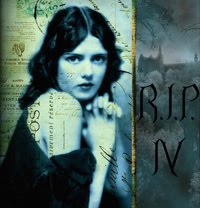
Oh, and I can count it for the RIP IV Challenge… 🙂

First off, I should mention that I didn’t read every story or poem in this book. I read the ones I remembered liking, which are basically his best-known ones — “The Tell-Tale Heart”, “The Cask of Amontillado”, “The Fall of the House of Usher”, “The Pit and the Pendulum”, and “The Raven” and “Annabel Lee” — as well as a couple I’d never read before: “The Black Cat”, “Ligeia”, “The Masque of the Red Death”, “The Gold-Bug”, and “Ms. Found in a Bottle” as well as assorted poems found in the Poetry for Young People collection we have kicking around the house.

Some general thoughts? When Poe is on, he’s brilliant at mood. “The Tell-Tale Heart”, “The Black Cat”, “The Pit and the Pendulum” and “The Raven” are all absolutely chilling. One of my most vivid school memories is listening to “The Tell-Tale Heart” in eighth-grade English, the lights out and curtains drawn. Deliciously terrifying. And it still is.

The other thing I noticed about Poe’s horror stories is that his protagonists are liable to flip off at any little thing; they, on many levels, are genuinely crazy. Take the guy in “The Black Cat”, for instance: he totally loses it because the cat is bothering him (obviously, he’s not a cat-person), and hangs it. Then another cat comes along, which he begins to believe is the dead cat out for vengeance, so he tries to kill it with an axe. And ends up offing his own wife, for which he feels no remorse. Sometimes, you just have to scratch your head and ask, “What was Poe on when he wrote this?”

The thing is, when Poe was off whatever it was that he was usually on, his writing is really not very good. “The Gold-Bug” was an interesting exercise in deduction to find a pirate’s treasure, but “The Masque of the Red Death” was odd (and not in a good way, either) and “Ligeia” made no sense at all. (It might have been me, though.) However, I did find that I enjoyed much of his poetry. In fact, my new favorite poem of his is a sweet one called “For Annie“, about a man expressing his love and gratitude for Annie, who helped him through a severe illness. It’s very touching and tender (and sane).

Do I love Poe as much as I once did? No… but that’s probably more of a factor of age and temperament than anything else. Poe was a brilliant writer, and is deserving of the praise he has gotten over the years.

Kidlit Mania

First off: Just a reminder (you’ll be getting a lot of these in the next week), that the Cybils are coming! The nominations for the various categories — from non-fiction picture books through to YA fiction — will be open on October 1st. Anyone can nominate one book in any (or all!) categories, so start thinking about the books you’ve loved this year. I know I’ve got a list forming (first choices and backups, in case my first choices are already taken…) in my head (and on a few pieces of paper).

While you’re at it, don’t forget to pick up some Cybils bling — I’m determined to pick up at least a T-shirt before October, and…

the Kitlit Conference!

I’m SO excited to be going this year; I’ve wanted to go since it was started, and — bad economy and all — the stars have aligned in such a way that I’m able to go, meet, learn and enjoy!

Which brings me to what I need from you (hopefully, you’ve made it through until this point)! Pam has asked me (eek!) and several other awesome bloggers (I feel like an imposter!) to throw together a panel on issues in book blogging and reviewing. It’ll be a bit of a Q&A — we hope (I don’t know, maybe we’ll all just get up there and blather a bit about how wonderful the kidlitosphere is or something) — and we’re soliciting Qs beforehand (so we have some time to think about the As). So… what do you want to know? Any issues that you want to addressed? Any ideas/processes you want me to spill the beans about? Any tips you want me to pass along? Any thoughts? (Bueller? Bueller?) (OK. I did just date myself.)

C’mon, people: I’m begging here!

(And, yes, I know you can’t all come — so sad about that, too! — but I WILL blog about this afterward, so you’ll get your As. I promise.)

Willow

by Julia Hoban
ages: 14+
First sentence: “Maybe it’s just a scratch.”

As it turns out, Heather, Kailana and I all read this book within weeks (days?) of each other, which we realized thanks to Twitter. I had such a grand time doing a buddy review with Kailana, that when she suggested that the three of us review this one together, I couldn’t say no.

The format we used was to each ask one question about the book that the others would respond to. Mine is below the plot summary…. for the other questions/reviews, stop by Heather‘s and Kailana‘s blogs today.

Willow has done the unthinkable: seven months ago, she was driving her parents home in a rainstom when she lost control of the car, totalling it and killing both of her parents instantly. That is she is grief-stricken is an understatement: she is terrified of facing the grief and so has taken to cutting. The physical pain of the razor slicing her skin is for her, much more bearable than the emotional pain of dealing with her parents’ death. So, she goes about in a haze, cutting herself when things get too bad. Until she meets Guy, who finds that as much as Willow wants him to, he just isn’t able to leave her to her destructive ways. It’s because gets involved in her life in ways that Willow didn’t expect that finally allows her to begin healing.

What did you think of the book being written in present tense? Did it work for you, or not?

Heather: I thought it added something to the immediacy of her situation. Made it seem more precarious, more…real. I think if it had been in past tense it would have had that “already happened” feeling and, for me at least, would have made me feel certain that she came out okay. Being present tense kept me feeling unsure, worried, was she going to be okay? Would she learn to deal with her pain in a different way? Or would she seriously hurt herself? It definitely worked for me; in fact, I don’t think I would have liked it nearly as much if it had been written in anyway other than the way it was.

Kailana: I liked the writing style. I thought it worked really well for this story because we learned what Willow was going through with her. We experienced it as she was experiencing it; which I thought was fitting considering how complicated things were for her. Willow was a teenager living her life and the reader got to live it with her, so I think that the present tense was a good idea and worked well for the novel.

Me: This doesn’t really have a lot to do with being in present tense, but I think it can fit here… This the first time I can remember reading a book the main character dealt with pain in such an obviously addicting and destructive behavior. It was painful for me, as the reader, to see such obvious pain in a person, and yet be nearly powerless to do anything about it. Because, on top of being grief-stricken, Willow is a terribly unreliable narrator. Sure, the book is written in third person present tense (which usually drives me nuts), but we’re seeing things from Willows perspective. And, as I could tell more and more as the book went on, Willow was wantonly misinterpreting almost everything around her. It made the cutting more powerful, and the reader more helpless.

It was a good book: gripping and powerful as well as ultimately healing, and in ways that really worked for me as a reader (including the sex scene at the end, which really surprised me). Worth reading.

A Finder’s Magic

by Philippa Pearce/Illus. by Helen Craig
ages: 8 to 10
First sentence: “There was a boy who went to bed in despair.”

Some books are fun and exciting and adventuresome. Some books lure you in with flashy covers, or great blurbs, and keep you there with engaging characters and winning premises. Then there are other books, quiet books, simple books with a simple story to tell. Books that when you finish, you think that was nothing remarkable, except it left you with a smile on your face. And, really, that was sufficient.

The plot is so simple, it’s almost mundane: Till has lost his precious dog, Bess. He’s heartsick about this, and has trouble sleeping one night. The next morning, a strange, little man appears at his gate and announces that he’s a Finder: someone who helps find things (I could use one of these on occasion!). He takes Till through the path of the previous day, and they make it to the meadow where Bess was last seen. Then the Finder begins to work his magic… he gives Till the courage to talk to the old ladies — Miss Gammer and Miss Mousey — who live in the meadow. He gathers information from the other creatures in magical and mysterious ways. And they do find Bess (was there much doubt?) in a wholly unexpected way.

Still, in spite of the plain plot, the book had a certain charm. Much of this was garnered from the inscription: Philippa Pearce wanted to write a book for her two grandsons, and wanted to collaborate with her grandson’s other grandmother: Helen Craig. They came up with an idea, and as soon as she passed it off to Helen, Philippa died. It’s a touching little love story to her grandchildren, a legacy of imagination left in words. But it was also in Helen Craig’s beautiful watercolor (I’m assuming) illustrations, and in the simplicity of the story itself.

I’m not sure who would want to pick this up — it doesn’t really scream read me (though I picked it up on a whim). However, I do think it would make a lovely read-aloud to a younger child. Which is maybe what it’s really meant for.

Dreaming Anastasia

by Joy Preble
ages: 12+
First sentence: “I didn’t always dream about my family.”
Review copy sent to me by the publisher.

Dreams are funny things.

They’re often just manifestations of stress or hopes or fears. But, what if they were real? What if what you dreamed really happened… or was about to happen? And what if you dreamed about someone other than yourself?

Anne has dreams like that: she dreams she’s Anastasia Romanov, grand duchess of Russia, supposedly dead as part of the communist revolution in 1918. Except, as Anne slowly finds out, things aren’t always as they seem. Her life was ordinary — except that her brother recently died of cancer — until Ethan showed up… and then ordinary became extraordinary (and not just because he was wicked hot), as both Anne and Ethan work to put right the wrong that was done to Anastasia nearly 100 years before.

Part historical novel, part fantasy, part romance: this book has a little bit for everyone. The best bits were the ones with Anne and Ethan — told in alternating chapters — as they tried to figure out how to unravel the magic that was done 100 years before. It was intense in the action, the magic wasn’t overpowering or awkward, and while the romance was very, very subtle, there was still enough of it to satisfy. I enjoyed Anne as a character as well, as she struggled to grow into herself and come to terms not only with her dreams, but with her own history as well.

In fact, the only real complaint I have is the font for the Anastasia letters — it’s so incredibly difficult to decipher (and I thought my handwriting was bad!) that I was pretty sure I was missing plot points. Other than that, it was an entertaining read.

Check out the rest of the tour:
Hope is the Word (9/20)
Zoe’s Book Reviews (9/21)
Homespun Light (9/21)
Teen Scene magazine (9/21)
Galleysmith (9/22)
Once Upon a Bookshelf (9/22)
Café of Dreams (9/23)
My Friend Amy (9/23; 9pm EST author chat)
The Brain Lair (9/24)
Ms. Bookish (9/24)
Lori Calabrese Writes (9/25)
Mrs. Magoo Reads (9/25)
Ramblings of a Teenage Bookworm (9/26)
Fantasy Book Critic (9/26)
Into the Wardrobe (9/27)
In the Pages (9/27)
Beth Fish Reads (9/28)
Reverie Book Reviews (9/28)
BookLoons.com (9/28)

From Cover to Cover

Evaluating and Reviewing Children’s books
by Kathleen T. Horning
ages: adult (I’m sure teens could read it, if they’re interested).
Support your local independent bookstore: buy it there!

I think it was Liz who mentioned this book in passing, though the title immediately intrigued me. Lucky me: the library had a copy, so I stuck it on hold.

I never intended to read the whole thing: much of the book is on evaluating and understanding picture books and easy readers, neither of which (while I enjoy reading them) I’m interested in learning how to review better. So, I skipped ahead to the last two chapters: on reading and reviewing fiction.

And, while (as Liz pointed out) this book is a bit outdated (being published in 1997, before the Harry Potter phenomenon) and I’d be curious to see what she thinks about the book blogging communities, it is an interesting book. I learned that what I write (and I probably knew this) is less of a proper review and more of a reaction, and I found that I’m okay with that. I don’t take notes as I read the book — though sometimes I’ve thought I should; I would be able to remember things about the book more when I’m finished — and I don’t really think about themes or style or impact. My approach is to enjoy the book (or try to, anyway), and then blog about that. I am interested in trying to stretch myself, so maybe I’ll pick up a notebook, and start taking notes on the books I read. We’ll see….

Anyway. Not a bad little primer on “proper” book reviewing.