Sunday Salon: Catcher in the Rye Read-a-long

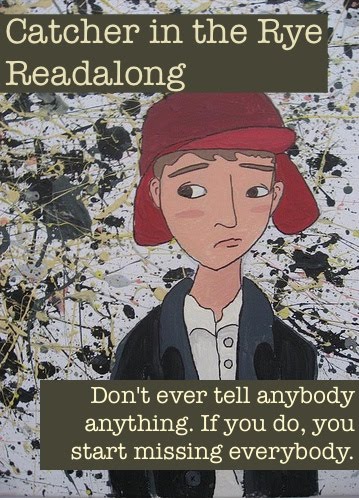
This past Thursday, J. D. Salinger, the author of The Catcher in the Rye, passed away. As I was watching people’s reactions on Twitter, I realized something: I’ve never read Catcher in the Rye. Somehow, for some reason (actually many reasons, some of which I can actually recall but won’t go into here), I managed to completely miss this book.

Which is why Amanda, Heather and Jackie at Farmlanebooks put our heads together (metaphorically, of course), and came up with an idea to have a Catcher in the Rye read-a-long. It’s going to be pretty easy-going. We’re planning on starting Sunday, February 14th and wrapping up around the end of the month. I’ll make sure there are posts after February 14th where you can leave your spoiler comments, questions, and discussion points.

I’m not going to do anything formal with signing up and all that, but if you’re interested in reading along with us — either for the first time or the 20th — please leave a comment and let us know!

I’m quite curious to see what all the fuss is about.

(Oh, and many thanks to Amanda and Jason for the lovely button.)

January 2010 Jacket Flap-a-thon

It’s the end of January (finally). It wasn’t a bad month, reading wise. It started out slow, but picked up near the end, I think. And that’s a good thing. On a side note: do y’all like my commentary on the jacket flaps or not? Sometimes, I don’t know what to say and so I’m wondering if I should just leave them to speak for themselves. Something to think about, anyway.

My three favorite jacket flaps from the books I picked up this month:

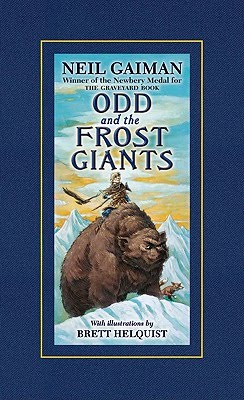
Odd and the Frost Giants (Harper): “In this inventive, short, yet perfectly formed novel inspired by traditional Norse mythology, Neil Gaiman takes readers on a wild and magical trip to the land of giants and gods and back. In a village in ancient Norway lives a boy named Odd, and he’s had some very bad luck: His father perished in a Viking expedition; a tree fell on and shattered his leg; the endless freezing winter is making villagers dangerously grumpy. Out in the forest Odd encounters a bear, a fox, and an eagle — three creatures with a strange story to tell. Now Odd is forced on a stranger journey than he had imagined — a journey to save Asgard, city of the gods, from the Frost Giants who have invaded it. It’s going to take a very special kind of twelve-year-old boy to outwit the Frost Giants, restore peace to the city of gods, and end the long winter. Someone cheerful and infuriating and clever… Someone just like Odd…”

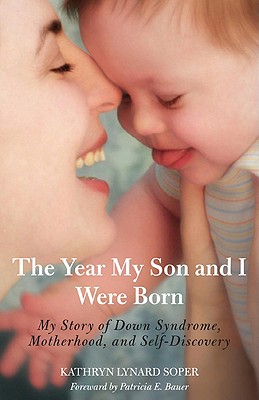
The Year My Son and I Were Born (GPP Life): “With six other children at home, Kathryn Lynard Soper was prepared for the challenges another newborn would bring. But after Thomas’s complicated birth, his diagnosis—Down syndrome—forced her to face her deepest fears and weaknesses, her ignorance and prejudice, and her limitations as a mother and as a human being. Her struggle, coupled with the demands of caring for a fragile baby and juggling her family’s needs, sparked the worst episode of depression she’d experienced in decades. The Year My Son and I Were Born is Kathryn’s brutally honest yet beautiful account of how she escaped a downward spiral of despair and emerged with newfound peace. Antidepressant therapy restored her equilibrium, and interactions with friends and family brought needed perspective. But the most profound change came through her growing relationship with Thomas. His radiant presence shone through her outer layers of self, where fear and guilt festered, and reached the center of her very being—where love, acceptance, and gratitude blossomed in abundance.”

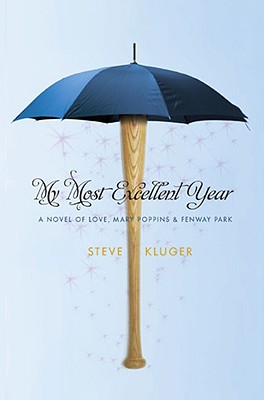
My Most Excellent Year (Dial Books):
“TCKeller: What’s ‘flap copy’ anyway?
AugieHwong: It’s what they put on a book jacket to tell you what’s inside, you rock-head. We can use the one from Liza Minnelli’s bio as a template.
TCKeller: Or not.
AlePerez: This is positively mortifying. They were just supposed to be classroom essays! I can’t believe the entire world is about to find out how I played Anthony like a violin for five months.
TCKeller: I let you do that. Hey, why don’t we open the flap with a quote about the 1918 Red Sox–
AugieHwong: No way, dude. If you’re looking for a warm-up act, we open /with Bette Davis in All About Eve.
AlePerez: Hello? Jacqueline Kennedy would be a far more appealing, not to mention intelligent, choice. Besides, I outrank both of you.
TCKeller: Oh, yeah? I have a Carlton Fisk rookie card.
AugieHwong: I have Angela Lansbury’s autograph.
AlePerez: I have a Secret Service agent.
TCKeller: Guys! Why don’t we just forget the flap copy and start at the very beginning?
AugieHwong: A very good place to start….”

Other books read this month:
Calamity Jack
Dream Girl
The Street of a Thousand Blossoms
Saving Maddie
Wrinkle in Time
Front and Center
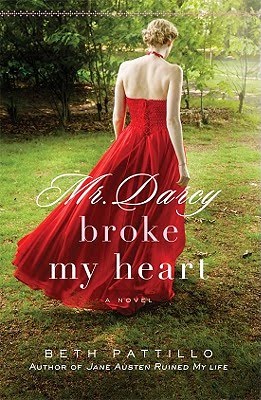
Mr. Darcy Broke My Heart
Unfinished Angel
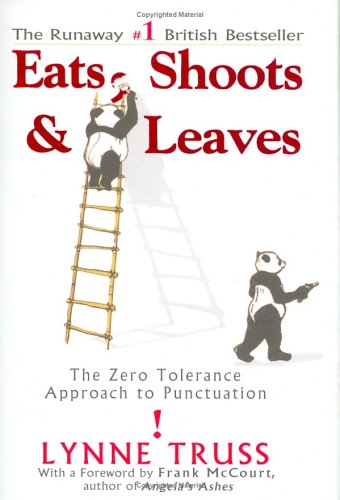
Eats, Shoots & Leaves
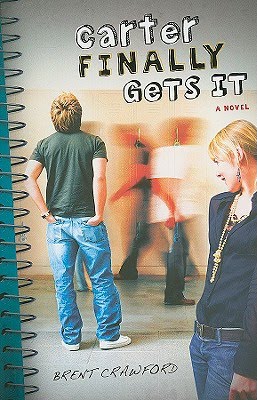
Carter Finally Gets It

Running Total: 13
Adult fiction: 2
YA: 5
MG: 3
Non-fiction: 2
Graphic Novel: 1

Carter Finally Gets It

by Brent Crawford
ages: 13+
First sentence: “In the back room of the Pizza Barn, with only two weeks before the start of high school, my boys and I are at the Freshman Mixer.”
Support your local independent bookstore: buy it there!

Carter is not exactly what you’d call a suave person. He’s got ADD, and he has a stuttering problem, especially around girls he’s attracted to. He rides a bike. He can’t quite do a gainer off the diving board. He’s on the football team, but in one of the less glamorous positions. And yet, here he is, starting high school, hoping it’ll be all that he’s ever wanted: (in his horny 14-year-old boy case) sex, preferably with a hot chick.

The book chronicles Carter’s ups (such as they are) and downs (and, hoo-boy, are they spectacular) over the course of his freshman year as he tries (and tries again) to figure out how to go about this whole high school business. I have to say that as a mom, I cringed: if 14-year-olds are anything like Carter (and they probably are), then why am I letting my daughter out among them? But, as a reader? As a reader, I found myself warming to Carter and his doofishness. He’s so adorably clueless that I think you can’t help but love him (eventually) and cheer for him. It helps that Crawford is a captivating writer; he got 14-year-olds spot-on (which is part of the reason I’m anxious about my daughters….), and he treats his characters (all of them: from Carter’s “boys”, to his older sister and parents, to the upperclassmen that Carter interacts with) with intelligence, affection, and, most of all, humor.

Because, whatever else this book is (a coming-of-age story, a high school book, a guy book), it’s funny. Carter, mostly inadvertently, is hilarious. It’s a combination of things: Carter, the character; the situations he gets himself into; and the way Crawford writes about it all.

At any rate, I grew to really like Carter. I still may not let my daughter go to high school, though.

Eats, Shoots & Leaves

by Lynn Truss
ages: adult (but it’s not inappropriate for anyone really interested in punctuation)
First sentence: “To be clear from the beginning: no one involved in the production of Eats, Shoots & Leaves expected the words “runaway” and “bestseller” would ever be associated with it, let alone upon the cover of an American edition.”
Support your local independent bookstore: buy it there!

I am just geeky enough to truly love this book.

I loved it when it came out — Hubby bought it for me in hardback (and its sequel) — and, even though I haven’t picked it up in years, I found that I still laugh hysterically at the examples, and I find myself still being a complete and total stickler when it comes to punctuation. (Am I the only one who edits my friends’ Facebook statuses, if only in my head?)

So this is not quite a review. More of a love letter to Truss and her oh-so-funny look at punctuation. (And yes, I’ve gone back and checked and double-checked to make sure it’s all right. And it’s probably not.)

I think what I loved most was her examples. Sure, she pulled examples from literature, but she also would just throw things in as she went along. Like this (it’s my favorite):

Assuming a sentence rises into the air with the initial capital letter and lands with a soft-ish bump at the full stop, the humble comma can keep the sentence aloft all right, like this, UP, for hours if necessary, UP, like this, UP, sort-of bouncing, and then falling down, and then UP it goes again, assuming you have enough additional things to say, although in the end you may run out of ideas and then you have to roll along the ground with no commas at all until some sort of surface resistance takes over and you run out of steam anyway and then eventually with the help of three dots … you stop.

How can you not love that? Or this:

So it is true that we must keep an eye on the dash — and also the ellipsis (…), which is turning up increasingly in emails as shorthand for “more to come, actually … it might be related to what I’ve just written … but the main thing is I haven’t finished … let’s just wait and see … I could go on like this for hours …”

I also loved that, while it’s funny and accessible, you actually learn things. Or, at the very least, you’re reminded of things. Like the uses of apostrophes (or not). Or when to use the dash versus when to use parentheses. Or exclamation points! Or… (yeah, those things, too.)

Most famously of all, the apostrophe of omission creates the word “it’s”:
It’s your turn (it is your turn)
It’s got very gold (it has got very cold)
It’s a braw bricht moonlicht nicht the nicht (no idea)

But, learning aside, the best part of the book is really the geeky part. Truss is persnickety about punctuation, and it makes me laugh.

Now there are no laws against iprisioning apostrophes and making them look daft. Cruelty to punctuation is quite unlegislated: you can get away with pulling the legs off semicolons; shrivelling question marks on the garden path under a powerful magnifying glass; you name it.

Sticklers, unite!

LIbrary Loot 2010-04

I’m going to top last week’s pathetic loot because this week I didn’t even bother going to the library because I’m sick as a dog (where on e, instead sending K with a friend. All they brought back were my holds, so that’s what we have for the week.

This week’s loot:

Middle Grade books:
The Lost Conspiracy, by Frances Hardinge

YA books:
In the Coils of the Snake: Book III — The Hollow Kingdom Trilogy, by Clare B. Dunkle
Going Bovine, by Libba Bray

Adult Fiction:
Storm Glass (Glass, Book 1), by Maria V. Snyder

The roundup is either at Reading Adventures or A Striped Armchair. Obligatory FTC note: the links are provided through my Amazon Associates account. If you click through and actually purchase one of these books, I’ll get a teeny, tiny payment. But, since no one ever does, and it’s SO much easier using the associates account to put up these links, I’m going to keep doing it.

Mr. Darcy Broke My Heart

by Beth Pattillo
ages: adult
First sentence: “The taxi pulled up outside Christ Church, and I climbed out of the backseat, but the scorching July heat stole my breath and the threatened to press me back inside the cab.”
Support your local independent bookstore: buy it there!
Review copy sent to me by a publicist.

Claire is one of those long-suffering heroines that readers tend to either really identify with or supremely hate. Since her parents’ deaths when she was 18, she has done everything in her power to help her younger sister, Missy. Claire sacrificed her education, getting a GED and foregoing college. She sacrificed a good job: most recently she was an office manager for a pediatricians’ office, and has been recently laid of. She’s been unlucky in men, settling for Neil, a sports enthusiast who, while nice enough, may not even know that Claire’s off to Oxford, in her sister’s place, for a week-long seminar on Pride and Prejudice.

It’s only once Claire’s across the pond that all she’s sacrificed comes plainly into view. She meets James — suave, polished, gorgeous, rich — and immediately falls for him. In addition, she meets Harriet, of the Formidables (a society devoted to keeping Austen’s secrets), who lets Claire on a big secret: she has the original copy of First Impressions, the novel P&P is based on. As Claire reads on — noting the substantial changes from the final novel — she finds similarities to her own life (funny how that happens), and ends up doing some major soul searching. It’s a happily-ever-after, but not the one that you were expecting.

I should be jumping and cheering: the average Joe gets the girl! (Sorry. Spoilers there.) Claire goes with the normal, the everyday, and finds happiness. Yet… Claire is so insipid that I could hardly stand her enough to get through the novel. She eventually finds a backbone, but not before she goes through pages and pages of waffling. Sure, she’s still grieving over the loss of her parents — or rather, she’s suppressed the grieving process in favor of responsibility — but we’re never really given much of a chance to connect with her on that level. But what really bugged me was the significant changes to the P&P story. Sure, it’s nice to imagine that a copy of First Impressions could be out there, and sure it’s plausible that the story would be radially different from the final P&P, but it just didn’t work for me. At all. Period. I skipped those pages, cringing at the attempt to capture the magic that is Jane Austen.

As the characters in the novel eventually figure out: some things are better left untouched.

Something I’ve Been Meaning to Do Anyway

And along comes a challenge to help me with it. It’s the POC Reading Challenge. It’s an easy one, too: sign up for a level — in my case, Level 3 (7-9 books) but I’m aiming for Level 4 or 5 — and commence reading books. I’m going to keep a running tally here (starting now).

Where the Mountain Meets the Moon, by Grace Lin
Peace, Locomotion, by Jacqueline Woodson
Shine, Coconut Moon, by Neesha Meminger
Sugar, by Bernice L. McFadden
Marching for Freedom, Elizabeth Partridge
Two Moon Princess, by Carmen Ferrerio-Esteban
Skunk Girl, by Sheba Karim
The Prince of Fenway Park, by Julianna Baggot
A Step from Heaven, by An Na
Mare’s War, by Tanita S. Davis
Claudette Colvin: Twice Toward Justice, by Phillip Hoose
Girl in Translation, by Jean Kwok
Marcelo in the Real World, by Francisco X. Stork
The Red Umbrella, by Christina Diaz Gonzales
One Crazy Summer, by Rita Williams-Garcia
Zora and Me, by Victoria Bond and T. R. Simon
Bamboo People, by Mitali Perkins
The Lost Hero, by Rick Riordan
Shooting Kabul, by N. H. Senzai
Out of My Mind, by Sharon Draper
Tortilla Sun, by Jennifer Cervantes

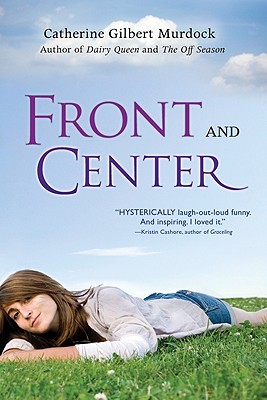
Front and Center

by Catherine Gilbert Murdock
ages: 12+
First sentence: “Here are ten words I never thought I’d be saying…”
Support your local bookstore: buy it there!

I adored both Dairy Queen and The Off Season. Really, I did. But… maybe it had been too long since I read those books. Maybe I really wasn’t in the mood for D.J. (which surprised me, because she is one of my favorite characters). Maybe there was something just off about this book, because while I enjoyed it, I just didn’t love it like I did the other two books.

We basically pick up where we left off in The Off Season: D.J.’s back at school after taking a month off to help her brother Win after his injury. It’s not easy being back: for one thing, she can no longer hide on the sidelines. For another, basketball season is starting and there is major pressure on her to pick a college and verbally commit. Not to mention her coach breathing down her neck about showing “leadership skills”. This is all overwhelming for D.J., who’s used to just basically sliding by.

Perhaps it was this waffling D.J. that grated on me after a while. While I recognize that she’s always been shy as a character, for some reason the arc of this book — with D.J. finally realizing how to believe in herself — was a bit much for one book. Granted, there was a sub-plot with a love triangle between D.J., her former boyfriend Brian, and her current boyfriend Beaner. Again, while it was enjoyable, there was too much waffling and agonizing for my taste. Then again, it may be just that it’s been too long since I was in D.J.-land. I do wonder if I had read this right after the other two, then maybe I would have liked it more. Because I do think it’s a fitting stopping point (not really an end…) to D.J.’s story.

Sunday Salon: Unsung YA Books

I’m a little late to this party, but since Kelly at YAnnabe made the suggestion that I throw my hat into the ring, I haven’t been able to stop thinking about it. So, my two cents about the best YA books you’ve probably never read.

The Order of the Odd-Fish, James Kennedy: I keep plugging James’s book, but you aren’t reading it. Why? Seriously, people, read this book.

Nothing But Ghosts or House of Dance, Beth Kephart: if you haven’t experienced the lyricism that is Kephart’s writing, you really ought to.

Flygirl, Sherri L. Smith: a quietly feminist book, one that makes you want to stand up and cheer!

Secret Keeper, Mitali Perkins: a book about love, a book about India, a book about sisters. Almost perfect.

Two Parties, One Tux, and a Very Short Film about the Grapes of Wrath, Steven Goldman: Clever, snarky, and geeky extraordinaire. Can’t go wrong with that.

Saving Juliet, Suzanne Selfors: Yeah, it’s fluff. But it’s fun fluff, and it’s fun to see how it works with the Shakespeare.

Fly By Night, Frances Hardinge: Fuse #8 loves Hardinge, and for good reason: she’s a fabulous writer.

There you have it: my thoughts. What’s the best unsung YA book that you’ve read recently?

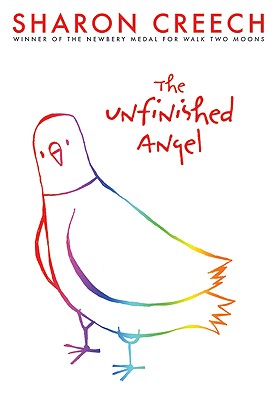
Unfinished Angel

by Sharon Creech
ages: 8+
First sentence: “Peoples are strange!”
Support your local independent bookstore: buy it there!

Some books stick in your mind because they have a brilliant plot. Some because they have created a fabulous world. Others because they have great characters, ones that you want to take home to your mother.

And others, still, because the voice — the way the narrator speaks to you, as a reader — is so unique, so endearing, that you can’t help but love the book.

The voice of Angel, the title character in this sweet little book, is wonderful. It’s not just the word choices that Creech uses, though that is a lot of it. Some of the words that just endeared me to Angel: peoplealities, surprisements, mishmaseroni, glompsing (I really love this one!), struddles. How can you not love a character who uses words like that? But if it was just a sprinkling of fun words throughout the book, it probably would have been more annoying than endearing. No, it was everything about Angel: from his/her irritation with yet love for the people in her (I’m not sure if it was a his or a her, but it felt like a her to me…) Swiss/Italian village, to Angel’s gradual acceptance of the crazy American girl — Zola, who is just extramarkable — and the village’s slow awakening to the sense of community.

Sure, I got all of that out of this as an adult, but I think what kids will see, and probably come to love, is Angel. It’s such an endearing character, and a captivating voice that it will keep practically anyone turning pages. The rest is just frosting.