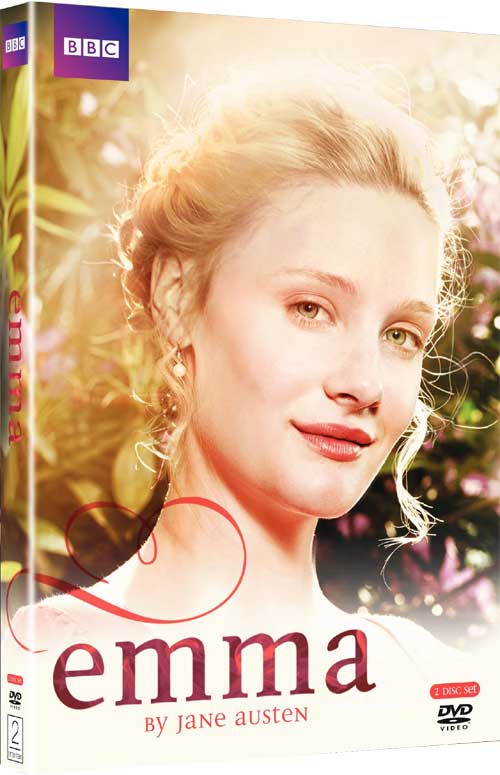
Book to Movie Friday: Masterpiece Theater’s Emma

I do have a confession before I begin: Jeremy Northam is really, truly the only Mr. Knightly in my mind. It is hard for me to imagine Mr. Knightly any other way, no matter how good the actor is.

Given that, I was more than willing to try out the new Emma — love of all things Austen trumped love of Mr. Knightly — and see how they treated one of Austen’s funniest books.

And…

Sigh.

I really wanted to like this. Yes, even given my above confession, the 1996 movie version with Gwyneth Paltrow drives me a bit bonkers. I’d love a new movie version of Emma I could love and adore and laugh at. However, this wasn’t it. I did like Romola Garai as Emma; I felt she managed to capture a bit of Emma’s silliness and immaturity without being utterly annoying. Mr. Knightly, well, wasn’t Jeremy Northam, which really is no fault of his own. But, beyond that, he was much too earnest for my taste. In fact, I think that’s my biggest complaint with the whole movie: aside from adding things in which really didn’t need to be there (four hours? Really? There’s not that much in the book!) — back stories and extra scenes that I know weren’t in the book! — it just took itself way too seriously.
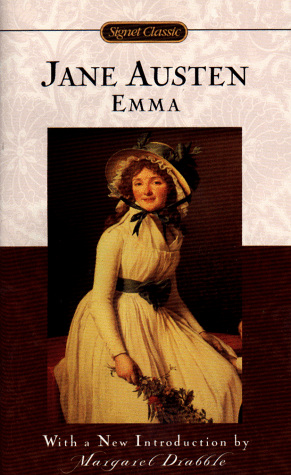
I know: I adore the Colin Firth Pride and Prejudice, which also takes itself more seriously than the book warrants. But, Emma is a comedy, more so than any of Austen’s other books. We’re supposed to laugh at Emma’s folly. We’re supposed to laugh at the silliness, the vanity, the insecurity, the puffed up characters. We’re supposed to dislike Mrs. Elton because she’s annoying and vain, not because she’s mean. We’re supposed to laugh at Miss Bates because she’s a ditz not roll our eyes at her because her mannerisms grate on us. Something is wrong when the funniest character is one — John Knightly — that’s barely in the book at all.

We’re not really supposed to swoon. It’s not a swooning book. It’s not a swooning story. Sure, Emma and Mr. Knightly end up together, but it’s a love born of many, many years, of a deep and lasting friendship. Which is really not swoon material. (Don’t get me wrong: I’d rather a marriage like that than a swooning one, but that’s not the point.) It’s a frivolity, a romp, a mirror for us to hold up to ourselves and say, yes, we’re Emma. Thank heavens there’s Knightly out there to love us anyway.

Verdict: The book’s best. But even though Gwyneth’s highly annoying, I think that version is a better adaption.
Book to Movie Friday: Howards End

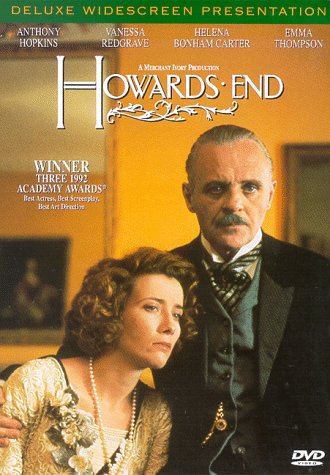
I first saw this movie soon after it came out in 1992. I’m not sure what I thought about it then, but I do remember being put off by the ending; it all seemed a bit abrupt and not a little melodramatic.

But, since I didn’t really remember it that well, I picked it up soon after finishing reading Howards End this time, just to see if it holds up as a movie, and as a book adaptation.

And, while the acting is brilliant — it is Anthony Hopkins and Emma Thompson, after all — and the costuming and the scenery is gorgeous — it is Merchant-Ivory, after all — I’m not quite sure
how I liked it as a movie.

My first impression was that if I hadn’t read the book, I wouldn’t have been quite able to follow the plot. It seemed to fall into the trap that many books from movies do: it was wonderfully acted, beautiful scenes lifted straight from the book. There was no real coherent plot arc; questions arose –like: who was that woman with Lenny? Why was he going to the Schlegels? Why don’t the Wilcoxes like Margaret? — that were answered in the book, but had no real answers in the movie. It held together by sheer force of will and personality. And the ending really is quite melodramatic, much more so than the book.

To be fair, Hubby came in about halfway through, watched the rest of it with me, and said it held up fine. Then again, he has a better memory than I do, and is better at catching subtleties in movies than I am. But, for me, it was a bit of a failure. A beautiful, well-acted failure, but a failure nonetheless.

The Dark is Rising

by Susan Cooper
ages: 10+
First sentence: “‘Too many!’ James shouted, and slammed the door behind him.”
Support your local independent bookstore: buy it there!

When Kelly at The Written World suggested doing another read buddy read and I found that she had stopped reading The Dark is Rising sequence after the first book (understandable), I suggested reading this one. I’m always up for an opportunity to spread the joy of my favorite mid-winter read. Thankfully, she was willing to go along with me on that. Head over to her blog for the first half of our conversation.

Melissa: I can see that. Perhaps, like you said, it’s a case of not having read the book before, when you were a kid. I do think her use of the mid-winter holidays as the strongest time for the Dark was interesting, if not unique. I thought the arc of the book from mid-winter through Twelfth Night was interesting, as well. As for character, I liked the Stanton family. Will was okay — he was obviously an archetype — but I really liked the whole family dynamic. The craziness, the loudness, the sheer familial presence that they had. And the way that Will interacted with the individual siblings, especially Paul and James. Speaking of the brothers, one of my favorite scenes in the book was on Christmas day when the Dark attacked the church. I thought the use of light and Will’s tender concern for his brother was nice. Merriman was interesting, even though, in retrospect, I’m not sure how much he actually *did*. I thought that it was unclear in this book that he was Merlin, however. I do wish that had been made more clear. There were aspects of the Will-Merriman relationship that reminded me of the Merlin-Arthur one in Once and Future King, which, for me, fed into the whole mythical feeling of the book. Was there anything that stood out to you at all?

Kelly: I liked the idea of the Dark being the strongest during mid-winter. I know that when that time of the year hits it feels pretty Dark out. It makes sense that the terrible things would happen during then; especially considering people get depressed during the holidays. As for the characters, I was not a huge fan of Will. I imagine he would have worked if I had read the book as a child, but I couldn’t relate to him. I did like his family, though, and the family dynamic. It was done pretty well. You got the sense of the large family and making everything work the best that you could, so I liked that. I have to agree on the Arthur connection. I was told it existed, but if I didn’t know it was there I am not sure if I would have made the connection. I guess I was hoping there was more to it, but really there was just a guy with a similar name taking on a child and teaching him skills. It could have been any story. Merriman was a mage, so I suppose there is that connection, but otherwise I didn’t really see it. I was reading your response and saw the word ‘nice’ and it got me thinking of the book as a whole. This is a ‘nice’ book. There is lots of effort to be ‘nice’ to other people and being ‘nice’ about the story. I think that is why I feel it didn’t work well for me. Maybe if I was child, but as an adult it was just too ‘nice’. Does that make sense?

Melissa: Perfect sense. Though I wonder if a lot of the niceness is a result of the time it was written in 1974. I know when I go back and reread books from the 70s, I’m struck with how, well, different they are from the books that are written now. It’s almost as if we had a completely different sensibility back then. Then again, a story is almost as much a reflection on the time it’s written as anything else. There’s much about this book that can be pointed to the conflicts in England and the world in the 1970s (not just the language… the one that struck me was calling a girl a “bird”), rather than it being just an overall fantasy story. Or maybe I’m reading too much into it? I don’t suppose you’re going to bother with the rest of the series then?

Kelly: Yeah, it is the time that it was written in. When I was a kid it didn’t bother me, but as an adult I guess I am into more ‘risque’ writing. It’s the same with say Carolyn Keene. When I was a kid I liked Nancy, but when I go back and reread that series now I find it way too ‘nice’. My reading has just evolved since I was a kid and I am interested in other things, I guess. You are seeing things that I didn’t even think about. I think I went into the book not expecting to like it at all, so I didn’t read too far into things! I might read the rest of the series; I own them all, but I am not in any particular hurry to do so. Hopefully I enjoy our next buddy read better!

Melissa: Maybe I’ll let you choose it next time. 😀

Library Loot 2010-14

Two reasons this is short. One, story time is over and, for some reason, I always check out less books when I’m not going to story time. Two, I injured my knee this morning working out and hobbling around the library was not high on my lists of things to do. So we went in, picked up a few picture books and our holds and got out. Hopefully, next week will be better. On the upside, I got Bright Star, so I have something to watch while I’m laid up.

This week’s loot:

Picture Books:
Fanny & Annabelle, by Holly Hobbie
One True Bear, by Ted Dewan
Little Devils, by Robert J. Blake
Miss Smith and the Haunted Library, by Michael Garland

YA Fiction:
Radiant Darkness, by Emily Whitman

Adult Fiction:
The Picture of Dorian Gray, by Oscar Wilde

The roundup is either at Adventures of an Intrepid Reader or A Striped Armchair. Obligatory FTC note: the links are provided through my Amazon Associates account. If you click through and actually purchase one of these books, I’ll get a teeny, tiny payment. But, since no one ever does, and it’s SO much easier using the associates account to put up these links, I’m going to keep doing it.

Top 100 Children’s Novels Memeish Thing

The Top 100 Children’s Fiction Books as turned into a meme by Teacherninja, via Abby (the) Librarian and MotherReader. I’m 81/100. Not bad, not bad. There’s some books on this list that I’ve been meaning to get to for ages and ages.

How did you do?

100. The Egypt Game – Snyder (1967)
99. The Indian in the Cupboard – Banks (1980)
98. Children of Green Knowe – Boston (1954)
97. The Miraculous Journey of Edward Tulane – DiCamillo (2006)
96. The Witches – Dahl (1983)

95. Pippi Longstocking – Lindgren (1950)
94. Swallows and Amazons – Ransome (1930)
93. Caddie Woodlawn – Brink (1935)
92. Ella Enchanted – Levine (1997)

91. Sideways Stories from Wayside School – Sachar (1978)
90. Sarah, Plain and Tall – MacLachlan (1985)
89. Ramona and Her Father – Cleary (1977)

88. The High King – Alexander (1968)
87. The View from Saturday – Konigsburg (1996)
86. Harry Potter and the Chamber of Secrets – Rowling (1999)
85. On the Banks of Plum Creek – Wilder (1937)

84. The Little White Horse – Goudge (1946)
83. The Thief – Turner (1997)
82. The Book of Three – Alexander (1964)
81. Where the Mountain Meets the Moon – Lin (2009)
80. The Graveyard Book – Gaiman (2008)

79. All-of-a-Kind-Family – Taylor (1951)
78. Johnny Tremain – Forbes (1943)
77. The City of Ember – DuPrau (2003)
76. Out of the Dust – Hesse (1997)
75. Love That Dog – Creech (2001)
74. The Borrowers – Norton (1953)
73. My Side of the Mountain – George (1959)
72. My Father’s Dragon – Gannett (1948)
71. The Bad Beginning – Snicket (1999)
70. Betsy-Tacy – Lovelae (1940)
69. The Mysterious Benedict Society – Stewart ( 2007)
68. Walk Two Moons – Creech (1994)
67. Jeremy Thatcher, Dragon Hatcher – Coville (1991)
66. Henry Huggins – Cleary (1950)

65. Ballet Shoes – Stratfeild (1936)
64. A Long Way from Chicago – Peck (1998)
63. Gone-Away Lake – Enright (1957)
62. The Secret of the Old Clock – Keene (1959)
61. Stargirl – Spinelli (2000)
60. The True Confessions of Charlotte Doyle – Avi (1990)
59. Inkheart – Funke (2003)

58. The Wolves of Willoughby Chase – Aiken (1962)
57. Ramona Quimby, Age 8 – Cleary (1981)
56. Number the Stars – Lowry (1989)
55. The Great Gilly Hopkins – Paterson (1978)
54. The BFG – Dahl (1982)
53. Wind in the Willows – Grahame (1908)
52. The Invention of Hugo Cabret (2007)

51. The Saturdays – Enright (1941)
50. Island of the Blue Dolphins – O’Dell (1960)
49. Frindle – Clements (1996)
48. The Penderwicks – Birdsall (2005)
47. Bud, Not Buddy – Curtis (1999)
46. Where the Red Fern Grows – Rawls (1961)
45. The Golden Compass – Pullman (1995)
44. Tales of a Fourth Grade Nothing – Blume (1972)
43. Ramona the Pest – Cleary (1968)
42. Little House on the Prairie – Wilder (1935)
41. The Witch of Blackbird Pond – Speare (1958)

40. The Wonderful Wizard of Oz – Baum (1900)
39. When You Reach Me – Stead (2009)
38. HP and the Order of the Phoenix – Rowling (2003)
37. Roll of Thunder, Hear My Cry – Taylor (1976)
36. Are You there, God? It’s Me, Margaret – Blume (1970)
35. HP and the Goblet of Fire – Rowling (2000)
34. The Watson’s Go to Birmingham – Curtis (1995)
33. James and the Giant Peach – Dahl (1961)
32. Mrs. Frisby and the Rats of NIMH – O’Brian (1971)
31. Half Magic – Eager (1954)

30. Winnie-the-Pooh – Milne (1926)
29. The Dark Is Rising – Cooper (1973)
28. A Little Princess – Burnett (1905)
27. Alice I and II – Carroll (1865/72)
26. Hatchet – Paulsen (1989)
25. Little Women – Alcott (1868/9)
24. HP and the Deathly Hallows – Rowling (2007)

23. Little House in the Big Woods – Wilder (1932)
22. The Tale of Despereaux – DiCamillo (2003)
21. The Lightening Thief – Riordan (2005)
20. Tuck Everlasting – Babbitt (1975)
19. Charlie and the Chocolate Factory – Dahl (1964)
18. Matilda – Dahl (1988)
17. Maniac Magee – Spinelli (1990)
16. Harriet the Spy – Fitzhugh (1964)
15. Because of Winn-Dixie – DiCamillo (2000)
14. HP and the Prisoner of Azkaban – Rowling (1999)
13. Bridge to Terabithia – Paterson (1977)

12. The Hobbit – Tolkien (1938)
11. The Westing Game – Raskin (1978)
10. The Phantom Tollbooth – Juster (1961)
9. Anne of Green Gables – Montgomery (1908)
8. The Secret Garden – Burnett (1911)
7. The Giver -Lowry (1993)
6. Holes – Sachar (1998)
5. From the Mixed-Up Files of Mrs. Basil E. Frankweiler – Koningsburg (1967)
4. The Lion, the Witch, and the Wardrobe – Lewis (1950)
3. Harry Potter #1 – Rowling (1997)
2. A Wrinkle in Time – L’Engle (1962)
1. Charlotte’s Web – White (1952)

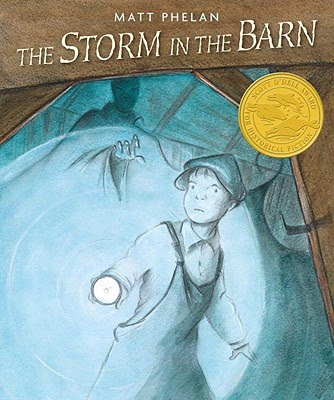
The Storm in the Barn

by Matt Phelan
ages: 11+
First sentence: “The dust can have it.”
Support your local independent bookstore: buy it there!

I don’t quite know what to say about this one. I picked it up because of SLJ’s Battle of the Kids Books, but I’m not sure what I expected. First off, it’s gorgeously drawn. I do love the mood it evokes: the browns and blues of the Dust Bowl. There are subtle things too, like a raised eyebrow, or a simple tear that make this book just beautiful to look at. Almost like I was looking at timeless photographs.

That and it references Ozma of Oz (well, it is set in Kansas, after all), which is nice. Alluding to the desert that Dorothy has to cross and the hardships she goes through to get back to Oz make a nice parallel to the story of our 11-year-old hero, Jack, as he deals with the trials of the Dust Bowl, and learns to face his fears about what just might be in the neighbor’s barn.

But.

I’m not sure I quite got the story. There’s a mythical element to it, a larger-than-life aspect that just didn’t sit well. There were parts that confused me, and I had to go back and reread (relook?) at them a few times in order to make sense. It’s told mostly through pictures; there’s very little dialogue, and I’m afraid I missed elements that would have made the story more cohesive. For me. But, this was not really a pouring over book; there weren’t little details that made me want to linger over the individual pictures. It wanted to propel itself forward; I always felt a little annoyed when I had to turn back and reread a section.

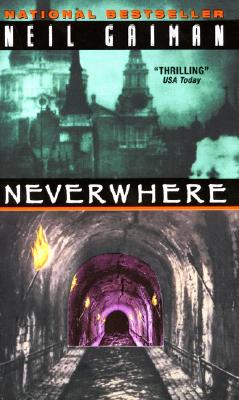
Neverwhere

by Neil Gaiman
ages: adult
First sentence: “The night before he went to London, Richard Mayhew was not enjoying himself.”
Support your local independent bookstore: buy it there!

Being a Neil Gaiman fan has been sneaking up on me for the past two or so years. I’ve been slowly working my way through his books and have yet to be really disappointed in one. (Okay, I wasn’t terribly thrilled with American Gods, but it did have a good concept.) But, this one put me over the top. Neil Gaiman is a brilliant storyteller, a master juggler, someone who can grab you and hold your attention, entertaining you the whole time.

Richard Mayhew has a boring, normal, everyday London life. He goes to work, he does his job, he goes home. He’s got a fiance, someone who’s upwardly mobile; someone beautiful, slightly intimidating and predictable. Then, one night, he finds a girl wounded on the sidewalk, and, in the simple act of helping her, his life changes. After she — the Lady Door — leaves, he finds that he no longer exists in his life. And he discovers a whole other London, one of class and fiefdoms, of weirdness and magic, and of violence and heroism. He falls in with Door, becomes one of her companions on her quest to find out who murdered her family. And, in the process, finds out what is really real in his life.

I loved this one. It had me from the first sentence, and I couldn’t put it down. (Yes, it was one of those “let my kids watch too much TV because I have to finish this book” books.) The thing that really stood out to me, though, was how masterfully Gaiman juggled plots and characters. It’s like he had all these balls in the air, and he would, oh-so-calmly pick up another one and throw it in the mix without even blinking an eye. New characters, plot twists, descriptions of the underworld: it all came at exactly the right moment and made perfect sense. He would flit back and forth between plot lines and it never felt jarring or awkward. He gave details of the characters, helped us understand not only their inner workings, but also sympathize with and enjoy their interactions with each other. (Okay, one tiny quibble: he kept describing Hunter as “caramel colored” and after a while it did bother me. I felt like saying, “Yes. I know she is. Give it up already.”) It was funny, it was touching, it had the absolutely perfect ending. He led me on a storytelling journey and kept me positively breathless the whole time.

Masterful. Absolutely masterful.

I Am Morgan le Fay

A Tale from Camelot
by Nancy Springer
ages: 12+
First sentence: “Seated at the high table, with the emerald necklace her husband had given her resting on her half-naked bosom, the emerald tiara nestled in her dark hair, Lady Igraine tried not to answer the leer of the king.”

As many of you know, I love my King Arthur books. I love the different aspects of the myth that each individual author brings to the collective whole. I love the familiarity of the story; I know which elements are essential, which elements are trivial, and I delight in knowing how it’s all going to play out.

But, I’m wondering if I’m getting a bit burned out – even though I really don’t read more than one or two a year — because I was highly bored with this one.

Sure, it takes the myth from Morgan’s point of view; telling her story, about how she became Morgan le Fey. Aspects of the tale were woven in and through the story — Merlin, Uther and Igraine were there — but it was Morgan’s tale of how she longed for love, and yet was unwilling to accept it as its own thing when it finally came in her life. It was a choppy story, bouncing through time and place, never really settling down into something one could sink their teeth into. I’m generally not one for wordiness, but this one felt too much the other way: too pared down, not enough meat for the story to hang on. Everything felt like a caricature; as if Springer expected us to know who all these people were, and that we would fill in the blanks for her.

Perhaps this is a corollary to it being pared down, but it also felt rushed. I wanted more of Morgan’s life. We got her childhood through her time at Avalon — which really wasn’t the Avalon of my mind. Not that that’s a bad thing. — and her coming into power. But, I wanted it to go beyond, to see how it all would play out in Springer’s imagination.

Disappointing.

On the upside, though, it made me want to reread Mists of Avalon.

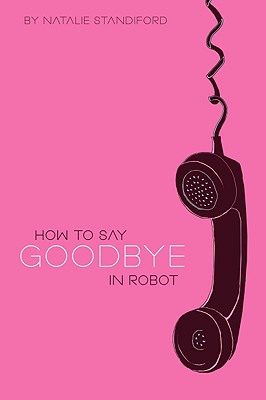
How to Say Goodbye in Robot

by Natalie Standiford
ages: 14+
First sentence: “Goebbels materialized on the back patio, right before we moved to Baltimore, and started chewing through the wicker love seat.”
Support your local independent bookstore: buy it there!

The jacket-flap of this book says it’s for those who have experienced “the wonderful, treacherous, consuming, meaningful world of true friendship”. So, I think I expected something profound, something deep, something… less angsty. But then, it is a teen novel, and angst is the name of the game.

Bea Szabo has moved to Baltimore for her senior year. She’s moved a lot — her dad is a serial one-year college appointment professor — and so has some expectations about her new school. Then the alphabet conspires — they have to sit in alphabetical order for Assembly — to put her next to Jonah Tate, aka Ghost Boy, who hasn’t made a new friend since third grade. See, his mother and twin brother died in a car wreck, and he’s basically shut down. Until he meets Bea. Together these two loners find some kind of solace together in their not-quite-boyfriend/girlfriend-but-somehow-more-than-just-friends. There’s ups — the late-night call-in show that they both listen to, or the trip to Ocean City instead of going to prom. And there’s downs — if you’re not really boyfriend/girlfriend, is it okay to go out with other people? Not to mention the fights and disagreements.

Standiford takes us on an interesting, if angst-filled, journey with these two. There are humorous moments, and the overall story arc, especially involving Jonah’s family, was intriguing. Unfortunately, it was one of those books where I, personally, couldn’t divorce myself from my age and experience: I kept shaking my head because the two of them acted like the kids they are. Sure, I empathized: who hasn’t had an up-and-down relationship with someone, wondering if they’ll talk to you, wanting to help but being powerless. I understand feeling deeply, wanting more, and I even understand heartbreak. I just thought this all was a bit overmuch.

I have nothing wrong with angst. But then, too much of a good thing is always bad.

Library Loot 2010-13

Call me weird, but I feel an inexplicable sadness whenever it’s the last story time of the season. I still go to the library, but there’s not as much to look forward to. And, since the summer reading program is next, there won’t be a story time until September. What am I going to do when K finally starts Kindergarten, and I won’t have a reason to go to story time at all??

This week’s loot:

Picture Books:
Mr. and Mrs. Portly and Their Little Dog, Snack, by Sandra Jordan/Illus. by Christine Davenier
Brand-New Baby Blues, by Kathi Appelt/Illus. by Kelly Murphy
Starlight Sailor , by James Mayhew and Jackie Morris
Groundhog Weather School, by Joan Holub/Illus. by Kristin Sorra
Here Comes Gosling!, by Sandy Asher/Illus. by Keith Graves
Stanza, by Jill Esbaum and Jack E. Davis

Middle Grade Fiction:
Boys without Names, by Kashmira Sheth

YA Fiction:
Academy 7, by Anne Osterlund
A Conspiracy of Kings, by Megan Whalen Turner

Adult Fiction:
The Girl Who Chased the Moon, by Sarah Addison Allen

The roundup is either at Adventures of an Intrepid Reader or A Striped Armchair. Obligatory FTC note: the links are provided through my Amazon Associates account. If you click through and actually purchase one of these books, I’ll get a teeny, tiny payment. But, since no one ever does, and it’s SO much easier using the associates account to put up these links, I’m going to keep doing it.