Ivanhoe

by Sir Walter Scott
ages: adult
First sentence: “In that pleasant district of merry England which is watered by the river Don, there extended in ancient times a large forest, covering the greater part of the beautiful hills and vallies which lie between Sheffield and that pleasant tow of Doncaster.”

Oh, Ivanhoe. How I wanted to like you. I like historical fiction, generally speaking, and I wanted, so very much, to enjoy the book that basically defined it as a genre. I love Robin Hood and the legend surrounding him, and I don’t mind the whole Prince John/Prince Richard, early England thing. In fact, I adore Renaissance festivals. So, it’s not the subject matter.

No, it was the language. The best word I can think of was “stuffy”. And I don’t know why that was: I don’t mind, usually, books written in the early 1800s. I can wade through long, complex sentences. But with you, Ivanhoe, I felt like I was looking at the words, reading them, and then they would just slide right out of my brain. I’m pretty sure I couldn’t even tell you half of the main characters, let alone the plot. At one point, I was thinking that maybe I had a bad translation, and if I just found a different one, everything would be okay… then I remembered that Scott was English.

I’m sure you’re a fun adventure story, full of jousts, knights, antisemitism, and silly jesters, but honestly? I’m not sure I care enough to wade through the book again to find out.

I know it’s me, though, and not you.

Audiobook: Water for Elephants

by Sarah Gruen
Read by David LeDoux and John Randolph Jones
ages: adult
Support your local independent bookstore: buy it there!

It’s no secret that I don’t do well with books on the bestseller list. And so it was with much trepidation that I picked this one up. (I say “much trepidation” but really it was curiosity and a sense that maybe the hype had died down…)

For the three of you who haven’t read it: it’s the Depression and Jacob Jankowski is a veterinary student at Cornell, just about to sit for his last final exams when his parents were killed in a tragic accident. This throws Jacob completely off course, and one fateful night, he jumps a train. It turns out to be the train for the Benzini Brothers Most Spectacular Show on Earth. And in one fell swoop  — and for three and half tumultuous months — Jacob’s life is changed.

First and foremost, this is a circus book. And it’s not a pretty picture. There’s Uncle Al, the ring master, who is vain and malicious. August, the animal trainer who is alternately charming and violent. And because these two are in charge, the whole environment of the circus is not healthy, to say the least. Jacob falls in with a dwarf named Walter; the relationship is rocky at first, but eventually they form a close friendship. And he falls in love with the lovely Marlena, the star of the Liberty Horse act, and August’s wife.

But where do the elephants come in? I have to admit that I was a tad disappointed there; the jacketflap (do audiobooks have jacketflaps?) implied that there was a bond between Jacob, Marlena and Rosie, the elephant the Benzini Brothers show picks up soon after Jacob joins on. But, I never really felt it. Sure, the elephant was the catalyst for much of what happened in the book, but really? I wish Jacob had done more, interacted more with the elephant. It seemed to me he spent much of his time running around, baffled as to what the heck was going on. And I did feel quite cheated by the climax. It was an honest twist, but I think Gruen misled us on purpose, which always gets my hackles up.

What really made the book for me was the present day segments, when Jacob was “ninety or ninety-three.” I have a friend who is currently studying gerontology, and keeps me up to date on her studies. Because of that, I had more sympathy for Jacob’s situation, being in a nursing home, and his concerns about getting old. He was alternately a sweetheart and a firecracker, and I adored him.

That said, I think that audio was the best way for me to experience this one. Both the narrators were excellent (LeDoux read the young Jacob; Jones the older one), and because of that I was able to really “see” the book in a way I don’t think I would have, had I read it.

I’m not sure if my good experience with this one will change my opinion on bestsellers. But I can say that this one was worth my time.

Maman’s Homesick Pie

by Donia Bijan
ages: adult
First sentence: “My mother had been dead eight days when I showed up in her kitchen.”
Support your local independent bookstore: buy it there!

This book is very much like a gumbo: it needs a little bit of everything to make it work. It’s one part cookbook — every chapter has a couple recipes from the kitchen of world-class chef Donia Bijan; one part memoir — it’s nominally Bijan’s story from Iran to France to the kitchen of her own restaurant; but also one part love story to her mother.

Bijan grew up in Iran, the third — and last — daughter of a doctor and a nurse. She was privileged there, going to a private international school, enjoying holidays on the Caspian Sea. Her family was on vacation in Spain when the revolution happened in 1978, effectively cutting them off from their country. For Bijan, her sisters, and her mother, this was a hardship, but also an opportunity: they emigrated to America, and took to their new lives. For her father, however, this became an obstacle that he never surmounted.

He also had issues when Bijan decided to major in French in college with the express goal of going to France to learn to be a chef. Her mother, on the other hand, supported her wholeheartedly. This was where the book fell apart for me. Her memories of childhood were sweet, and even her life in transition was interesting. However, by the time she got to France to learn cooking, I began to wish that there was more to this book. It felt like she was brushing over everything lightly, not wanting to deal with the negatives, or even with the hardships, not thinking about anything too much. All this is well enough, but I wanted more: more feeling, more depth, more descriptions of food, more of her life.

While I found it a pleasant homage to her mother and the way she supported Bijan in her endeavors, there wasn’t quite enough in it to make this book anything more than “nice.”

Jefferson’s Sons

by Kimberly Brubaker Bradly
ages: 10+
First sentence: “It was April and all Monticello was stirring, but in their cabin Mam had just put baby Maddy down to sleep and she told Beverly and Harriet to be still.”
Support your local independent bookstore: buy it there!

I’ll be up front from the start: some people will love this book. It will most likely win awards. But, it’s one of those books that’s full of Important Things, and that we Should Read because it will Enlighten us.

And I never got past that.

It’s basically the (admittedly very well-researched) story about slavery in the early 1800s. Told from the consecutive point of view of two of Sally Hemmings’ sons and one of their close friends, it shows what life was like for the slaves at Monticello. Granted, that’s a time period no one ever really talks about: slavery is for the Civil War, and we tend to brush over the fact that many of the Founding Fathers owned slaves. In fact the biggest thing I felt while reading this book was that it was a reminder (perhaps to those who Honor and Revere the Founding Fathers?) that Jefferson was anything but perfect. In fact, he was far from it. He spent money he didn’t have. He slept with one of his slaves (okay, not until after his wife died), and fathered children by them. And while he was better than many slave masters, he was still a slave owner.

Perhaps that was the problem I had, ultimately, with the book. (Not that I revere Jefferson.) It wasn’t really about the children, or even about Jefferson’s slaves, but more about Ideas — Freedom, Justice, Equality — and how they related to Jefferson. There was a lot of talk about Jefferson and the Declaration of Independence (“But it says all people are free,” Peter said. “Not all white people. Right?”), and the dichotomy between his writing that and the fact that he owned People.

It wasn’t a bad book, really. It was well-researched, it was a new take on an old subject. But I sat back and looked at it thinking, this is Interesting because it’s Supposed to Be. Not because it really was.

The Snow Child

by Eowyn Ivey
ages: adult
First sentence: “Mabel had known there would be silence.”
Support your local independent bookstore: buy it there!
Review copy provided by publisher through my place of employment.
Release date: February 1, 2012

I have sat down several times since I finished this quiet and lovely book last week, trying to figure out what to say about it, coming up short every time. I’m not sure I have the words in me to write this, but I’m going to try.

It’s the Alaskan frontier in 1920, and Mabel and Jack — an older, childless couple, from “Back East” in Pennsylvania — are giving the whole frontier experience a try. They’ve been at it for a couple of years, and it’s not going well: Jack can’t seem to make the land work for him, and Mabel is becoming desperately helpless in the face of the cold, the dark, and the silence. Then, in the first snowfall of the year, a bit of whimsey overtakes them, and they build a snow child. It doesn’t seem like much, but the next morning, the snow child is gone, and in its place is a little girl, half-wild and almost unwilling to be tamed.

Mabel and Jack take to the girl — who may or may not be a fairy child; in many ways that question is irrelevant to purpose the book. For whatever the jacket copy may say, this is not a fantasy —  whose name is Faina, and slowly adopt her into their family, even though she never lives with them. Even though she disappears each spring, returning with each snowfall. By knowing Faina — and for us, by following hers, and Mabel’s and Jack’s stories — Mabel and Jack come to know and appreciate and love the wildness of Alaska, with all its joys and pains.

In many ways this is two books in one: yes, it’s a story about a childless couple coming to terms with both the hardship of a new life (which they chose), but also the hardship of the loss of their only child as an infant. But, perhaps more importantly, it’s a love story to the wilderness; from the breathtaking descriptions of the snow-covered landscape, to the brutal way in which the animals are hunted for food, Ivey captures life in the Alaskan outback with meticulous detail. I almost wanted to go see it for myself.

It was a soft and poetic book, something substantial enough to curl up with and enjoy on a cold winter’s night and yet magical enough to provide an escape from everyday life.

The Fault in Our Stars

by John Green
ages: 14+
First sentence: “Late in the winter of my seventeenth year, my mother decided I was depressed, presumably because I rarely left the house, spent a lot of time in bed, read the same book over and over, ate infrequently, and devoted quite a bit of my abundant free time to thinking about death.”
Support your local independent bookstore: buy it there!

I love John Green, the person. I adore his blog, think he’s a smart, insightful, funny guy, and would absolutely love to have him (and his wife and kid) over for dinner sometime.

I have not, however, been a really huge fan of his books. Saying that almost makes me an outcast in Nerdfighteria, but I’ll live with that. Sure, he has moments of brilliant hilarity, but I have always thought that he tries too hard to be Deep, which too often comes off as pretentious.

That said, I think he’s one of those writers that as he gets older, he gets better. I’ve liked each one of his books better than the last, thinking that maybe he’s figuring out the balance between angst and thoughtfulness, human observation and invention.

Which leads me to The Fault in Our Stars: I honestly can say that this is a John Green book that I loved. Seriously, wonderfully, amazingly loved. (No, I didn’t cry. I’d figured it out before it came along, and I managed to steel myself, but I do admit that I was moved.)

Hazel is 16 and dying of cancer. Sure, she’s had a miracle drug that’s prolonged her life, but really: she has cancer, she is slowly dying, mostly because her lungs are “crap”. Tethered to an oxygen tube, she basically exists, waiting to die. Then she meets Augustus Waters. Hot, amazing, full-of-life (even though he’s got cancer as well), Augustus Waters. We get to watch them slowly fall in love, as they share Thoughts, and Books, and Ideas, and Hopes, and Fears. Sure, there’s an improbable trip (cancer perk!) to Amsterdam to meet the douchebag author (as M called him) of the book that Hazel adores (and Augustus grew to love as well).

But really it’s mostly one of those books that Makes You Think. But, this is where John’s gotten better: it’s not pretentious. Really. The emotions are honest; the cynicism, the reflections, the quoting of improbably sophisticated literature all works in this context. And yes, it is heartbreaking and hilarious, as everyone promises.

In other words, if you want the best that John Green has to offer, this is it. (Until he writes another book.)

Sunday Salon: Bestsellers

The New York Times Bestseller shelves at Watermark

I have had, for years, a terrible relationship with the New York Times Bestseller list. At one point in my reading life, I would slavishly follow the list, picking out ones from it to read, because — as the reasoning goes — if it’s on the NY Times list, then it must be good. Right?

But, invariably, I’d be disappointed. Seriously disappointed. I hated a good number of the books, and was turned off by the rest.

Sure, there was always exceptions, but the trick was to catch them early. I read Harry Potter first in 1999, before it got huge. The same for Percy Jackson (2005), Twilight (2007), and Hunger Games (2009). You’ll notice that they’re all middle grade and young adult novels, which probably has something to do with my enjoyment of them as well.

But, I’m more than halfway through Water for Elephants, which is up there on those shelves, and I’m loving it. Which is making me wonder: why do I really have this dislike of the Bestseller lists? What is the real source of my mistrust?

I have no answers. Do you? What’s your relationship to the bestseller lists?

The Heroines

by Eileen Favorite
ages: adult
First sentence: “I was so angry with Mother!”
Review copy sent by the author’s publicist. 

The pitch: a literary fantasy in which heroines of beloved novels (most of them tragic) escape to a bed and breakfast in rural Indiana in 1974.

The heroine: thirteen-year-old Penny who is at odds with her mother, Anne-Marie. Mostly because her mother won’t let her interfere with the heroines, but also because she’s 13 and that’s what 13-year-olds do.

The plot: I don’t know. I never got there. Seventy pages in, and I was still struggling to figure out what the heck was going on. I got that there was tension between the mother and daughter, and there was something about not running through the woods, but that’s really all.

The reason I abandoned this one: It was boring. Painfully so. I think it was meant to be cute and pretentious, but honestly? It put me to sleep. Multiple times. I don’t even have anything clever to say about this one because I didn’t even actively dislike it.

I hate to say this, because I did like the idea of the premise, but this one just didn’t work for me.

Audiobook: The Eyre Affair

by Jasper Fforde
read by Susan Duerden
ages: adult
Support your local independent bookstore: buy it there!

When I finished Jane Eyre a few years (well, five) back, someone told me that now I needed to read The Eyre Affair. I said okay, and stuck it on the TBR list, and then promptly forgot about it.

As I finished up my last audio book, I was looking through my old lists for a good audio book to read, and this one stood out. Why not give Jasper Fforde and Thursday Next a try?

I can safely say I’m torn about this novel. On the one hand, it was weirdly brilliant: why not create an alternative world, where in 1985 there’s time travel and interesting inventions; where planes aren’t used for commercial travel, and there’s a questionably moral corporation — Goliath — basically running England, and where the ending to Jane Eyre is that she goes off with her cousin to India. In this world, there are people called Litera Techs, SpecOps-27, who deal with crimes on literature. It’s a pretty mundane job, for the most part, especially for Crimean War veteran (the Russians and the English have been fighting this war for more than a century) Thursday Next. Then evil mastermind Archeron Hades steals the manuscript for Charles Dickens’ Martin Chuzzlewit and all hell breaks loose, and it’s up to Thursday to put it right.

The other really brilliant thing in this book was the names: from Archeron (and his brother Styx) Hades, to Thursday’s partners Victor Analogy and Bowden Cable and her ex-boyfriend Landon Parke-Lane (not to mention the Goliath head honcho Jack Schitt. Yes, that is exactly how you say it.) they are all brilliant. No, I didn’t get all the British references, but I got enough to find it amusing.

But, in the end, that’s all the book had: a great premise and some funny literary illusions. It took much too long in set up, getting around to the point of the novel; why was it called the Eyre Affair, when it was such a small part of the whole novel? I enjoyed the Shakespeare debates, but felt they didn’t really serve much purpose in the overall arc of the story. In fact, I could say that for a lot of the novel: it took too much time building the world, which was only sometimes fascinating, and then it took too much time wrapping up (and setting up the next one) in the end. It was just… too long.

A note about the reading: it was quite good. I probably had more patience for this book in audio form because Duerden was such a capable reader, creating a world for me with her voice that wouldn’t have otherwise existed. (Plus it helped that she tackled both the Welsh and the French with aplomb, something which I couldn’t have done on my own.)

So, cut 150 or so (just guessing here; a few discs would have been nice), and perhaps it’d be a really great novel.

Sunday Salon: The State of the TBR Pile 3

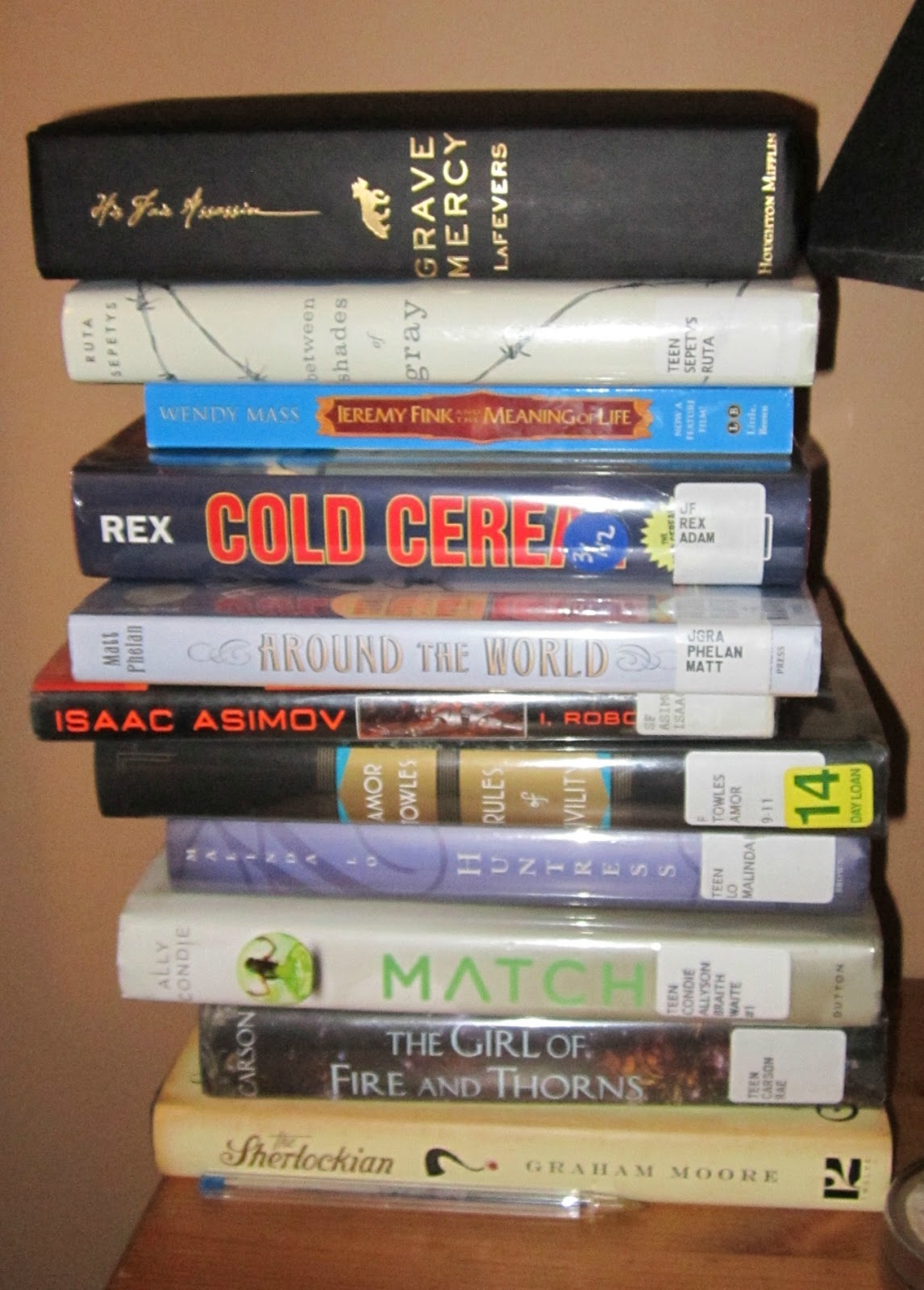
Currently on my nightstand:

A handful are the second-round Cybils books, but there’s a good assortment of others as well. And only one holdover from last month!


Grandmothers’ Stories (for my in person bookgroup)
Ivanhoe (for my online bookgroup)
The Great Wall of Lucy Wu (Cybils book)
The Friendship Doll (Cybils book)
Words in the Dust (Cybils book, which I’ve read but wanted to revisit.)
Darth Paper Strikes Back (Ditto.)
Warp Speed (Cybils book)
Ghetto Cowboy (Cybils book)
Kat, Incorrigible (I don’t remember where I saw this, but it sounds cute.)
Breadcrumbs (I was made curious by emilyreads; that it made the Cybils shortlist was the clincher.)
Notes from an Accidental Band Geek (C got it for Christmas, and said it was good)
Jefferson’s Sons (this has been getting some Newbery buzz, and I was curious)
Maman’s Homesick Pie (from work; I wanted a good foodie book)
Child of the Prophecy (for a buddy read with Kelly, which I really will get to. Soon!)


Is there anything really good on your pile?