Crossed

by Ally Condie
ages: 12+
First sentence: “I’m standing in a river.” 
Support your local independent bookstore: buy it there!
Others in the series: Matched

I’m not quite sure how to do this without giving too much of Matched away, so if you’re one of the people in the world who haven’t read it, you might want to skip this.

Cassia and her True Love, Ky, have been separated, but Cassia’s not going to let that stop her. She gets herself reassigned to the Outer Provinces, in hopes of tracking him down; he was sent there as a result of a sort she had done earlier. In the meantime, Ky is doing his best to survive, and when he finally lands in the village he was from, he sees his chance, and with a couple others, takes it.

Eventually, Cassia and Ky meet up (was there any question that they would, really?), and find their way — with their hangers on — through the caverns of the Carving to something resembling safety: the Rising, or rebellion.

In some ways, this was less pedantic than Matched: instead of treading the same old dystopian line, Condie is expanding her world, showing bits and scraps of the Society, its founding and what it’s capable of. It’s also interesting to get things from Ky’s perspective; in many, many ways he’s a more interesting and complex character than Cassia is. I appreciated knowing his history and motivations, things we weren’t given in Matched.

But there’s still so many unanswered questions, so many loose threads at the end of the book. It makes you curious, but at the same time impatient for answers. And even with all the loose ends, this one is less gripping than Matched.  Too many moments of Ky and Cassie either pining for one another, or staring into each others’ eyes once they do meet back up. Gag. There has to be more to a plot than Romance, right?

So. I don’t know if I’ll scramble for the next one, waiting for it to come out with baited breath. But it wasn’t a complete waste of my time. 

Postcards from Pismo

by Michael Scotto
ages: 8-10
First sentence: “Dear Soldier, I’ll bet you weren’t expecting a letter from me, were you?” 
Support your local independent bookstore: buy it there!
Review copy provided by the author.

It started out as a school assignment. Felix, in fourth grade, was supposed to write to a soldier in Afghanistan. What he never expected was for the soldier — Lieutenant Marcus Greene — to write back. Thus begins a 7-month correspondence in which we, as readers, learn a lot about Felix — about his life in Pismo Beach, California, his family, and his concerns — and a little about life as an active duty military member.

The thing I liked best about this book was that it really, truly was written for a beginning chapter book crowd. It’s simple, easy to read, but it’s not simplistic. Felix deals with a lot of issues in a way a 10-year-old would: he has kids who pick on him, but instead of confronting them, he avoids them. He idolizes his older brother, Quin, and when Quin decides to join the Army National Guard to earn money for college, Felix takes his concerns to Lt. Greene. He is a curious kid, and Scotto finds a way for us to learn a bit about Marcus and his life without having Marcus be a direct character: we never see the letters and emails from Marcus to Felix. And when Marcus goes missing, not answering his emails, Felix freaks out in a way only 10-year-olds can.

It’s a good, non-depressing way to give kids a glimpse into the military and to address concerns of leaving and fighting and standing up for oneself.

Batman Graphic Novels

The Dark Knight Returns, Dark Knight Triumphant, Hunt the Dark Knight, The Dark Knight Falls
by Frank Miller/Klaus Janson/Lynn Varley
and
Batman: The Killing Joke
by Alan Moore/Brian Bolland/John Higgins
ages: adult
Support your local independent bookstore: buy it there!

My husband picked up these comics, first run, back in the mid-1980s and has kept them in pristine condition (yes, in plastic sleeves) ever since then. He has been after me to read them since the first Dark Knight movie came out in 2005, and since my only frame of reference for Batman was the movies (yes, I did see the ones with Michael Keaton, though I’d bailed by the time George Clooney took a turn), I agreed. And then stuck the comics on my shelf for years.

So. Since the last of the three movies is coming out this year, I told Hubby that I’d finally get around to reading them. And as I was hunting around for something to read, he reminded me of my promise.

I’m not really going to give a plot summary, since I’m not sure I really comprehend fully what went on, but how about some thoughts:

1. The Killing Joke is totally the 1989 movie. Tim Burton totally ripped if off. That said, it was a pretty intense stand-alone comic. I liked the interplay between Batman and the Joker, the ways in which they were connected. And, honestly: the Joker scared the heck outta me.

2. The other four were fascinating. I liked the idea of Batman being older — in his 50s — and coming back to the… gig… after a long time away. I liked the use of the old villains — Harvey Dent and the Joker — mixed in with newer ones. I liked the interplay between Batman and his third Robin (first one left, second one died), a 13-year-old girl named Carrie Kelley. That made for some interesting dialogue, especially since he kept trying to fire her.

3. I liked the constant discussion going on in the background about whether or not Batman was “good” or “bad.” As Hubby pointed out when we were talking about this, he’s both. And that’s what makes him interesting.

4. What really surprised me was the role that Superman played. I guess it’s common knowledge in the comic book world, but obviously people showed up in others comics. And the interactions between the two superheroes are quite fascinating.

And from all this, I saw just how much Christopher Nolan respects and uses the Frank Miller comics as his inspirations for the movies. Which leads me to two conclusions: 1) the movie will be pretty awesome, and 2) don’t expect it to have a happy ending.

The List

by Siobhan Vivian
ages: 14+
First sentence: “For as long as anyone can remember, the students of Mount Washington High have arrived at school on the last Monday in September to find a list naming the prettiest and the ugliest girl in each grade.”
Support your local independent bookstore: buy it there!
Review copy provided by my place of employment.

As the title and first sentence suggest, the story centers around The List. The List being an “impartial” judgement of who the prettiest and ugliest (one girl each) of each grade is, along with a short comment about why. We follow the eight girls who were chosen, four “pretty” and four “ugly”, for the week after the post was put up, from Monday morning, when the list was put up until the homecoming dance on Saturday night.

It’s not pretty.

The book is basically an exploration of labels and perceptions of beauty: from the freshman girl, Danielle, who was labeled “ugly” and her desperation to keep her boyfriend who is increasingly uncomfortable being around her; to Bridget, the junior girl labeled “pretty” and her discomfort at that, because she’s always been a bit overweight, and her spiraling into anorexia; to the desperation of Jennifer Biggs, labeled “ugly” all four years of high school, and how that has completely wrecked her psyche, it’s all heartbreaking and disheartening that this would happen.

However, since it’s such an extreme situation, a laboratory if you will, it’s easy to sit back and be clinical, watching it all fall out. While I think Vivian wrote very believable characters, I never really felt like I was given a chance to connect with them, even though I understood motivations behind the actions. As a reader, I felt distanced from the action, even as I was curious to know how it will all play out. I think this one would be a good one to hand to teen girls, along with Uglies and Wintergirls, as a way to spearhead perceptions of beauty and the harshness that labeling and judging others has on our selves, as well as the pressures of society on women.

And for that, it’s worth the read.

Matched

by Ally Condie
ages: 12+
First sentence: “Now that I’ve found the way to fly, which direction should I go into the night?”
Support your local independent bookstore: buy it there!

I’m probably the last person on earth to read this, which is part of the reason why I’ve avoided it for so long. (You know me and my hesitance to read popular books…) I figure something that popular couldn’t be that good. Right?

Well, in some ways yes: perhaps it’s because I’m immensely tired of dystopian books, but it seems as if this one doesn’t really cover anything new. A perfect society, headed by a controlling government? Check. A person who, after years, realizes that the society and perfection isn’t all it’s cracked up to be? Check. A love triangle? Check. Lots and lots of set-up for the next in the series (because none of these can be stand alones)?  Check. It was all very run-of-the mill.

And yet, I enjoyed the world that Condie had built: while she never explained the demise of the society, she did manage to convey the loss of history, of tradition that is so important in a diverse culture. I liked Cassia and Ky and even Xander as characters, and liked that Condie didn’t make anyone out to be truly malicious. In a sense, everyone in the book was just a cog in the system, which in itself is unique.

It’s enough to make me curious about the second book, and I’ve got it sitting in my pile for the weekend. That said, I don’t think it’s the best, or even most original, dystopian tale out there.

The Lost Code

by Kevin Emerson
ages: 12+
First sentence: “The morning after I arrived at Camp Eden, I drowned for the first time.”
Support your local independent bookstore: buy it there!
Review copy provided by the author, whom I met at KidLitCon 2011

Owen is not what you’d call the outdoorsy type. Growing up in the Hub — the caves where people live in the outer reaches of the society — he never really had a chance to go outside, to get much exercise, to enjoy nature. Sure, much of this has to do with the radiation levels from the depleted ozone. But, it’s also because that’s not exactly the person Owen is. So, when he gets a chance to go to Camp Eden — a nature preserve inside a dome that protects the world from the radiation — he takes it. Even if it seems like something he wouldn’t do.

Once there, weird things start happening: he drowns, but doesn’t die. He grows gils, he discovers a secret society. And the people who are supposed to be protecting him and the other campers turn out to be something more… sinister.

The thing that this book really has going for it is that it’s a unique combination of dystopian and fantasy: the world that Emerson builds is clearly dystopian: there’s talk of radiation leaks, and technology that has enabled people to be frozen and reawakened later. But, it’s also fantasy: the evolution of gils, and the set-up of a quest that involves Owen and some friends he makes at camp are clearly not in the realm of the possible. In addition, it’s got that summer-camp feel to it: there are typical power dynamics and interactions (including a romance) that could fit in any YA novel. It truly is a unique hybrid of styles.

Unfortunately, though, it’s all set-up, and it does take a long time to get to where the action really begins. There are a lot of questions, and while many of them are answered by the end, it almost takes too long to get there.

Still, it’s an intriguing enough beginning to make me curious as to where the series will go.

48 Hour Reading Challenge Starting Line

So, for the next 48 hours, I will be reading as much as possible. No, I’m not going to read for the ENTIRE 48 hours, but I’m going to aim for at least 24. As always, thanks to my dear hubby who watches the kids and lets me lounge around reading for two full days once a year. He’s a dear.

Two more quick things. One: Pam wants us to donate something to Reading is Fundamental, as part of this whole readathon. So, here’s my goal: one dollar per hour spent, or $25, whichever is greater.

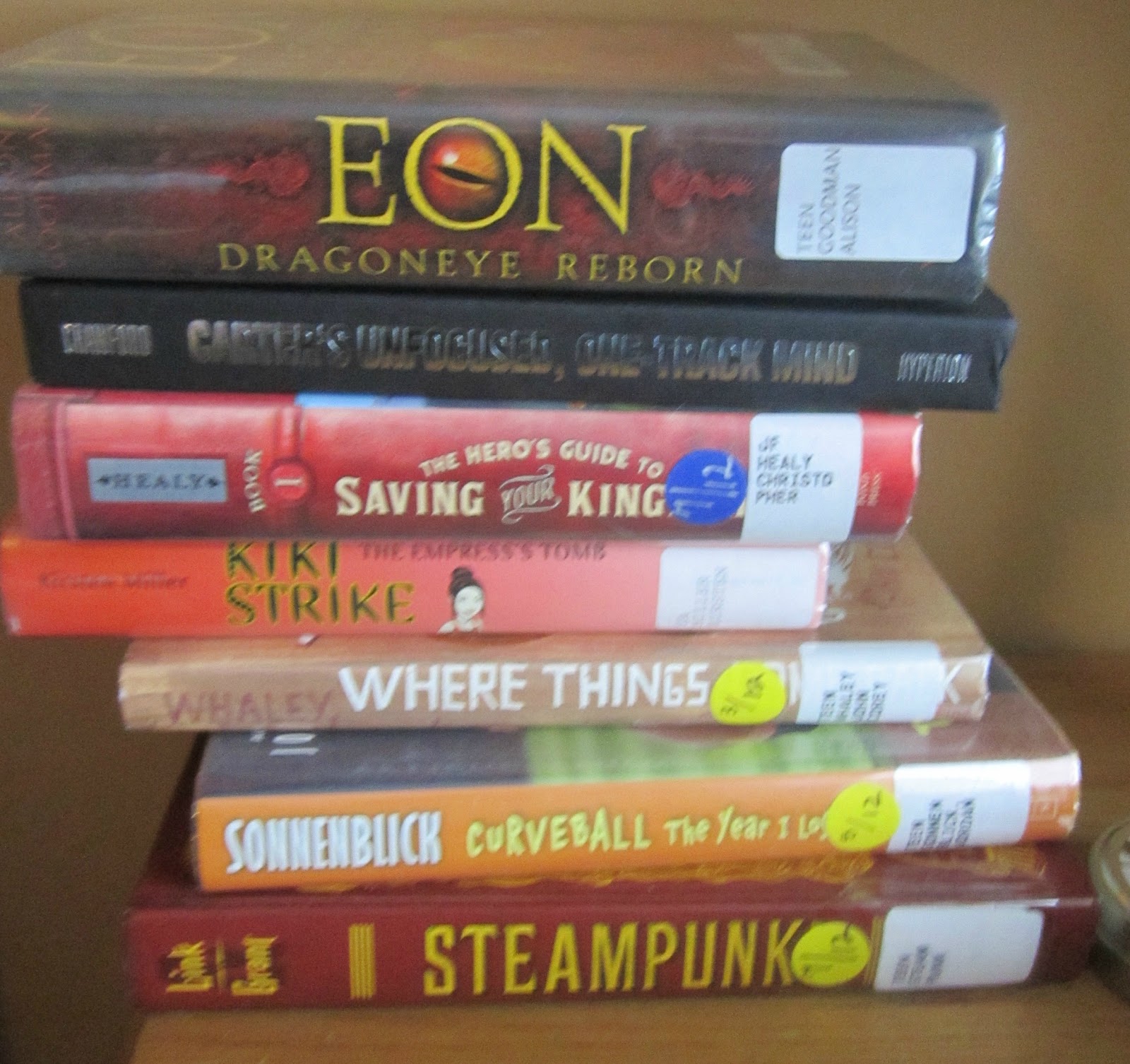
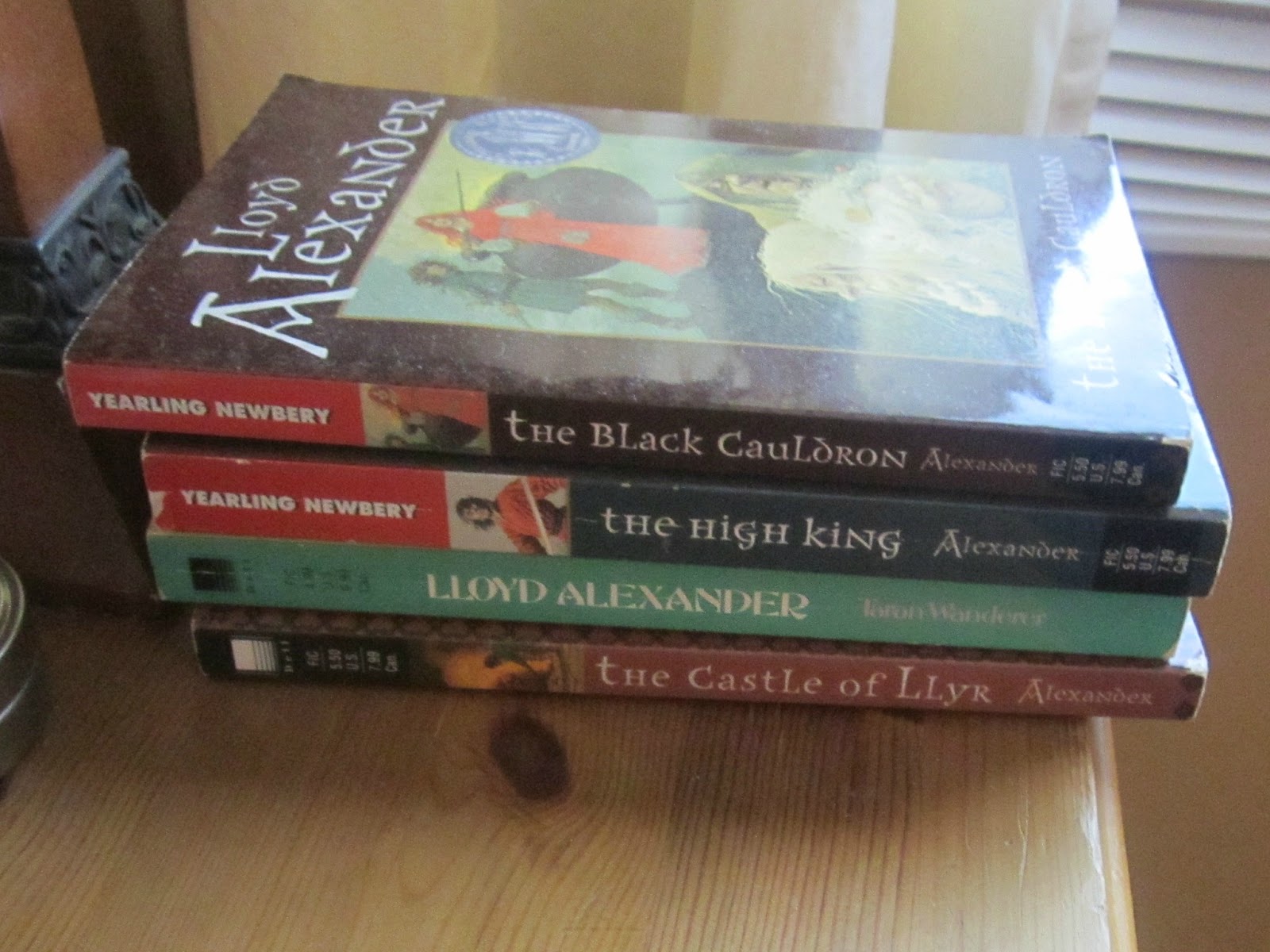
And two: here’s the pile I’m working from. Thought you’d like to see it. 🙂

(That’s the other TBR pile, mostly of ARCs from publishers — on the left — and work — on the right.) Here’s hoping I can make a dent.

And… I’m off!

The Serpent’s Shadow

by Rick Riordan
ages: 11+
First sentence: “Sadie Kane here.”
Support your local independent bookstore: buy it there!
Others in the series: The Red Pyramid, The Throne of Fire

It’s the end of the world. Seriously. Apophis is rising and is going to swallow the sun, sending the whole world into Chaos. And the gods, from the dotty old man Ra down to Carter and Sadie Kane’s father in the underworld, are powerless to stop it.

Which means, saving the world is up to a 12- and 14-year-old.  Can they trust the dead, somewhat evil, ghost magician and go through with their certifiably insane plan? And if they do, will it actually work? (And in the meantime, can they figure out their love lives?)

I’m not sure that I have anything original to say about this one, that I haven’t said about the other two in the series. It’s still a fun adventure, and Carter and Sadie are still acting way older than their age (though Riordan deftly acknowledges this: he has a throw away line about how kids who channel gods and are technically orphans tend to act older). I still think the whole channeling gods thing is weird, though, again, Riordan deals with this in a clever way, addressing the readers’ concerns through the voice of Sadie.  It’s not as funny as the Olympus books, but there are moments of laughter. I do have to admit, that Riordan ended the series well. There are a few loose ends, so he could revisit Carter and Sadie if he wanted to (including a vague reference to joining up with “other gods”, which should make Percy fans happy), but this story is complete.  (And he managed without an overlong epilogue telling us where Carter and Sadie are in 20 years!)

It’s not my favorite series, or even my favorite of Riordan’s work, but it’s a good solid one, that should appeal to those fascinated by Egypt and Egyptian mythology.

Three Times Lucky

by Shelia Turnage
ages: 9+
First sentence: “Trouble cruised into Tupelo Landing at exactly seven minutes past noon on Wednesday, the third of June, flashing a gold badge and driving a Chevy Impala the color of dirt.”
Support your local independent bookstore: buy it there!
Review copy provided by the publisher.

It was all just being in the wrong place at the wrong time. See, Mo (that’s short for Moses; and yes, she is a girl) LoBeau’s (emphasis on the second syllable because it classes it up) friend Dale (Earnheart Junior III) just wanted to borrow Mr. Jesse’s boat, and then decided to return it for a “finders fee.” It wasn’t Dale’s fault Mr. Jesse turned up dead.

Honest.

(It has occurred to me that I’ve read a number of middle grade books with dead people recently. Must be a trend…)

From there, of course, Mr. Jesse’s murder (It’s not grisly, at all. Promise.) turns the tiny, rural, North Carolina town of Tupelo Landing upside down. And Mo and Dale are smack dab in the middle of it. To clear Dale’s name, they set out trying to solve the mystery, and are thwarted at every turn by Detective Joe Starr, the adult who’s (really) working the case. Mo and Dale keep at it, though, because the whole case somehow seems to involve the Colonel and Miss Lana, the two people to whom Mo, an orphan, is closest.
Honestly: I’ve read my share of Southern novels, and so I figured it was just another run-of-the-mill, murder-mystery-light/Southern thing. But I couldn’t put it this book down. In addition to murder, this book has everything: drama, car racing, suspense, plucky kids, arch-enemies, robbery, unrequited love, and karate.  It’s everything Southern, but the pecan pie. (And I’m sure that would have shown up, had the book been set at Thanksgiving instead of during the summer.) There’s a little something for everyone here, which makes any book appealing.

But the real reason to fall in love with this book — as I did — is because Turnage has created a wonderful couple of characters in Mo (“My heart leaped like the cheerleader I will never be.”) and Dale (“Dale may not know much from the classroom, but his recess skills are legendary.”). In fact, all the characters, from Miss Lana (“I passed the wigs to Miss Lana, completing her Hollywood Through the Ages collection. Miss Lana has a flair for drama.”) and the Colonel (“Miss Lana says hugging the Colonel’s like hugging a turning plow.”), down to Mayor Little (“We always choose a Little for mayor in case a television crew ever comes to town. Littles like to talk and they’re naturally neat; even their babies dress good.”) and aspiring lawyer Skeeter (“Rumor has it she’s already written to Matchbook University for a paralegal course under an assumed name. She won’t say if that’s true or false, only that unsubstantiated rumor won’t hold up in court.”) pop off the page, and it’s entirely because of the way Turnage writes.

It’s also the small-town, rural Southern feel: kids biking everywhere, technology limited because coverage is spotty, rusted cars on lawns. It’s a place caught out of time, perfect for two kids to have the adventure of a summer. And perhaps to learn a little bit about themselves, and the meaning of family, in the process.

For us, it means an perfectly charming book. Period.

Good Omens

by Terry Pratchett and Neil Gaiman
ages: adult
First sentence: “It was a nice day.”
Support your local independent bookstore: buy it there!

This is one of those “everything but the kitchen sink” kind of books. There’s witches (who carry bread knives around for protection, because that’s the sort of witch they are) and witch hunters. Prophetesses (well, one: who wrote the Nice and Accurate Prophecies of Agnes Nutter, which is surprisingly correct) and anti-Christs (well, one. He’s eleven.). Demons and angels. Not to mention the four riders of the Apocalypse, as well as several telephone salespeople.

And all are headed toward Lower Tadfield. Because, of course, that’s where the End of the World/The Great War/Impending Doom is going to take place.

I adore Gaiman and Pratchett separately, so I figure together (and, yes, it was about time I read this book!) they’d be brilliant. And they were. So much so, that I think I missed a good 60% of the jokes. Completely. It’s not that I didn’t like the book: I did. I laughed at parts, I kept turning pages, I did love bits and pieces of it. But really (and Hubby says it’s because I haven’t seen The Omen, nor do I have plans to), I felt like I was sitting in on a conversation where I got some of what was being talked about, but was, for the most part, left completely out to pasture.

Which means, although it’s brilliant (I really did like the forward and afterward in my 2006 edition), it’s not my favorite Gaiman or Pratchett.