Audiobook: Soil

by Camille T. Dungy
Read by the author
Support your local independent bookstore: buy it there!
Or listen at Libro.fm
Content: There is some mild swearing (I think? Maybe not?) and frank talk of racism and violence against Black people. It’s in the Creative Non-fiction section of the bookstore.

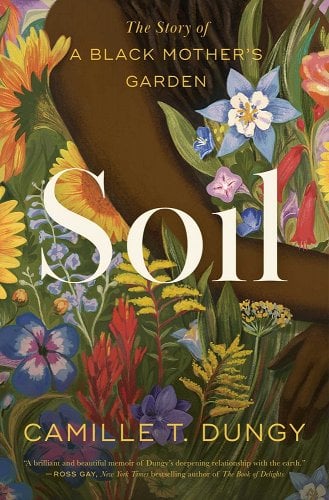
The premise of this is simple: Camille Dungy owns a house in Ft. Collins, Colorado, and she wants to make her overly-chemicalized turf lawn into something more environmentally friendly and sustainable. She writes about the process the “prairie project” as she and her husband dub it, but the book is more than that. It’s a reflection on environmental writing and the people who usually write (read: white, rich, often men) about the environment. It’s about the intersection of social and environmental justice. It’s how, as a Black woman, Dungy feels not only called to work the land but also compelled to protect it and welcome all living things.

This was such an enjoyable audiobook experience. Dungy is an excellent narrator, and I felt myself not only learning from her but having my own need to garden and see growing things affirmed. I should be better about growing things that are native here, as opposed to just planting any old thing (and seeing what grows), which is kind of what I do now. But, I loved and respected what Dungy had to say about the earth, the environment, and about social justice.

Excellent.

Walking With Sam

by Andrew McCarthy
First sentence: “When I was a very young man and became very successful in the movies very quickly, I harbored a notion that I had not earned my accomplishments, that I hadn’t done the requisite work, that it was all merely a fluke, that I didn’t deserve it.”
Support your local independent bookstore: buy it there!
Content: There is some mention of drug use, several f-bombs,, and other mild swearing. It’s in the Biography section of the bookstore.

I was probably always going to be interested in this book; I love travel books, and I have a friend who has walked the Camino twice. Plus there’s the celebrity factor. But, after finishing The Longest Way Home, I have immense respect for McCarthy as a travel writer. And he delivers in this book.

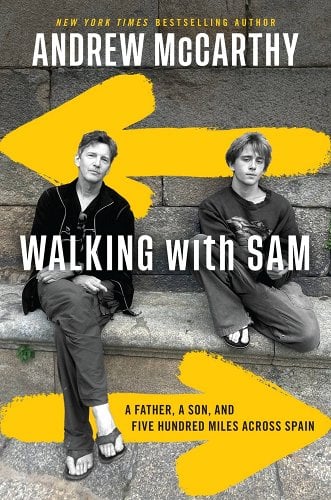
When he was in his early 30s, McCarthy walked the Camino – inspired by a book – and had a life-changing experience. As his oldest son grew up, McCarthy wanted to share that experience with him. His son wasn’t interested until he was 19 and had just broken off a bad long-term relationship. McCarthy jumped at the chance, and they were off. They walked the northern route – the Camino Frances (or at least that’s what I’m guessing from what he writes) through the Pyrenees and the Meseta, into Santiago. I’m not exactly sure how long it took them – the chapters were labeled with miles until Santiago. But McCarthy is strikingly honest about their walk. The ups and downs, both physically and emotionally, the stresses and joys of their relationship, and yes, you can see the growth in both McCarthy and Sam and between them.

Like the first travel book of his I read, I loved that he gave you a sense of walking the Camino with its own joys and hardships and dull moments, while being introspective. He both compared this walk to the one he took 25 years prior, and reflected on the nature of both his relationship with his son as well as the one he had with his own father. It’s engaging and interesting, as well as being introspective and thoughtful.

I found it an absolute delight to read.

The Longest Way Home

by Andrew McCarthy
First sentence: “‘Are you awake?'”
Support your local independent bookstore: buy it there!
Content: There’s some mild swearing, maybe one or two f-bombs, and mention of past alcoholism. It’s in the Biography section of the bookstore.

First: yes it’s that Andrew McCarthy. I knew he’d written a couple of books – I had put in a proposal for him to come to Wichita when he released his YA novel – but I thought it was more along the lines of “he’s got a vanity project” rather than “he’s a real writer.” Well, color me wrong: he’s an actual, real writer. And this book was quite good.

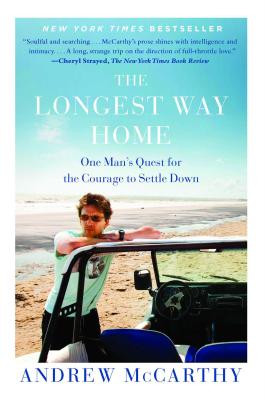
Seven years into his relationship with his now-wife, D, and four years after they first got engaged, she decided that they really Ought to get married, and started planning their wedding. McCarthy, reacting the only way he thought he could, immediately took off on writing assignments. The book follows his path through Patagonia, Costa Rica, the Amazon, Venice, Baltimore, up Kilimanjaro and ultimately to Ireland, where he and D do, actually get married (not a spoiler; the book opens with their honeymoon). It’s an introspective book, one where McCarthy examines his past relationships – including with his first wife and their son – and history as he tries to reconcile why he doesn’t, actually, want to get married. But it’s also a good travel book: McCarthy is a generous traveler, one that doesn’t mind being adventurous or solitary but also will interact and participate in a group (though he complains about it). I found myself captivated by his writing, and enjoying the time I spent in his reflections. It’s a good thing he’s got a few other works of non-fiction (including his new one, about walking the Camino) that I just might get around to reading. (Bonus: he’s coming to Wichita as part of the tour for the Camino book. I just might have to go!)

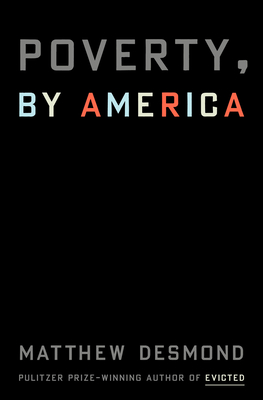
Audiobook: Poverty, by America

by Matthew Desmond
Read by Dion Graham
Support your local independent bookstore: buy it there!
Or listen at Libro.fm
Content: There are a few mild swear words. It’s in the Sociology section of the bookstore.

I was moved by the stories of the people in Desmond’s Evicted, but I think there was a part of me that could put it at a distance. At least that’s not my life. But in Poverty, by America Desmond pulls no punches: poverty is not just a “them” problem. It’s something that affects ALL of us. 

In this short, to the point, book Desmond uses data to show how the system exploits poor people, from the TANF government funds that so many states misuse or use for programs other than to actually help poor people (for every $1 of the fund, only 22 cents make it into the hands of poor people) to the landlords who nickel and dime the poor into higher rents for lower quality apartments that they can get evicted from. But it’s more than that: it’s the middle class with our health care and mortgage subsidies (the middle class and wealthy are subsidized by the government at much if not more than poor people are) and the wealthy and businesses who are not made to pay their (measly, comparatively) tax share. 

It’s Desmond challenging the reader to think about whether a corporation pays their employees a living wage before shopping there. It’s a call for a universal basic income. It’s a lament that for the past 50 years, in one of the wealthiest countries on earth, no progress has been made to help the people living in poverty. 

It’s quite probably one of the most important books I’ve read and challenged me as well as changed my perspective on things. 

It doesn’t get much better than that.

Audiobook: B. F. F.

A Memoir of Friendship Lost and Found
by Christie Tate
Read by the Author
Support your local independent bookstore: buy it there!
Or listen at Libro.fm
Content: There is talk of eating disorders, alcoholism, and swearing, including multiple f-bombs. It’s in the biography section of the bookstore.

In this memoir, Tate deconstructs her friendships with women, from the way she abandoned her high school friends for a (alcoholic, abusive) boyfriend, to the way she compared and sabotaged friendships as an adult. The throughline for all of this was, yes, her group therapy and recovery sessions, but also a woman she calls Merideth. A woman 20 years Tate’s senior with problems of her own that she is recovering from, Meredith became not just Tate’s rock to lean on, but her conscious and guiding hand. 

So what does one do when Meredith is diagnosed with an incurable and advanced form of cancer? How can she deal with being present for Meredith and with her own grief? How can she learn to be better?

I do have to say up front that, assuming all this is true, Tate is remarkably brave for putting it all out there. She is not likable for a good half of the book when she’s talking about how she abandoned friends due to jealousy and anger. She comes across as petulant and insecure, and yes I was judging her until I started really listening and figuring out where I’m like her. She has much to say about friendship, not just her friendships, and I think that part is worthwhile. The second part is Meredith’s decline and death, and I think Tate has a lot of good things to say about supporting people through that – not just the person who is ill, but the people around them as well – and about grief. But, the final section, after Meredith has passed on, where Tate writes letters about her healing and rekindling friendships she had thought she had permanently destroyed – that was the best section. I think it all had to be there, though. You had to get through petulant Tate to truly understand the healing process. 

While I think it’s kind of uneven in spots, it’s worth it for what Tate has to say about friendship, overall.

Audiobook: The Sum of Us

by Heather McGhee
Read by the author
Support your local independent bookstore: buy it there!
Or listen at Libro.fm
Content: It deals with some tough issues, and there is some swearing. It’s in the Sociology section of the bookstore.

Heather McGhee, a lawyer, former president of Demos, and someone who specializes in how the American economy works tackles how the idea of a “zero-sum game” between Black and white people is a losing proposition, and not just for people of color. For everyone. She looks at the economy, the housing market, environmental regulations, education, among other areas, and breaks down how racism is at the root of, well, pretty much everything, and how that is costing everyone. It’s especailly relevant for a white person to read: to be shown how white people, especially poor white people, will vote against their interests because the Powers That Be have convinced them that, well, at least they’re not Black (or Latinx, or an immigrant, or…)

I do have to admit up front that I’m not sure I got all her arguments and data, because I listened to the book and sometimes my attention wanders. And I was somewhat unsatisfied that there really wasn’t any clear solutions laid out, except for just “get out of your comfort zone, work with people not like you, and do better”. Which, in reality, is probably not a bad solution. There is a sense of urgency, though: things aren’t just going to get better on their own. If we want things to improve (and maybe we don’t because we’re white, and well-off, and maybe They should just Work Harder?), then we need to get involved. Start local. 

McGhee was a good narrator, and I think this is one of those books that i will think about for a long time. 

Audiobook: Lost & Found

by Kathryn Schulz
Read by the author
Support your local independent bookstore: buy it there!
Or listen at Libro. fm
Content: There’s some mild swearing and frank talk of dying. It’s in the Biography section of the bookstore.

The subtitle of this one is “Reflections on Grief, Gratitude, and Happiness” and I think that sums the book up really well. Schulz divides the book up into three parts: Lost, in which she reflects on the death of her father, and the process of grieving him; Found, in which she recounts the story about how she met and came to marry her wife; and And, in which she talks about coming together, and the importance of community. It’s a simple premise, but Schulz pulls it off beautifully.

I first heard about this when one of our Random House reps, Bridget, spoke highly about how this book about grief and loss wasn’t sad but filled her with gratitude for living. And she’s right: yes, it’s a book about loss and grief, but it’s also a book about learning to live with loss and grief, and gratitude for the simple act of living. It’s reflective and poignant and sometimes quite funny. And Schulz is a good narrator; she reads well and is captivating to listen to.

In short: the RH rep was right: it’s one of the best books about loss that I’ve read in a long time.

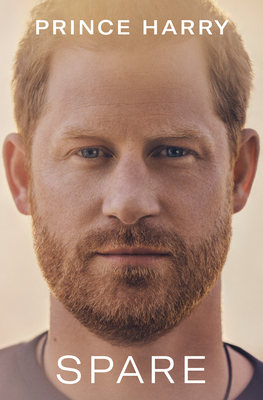
Audiobook: Spare

by Prince Harry, Duke of Sussex
Read by the author
Support your local independent bookstore: buy it there!
Or listen at Libro.fm
Content: There is some swearing, including a few f-bombs, as well as talk of drinking and drug use. It’s in the biography section of the bookstore.

Okay, I recognize that by reading this book I’m caving to peer pressure – everyone is reading this to find out the gossip. But, in my defense: I love celebrity memoirs (especially on audio), and Prince Harry is probably more of a relevant celebrity than, say, Bono. So, it was probably inevitable that I was going to listen to it.

Is this the point where I mention that while I’m not ignorant of the royals, I’m also not a super royal watcher. They’re interesting because, well, they’re the Royal family, but I’m not super invested in what Kate’s wearing right now.

That said, I was floored by the life Prince Harry has led. He had some smart observations on the nature of celebrity, musing at one point that the only thing he ever did to deserve having paparazzi chase him was be born. He’s not talented, he’s not a musician or an actor. Why is he a “celebrity”? Because he was born into this particular family. It’s a smartly written memoir (I’m assuming he had a ghostwriter help him), and he reads it well. And, well, if the purpose of the book was to work through the trauma surrounding his mother’s death and to explain why, ultimately, he and Meghan had to leave the family, then he did his job. It starts with his mom’s death, and moves forward through to the present day, and let’s just say that he has a deep resentment of both the paparazzi (who more than once just made up lies about him, his girlfriends, and now his wife) and the monarchy as an institution. He loves his family, and wishes he didn’t need to fight with them, but the monarchy? It’s not that great. It messes with people’s lives, it’s complicit in the bad press, and it desperately needs to be updated. And maybe Harry’s the person to do it.

It really was an interesting and engaging book, and surprised me with how engrossing it was. I definitly don’t regret reading it at all. And I wish Harry and Meghan all the happiness in the world. They deserve it.

Audiobook: My Hygge Home

by Meik Wiking
Read by the author
Support your local independent bookstore: buy it there!
Or listen at Libro.fm
Content: It’s pretty tame. It’s in the Design section of the bookstore, but it would work in the self-help section as well.

In this one-part design book, one-part explanation of what Hygge is, and one part self-help book on happiness, Wiking gives readers a layout of how to make their home their happy place. It’s got recipes, it’s got ideas on how to better develop communities (I feel like that’s a whole book in itself), and how to make your home a cozy, homey, inviting place. More hygge.

I did get some good ideas – more plants! more light! create nooks, and remember the functionality of the rooms – but mostly I was just delighted with Wiking’s narration. He was surprisingly delightful (I wasn’t expecting dad jokes!) and, well, Hygge, as he talked about his research at the Happiness Insitute in Copenhagen. Being Danish, he knows hygge (they invented it after all), and uses the philosophy and design elements to help stave off the dark winter months up there.

It’s not life-changing, but it was enjoyable, and I’ve found myself thinking about ways I can make my life this winter more hygge. So there’s that. At any rate, it’s a delightful listen, especially on a dark, January day.

Audiobook: Beyond the Wand

by Tom Felton
Read by the author
Support your local independent bookstore: buy it there!
Or listen at Libro.fm
Content: There is talk of substance abuse, and swearing including a handful of f-bombs. It’s in the film section of the bookstore.

An admission: I’m not really a fan of Tom Felton’s. To be honest, while I liked the Harry Potter movies well enough, I was too old to get into being a fan of the child actors. It’s kind of creepy, at any rate. Let them be kids.

But, on the encouragement of a co-worker, I picked up Felton’s memoir on audiobook. And honestly? It’s delightful. I liked Felton’s devil-may-care attitude and the humor that he expresses looking back at the sort of kid that he was to land the role of Draco. He talks about how he ended up acting (it was a good way to skip school!) and talks fondly about his older brothers keeping his ego in check. He devotes a chapter to each of the people in the Potter films that influenced him (he has very kind things to say about Emma, Ruper, Daneil, and Jason Isaacs among others) and then goes into the past ten years after Potter. It wasn’t a great time for him. But he found his way through, and honestly, he sounds like a pretty decent man. He’s a delightful narrator (and does a spot-on American accent!) and I thoroughly enjoyed listening to this one.