May Jacket-Flap-a-thon

Summer.

Our air conditioning is on the fritz, and while it’s okay in the house in the morning through mid-afternoon, by evening, we’re dying and retreat to the basement. We must get this fixed… because if it’s this hot at the end of May, who knows how hot it will be in a month!

Hope you’re staying (relatively) cool… On to this month’s books:

The Wee Free Men (HarperTempest): “There’s trouble on the Aching farm: monsters in the river, headless horsemen in the lane — and Tiffany Aching’s little brother has been stolen by the Queen of Fairies. Getting him back will require all of Tiffany’s strenght and determination (as well as a sturdy skillet) and the help of the rowdy clan of fightin’, stealin’, tiny blue-skinned pictisies known as the Wee Free Men!”

I’m sorry. I know this book is hard to describe and write a blurb about, but they didn’t even really try. It’s part of the reason why I took so long to actually read the book.

Doc Wilde and The Frogs of Doom (G.P. Putnam Sons): “To the world at large, the Wilde family is an amazing team of golden skinned adventurers, born to daring escapades and globetrotting excitement! Doctor Spartacus Wilde, world class scientist and inventor, physical exemplar, ultimate warrior, and loving dad! Brian and Wren Wilde, the worlds most swashbuckling kids, able to survive the most perilous situations through quick wits and the intensive training and astonishing gadgets that are their birthright! Aided by their dashing majordomo Phineas Bartlett and their loyal driver and pilot Declan mac Coul, the Wildes crisscross the Earth on a constant quest for new knowledge, incredible thrills, and good old fashioned adventure! The Frogs of Doom… “

Campy and fun and over the top. Just like the book.


The Year the Swallows Came Early (The Bowen Press): “Eleanor “Groovy” Robinson loves cooking and plans to go to culinary school just as soon as she’s old enough. But even Groovy’s thoughtfully—planned menus won’t fix the things that start to go wrong the year she turns eleven—suddenly, her father is in jail, her best friend’s long-absent mother reappears, and the swallows that make their annual migration to her hometown arrive surprisingly early. As Groovy begins to expect the unexpected, she learns about the importance of forgiveness, understands the complex stories of the people around her, and realizes that even an earthquake can’t get in the way of a family that needs to come together. Kathryn Fitzmaurice’s lovely debut novel is distinctively Californian in its flavor. Her rich characters and strong sense of place feel both familiar and fresh at first meeting—and worth revisiting, again and again.”

One of the better examples of a blurb that gives you the basic arc of the story without giving anything away. Perfect.

The Actor and the Housewife (Bloomsbury): “A very different kind of fantasy from New York Times bestselling author Shannon Hale. What if you were to meet the number-one person on your laminated list–you know, that list you joke about with your significant other about which five celebrities you’d be allowed to run off with if ever given the chance? And of course since it’ll never happen it doesn’t matter… Mormon housewife Becky Jack is seven months pregnant with her fourth child when she meets celebrity hearththrob Felix Callahan. Twelve hours, one elevator ride, and one alcohol-free dinner later, something has happened…though nothing has happened. It isn’t sexual. It isn’t even quite love. But a month later Felix shows up in Salt Lake City to visit and before they know what’s hit them, Felix and Becky are best friends. Really. Becky’s husband is pretty cool about it. Her children roll their eyes. Her neighbors gossip endlessly. But Felix and Becky have something special…something unusual, something completely impossible to sustain. Or is it? A magical story, The Actor and the Housewife explores what could happen when your not-so-secret celebrity crush walks right into real life and changes everything.”

And this one is just here because I really like the book. 🙂

Other books read this month:
Extras
The Screwtape Letters
The Amaranth Enchantment
The Lucky Ones
The Woman in White
Babymouse: The Musical
Life Sucks
The Good Neighbors

The Ordinary Princess
Ranger’s Apprentice: The Burning Bridge
The Last Olympian
The 19th Wife: A Novel
Devilish

April Jacket Flap-a-thon

The end of another month already? Would someone please tell me where this year is going? I can’t believe it’s May tomorrow…

At any rate, on with the flap-a-thon:

Caddy Ever After (Margaret K. McElderry Books): “Love is in the air for the Casson family! Four hilarious, endearing tales unfold as Rose, Indigo, Saffy, and Caddy each tell their intertwining stories. Rose begins by showing how she does special with her Valentine’s card for Tom in New York. Not to be outdone, Indigo has his own surprise in store for the Valentine’s Day disco at school. For her part, Saffy has an unusual date in a very, very dark graveyard, and is haunted by a balloon that almost costs her her best friend. But it is Caddy who dares everything — as she tells all about love at first sight when you have found the Real Thing. Unfortunately the Real Thing is not darling Michael. What is Rose going to do?”

I’ve never really liked the jacket-flaps for the Casson family books; they try to get the tone right, and end up sounding gratingly annoying. This one, however, is not too bad. Not great, but not too bad, either.

Nim’s Island (Scholastic): “A girl. An iguana. An island. And e-mail. Meet Nim–a modern-day Robinson Crusoe! She can chop down bananas with a machete, climb tall palm trees, and start a fire with a piece of glass. So she’s not afraid when her scientist dad sails off to study plankton for three days, leaving her alone on their island. Besides, it’s not as if no one’s looking after her–she’s got a sea lion to mother her and an iguana for comic relief. She also has an interesting new e-mail pal. But when her father’s cell-phone calls stop coming and disaster seems near, Nim has to be stronger and braver than she’s ever been before. And she’ll need all her friends to help her. “

This one, however, is adorable. Or at least very cute.

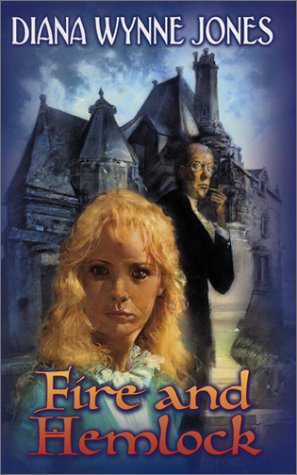
Fire and Hemlock (Greenwillow Books): “A photograph called “Fire and Hemlock” that has been on the wall since her childhood. A story in a book of supernatural stories — had Polly read it before under a different title? Polly, packing to return to college, is distracted by picture and story, clues from the past stirring memories. But why should she suddenly have memories that do not seem to correspond to the facts? Fire and Hemlock is an intricate, romantic fantasy filled with sorcery and intrigue, magic and mystery, all background to a most unusual and thoroughly satisfying love story.”

This is a hard book to write a blurb for, and I think the folks at Greenwillow did a good job. Intriguing, without giving anything away.

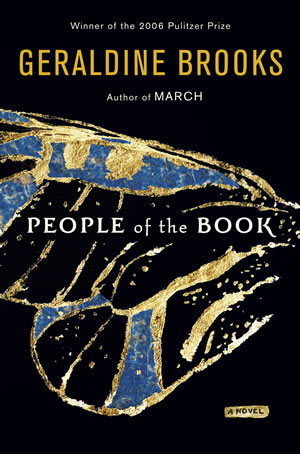
People of the Book (Penguin Books): “In 1996, Hanna Heath, an Australian rare-book expert, is offered the job of a lifetime: analysis and conservation of the famed Sarajevo Haggadah, which has been rescued from Serb shelling during the Bosnian war. Priceless and beautiful, the book is one of the earliest Jewish volumes ever to be illuminated with images. When Hanna, a caustic loner with a passion for her work, discovers a series of tiny artifacts in its ancient binding–an insect wing fragment, wine stains, salt crystals, a white hair–she begins to unlock the book’s mysteries. The reader is ushered into an exquisitely detailed and atmospheric past, tracing the book’s journey from its salvation back to its creation. In Bosnia during World War II, a Muslim risks his life to protect it from the Nazis. In the hedonistic salons of fin-de-siècle Vienna, the book becomes a pawn in the struggle against the city’s rising antisemitism. In inquisition-era Venice, a Catholic priest saves it from burning. In Barcelona in 1492, the scribe who wrote the text sees his family destroyed by the agonies of enforced exile. And in Seville in 1480, the reason for the Haggadah’s extraordinary illuminations is finally disclosed. Hanna’s investigation unexpectedly plunges her into the intrigues of fine art forgers and ultra-nationalist fanatics. Her experiences will test her belief in herself and the man she has come to love. Inspired by a true story, People of the Book is at once a novel of sweeping historical grandeur and intimate emotional intensity, an ambitious, electrifying work by an acclaimed and beloved author.”

Long, but informative without spoiling the plot. And actually very interesting.

Other books read this month:
The Darcys and the Bingleys
Pemberley by the Sea
Jane Austen Ruined My Life
The Order of the Odd-Fish
Lock and Key
The Diary of a Young Girl
The Sharper Your Knife, the Less You Cry
Inkdeath
The Spirit Catches You and You Fall Down
We Are the Ship
Ancedotes of Destiny and Ehrengard
The Farwalker’s Quest
Aurelia
Artichoke’s Heart

March Jacket Flap-a-thon

I am not coming up with anything witty to say as an introduction: I thought I’d read less because the weather was getting nicer, but I didn’t. I did, however, have the single highest number of posts in a month. (This one will be 48, Teaser Tuesday, which will go up soon will be 49. I should do one more to make it an even 50.) I suppose that should be an accomplishment. Either that, or it means I should be spending more time with my kids…

Graceling (Harcourt, Inc.): “In a world where people born with an extreme skill — called a Grace — are feared and exploited, Katsa carries the burden of a skill even she despises: the Grace of killing. She lives under the command of her uncle Randa, King of the Middluns, and is expected to execute his dirty work, punishing and torturing anyone who displeases him. When she first meets Prince Po, who is Graced with combat skills, Katsa has no hint of how her life is about to change. She never expects to become Po’s friend. She never expects to learn a new truth about her own Grace — or about a terrible secret that lies hidden far away… a secret that could destroy all seven kingdoms with words alone.”

One of the most difficult things to do when writing jacket flaps is to conceal a twist or a big revelation and yet not give a false sense of the book. This one does both admirably.

Bee Season (Doubleday): “Eliza Naumann has no reason to believe she is anything but ordinary, especially after her teachers place her in the class for slow learners. Her father, Saul, dotes on her older brother Aaron’s rabbinical ambitions. Her mother, Miriam, seems fully absorbed by her law career. When a spelling bee threatens to reaffirm her mediocrity, Eliza amazes everyone: she wins. Her new found gift garners an invitation not only to the national competition, but to her father’s sacred study where a new dictionary beckons, Jewish mysticism lurks in leather tomes, and language offers a spiritual awakening. Eliza’s unexpected success sends her off-kilter family into a tailspin, and Eliza comes to depend upon her own divination to hold the family together. With intense imagination and great emotional acuity, Bee Season evokes a child’s desperate longing for praise and acceptances and is a masterful portrayal of modern family life.”

This one did its purpose: it made me want to read the book. Too bad I liked the summary better than the book itself…


Speak (Farrar Straus Giroux): “From her first moment at Merryweather High, Melinda Sordino knows she’s an outcast. She busted an end-of-summer party by calling the cops — a major infraction of high-school society — so her old friends won’t talk to her, and people she doesn’t know glare at her. She retreats into her head, where the lies and hypocrisies of high school stand in stark relief to her own silence, making her all the more mute. But it’s not so comfortable in her head, either– there’s something banging around in there that she doesn’t want to think about. Try as she might to avoid it, it won’t go away, until there is a painful confrontation. Once that happens, she can’t be silent — she must speak the truth. In this powerful novel, an utterly believable, bitterly ironic heroine speaks for many a disenfranchised teenager while learning that, although it’s hard to speak up for yourself, keeping your mouth shut is worse.”

I liked the straightforwardness of this: it basically tells you what to expect, but there’s still a little sense of mystery that makes you want to find out what happens to Melinda.


Other books read this month:
Stop Me if You’ve Heard This One Before (Hyperion)
The Parliament of Blood (Bloomsbury)
Somewhere in Heaven (Hyperion)
To Catch a Mermaid (Little, Brown)
Permanent Rose (Margaret K. McElderry Books)
Life As We Knew It (Harcourt)
Just One Wish (G.P. Putnam Sons)
So Many Books, So Little Time (Berkley Trade)
Banker to the Poor (PublicAffairs)
The Hitchhiker’s Guide to the Galaxy
Rosewater and Soda Bread (Random House)
The Death of Ivan Ilyich
Evernight (HarperTeen)
Flygirl (G.P. Putnam’s Sons)
Stealing Heaven (Harper Teen)
Ranger’s Apprentice: The Ruins of Gorlan (Puffin)

February Jacket Flap-a-Thon

I have nothing witty to stay to begin. Generally, February is better than January in my book, but for some reason, I never really got a grasp on the month. Nothing drastic or dramatic, just couldn’t shake a general funk. Thank heavens for books….

Indigo’s Star (Margaret K. McElderry Books): “IT’S BACK TO SCHOOL FOR THE START OF A NEW TERM, AND THE ECCENTRIC CASSONS ARE UP TO THEIR OLD TRICKS! Indigo, having just recovered from a bout of mononucleosis, must return to school after missing an entire semester. Only his younger sister and loyal sidekick, Rose, knows why he’s dreading it so much. As it turns out, the school bullies are eagerly awaiting Indigo’s return so that they can pick up where they left off — flushing his head in the toilet. But Indigo hasn’t counted on meeting Tom, an American student who is staying with his grandmother in England for the year. With his couldn’t-care-less attitude and rock-and-roll lifestyle, Tom becomes Indigo’s ally, and together they work to take back the school. Meanwhile, eight-year-old Rose is desperately trying to avoid wearing horrible glasses, nineteen-year-old Caddy is agonizing over her many suitors, Saffy is working overtime with her best friend, Sarah, to protect Indigo from the gang, and with their father, Bill, in London at his art studio, their mother, Eve, is just trying to stay on top of it all!”

Actually, this is a good bad one. M read the blurb and had no interest in reading the book. (Her exact words: “I have no desire to read about heads being flushed in toilets.”) It was only after I read it, gushed, cajoled and reminded that she actually read the book. And loved it.

Princess of the Midnight Ball (Bloomsbury): “A tale of twelve princesses doomed to dance until dawn… Galen is a young soldier returning from war; Rose is one of twelve princesses condemned to dance each night for the King Under Stone. Together Galen and Rose will search for a way to break the curse that forces the princesses to dance at the midnight balls. All they need is one invisibility cloak, a black wool chain knit with enchanted silver needles, and that most critical ingredient of all—true love—to conquer their foes in the dark halls below. But malevolent forces are working against them above ground as well, and as cruel as the King Under Stone has seemed, his wrath is mere irritation compared to the evil that awaits Galen and Rose in the brighter world above. Captivating from start to finish, Jessica Day George’s take on the Grimms’ tale The Twelve Dancing Princesses demonstrates yet again her mastery at spinning something entirely fresh out of a story you thought you knew.”

Perhaps I notice this because I read a lot of Bloomsbury books, but the folks there really know how to pique a reader’s interest without giving too much away.

Matrimony (Vintage Contemporaries): “It’s the fall of 1986, and Julian Wainwright, an aspiring writer, arrives at Graymont College in New England. Here he meets Carter Heinz, with whom he develops a strong but ambivalent friendship, and beautiful Mia Mendelsohn, with whom he falls in love. Spurred on by a family tragedy, Julian and Mia’s love affair will carry them to graduation and beyond, taking them through several college towns, over the next fifteen years. Starting at the height of the Reagan era and ending in the new millennium, Matrimony is a stunning novel of love and friendship, money and ambition, desire and tensions of faith. It is a richly detailed portrait of what it means to share a life with someone — to do it when you’re young, and to try to do it afresh on the brink of middle age.”

I like this because the book is about such normal, everyday things which are hard to summarize. But, the copy does a good job with this.

The Trouble Begins at 8 (Greenwillow Books): “Mark Twain was born fully grown, with a cheap cigar clamped between his teeth.” So begins Sid Fleischman’s ramble-scramble biography of the great American author and wit, who started life in a Missouri village as a barefoot boy named Samuel Clemens. Abandoning a career as a young steamboat pilot on the Mississippi River, Sam took a bumpy stagecoach to the Far West. In the gold and silver fields, he expected to get rich quick. Instead, he got poor fast, digging in the wrong places. His stint as a sagebrush newspaperman led to a duel with pistols. Had he not survived, the world would never have heard of Tom Sawyer or Huckleberry Finn—or red-headed Mark Twain. Samuel Clemens adopted his pen name in a hotel room in San Francisco and promptly made a jumping frog (and himself) famous. His celebrated novels followed at a leisurely pace; his quips at jet speed. “Don’t let schooling interfere with your education,” he wrote. Here, in high style, is the story of a wisecracking adventurer who came of age in the untamed West; an ink-stained rebel who surprised himself by becoming the most famous American of his time. Bountifully illustrated.”

My only quibble is the “Bountifully illustrated.” Huh? (They weren’t even really illustrations, more a combination of photographs and reprinted cartoons.) But the rest is a good teaser inviting readers to learn more about Mark Twain.

Other books read this month:
Everything Beautiful
Beside a Burning Sea
Maus I and Maus II
Skeleton Creek
The Dragonfly Pool
Madame Pamplemousse and Her Incredible Edibles
Becoming Jane Austen
The Adventures of Boone Barnaby
The Four Agreements
The Graveyard Book
The Bermudez Triangle
A View from Jerusalem
Dear Julia
Chocolat

January Jacket Flap-a-thon

I decided I did like doing the jacket flap-a-thon after all. 🙂 Though I think it needs a bit of tweaking. I’ll only post my top few (one per reading “category”, perhaps?), and no worst ones, unless there’s one that’s truly horrible.

I think that’s about all the tweaking I’ll do, though… On we go. This month’s three:

The Disreputable History of Frankie Landau-Banks (Hyperion):
“Frankie Landau-Banks at age 14:
Debate Club.
Her father’s “bunny rabbit.”
A mildly geeky girl attending a highly competitive boarding school.

Frankie Landau-Banks at age 15:
A knockout figure.
A sharp tongue.
A chip on her shoulder.
And a gorgeous new senior boyfriend: the supremely goofy, word-obsessed Matthew Livingston.

Frankie Landau-Banks.
No longer the kind of girl to take “no” for an answer.
Especially when “no” means she’s excluded from her boyfriend’s all-male secret society.
Not when her ex-boyfriend shows up in the strangest of places.
Not when she knows she’s smarter than any of them.
When she knows Matthew’s lying to her.
And when there are so many, many pranks to be done.

Frankie Landau-Banks, at age 16:
Possibly a criminal mastermind.

This is the story of how she got that way.”

Totally, totally draws the reader in. How could you NOT want to read the book after reading the jacket flap?

Skulduggery Pleasant (Harper Trophy): “Meet Skulduggery Pleasant: Ace detective, snappy dresser, razor-tongued wit, crackerjack sorcerer and walking, talking, fire-throwing skeleton. As well as ally, protector and mentor of Stephanie Edgely, a very unusual and darkly talented twelve-year-old. These two alone must defeat an all-consuming ancient evil. The end of the world? Over his dead body.”

Short, too the point, and very, very clever.

A Year in the World (Broadway Books):A Year in the World is vintage Frances Mayes — a celebration of the allure of travel, of serendipitous pleasures found in unlikely locales, of memory woven into the present, and of a joyous sense of quest. An ideal travel companion, Frances Mayes brings to the page the curiosity of an intrepid explorer, remarkable insights into the wonder of the everyday, and a compelling narrative style that entertains as it informs. With her beloved Tuscany as a home base, Mayes travels to Spain, Portugal, France, the British Isles, and to the Mediterranean world of Turkey, Greece, the South of Italy, and North Africa. In AndalucĂ­a, she relishes the intersection of cultures. She cooks in Portugal, gathers ideas in the gardens of England and Scotland, takes a literary pilgrimage to Burgundy, discovers an ideal place to live in Mantova, and explores the essential Moroccan city of Fez. She rents houses among ordinary residents, shops at neighborhood markets, wanders the back streets, and everywhere contemplates the concept of home. While in Greece, she follows the classic Homeric voyage across the Aegean, lives in a bougainvillea-draped stone house in Crete, and then drives deep into the Mani. In Turkey with friends, she sails the ancient coast, hiking to archaeological sites and snorkeling over sunken Byzantine towns. Weaving together personal perceptions and informed commentary on art, architecture, history, landscape, and social and culinary traditions of each area, Mayes brings the immediacy of life in her temporary homes to the reader. An illuminating and passionate book that will be savored by all who loved Under the Tuscan Sun, A Year in the World is travel writing at its peak.”

This one is so detailed that you almost don’t have to read the book. Still, it does give you a taste of what to expect.

Other books read this month:
Aunt Nancy and the Bothersome Visitors (Candlewick Press)
Chalice (G.P. Putnam’s Sons)
Paper Towns (Dutton)
The Hunger Games (Scholastic Press)
The Musician’s Daughter (Bloomsbury)
Two Girls of Gettysburg (Bloomsbury)
Wild Magic (Walker Books)
Breathing Out the Ghost (River City Publishing)
Babymouse: Rockstar, Babymouse: Monster Mash (Random House Books For Young Readers)
The Leanin’ Dog (Joanna Colter Books)
Saffy’s Angel(Margaret K. McElderry Books)
Captain Alatriste (Plume Books)
The Miraculous Journey of Edward Tulane (Candlewick Press)
The Rule of Won (Walker Books)
The Underneath (Atheneum Books)
The Geography of Bliss (Twelve)
Chains (Simon and Schuster)

December Jacket-Flap-a-Thon

Last one for the year. I’ve enjoyed thinking about jacket-flaps this year, and have learned that mostly it’s personal taste whether they “work” or not. In general, though: shorter is better, without giving away important (or near the end of the book details), while keeping to the style of the book all contribute (generally) to a good jacket flap.

I don’t think I’ll keep this up, though, next year (unless there are some of you that REALLY want me to…). Perhaps I’ll find some other way to keep track of my monthly reading.

5. Shooting the Moon (atheneum books for young readers):Jamie thinks her father can do anything… until the one time he can do nothing. When twelve-year-old Jamie Dexter’s brother joins the Army and is sent to Vietnam, Jamie is plum thrilled. She can’t wait to get letters from the front lines describing the excitement of real-life combat: the sound of helicopters, the smell of gunpowder, the exhilaration of being right in the thick of it. After all, they’ve both dreamed of following in the footsteps of their father, the Colonel. But TJ’s first letter isn’t a letter at all. It’s a roll of undeveloped film, the first of many. What Jamie sees when she develops TJ’s photographs reveals a whole new side of the war. Slowly the shine begins to fade off of Army life – and the Colonel. How can someone she’s worshiped her entire life be just as helpless to save her brother as she is? From the author of the Edgar Award-winning Dovey Coe comes a novel,both timely and timeless, about the sacrifices we make for what we believe and the people we love.”

Slightly misleading… it makes you think her plays a more active role than he actually does (he kind of is an overarching presence, rather than an active player). But it captures the tone of this coming-of-age book well.

4. Persuasion (Quality Paperback Book Club): “In a letter to her niece, Jane Austen described Anne Elliot — the shy, intelligent heroine of Persuasion — as ‘almost too good for me.’ An increasingly spinsterish heiress, Anne is slighted by her spendthrift father and attendance social circle because of her past engagement to Frederick Wentworth, a young naval officer considerably below her in social class and prestige. Persuasion begins seven years after the end of that engagement, when Wentworth is thrown back into Anne’s sphere and the two are left to resolve the smarting wounds of their past liaison. Powers have shifted: Wentworth’s distinction has risen estimably in rank and measure, while much of Anne’s youthful beauty is gone. Persuasion, which some critics speculate is based loosely on Austen’s memories of a mysterious suitor, is the author’s most serious, compelling novel, a deeply felt tale of retaliation — and forgiveness — in the face of abiding love.”

It’s not often that I’ve liked a QPBC blurb; usually they’re abominable. But I think they do Persuasion justice.

3. A Christmas Carol (Dover): “In October 1843, Charles Dickens — heavily in debt and obligated to his publisher — began work on a book to help supplement his family’s meager income. That volume, A Christmas Carol, has long since become one of the most beloved stories in the English language. As much a part of the holiday season as holly, mistletoe and evergreen wreaths, this perennial favorite continues to delight new readers and rekindle thoughts of charity and good will nearly 150 years after it was first published. With its characters exhibiting many qualities — as well as failures — often ascribed to Dickens himself, the imaginative and entertaining tale relates Ebenezer Scrooge’s eerie encounters with a series of spectral visitors. Journeying with them through Christmases past, present and future, he is ultimately transformed from an arrogant, obstinate and insensitive miser to a generous, warm-hearted and caring human being. Written by one of England’s greatest and most popular novelists, A Christmas Carol has come to epitomize the true meaning of Christmas.”

Writing a blurb for something as well known as A Christmas Carol has got to be difficult. This balances information between the history behind and the story of the book quite nicely.

2. Alvin Ho (Schwartz & Wade books): “Here are some things you should know about Alvin Ho : 1. He is afraid of everything. Trains, bridges, substitute teachers, girls, school. Everything. 2. He is from Concord, Massachusetts, which is hard to spell. 3. He loves Aquaman, Wonder Woman, and all the superheroes of the world. In fact, he is a superhero himself — Firecracker Man! 4. He is trying very hard to be a gentleman, like his dad, but there are a lot of rules and they are hard to remember. 5. He can talk at home and on the school bus, but never, ever at school. It’s just too scary. (See #1.) And there’s a lot more to learn about this amazing kid, so meet Alvin Ho…”

Cute, clever, sweet… keeps the style of the book wonderfully, and entices just enough without giving much away at all.

1. Yellow Star (Marshall Cavendish): “In 1939, the Germans invaded the town of Lodz, Poland, and moved the Jewish population into a small part of the city called a ghetto. As the war progressed, 270,000 people were forced to settle in the ghetto under impossible conditions. At the end of the war, there were about 800 survivors. Of those who survived, only twelve were children. This is the story of one of the twelve.”

Short, to the point, and powerful.

The One Worst:
Thank You, Lucky Stars (Schwartz & Wade Books): “It’s the first day of fifth grade, and Ally is totally psyched. She and Betsy, her best friend — okay, her only friend — are in the same class. They’re even going to sing “Bridge Over Troubled Water” together in the annual talent show. Ally is sure this is going to be the best year ever. But suddenly Betsy is ignoring her, and Ally doesn’t have a clue why. What’s worse, Betsy’s spending every minute with their sworn archenemy, Mona; they’re wearing matching jeans skirts, eating lunch at the same table as with the other cool kids, even planning to sing in a rock band together for the talent show! Now practically the only kid who wants to do stuff with Ally is the weird new girl, Tina, who wears her hair in Princess Leia buns and seems determined to make a fool of herself in the talent show. How could fifth grade, which looked so promising from a distance, turn out to be so lonely? Will disco, Ally’s favorite dance, make a comeback at the talent show? And can Ally be friends with a girl who enjoys being different… even if she knows Tina is a kindred spirit?”

I think it tries to capture the tone of the book, but just ends off coming annoying. I didn’t particularly want to read the book after reading the blurb, even though it turned out to be fairly cute.

November Jacket Flap-a-Thon

The (mostly) Middle Grade edition…
How the Garcia Girls Lost Their Accents (Algonquin Books): “The Garcias — Dr. Carlos (Papi), his wife Laura (Mami), and their four daughters, Carla, Sandra, Yolanda, and Sofia — belong to the uppermost echelon of Spanish Caribbean society. They descend from the conquistadores. Their family compound adjoins the palacio of the dictator’s daughter. The Garcia girls giggle at the sight of the dictator and his toddler grandson in matching general’s uniforms. The Garcia grownups are careful not to seem to snub the neighbors (much less dispose them). So when Papi’s part in a coup attempt is discovered, the family must flee. This is the chronicle of that family in exile. Papi has to find new patients in the Bronx. Mami, far from the compound and the family trainers, must find herself. The girls try to lose themselves by ironing their hair, buying bell-bottoms and fringe, forgetting their Spanish. Before Papi knows it, his “harem” has broken out in new identities that are at definite odds with the very proper Island life of maids and manicures. For the Garcia girls, it is exhilarating and terrifying, liberating and excruciating being betwixt and between, trying to live up to Papi’s version of honor while accommodating the expectations of their American boyfriends. Little revolutionary plots evolve at home. Little stores of pot, birth control devices, explicit love letters are squirreled away. But Papi is not so easily overthrown. The boarding schools fill up with Garcia girls’ the analyst’s couch and divorce courts will too. Julia Alvarez’s brilliant first book of fiction sets the Garcia girls free to tell their irrepressibly intimate stories about how they came to be at home — and not at home — in America.”

This is actually a really good blurb: the book’s written backwards, so the blurb not only gets people interested in the book, but actually helped those of us who were a bit disoriented by the style. Who knew a blurb could do so much?

4. My Dad’s a Birdman (Candlewick Press): “Roll up! Roll up! A new illustrated novel by David Almond! IN a rainy town in the north of England, there are strange goings-on. Dad is building a pair of wings, eating flies, and feathering his nest. Auntie Doreen is getting cross and making dumplings. Mr. Poop is parading the streets, shouting louder and LOUDER, and even Mr. Mint, the headmaster, is getting in a flap. And watching it all is Lizzie, missing her mam and looking after Dad and thinking how beautiful the birds are. What’s behind it all. It’s the Great Human Bird Competition, of course!”

This was one of those instances when I liked the blurb better than the book.


3. Island of Mad Scientists (Kids Can Press): “‘We are running away!’ Aunt Lucy announces to her eccentric household. Her niece, fourteen-year-old pioneering aviatrix Emmaline Cayley, ‘indestruckable’ pilot Rubberbones and lovably ferocious Princess Purnah of Chiligrit are looking forward to their upcoming holiday. (‘Holiday,’ in this case, being another word for escaping from the authorities.) But things don’t go entirely as planned. Before long, this merry band of travelers is en route to a cold and damp Scottish isle used by experimental scientists. And Purnah is once again being pursued by nefarious forces intent upon returning her to St. Grimelda’s School for Young Ladies. An even greater peril threatens Emmaline and Rubberbones: a sinister old man known as the Collector aims to capture the duo, with the help of two misfit thugs and a sneaky master of disguise, and add them to his alphabetically organized collection of brilliant scientists…”

Terribly funny. Like the book.

2. The London Eye Mystery (David Fickling Books): “What goes up must come down… mustn’t it? When Aunt Gloria’s son, Salim, mysteriously disappears from a sealed pod on the London Eye, everyone is frantic. Has he spontaneously combusted? (Ted’s theory.) Has he been kidnapped? (Aunt Gloria’s theory.) Is he even still alive? (The family’s unspoken fear.) Even the police are baffled. Ted, whose brain runs on it’s own unique operating system, and his older sister, Kat, overcome their prickly relationship to become sleuthing partners. They follow a trail of clues across London in a desperate bid to find their cousin while time ticks dangerously by…”

Clever and intense. Made me want to read the book.

1. Every Soul a Star (Little, Brown and Company): “At Moon Shadow, an isolated campground, thousands have gathered to catch a glimpse of a rare sight: a total eclipse of the sun. Three lives are about to be changed forever. Ally: Ally likes the simple things in life — labyrinths, stargazing, and comet hunting. Her home, the Moon Shadow campground, is a part of who she is. She refuses to imagine it any other way. Bree: Popular, gorgeous (everybody says so), and a future homecoming queen for sure, Bree wears her beauty like a suit of armor. But what is she trying to hide? Jack: Overweight and awkward, Jack is used to spending a lot of time alone. But when opportunity knocks, he finds himself in situations he never would have imagine. With humor and warmth, Wendy mass weaves an intricate and enchanting tale. Told from three unique perspectives, Every Soul a Star is about strangers coming together, unlikely friendships, and finding one’s place in the universe.”

This was a hard one to choose, because they all were good. But I think this blurb captured the essence of the book (without giving too much away) the best.

There was no one worst. Go figure. It was a good blurb month.

October Jacket Flap-a-Thon

Presenting the Halloween edition of the Jacket Flap-a-thon…

5. The Gollywhopper Games (Greenwillow Books): “Ladies and Gentlemen! Boys and Girls! Welcome to the biggest, bravest, boldest competition the world has ever seen! The Gollywhopper Games! Are you ready? Gil Goodson sure hopes he’s ready. His future happiness depends on winning the Golly Toy & Game Company’s ultimate competition. If Gil wins, his dad promised the family can move out of Orchard Heights — away from all the gossip, the false friends, the bad press that have plagued the Goodsons ever since The Incident. Gil’s been studying for months. He thinks he knows everything about Golly’s history and merchandise. But does he know enough to answer the trivia? Solve the puzzles? Complete the stunts? Will it be more than all the other kids know? Gil’s formidable opponents have their own special talents. He must be quicker and smarter than all of them. The ride of Gil’s life is about to begin. Win! Win! Win!”
Aside from the cloying “Win!Win!Win!” at the end, it’s a pretty good blurb, getting readers geared up for the fun ride that the book is.

4. Frankenstein (Signet Classics): “The story of Victor Frankenstein and of the monstrous creature he created has held readers spellbound ever since it was published almost two centuries ago. On the surface, it is a novel of tense and steadily mounting horror; but on a more profound level, it offers searching illumination of the human condition in its portrayal of a scientist who oversteps the bounds of conscience, and of a monster brought to life in an alien world, ever more desperately attempting to escape the torture of his solitude. A novel of hallucinatory intensity, Frankenstein represents one of the most striking flowerings of the Romantic imagination.”
Short, to the point, and intriguing.

3. Diamond Willow (Frances Foster Books): “Twelve-year-old Willow would rather blend in than stick out. But she still wants to be seen for who she is. She wants her parents to notice that she is growing up. She wants her best friend to like her better than she likes a certain boy. She wants, more than anything, to mush the dogs out to her grandparents’ house, by herself, with Roxy in the lead. But sometimes when it’s just you, one mistake can have frightening consequences . . . And when Willow stumbles, it takes a surprising group of friends to help her make things right again.”
A hard novel to write a blurb for, but I think they did a pretty good job capturing at least the essence of the story.

2. Coraline (Harper Collins): “In Corlaine’s family’s new flat are twenty-one windows and fourteen doors. Thirteen of the doors open and close. The fourteenth is locked, and on the other side is only a brick wall, until the day Coraline unlocks the door to find a passage to another flat in another house just like her own. Only it’s different…. At first, things seem marvelous in the other flat. The food is better. The toy box is filled with wind-up angels that flutter around the bedroom, books whose pictures writhe and crawl and shimmer, little dinosaur skulls that chatter their teeth. But there’s another mother, and another father, and they want Coraline to stay with them and be their little girl. They want to change her and never let her go. Other children are trapped there aw well, lost souls behind the mirrors. Coraline is their only hope of rescue. She will have to fight with all her wits and all the tools she can find if she is to save the lost children, her ordinary life, and herself. Critically acclaimed and award-winning author Neil Gaiman will delight readers with his first novel for all ages.”
Good. Creepy. And makes me want to read the book. (How does she get out?)

1. The Call of the Wild (Simon and Schuster): “Buck lived the happy, comfortable life of a pet in the sun-kissed Santa Clara Valley. But when one of the garden workers brings him to the train station and sells him, his whole life changes. Buck is caged and forced to travel by train — without food or water — to the frozen North. When he arrives, he is full of fury. But a man with a club shows Buck who’s boss, and Buck has no choice but to obey. So begins the story of a dog taken from his home and master, and forced to learn the ropes as a sled dog in the tough, frozen world of the Klondike gold rush. Unaccustomed to the savage, unruly ways of the North, Buck learns by trial and error. But his spirit is unbreakable, and he grows strong in the wilderness. From one master to another, Buck thrives on hard work and discipline, becoming a lead dog on the team. He toils long and hard, keeping the other dogs in line. He remembers his easy life in California, bu this new life stirs up ancient instincts, and Buck knows that he belongs in the wild. With vivid, passionate details of the North, Jack London tells the classic story of a sled dog during the 1900 Alaskan gold rush. An introduction by award-winning author Gary Paulsen and realistic, evocative illustrations by Bary Moser make this edition of The Call of the Wild one to be treasured for generations to come.”
A bit long, but evocative. Granted, it tells you pretty much the whole story (at least a good part of it), but in this case it actually helps rather than hurts.

The One Worst:
Sense and Sensibility (QPBC):
“Perhaps the most affecting and accomplished of Jane Austen’s novels, Sense and Sensibility (which grew out of an adolescent sketch “Elinor and Marianne”) tells the story of two sisters, polar opposites Elinor and Marianne Dashwood, whose hopes of marrying well are smashed when their family’s estate is left to an arrogant stepson upon the death of their father. Thus pauperized, the practical, almost prissy Elinor (the “sense” of the duo) sets out to hide her deep affection for her brother-in-law, pained at the fact that they cannot marry. But when younger Marianne, indulging her almost hedonistic pursuit of passion, becomes infatuated with a dashing rogue, her clamorous spirit threatens to blind her to a more lasting and genuine love. Delicately piercing and exquisite in its irony, Sense and Sensibility — Austen’s first published novel — is a profound examination of two sisters who discover the limits of both mind and the heart.”
Okay, it’s not that bad (it is accurate after all)… but it is a bit chatty for Jane Austen, and calling Elinor prissy?! C’mon.

September Jacket Flap-a-Thon

Ah.it’s been a bit of a challenge to get to the computer today. Mostly because I have everyone home — M’s sick, C has a matinee — and everyone’s monopolizing my computer time!! The joys of motherhood. 🙂

The Five Best:
5. Audrey, Wait! (razorbill): “Everybody’s singing ‘Audrey, Wait!’ Audrey Cuttler’s life hasn’t been teh same since that song, ‘Audrey, Wait!’ hit the airwaves. All she wants to do is go to concerts, hang out with her friends, and maybe score a date with the cute boy who works with her at the Scooper Dooper. But now, her ex-boyfriend’s song about their breakup is at the top of the charts and she’s suddenly famous! The paparazzi won’t leave her alone, the tabloids are trying to make her into some kind of rock goddess, and the Internet it documenting her every move! Will Audrey ever be able to have a normal life again? Get ready to find out, because it’s time for Audrey to tell her side of the story.”

This blurb was one of the reasons I started the book. It’s clever and catchy, like the cover. It’s not their fault I didn’t like it. 🙂

4. Grail Prince (Ballantine Books): “The wheel is turning and the world will change. . . . And a son of Lancelot, with a bloody sword and a righteous heart, shall renew the Light in Britain before the descent of savage dark. . . . So spoke the Lady of the Lake. Now her grim prophecy is coming true. King Arthur lies dead, struck down along with Mordred, his son and heir, and the greatest knights of Camelot. Of that peerless company, only Lancelot survives, a broken man who has turned his back on Britain and his forbidden love of Guinevere. Yet one knight, scarcely more than a boy, fights amid the ruins to keep Arthur’s dream alive: Galahad, the son of Lancelot. Before his death, Arthur swore the young knight to undertake a quest: a search for the scattered treasures of an ancient king. On the recovery of these powerful relics–a grail, a spear, and a sword–hinges the future of Britain. But it is the past that torments Galahad. He cannot forget or forgive his father’s betrayal of his king. Nor can he banish thoughts of the intoxicating Dandrane, sister of his friend Percival, from his mind. Yet only a man pure in heart can fulfill the prophecy of the Lady of the Lake. Not since The Mists of Avalon has an author so brilliantly reimagined and brought to life the enduring Arthurian legends. Weaving back and forth through time, from Arthur’s mighty reign and commanding influence to Galahad’s ultimate quest to preserve the destiny of a nation, The Grail Prince is an unforgettable epic of adventure and romance, of clashing swords and hearts set in a magical world as deadly as it is beautiful.”

One of those instances where the blurb is so good that it sets up unreasonable expectations for the book, which isn’t nearly as good. Still. Makes you curious, doesn’t it?

3. Balzac and the Little Chinese Seamstress (Alfred A. Knopf):
“An enchanting literary debut — already an international best-seller. A the height of Mao’s infamous Cultural Revolution, two boys are among hundreds of thousands exiled to the countryside for “re-education.” The narrator and his best friend, Luo, guilty of being the sons of doctors, find themselves in a remote village where, among the peasants of Phoenix mountain, they are made to cart buckets of excrement up and down precipitous winding paths. Their meager distractions include a violin — as well as, before long, the beautiful daughter of the local tailor. But it is when the two discover a hidden stash of Western classics in Chinese translation that their re-education takes its most surprising turn. While ingeniously concealing their forbidden treasure, the boys find transit to worlds they had thought lost forever. And after listening to their dangerously seductive retellings of Balzac, even the Little Seamstress will be forever transformed. From within the hopelessness and terror of one of the darkest passages in human history, Dai Sijie has fashioned a beguiling and unexpected story about the resilience of the human spirit, the wonder of romantic awakening and the magical power of storytelling.”

Good. Not brilliant, but short, and accurate. Which counts for a lot when it’s an adult book.

2. Crown Duel (The Crown and Court Duet) (Firebird): “Battle on and off the field, with sword and fan, with might and manners… It begins in a cold and shabby tower room, where young Countess Meliara swears to her dying father that she and her brother will defend their people from the growing greed of the king. That promise leads them into a war for which they are ill-prepared, a war that threatens the homes and lives of the very people they are trying to protect. But war is simple compared to what follows, when the bloody fighting is done and a fragile peace is at hand. Although she wants to turn her back on politics and the crown, Meliara is summoned to the royal palace. There, she soon discovers, friends and enemies look alike, and intrigue fills the dance halls and the drawing rooms. If she is to survive, Meliara must learn a whole new way of fighting — with wit and words and secret alliances. In war, at least, she knew whom she could trust. Now she can trust no one….”

Clever way to intrigue, and write about two different books that have been combined into one.

1. Dracula (HarperCollins Publishers): “The punctured throat, the coffin lid slowly opening, the unholy shriek as the stake pierces the heart — these are just a few of the chilling images Bram Stoker unleashed upon the world with his 1897 masterpiece, Dracula. Inspired by the folk legend of Nosferatu, the undead, Stoker created a timeless tale of gothic horror and romance that has enthralled and terrified readers ever since. This illustrated edition does full justice to the dark splendor of Stoker’s novel of the count who feeds off the blood of the living. Stark and powerful relief engraving from renowned illustrator Barry Moser brings to life the story’s most unforgettable moments and characters: the ship of death that brings Dracula to English shores as it pitches upon the sea; the final terrible siege at his Transylvanian lair; and the faces of clever, loving Mina Harker, mad, ravenous Renfield, wise Professor Van Helsing, and of course, Count Dracula himself. Told in letters, diary entries, and news clippings, Dracula maintains an uncanny power over the reader, not only in the chilling charisma of its of-imitated character, but in the pace and fury of its storytelling. Stoker’s novel has inspired countless movies and like its hero, has the power to live forever.”

As good as the book…. makes me want to read it again!

The One Worst:
Just So Stories (Magnum): “‘In the days when everybody started fair, Best Beloved, the Leopard lived in a place called the High Veldt. ‘Member it wasn’t the Low Veldt, or the Bush Veldt, or the Sour Veldt, but the ‘sclusively bare, hot, shiny High Veldt, where there was sand and…’ More? Find in this book ‘How the Leopard Got His Spots,’ and you will be carried along (but always toward the astonishing answer) on a soaring wave of sounds and pictures meant by Rudyard Kipling to be read aloud — and ‘sclusively for children of all ages. And then frolic through other pages to see How the Whale Got His Throat, How The Rhinoceros Got His Skin and even (but don’t really believe it) How the Alphabet Was Made… Kipling wrote the delightfully imaginative Just So Stories in 1902, for his own Best Beloved, his daughter Josephine. But millon have since felt no less loved through his gift to them of his playful wit and the sheer music of his language. The Just So Stories are set, literally, in India, the scene of many Kipling’s books, but they come, in a sense, from a country of magic.”

Ack. Really. It’s bad. But then, the copy was written in 1968. We’ve gotten much, much better since then.

The Other One Worst:
The Acts of King Arthur and his Noble Knights (Farrar, Straus and Giroux):

I’m not even going to bother writing it out. They just took the introduction and used it as flap copy. Lazy, lazy, lazy. Bad copy writers.

August Jacket Flap-a-Thon

I didn’t read as much as much, as I have in past months… but then, it’s hot, I was on vacation, and I tackled Alexandre Dumas. I guess I can’t have it all. So… the best of what I read:

5. Breaking Dawn (Little, Brown): “When you loved the one who was killing you, it left you no options. How could you run, how could you fight, when doing so would hurt that beloved one? If your life was all you had to give, how could you not give it? If it was someone you truly loved? To be irrevocably in love with a vampire is both fantasy and nightmare woven into a dangerously heightened reality for Bella Swan. Pulled in one direction by her intense passion for Edward Cullen, and in another by her profound connection to werewolf Jacob Black, she has endured a tumultuous year of temptation, loss, and strife to reach the ultimate turning point. Her imminent choice to either join the dark but seductive world of immortals or pursue a fully human life has become the thread from which the fate of two tribes hangs. Now that Bella has made her decision, a startling chain of unprecedented events is about to unfold with potentially devastating and unfathomable consequences. Just when the frayed strands of Bella’s life — first discovered in Twilight, then scattered and torn in New Moon and Eclipse — seem ready to heal and knit together, could they be destroyed… forever? The astonishing, breathlessly anticipated conclusion to the Twilight Saga, Breaking Dawn illuminates the secrets and mysteries of this spellbinding romantic epic that has entranced millions.”

Yeah, I didn’t like the book all that much… but I have to admit: this flap is great at luring a reader in. Especially if you’ve read the other three.

4. Crown Duel: The Crown and Court Duet, Book 1 (Jane Yolen Books): “In a cold and shabby tower room, in a cold and shabby castle, young Countess Meliara and her brother, Branaric, swear to their dying father that they will defend their people from the growing greed of the king. But that promise may cost them everything they cherish. It leads them into a war for which they are ill-prepared, a war that threatens the homes and lives of the very people they are trying to protect. Worse still, it lands one of the pair in a torture chamber and leaves the other with an arrow in the back. Full of action, intrigue, and a touch of magic, Crown Duel is not only a novel of treachery and revolution but also the story of a hardy young heroine’s coming-of-age.”

It does have a little bit of the problem of letting us know stuff that happens late in the novel, and it’s not entirely accurate, but it is compelling…

3. Rebecca (Doubleday & Co): “When Rebecca was first published, Christopher Morley said of it, ‘This is melodrama with all the trimmings. It is superb good entertainment.’ Rebecca has an urgency about its story, a brilliantly created atmosphere of suspense. It is a novel that is infinitely moving, deeply concerned with the inner workings of the minds of men and women. The principal setting is the great Cornwall estate of Manderley, one of the most famous country homes in England. Rebecca, its glamorous mistress, has been dead for eating months when the story opens — drowned in a sailing accident. But through the eyes of Maxim de Winter’s young and frightened second wife the reader comes to know Rebecca form the tall and sloping R with which she signed her name, to the way she organized the magnificent annual costume ball that was attended by the whole country side. There are dozens of superbly drawn characters. Mrs. Danvers, the housekeeper, is particularly sinister. To suggest the story in brief compass is impossible. The reader must experience the atmosphere of impending disaster, the exquisite love story with its emotion heightened by drama, these surprises, the superb moment of melodrama.”

Writing flaps for classics is always a challenge, one that I think this handles well. I like the fact that whomever wrote this didn’t even bother to summarize: to suggest the story in brief is impossible. Touche.

2. Rapunzel’s Revenge (Bloomsbury): “Once upon a time, in a land you only think you know, lived a little girl and her mother . . . or the woman she thought was her mother. Every day, when the little girl played in her pretty garden, she grew more curious about what lay on the other side of the garden wall . . . a rather enormous garden wall. And every year, as she grew older, things seemed weirder and weirder, until the day she finally climbed to the top of the wall and looked over into the mines and desert beyond. Newbery Honor-winning author Shannon Hale teams up with husband Dean Hale and brilliant artist Nathan Hale (no relation) to bring readers a swashbuckling and hilarious twist on the classic story as you’ve never seen it before. Watch as Rapunzel and her amazing hair team up with Jack (of beanstalk fame) to gallop around the wild and western landscape, changing lives, righting wrongs, and bringing joy to every soul they encounter.”

Delightful, cheeky and fun; makes me want to go re-read the book.

1. Suite Scarlett (Point): “Scarlett Martin has grown up in a most unusual way. Her family owns the Hopewell, a small hotel in the heart of New York City. Her nineteen-year-old brother, Spencer, is an out of work actor facing a family deadline to get his career in order. Eighteen-year-old Lola has the delicate looks of a model, the practical nature of a nurse, and a wealthy society boyfriend. Eleven-year-old Marlene is the family terror with a tragic past. When the Martins turn fifteen, they are each expected to take over the care of a suite in the once elegant, now shabby Art Deco hotel. For Scarlett’s fifteenth birthday, she gets both a room called the Empire Suite, and a permanent guest named Mrs. Amberson. Scarlett doesn’t quite know what to make of this C-list starlet, world traveler, and aspiring autobiographer who wants to take over her life. And when she meets Eric, an astonishingly gorgeous actor who has just moved to the city, her summer takes a second unexpected turn. With Mrs. Amberson calling the shots, Spencer’s career to save, Lola’s love life to navigate around, and Marlene’s prying eyes everywhere, things won’t be easy. Before the summer is over, Scarlett will have to survive a whirlwind of thievery, Broadway glamour, romantic missteps, and theatrical deception. The show, as they say, must always go on . . .””

Captures the essence of the book, is interesting, and doesn’t give too much away. Perfect. (Like the book.)

The One Worst:
Apples and Oranges (Farrar Strauss Giroux):
“To be sure, some brothers and sisters have relationships that are easy. But oh, some relationships can be fraught. Confusing, too: How can two people share the same parents and turn out to be entirely different? Marie Brenner’s brother, Carl—yin to her yang, red state to her blue state—lived in Texas and in the apple country of Washington state, cultivating his orchards, polishing his guns, and (no doubt causing their grandfather Isidor to turn in his grave) attending church, while Marie, a world-class journalist and bestselling author, led a sophisticated life among the “New York libs” her brother loathed. From their earliest days there was a gulf between them, well documented in testy letters and telling photos: “I am a textbook younger child . . . training as bĂŞte noir to my brother,” Brenner writes. “He’s barely six years old and has already developed the Carl Look. It’s the expression that the rabbit gets in Watership Down when it goes tharn, freezes in the light.” After many years apart, a medical crisis pushed them back into each other’s lives. Marie temporarily abandoned her job at Vanity Fair magazine, her friends, and her husband to try to help her brother. Except that Carl fought her every step of the way. “I told you to stay away from the apple country,” he barked when she showed up. And, “Don’t tell anyone out here you’re from New York City. They’ll get the wrong idea.” As usual, Marie—a reporter who has exposed big Tobacco scandals and Enron—irritated her brother and ignored his orders. She trained her formidable investigative skills on finding treatments to help her brother medically. And she dug into the past of the brilliant and contentious Brenner family, seeking in that complicated story a cure, too, for what ailed her relationship with Carl. If only they could find common ground, she reasoned, all would be well. Brothers and sisters, Apples and Oranges. Marie Brenner has written an extraordinary memoir—one that is heartbreakingly honest, funny and true. It’s a book that even her brother could love.”

Blah, blah, blah. Too long, too pretentious, too boring. After the second sentence, I realize that I don’t really care. (Granted, I didn’t like the book, so that may have influenced things…)