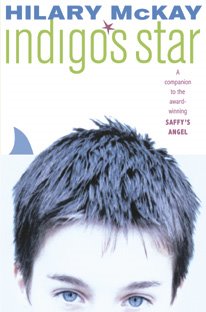
Indigo’s Star

by Hilary McKay
ages: 10+
First sentence: “For the first time in his life Indigo Casson had been properly ill.”

Have I said how much I love the Casson family? I have? Oh. Well. I’m saying it again:

I love the Casson family. Adore them. These books make me so utterly happy.

The basic plot of this one involves Indigo and his troubles at school. He’s been bullied by the local “rabble” and, after being out for an entire term with mono, has to go back and face them at school. Once there, he discovers that there’s a new target for the rabble’s ire: Tom, who’s spent the year visiting from America. Indigo and Tom fall into a sort of friendship, which blossoms into a real friendship, which means that Tom is now a part of the Casson family.

But, like all these books, it’s not so much about the plot as it is about the family. Caddy’s going through boyfriends, mostly because she’s trying to figure out what they all already know: that Michael is the one for her. (The boyfriends, by the way, are hilarious.) Saffy (and Sarah) are just Saffy and Sarah, presences that add a certain spark, but don’t actually do anything. Eve is still delightfully daffy, and Bill is less anal, mostly because he’s mostly absent (which surprised me, until I figured out sometime near the end that Bill and Eve got a divorce. Makes sense), but turns out to be a halfway decent fellow. But the book-stealer, right out from under Indigo’s nose, is Rose. Oh, Rose made me laugh until I cried. Her letters to her dad were priceless, as was the wall mural and her refusal to wear her glasses except for when she looks at stars. And the end… oh the end (which I won’t give away), had me in tears. 🙂

A short example of Rose, because I can’t resist:

Darling Daddy,

This is Rose.

So flames went all up the kitchen wall. Saffron called the fire brigade adn the police came too to see if it was a trick and the police woman said to Saffron Here You Are Again because of when I got lost haveing my glasses checked. But I was with Tom whose grandmother is a witch on top of the highest place in town.

Love, Rose.

How can you not love her?

At least the next book in the series is ALL about Rose (or at least has her in the title!).

Chains

by Laurie Halse Anderson
ages: 10+
First sentence: “The best time to talk to ghosts is just before the sun comes up.”

Isabel is a slave. But this is not a plantation in the Civil War South; it is 1776, and New York is bristling with the news of an impending British invasion. Isabel and her younger sister Ruth’s former master died, and instead of being set free, like they thought they were, they are sold to a couple of Tories: Mr. and Madame Lockton, and taken to New York, where they are caught in the middle of the revolution. It’s just a matter of time, and circumstances, before Isabel decides which side she will be on. And what price that will cost her.

First: this book is beautiful. I’m not usually a tactile reader, but in this instance, I kept looking at the more-than–perfect cover, stroking the pages, and loving the font. Especially the blurb on the back cover. I could tell much care was taken with the design of the book. And I, for one, appreciated it.

Moving on…

In the interview at the back of the book, Anderson says that the whole slave issue cannot be broken down into “good guys” and “bad guys”. Which is an understatement. There are sympathetic characters on both sides of the revolution — while the politics of the revolution play a role in this book, it is not an indicator of character. (Nor should it ever be.) Chains is thoroughly complex and unflinching, presenting the issues at hand — freedom, slavery, revolution — with honesty. Anderson doesn’t write down to the reader; the book is quite brutal at times. That’s not to say the book is harsh. Rather, interspersed with all the brutality are moments of absolute poignancy. The book just about ripped my heart in two at parts. Isabel as a character is not just compelling, she’s strong and captivating, and honest. I felt for her, I adored her, I cheered for her.

In short, it’s historical fiction at its finest. But then, it’s Laurie Halse Anderson.

(And yes, I do need to read her other books. I know that. Which one to start with, though?)

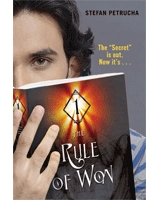
The Rule of Won

by Stefan Petrucha
ages: 12+
First sentence: “Garish.”
Review copy sent to me by Bloomsbury/Walker Books. (Yes, I am branching out and actually reviewing ARCs on my blog. They have to go somewhere…)

Caleb Dunne is a slacker. Self-proclaimed, all he aspires to do is not work very hard. He got suspended for something he didn’t do (wrong place, wrong time), and now, at the start of a new school year, he’s feeling the results of that: no one’s talking to him, except for his girlfriend Vicky. And she wants him to come to this after-school club, the Crave, and read this book The Rule of Won. The idea is that anything can happen to you or for you if you only think about it hard enough and want it bad enough.

Everything’s fine and good for a while — they do a couple of immanifests (the visualizing and chanting that gets you what you want) that work out, and Caleb is flying high. Until… well, until a teacher gets into a car accident, a close friend attempts suicide and another acquaintance is beaten up and put in the hospital. The book is less about Caleb’s self-discovery and relationships, though that’s a big part of it, and more about the dangers of group-think, and the line between “club” and “cult”. On those levels, it works quite well. Caleb is an engaging character, humourous, slightly dense, earnest, and likeable. His own relationship with the Crave is an interesting one; it starts out being just for Vicky and then morphs into something more challenging, and, eventually, more dangerous. Pertucha did a fabulous job writing group think — the chapters that are the Crave’s message board get more and more creepy as the book goes along, as the members get more and more immersed in the mob-mentality — as well as making Caleb and some of the secondary characters extremely compelling.

But, I think the book falters because there’s this element of mysticism surrounding Ethan’s (that’s the Crave leader) younger sister. Can she do magic? Or all those coincidences? Really? In the end, it’s murky. I think we’re supposed to believe, on some level that Ethan’s sister is making things happen. On the one hand, that’s really quite cool (and the way she does it is very unique). On the other hand, I think it undermines the message (if there’s even supposed to be one) that there’s a fine line between achieving things, and achieving things at all costs.

Even with that teeny bit of misdirection, the bottom line is clear: Fanaticism is a bad thing. Even if you’re fanatic about something as simple (?) as a book.

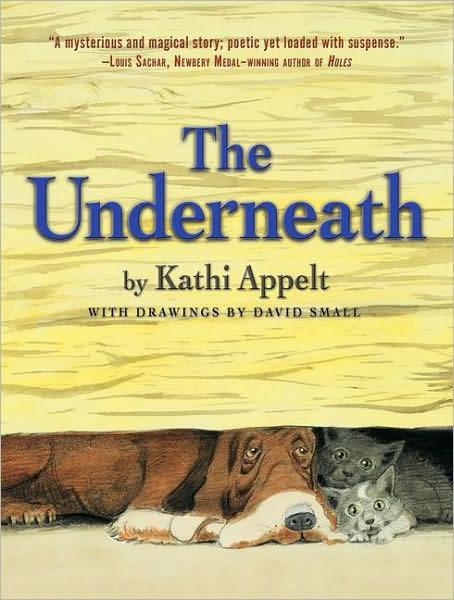
The Underneath

by Kathi Appelt
ages: 11+
First sentence: “There is nothing lonelier than a cat who has been loved, at least for a while, and then abandoned on the side of the road.”

I wrote this back in December, in the middle of the Cybils shortlist discussion, but didn’t post it. I figured it was safe, now that it’s won a Newbery Honor. I admit that I’m not feeling the love that others have for this book, though I also think that Sarah might be on to something… perhaps it’s one (like The Tale of Despereaux) that really should be read aloud, and maybe if I got a copy of the audio book (or read it aloud to C), I would feel differently.

On with the review…

There are some books that intellectually I get: I can understand why it’s a good book, I can see the craft that went into it, and can understand why it’s getting the buzz it’s getting. But on a visceral, emotional, story-enjoying level, I find myself wondering if the book is all about the hype, the craft, the buzz. Because I couldn’t stand it.

The Underneath is one of those books. Done in a series of short prose-poems, hauntingly done, it tells the story of the friendship between one hound dog, a mother cat and her two kittens. And their trials brought about at the hands of a very disturbed, evil individual named Gar Face. There’s also a sub-plot about Grandmother Moccasin, a water moccasin-changeling, who is engulfed in hatred because her daughter, 1,000 years ago, chose love with a man over her mother. It’s a journey and discovery for both of the stories, enveloped in sorrow and adventure.

Unfortunately, even though I could recognize it’s beauty and sense where Appelt was going, and know that this one will at least get a Newbery Honor [I was right… wow!], I didn’t like it. At all. In fact, I found myself rolling my eyes and yawning. I was bored. Stiff. The pacing was horrible, and even though the language was beautiful, it wasn’t enough to keep me from cringing every time Grandmother Moccasin showed up. “Go back a thousand years…” Um. Let’s not and just say we did. The plot kept jumping between Gar Face’s past, the present with the dog and kittens and the long past with Grandmother Moccasin, which is all fine and good, but after about 100 or so pages of it, I’d had enough. Then there was the animal cruelty. This is not a book for weak stomachs. Or sensitive readers. Don’t give it to the girl who loves her kitty. Or, probably, the boy who’s a bit mean to the dog.

But, I’ve heard it’s a good read-aloud. So, maybe someday, I’ll get an audio version of this book and then decide I really like it. It’s happened before. It could happen again.

We’ll see.

Saffy’s Angel

by Hilary McKay
ages: 10+
First sentence: “When Saffron was eight, and had at last learned to read, she hunted slowly through the color chart pinned up on the kitchen wall.”

Back in November, when I read and gushed about Forever Rose, I made a resolution: I was going to read all the books about the Casson family, starting from the beginning. I finally got around to it this month, and I have to say that this one is just as lovely, charming, funny, enjoyable as Forever Rose was. (Start at the beginning, though. It makes more sense.)

Saffron, called Saffy, at age eight, discovers accidentally that she was adopted by the Cassons — her mother was Eve’s (that’s the Casson mom) sister, sure but that doesn’t make her belong. Fast forward five years, years where Saffy has felt not-quite-right. These feelings all come to a head with the death of the grandfather; he leaves each child something, and to Saffy, he leaves her “angel.” No one knows what that is, and so Saffy, propelled by a desire to know and a new friend, sets off to discover what that is (and in the process, finds home).

It’s not the plot, though, that won me over. I still adore the Cassons. I love the way McKay presents them — from their wacky house (named The Banana House) to their each individual traits. I loved how pragmatic Rose is — the way she “handled” Daddy on the phone was priceless — and Caddy’s ditziness is totally charming. Then there’s Indigo with is protectiveness and determination to overcome all his fears (by sitting in a windowsill), and Saffy herself, with her fierce determination and longing. I loved that McKay tackled difficult life issues with humor (though I won’t say grace, because the Cassons are anything but graceful. Crazy, yes. Elegant, no). I loved the daft English-ness of it all (again with that wacky English movie feel). It just made me smile (and laugh out loud).

(Well, I didn’t like Bill, the dad. He was a bit of a stuffed shirt, but I could understand how an OCD person would really have an issue with Eve and the way she didn’t keep house. I thought, though, that it was nice that he just left and lived in London rather than trying to force Eve into making herself over into something that he could stand. Worked for me, anyway.)

On to the next one, and I’m hoping it’s just as lovely…

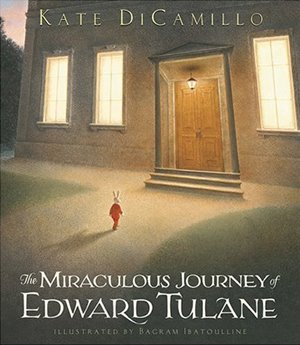
The Miraculous Journey of Edward Tulane

by Kate DiCamillo
ages: read-aloud, any age. Read alone, ages 7-10
First sentence: “Once, in a house on Egypt Street, there lived a rabbit who was made almost entirely out of china.”

C got this one for Christmas from Santa, and her reaction (which made me laugh), was part “Huh?!” and part “That’s stupid. I don’t want to read that.” So, she did voice some opposition when I said that this should be the next one we read aloud. But, since I’m mom, and since I wanted to read it, my desires prevailed. (bwahahaha!)

If you don’t know already, this is the story of Edward Tulane, a china rabbit who is loved, but who is so incredibly stuck on himself that it’s impossible for him to love in return. He is lost on a trip, and then spends years traveling the world (he can’t move himself; he’s passed from owner to owner), learning to love, losing and then learning to hope again.

It’s a simple plot, but an absolutely wonderful book. It’s beautiful, picturesque language was a dream to read out loud. It’s amazing pictures were lovely to look at; C’s biggest complaint while reading it was that she was missing the pictures. It’s got a beautiful moral (yes, I am gushing), but is not heavy handed in the telling of that moral. In short, it’s a perfect book.

C, when we finished last night, told me that she didn’t think much of the book when she saw it on Christmas. “But, Mom,” she said, “I was wrong. I’m glad you read it to me. It’s a GREAT book.”

And she couldn’t be more right.

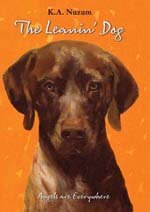
The Leanin’ Dog

by K. A. Nuzum
ages: 8-12
First sentence: “I shoved my braids up into my woolen cap, pulled the itchy thing farther down over my ears and crossed to the cabin window.”

Have you ever noticed how prevalent dead/crazy/absent moms are in kids literature? Me either, until I started reading a bunch for the Cybils. Sherry over at Semicolon was curious about the idea after one of our panel’s chats, and made up a list of all the books with missing — dead or otherwise — moms. There’s quite a few.

Add this one to the list. (Actually, is the second out of three that I’ve read with dead moms in the last week — the other two are Estella Revenge books — and so, I have to admit up front, that colored my opinion of this one. I’m heartily tired of dead moms.)

Dessa Dean lives with her father up in the mountains. He’s a trapper, and she’s an only child. Her mother used to live with them, but she and Dessa Dean got caught out in an early-winter blizzard and Dessa watched her mother freeze to death. That obviously traumatized Dessa: she’s discovered in the time since that she can’t leave the cabin. She’s lonely and sad, and subject to both night- and daymares. Then one day, a wounded dog come scratching at the door when Dessa’s home alone. She takes a liking to the dog, who, slowly, helps Dessa not only through the tough first Christmas without her mother but to begin to heal from the tragedy.

Dead mom aside, I liked how this book felt. For something that deals with death and tragedy so directly (not to mention the general harshness of life alone in the mountains), it was a fairly positive book. I really liked Dessa’s voice; I liked her general determined nature (her stubborn streak, as she put it), but also just the way she looked at things. She’d spend her days doing school work: making up sentences for spelling words or making up math problems. As the book went on, the school work took on a life of its own: how many steps it takes to get to the door, how many times you can pet a dog before she wakes up. I also liked Dessa’s quest to find the dog’s true name. The dog-girl relationship was a sweet one, and I really liked the way Nuzum wrote the dog; it didn’t speak, but rather Nuzum wrote noises and body language so that I could really picture how the dog was acting.

So, in the end, I guess it was a pretty good dead mom book. One that I think kids going through some kind of tragedy could relate to, and possibly others would enjoy as well.

Skulduggery Pleasant

by Derek Landy
ages: 10+
First sentence: “Gordon Edgley’s sudden death came as a shock to everyone — not least himself.”

I haven’t had this much fun reading a book since… well, since I read Anna Smudge.

Stephanie is your normal 12-year-old girl. That is, she thinks she is, until her uncle dies a mysterious death (well, the doctor’s say it’s natural, but we know better, don’t we?), and she inherits his house. She stays there one night, and is summarily attacked by a strange man demanding a key and saved by a strange man that turns out to be a walking, talking, fire-wielding… skeleton. She decides to fall in with the skeleton, Skulduggery Pleasant of the title, and discovers a whole world of magic, and, yes, danger and excitement.

There’s a lot of similarities to Anna Smudge — not just a precocious 12-year-old who can figure things out and save the world — but in style. I loved the combination of sass (not really snark or sarcasm) in the banters between Skulduggery and Stephanie. I loved the world that Landy created, with magic and mages and sorcerers; a world, not unlike Harry Potter’s, that exists parallel to our own. It was an exciting plot, too — possibly a tad on the violent side for younger readers — one that was full of twists, turns, and daring escapes. I enjoyed the power that Stephanie had (aside from it being plausible); it’s always nice to see our main character doing the rescuing and thinking rather than just running around having things happen to her. Very, very cool.

It’s the first in a series, for those who love series, but it’s also a good stand-alone book. And have I mentioned that it’s a whole lotta fun?

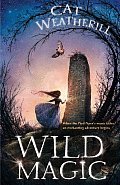
Wild Magic

by Cat Weatherill
ages: 8 – 12
First sentence: “Mariana felt fantastic.”

This book takes of where the fairy/folk tale The Pied Piper of Hamelin leaves off. What happens to the children when the Piper leads them away? What drove the Piper to do it in the first place? What kind of world is it where this could happen?

Jakob and Mariana — brother and sister — are among children in Hamelin town when the Piper comes to get rid of the rats, and fall under his spell when he begins to lead the children away. Mariana makes it through to the other side, a world of magic and pain and adventure; Jakob, who is crippled, doesn’t. Not at first. But, eventually, he does find a way through, where he is confronted with all the children having been turned into animals, as well as a Beast that stalks the night.

This is another book that just doesn’t do plot summaries well. I read it out loud to C, and at first we thought that Mariana was the heroine of the story (you would think so, from the cover and the first chapters). But, it’s a fragmented story, one that intertwines the stories of Piper, Mariana, Jakob and their father, Moller. It’s not always an easy story to understand; we were constantly flipping around trying to figure out did what when and why. It’s an intriguing story, however. I liked what Weatherill did with the Piper; he’s not just a creep who wanted payment, but a tortured soul looking for release from a curse. Mariana and Jakob were also interesting characters: both strong-willed, determined and resourceful, yet believeable in that their love for each other is the thing that drives them both.

The thing we both really liked about the story, though, is that it begs to be read aloud. In fact, the way it was written — with onomonpeic word like “vumm” and “doomf” and “crrp” speckling the prose — it would have bothered me had I read it to myself. But, read aloud, the words add something to the story, make it come alive. I could tell that Weatherill is a story teller from the way she writes: description, sounds, thoughts all played a big part in the development of the plot. It’s not a bad thing; I love listening to storytellers, but in a novel… well, let’s just say that this one is better read aloud.

It’s not a bad thing, though. If you’ve got a six to eight year old, and want something to curl up with in the evenings, this one is just perfect.

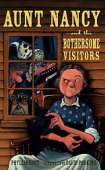
Aunt Nancy and the Bothersome Visitors

by Phyllis Root
age: 6-10
First sentence: “Aunt Nancy should of knowed Old Man Trouble was in the neighborhood.”

It’s a new year, and I’ve got…

another Middle Grade title?

Wait, I thought my part in the Cybils was over?

Well, it is, but my dear cousin Allison is a librarian in Salt Lake City and is on the Beehive Award committee. She needs readers to help with narrowing down their list. (All I have to do is read the book and give my opinion. Not hard.) Anyway. Since a lot of the books on their list were the same as the Cybils list, I happily said I would. Except that the four on my cousin’s part of the list weren’t on my Cybils list. (Are you still following?) Anyway, now that the Cybils are over, I can get to my cousins part of the Beehive Award list.

Whew.

There’s really not a whole lot to say about this book (hence the really long-winded introduction!), except that I liked it. It’s an easy reader book, designed for the younger set: lots of white space, great color illustrations beginning each chapter with black-and-white ones interspersed throughout the text. But, beyond that, it’s a series of four short folk tales, starring Aunt Nancy — that lovable, capable, witty aunt-type person that is immortalized in tales — outwitting Old Man Trouble, Cousin Lazybones, Old Woeful, and Mister Death. It’s very cleverly done and highly entertaining reading how Aunt Nancy ends up tricking each one of the visitors. Old Woeful is my favorite: an old woman who has a raincloud over her even when it’s sunny outside (don’t we all know someone like that?), she stops by Nancy’s house with a tale of misery. Everything Nancy is going to do is going to go bad. Until Nancy decides to start digging her own grave. Which completely unsettles Old Woeful, who then takes off, saying, “Aunt Nancy, you are about the gloomiest person I ever laid eyes on. I got to be getting along before you give me a serious case of the dismals.”

Now who wouldn’t want to spend a bit with characters (and well-told tales) like that?