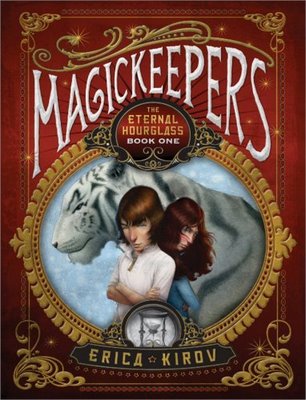
Magickeepers: The Eternal Hourglass

by Erica Kirov
ages: 9-12
First sentence: “The mysterious man in the black wool cloak sat in the front row of the Princess Theatre, precisely in the center seat.”

At first glance, you would be tempted to brush this book off. It’s a Harry Potter knockoff you would say: a 13 year old boy with a dead (beloved) mother, was raised (for protection purposes) outside of his “world” is reintroduced to a magical life he never knew existed, and finds out that he is the Chosen One, the magician that everything pivots upon.

But don’t brush it off too quickly.

Nick is our main character, and he’s much more jaded than Harry was. Nick’s grown up in a third-rate hotel on the Las Vegas strip where his father, a third-rate magician, performs every night (and twice on the weekends). Nick’s not a particularly special (or brilliant) kid: he likes his cheeseburgers, video games, and skateboard. So, when he’s kidnapped and wakes up in the most famous magician’s — Damian — hotel, told that he’s related, and that he’s one of the Magickiseepers — an ancient breed, of which this Russian family is the strongest, tasked with keeping track of magic relics — its understandable that Nick might just resist a little. Especially when there’s caviar and blini for breakfast.

This book suffers from first-in-a-series syndrome: there’s much exposition and explanation and very little pay off. That said, Kirov’s use — and slight twisting — of the historical (from Houdini and Jues Verne to Rasputin — the perpetual bad guy — and Princess Anastasia) was definately a highlight. And, by the end, the book has us hooked enough in the world to find us eagerly anticipting the next book (the final teaser with Edgar Alan Poe also helped). It’s a creative mix of magic and historical fiction that gives it just enough of a unique spin to make it different Harry Potter, in spite of all the similarities.

And it’s those differences that make it worth reading.

Buy it at: Amazon, Powells, or your local independent bookstore.

The Year the Swallows Came Early

by Kathryn Fitzmaurice
ages: 10+
First sentence: “We lived in a perfect stucco house, just off the sparkly Pacific, with a lime tree in the backyard and pink and yellow roses gone wild around a picket fence.”

I started wondering if I went back and looked through my posts, how many would start like this:

[Blank — this time it was Becky and Natasha] highly recommended this/loved it, and I thought it sounded good/interesting/intriguing/worth my time, and so when it showed up at the library/I found it/pulled it off my pile, I found that I really liked/loved/thought it was good, too.

And then I go on to summarize the book [essentially: a girl, Eleanor “Groovy” Robinson, whose father ends up in jail the summer she turns eleven, learns to forgive] and say what I thought about the book [very sweet, very cute, and I loved the asides, how all the expressions were given “verbalizations”, her friendships, and Groovy’s journey through sadness, anger and finally acceptance of her father again, as well as all the food — the strawberries, the tacos espeically — and the recipe at the back!]

And then I hope you read it, like it, and are interested in the book.

When, really, what I’d like to do sometimes, is this: Becky loved it. Natasha loved it. Take their words for what they’re worth: it’s a great book.

Ranger’s Apprentice: The Burning Bridge

by John Flanagan
ages: 10-14
First sentence: “Halt and Will had been trailing the Wargals for three days.”

When we last left our determined Hero, Will, he had just killed off a couple of Big Bad Guy Morgarath’s bad beasties, and received a hero’s welcome home. But, this being War, he is not allowed to rest. While the army and Rangers — including stodgy mentor Halt — prepare for the impending battle, Halt, his apprentice friend Horace, and Ranger Gilan head for Celtica to see if the king there will come to Aruelian’s aid.

Of course things go badly wrong, and Gilan heads back to the army to warn the king, while Gilan, Horace and a stray girl they picked up, Evelyn, follow later. Except they get sidetracked, and find out what Morgarath’s really up to. And because Will is determined, and plucky and brave and resourceful, he is able to find a way — with Horace and Evelyn’s help, of course — to stop (or at least slow down) Morgarath. Unfortunately, while his resourcefulness is no match for the Wargals, he and Evelyn are captured by the Skandians (another country, this one run by sea raiders whom Morgarath paid to help him), and at the end of the book, they are hauled off.

All that said, this is a blast to read (aloud). Next in the Ranger’s Apprentice series, it didn’t have any of the problems with exposition that the first one had. It came out with a bang, and managed to keep up the pace pretty much (go Horace!) throughout the whole novel. C lost interest, but I don’t think it was the book — she’s been heading off to her room to read by herself rather than asking me to read aloud to her. I’m sad to see the end of it, but M hit that point, too, and we still get along. 🙂 I ended up finishing this one on my own, and have every intention to keep going with the series (on occasion, when I’m in the mood for a good fantasy-war-action-hero book) on my own. Maybe C will even pick them up and then we can talk about them. I’d like that.

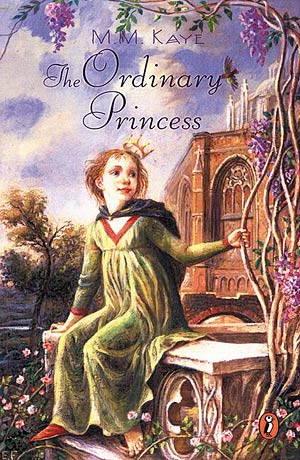
The Ordinary Princess

by M.M. Kaye
ages: 9-12
First sentence: “Long and long ago, when Oberon was king of the fairies, there reigned over the country of Phantasmorania a monarch who had six beautiful daughters.”

Charming. Completely and utterly charming.

The story of Amy — actually Amethyst Augusta Araminta Adelaide Aurelia Anne — who happens to be the seventh daughter of a king. The Queen and the council decide, since it’s tradition, to invite the fairies (over the King’s objection: “You may have forgotten what happened to my great-great-great-grandmother, but I have not. Had to sleep for a hundred years, poor girl, and the entire court with her, and all because of some silly fairy-business at the christening.”) to the christening of the baby. And, of course, something rash happens: the fairy Crustacea gives the baby the gift of being… ordinary.

Which means, of course, that next to her beautiful, stunning, perfect princess sisters, she’s pretty much nothing. And that no one wants to marry her. And that suits Amy just fine. She’s allowed the freedom to explore, to discover, to grow, to be. Until, because no one wants to marry her, her father decides to hire a dragon and imprison her in a tower until she is rescued.

Of course Amy won’t stand for that, and so she runs away, and hangs out in the forest until her dress falls apart. Then she gets a — shock — job, in order to save for a new dress. Since this is a fairy tale, she obviously has to meet The One, and of course it all has to work out as a happily-ever-after, but I will say this: you will be utterly charmed. And enchanted. And come away with a smile on your face.

Because it’s just that sort of book.

(Thanks, Sarah, for recommending it.)

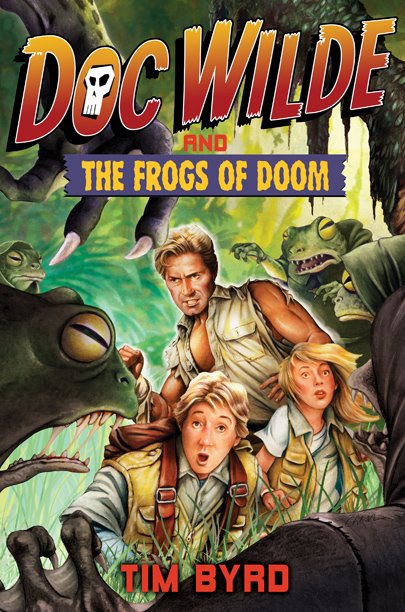
Doc Wilde and The Frogs of Doom

by Tim Byrd
ages: 9-12
First sentence: “The Lyceum of the Wilde family’s manor was a huge, odd room that seemed a combination of world-class library and Olympic gymnasium.”
Release date: May 14, 2009
Review copy sent to me by the publisher.

I needed something, after finishing The Woman in White, that was as far away from Victorian serialized novels as I could get. And, sorting through my piles of stuff, I came across this one. Which screams “not stuffy”. (Also “campy” and “not deep”, among other things.)

First off: how awesome is that title? Just saying it makes me grin… though I have to admit that I tend to say it in that movie-announcer voice: “DOC WILDE and the FROGS of DOOOOOOM!” Honestly: how much better can you get than frogs of doom? Not much.

That said, it totally and completely lived up to my campy expectations. You have a god of a Dad in Doc: a tall, muscular, blonde, intelligent, rich inventor who happens to Love his family and adventures. So he takes his family on adventures. Alas, his wife is dead (presumably, she was tall, muscular, blonde, intelligent and rich also), but that doesn’t seem to stop Doc or his two kids 12-year-old Brian and 10-year-old Wren (who are not tall and muscular, but are intelligent and rich). Add into this mix a British majordomo/butler who tends, in a crisis, to quote from literature (which the kids can always guess — though they stump him with Dr. Seuss — obviously they’re home schooled) and an Irish pilot/heavy and you pretty much have the Wilde family.

The adventure begins when their super-smart, tall, rich (he lives on the 86th floor of the Empire State Building) Grandpa Wilde goes missing. Of course the Wilde family have to go rescue him, and following his trail end up in the Amazon jungle of Hildago. Flying their gyrocopter into the jungle, they are attacked by MUTANT FROGS (Really. Totally. Awesome.), which crash the gyrocopter (but, which due to the super-intelligent design of Doc’s doesn’t actually crash), and the Wilde family are forced to hike through the forest. Where they’re attacked by more mutant frogs (but which they manage to fend off, without killing, because they respect all life forms, no matter how mutant, and are repelled by killing) one of which eventually possesses the body of one of them. Of course, Indiana Jones style, they manage to make their way into the lair, and rid the world of mutant frogs forever. (I would apologize for the spoiler, but really: did you think this could have any other ending?)

It’s smart, enjoyable, campy fun. Perfect for a hot summer day (or a kid whose tastes tend toward the mutant…).

The Amaranth Enchantment

by Julie Berry
ages: 10-14
First sentence: “I sit on a velvet stool at Mama’s feet, watching her brush her hair.”
Review copy provided by Bloomsbury.

I’m doing Dewey’s Q&A review, as part of requirement #3 for this week’s geek.

From Sherry: Is the story based on one particular fairy tale or is it just fairy tale-like?
It’s not really based on a particular fairy tale, though it does have elements of the Cinderella story. It does, however, read and feel like a fairy tale. A girl’s — Lucinda — parents are murdered, and she’s brought up being a servant in her Uncle and Aunt’s jewelry shop. Until one day, when a woman — the dreaded Amaranth Witch — comes in and leaves a stone to be repaired. That, and a visit in the night from Peter — a street thief whom Lucinda has never seen before — set in motion a series of events that end up changing Lucinda’s life.

What other books did it remind you of, if any?
That’s a hard one, mostly because I’m bad at that. I would say it feels similar to a Shannon Hale or Jessica Day George book. It’s a bit darker, though, more like the original Grimm tales. But really, it’s its own thing.

From Shannon: Did the fact that The Amaranth Enchantment was fairy tale based make it more interesting to read or less? I did find that it felt like a fairy tale made it quite interesting to read. I did like that the magic felt effortless, and wasn’t overbearing. It did have many of fairy tale elements, including the requisite bad guy, but he didn’t really do much except lurk around in the background. It really was just a tale of a girl trying to figure out how to get her old life back.

From Care: Is this the first book you’ve read by Julie Berry? Would you read another?
Yes, because it’s her first book. I would like to read more by her; she’s a good storyteller.

If you could only pick three words to describe this book, what would they be?
Unique. Intriguing. Fun.

And a bunch from Suey: Is this book a fantasy? It sounds like one.
It is but it isn’t. It’s could be called historical fiction, the country and place felt real even if it was imagined. And although there’s magic, it doesn’t really play a huge role. So, yeah, I think it’s fantasy, but not your traditional one.

What was your favorite thing about the story?
Hmmm. Tough question. I liked the mix of religion (of sorts) and history (of sorts) and magic (of sorts) to create a fairy tale (of sorts). It felt different than what I was expecting.

Who was the most interesting character?
I liked Peter best. Lucinda was interesting, but I never really quite got into her head. And Gregor (the love interest prince guy) was a bit too… shallow? perfect? good to be true? one-dimensional? for my taste. But, Peter. He wrapped me around his fingers and stuck me in his pocket from the moment he climbed in Lucinda’s window until the very end.

Thanks to all who provided the questions!

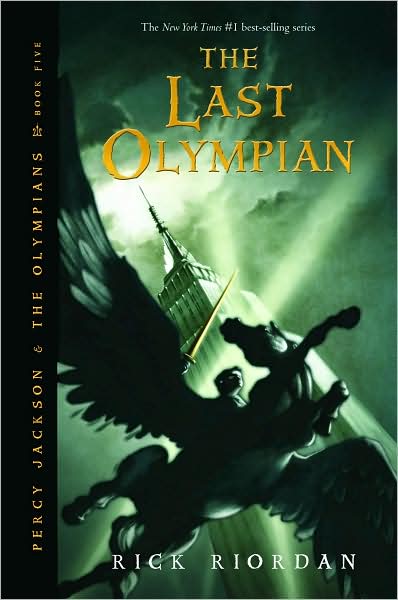
The Last Olympian

by Rick Riordan
ages: 9/10 (depending on the reading skill level) +
First sentence: “The end of the world started when a pegasus landed on the roof of my car.”

Things you need to know about this book, without giving too much away:

1. If you have not read the Percy Jackson series (I’m looking at you, Corinne), you are totally and completely missing out. However, now you can safely start the series, since the final one came out today.

2. Rick Riordan is an AWESOME plotter. He writes brilliant action, but he also does lulls and humor and keeps it all going so that you want to keep turning pages. I. Could. Not. Put. This. Down. (But then, I expected that.)

3. He also writes first person narrative really, really well. M was saying that he’s captured Percy’s voice perfectly, and I have to agree. That holds true in this book.

4. For the first time in the series, he hasn’t (I don’t think) taken on a Greek myth. There’s mythological aspects to the story, but it’s not based on any (well-known) at least. **Edited to add: Actually, a friend told me that this is the story of the Iliad. Didn’t know that. And, I have to admit, now I want to go read the Iliad…

5. There will be HP7 comparisons. But I think he handles the “understand your enemy by understanding their past” well. And it’s not too long or too boring.

6. It’s a perfect ending.

Go read it.

The Lucky Ones

by Stephanie Greene
ages: 10-14
First sentence: “They were two little girls, six and eight.”

I picked this one up at the library because the cover caught my eye. It’s a very cute cover, isn’t it?

But. (You were expecting that, weren’t you?)

I’m halfway through, and I just can’t get into it. I can’t figure out when this is supposed to be taking place — it’s about family on an island, told from the point of view of the third child, 12 year old Cecile — is it contemporary? The 60s? The 40s? And for some reason this fact really bugged me. I didn’t particularly like any of the characters: Cecile is struggling with the loss of a relationship with her older sister, Natalie, and with the impending doom of puberty and is alternately cute and really annoying. Natalie is, however, a royal wench. I loathed her. And their mother. I know women can really be like her, but I really wanted to throttle her. And halfway through, the plot consisted of Cecile whining and trying to enjoy the vacation on the island, and everyone else being different than before. Not much to keep my attention, especially when Percy Jackson is beckoning.

And then there’s all this sub-plot stuff that I kept reading into it: why was the oldest boy, Harry, banished to Canada? Are the mom and the next door neighbor on the island, King, having an affair? Really, do I care that much?

For the record: when I announced at breakfast that I was abandoning this one, M looked a me, kind of sheepishly, and said, “Well, I thought it was good.” So, there. Someone in the age group it’s targeted for liked the book.

That’s probably a better recommendation than I could give, anyway.

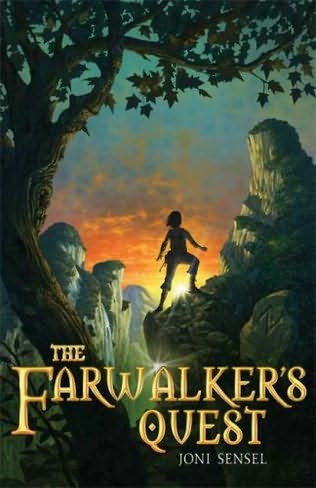
The Farwalker’s Quest

by Joni Sensel
ages: 10+
Review copy received from the publisher
First sentence: “Zeke’s tree wouldn’t speak to him.”

I knew a bit of what to expect with this book, thanks to Charlotte and Becky, but I didn’t expect to be unable to put the book down. I was thoroughly captivated by the world that Sensel built — part fantasy, part dystopian — and the story which, although it’s a coming-of-age/adventure story, took me to places and in directions that I never quite expected.

It’s three days before the Naming festival, when 13 year olds pick a trade and thereby receive a surname. Ariel has always figured that she’d follow her mother into healing and become a Healtouch. But that’s before she and Zeke, her best friend, discover a relic from the ancient days before the Blind War: a telling dart. They have only an inkling of what a telling dart is, or even what it’s meant for (though somehow they both feel it’s for Ariel), but when two strangers — men called Finders — show up in town looking for the dart, both Ariel and Zeke know their lives are going to change. They just have no idea how, or even how much.

I don’t want to go into any more detail than that, since part of the enjoyment of the book is having no idea what’s coming around the corner. There’s adventure and suspense and action and mysteries. There’s “good” guys and “bad” guys, but the whole book isn’t black and white, something which I appreciated. I think I liked the world, best, though. I liked that it felt like it could have been our world that fell into chaos and evolved in this particular way. I liked that the magic was mostly organic, things which conceivably evolve if everyone in the world were blinded by some biological warfare. It made it seem more plausible (not that I have anything against implausible fantasy; I just thought that plausiblity lent some weight to this story). And the characters were not only likable but cheerable, too. Especially Ariel, who not only finds her true calling, but strength inside her that she never thought she had.

So, yes. All the things everyone has said about it and more. It’s a fabulous story.

Nim’s Island

by Wendy Orr/Illustrated by Kerry Millard
ages: 8-10
First sentence: “In a palm tree, on an island, in the middle of the wide blue sea, was a girl.”

I should, in the interest of full disclosure, admit that I picked this book up (which C bought at a book fair a while ago) only because I had stuck the movie on our Netflix queue, and it came last Friday. I decided, though, to be totally and completely fair to the book, to read it before I watched the movie. (The movie end will make it into a book-to-movie Friday soon.)

The plot is really quite simple: Nim and her father live on an undiscovered tropical island. They moved there after the disappearance of Nim’s mother (she was investigating the insides of a live whale’s stomach and a huge Troppo Tours boat came by scaring the whale, which dove into the ocean, taking Nim’s mother with it). They are perfectly happy, until one day when Nim’s father takes off on a boat to research plankton. Nim’s left alone on the island, supposedly for three days and three nights. She reads an adventure book by Alex Rover, and through some weird coincidences, she begins an email correspondence with the author. One thing after another happens to Nim’s dad, who is left stranded on a boat in the ocean, and it’s up to Nim (and, eventually, Alex) to survive on her own, figure out a way to keep the Troppo Tours boat from discovering the island, and get her dad back.

Okay, maybe that wasn’t so simple.

The book, however, is a delightful little read. I loved Nim’s resourcefulness and her level-headedness as a character. She was all about figuring out how to get things done on her own. And Alex was a character in and of herself; she’s stuck in the apartment, writing adventure novels and yet afraid to go outside. It’s only her increasing concern for Nim that propels her out, and even then, she’s more of a comic side character than an adult who actually accomplishes anything. 🙂 But my favorite thigns about the book were the use of similies — “fast like Fred (he’s an iguana) going after a coconut” is one that comes to mind — and the animals. None of them talked, yet each of them had personalities. There was Fred, the iguana; Selkie, the sea lion with mothering instincts; and Chica the sea turtle who saves the day. It’s all very amusing and quite fun.

In the end, it was an enjoyable way to spend a couple hours on a gloomy afternoon.