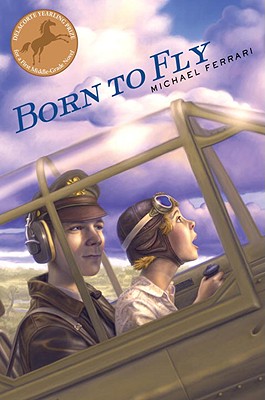
Born To Fly

by Michael Ferrari
ages: 9-12
First sentence: “Just ’cause I was a girl in 1941, don’t think I was some sissy.”
Support your local independent bookstore: buy it there!

Eleven-year-old Bird McGill has always wanted to fly, particularly the P-40 fighter plane. It’s something she and her dad have worked towards ever since she was old enough to reach the pedals. The fact that she’s a girl — and girls in 1941 weren’t supposed to be interested in flying airplanes — never seemed to matter to either her, or her father.

Then, the Japanese bomb Pearl Harbor, and Bird’s life changes. Her father gets shipped away to fight in the war, and a new kid — Kenji — comes to town. He’s Japanese, in Rhode Island to live with an uncle because of the forced internment his family in California is facing. He’s resentful, and — interestingly, realistically — faces much of the same resentment and racism that he’d faced in California.

Both being outcasts, Bird and Kenji form a tentative friendship, which is strained and tested when they inadvertently witness both the murder of a local draft dodger and the sabotage of a engine factory. Kenji’s uncle is framed for both, and found guilty. And it’s up to Bird to set things right.

It’s partly a mystery, partly an adventure story, partly a tale of friendship and ignoring expectations. It tries to do a bit too much, and is a bit over-the-top, but Ferrari succeeded admirably on one account: it’s a story with not only a strong female character, but a middle grade one who makes things happen. Sure, it’s unbelievable that she would actually get to fly a P-40 plane, but by the end, who cares? Bird is awesome. Bird makes things happen. Bird — in spite of, or perhaps because of, her faults, and insecurities — rocks. She’s inspiring.

In addition to a strong heroine, Ferrari unflinchingly tackles things like class and race and patriotism and makes it work in the context of the plot. Kenji is not just a cardboard 1940s Japanese character; he’s got hopes and dreams and frustrations, all of which are quite palpable. Enough so that you cringe when people call him the “Jap” and tell him to go back where he came from. Enough so, that you want Bird to rescue him, to beat down the bad guys, to show up everyone in town.

Again, it’s probably a bit heavy-handed to put so much in one book (I, personally, would have liked it if there was a bit less, and it did come off as a bit moralistic by the end), but overall, it works, and works well.

(Just for the record: because this is a Cybils nominee, I’ve been asked to make sure y’all know this is my opinion only, and not that of the panel.)
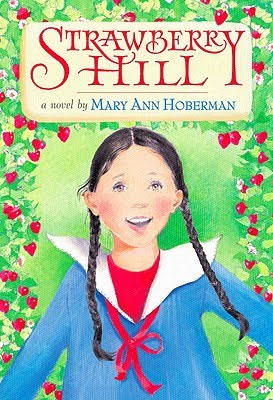
Strawberry Hill

by Mary Ann Hoberman
ages: 8-11
First sentence: “You would have thought it was the best news in the world.”
Support your local independent bookstore: buy it there!

It’s the Depression, and Allie’s father has lost his job in New Haven, Connecticut. He has, however, found another job in Stamford. However, that means the family — Allie, her brother Danny, and her parents — will be moving away from everything Allie has known.

However, when Allie finds out that they will be living on a street called Strawberry Hill, everything will be okay. Won’t it?

This is the story of how Allie came to accept the inevitable, learn to like her new home, and make friends. It’s a quiet story, somewhat predictable, that follows Allie’s ups and downs over the first year that she lives in Stamford. There’s new places to discover, there’s a new school class to get used to, there’s disappointments, there’s pretty mean girls (there’s ALWAYS pretty mean girls), there’s new best friends, there’s unexpected friends.

What really made this book stand out for me, though, was the undercurrent of Jewishness. Allie and her family are Jewish — something that, unlike in, say, All-of-a-Kind Family, isn’t readily noticeable or even prevalent, but nonetheless is still there. The only holiday we get is Hanukkah, and other than a few mentions of temple, that’s pretty much it. Except for an instance of Antisemitism. That, in particular, I found intriguing, especially when Allie’s mom lays into the kid. It was the most obvious sign of the times — aside from a few mentions of lost jobs and hobos, the book could have been contemporary — and one that I thought was done quite well.

Overall, though, the book could have been better. According to the author blurb, Hoberman is a poet of some renown, and I couldn’t help but thinking that the language of the book just fell flat for me. I expected more of a poet, I guess. Something more, well, poetical.

That said, it is an interesting look at the Depression-era, and a nice story of friendship.

(Just for the record: because this is a Cybils nominee, I’ve been asked to make sure y’all know this is my opinion only, and not that of the panel.)
Al Capone Does My Shirts

by Gennifer Choldenko
ages: 9-13
First sentence: “Today I moved to a twelve-acre rock covered with cement, topped with bird turd surrounded by water.”
Support your local independent bookstore: buy it there!

Moose Flannigan is NOT happy about his father’s new job. His father is a guard and an electrician on the most notorious prison in the country, especially in 1935: Alcatraz. And, because it’s 1935, that means the family gets to come along, too. Which means Moose has to leave his friends and start over.

All this is complicated by his sister Natalie’s condition. With today’s knowledge, she’d be diagnosed with autism. In the book — and I give Choldenko so much credit for making it seem as it probably really was, which was alternately quite revealing and very painful — she’s just got a “condition”, something that needs to be “cured”. Moose and Natalie’s mother was the hardest character to stomach: she couldn’t deal with Natalie, pretending she was ten for years, because younger children have more of a “chance” and because she just couldn’t deal with the fact that child was not “normal”. That I cringed every time she began to speak is a testament to how well Choldenko wrote her.

While autism, as well as Natalie’s acceptance to a special school in San Francisco, played a major role in the book, it wasn’t the whole plot. When Moose wasn’t struggling with his feelings about, or taking care of his sister, he was trying to figure out how to deal with the kids on the island — especially Piper (whom I wanted to smack!), the daughter of the warden, and who had it in her head that she could get away with just about everything — and trying to make friends at a new school, which is never easy. Choldenko got middle grade awkwardness down pat, from Moose’s reluctance to make waves to Piper’s bossiness. I also felt like she caught the time period; it felt like the 1930s, or at least what I imagine the 1930s to feel like.

Oh, and the ending: perfect.

Which makes me wonder what she’s done with Moose, Natalie and the island in the sequel. Something interesting, I hope.

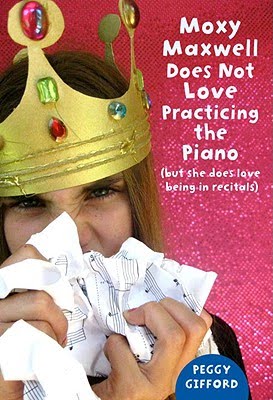
Moxy Maxwell Does Not Love Practicing the Piano

But She Does Love Being in Rectials
by Peggy Gifford
ages: 7-11
First sentence: “It was just after 10:00 a.m. on Saturday, April 7, and Moxy Maxwell was still in bed.”
Support your local independent bookstore: buy it there!

I love Moxy.

I’m not ashamed of this because Moxy is awesome.

Very few books make me laugh, chortle, snort, guffaw, and giggle. Moxy makes me do all of those. Perhaps that’s because my sense of humor is not very sophisticated — I mean why does this chapter crack me up every time:

Chapter 29: In Which We Learn What Was Inside The Envelope. Inside THE ENVELOPE was the note.

That’s it. Entire chapter. Cracks me up every time. As did the dog barking (“barking and barking and barking” written very small over and over… in the shape of a dog.) and Mark’s pictures, especially his titles. (“My Sister Looks Better with a Cape Over Her Face”) Or the other best chapter:

Chapter 7: The Hook. The Hook is the part of a story that makes you, the Reader, want to keep reading to find out what happens next. Ideally, the Hook should come as early as Chapter 1 — Chapter 2 at the latest. Any later, and the author risks “losing the reader.” Which means you, the Reader, might put this book down for just one second to get some gum and never come back. So please hang on — even though it is already Chapter 7, Something Really Big is about to happen.

And, yes, Chapter 8 is called Something Really Big.

There is a plot: Moxy is to be in a piano recital. Playing “Heart and Soul” with her little sister, Pansy. Except there’s two problems: Moxy has a hard time stopping playing when the song’s over (it’s too short… really, if she’s going to Be On Stage, then she ought to make the most of it), and she’s a bit too distracted getting together the Perfect Outfit in order to, um, practice. Yes, there are escapades (this time involving fake ermine trim and an explosion of Green Grass Powder Shake powder) and problems (what happens when it’s actually time to go On Stage??)

It’s so much fun, I was sad when it ended. Hopefully, though, Moxy will have many many more adventures. If only to entertain me, the Reader.

Emma-Jean Lazarus Fell in Love

by Lauren Tarshis
ages: 9-13
First sentence: “Emma-Jean Lazarus knew very well that the seventh-grade boys at William Gladstone Middle School behaved like animals at times.”
Support your local independent bookstore: buy it there!

I don’t know, after the events in the first book, if I really, truly expected Emma-Jean to be less quirky. I don’t think I did. Which is good, because she wasn’t.

This time, in Emma-Jean’s life, love abounds. It’s May, it’s time for the spring dance (both of these books revolved around dances). And it’s the girls turn to ask the boys out. Everyone’s pairing off, except Emma-Jean and Colleen. (Colleen wants to; Emma-Jean is considering it, to a certain extent.) And so, when Colleen gets a secret admirer note in her locker, she tasks Emma-Jean to figure out which boy it is. Brilliant deductions, quirky observations — but not over-the-top like in the first book.

Emma-Jean also has her first crush, which she takes on in Emma-Jean-style:

“A crush?” Emma-Jean said. This sounded very serious. She pictured a boa constrictor wrapped around the neck of a lemur.

“An infatuation,” her mother clarified.

“Is it the same as being in love?” asked Emma-Jean warily….

“No,” [her mother] said. “Being in love is one of the most powerful experiences anyone can have. I think that’s why we have crushes when we’re younger. Maybe it’s how we get ready for real love.”

This seemed logical to Emma-Jean. After all, many important life skills — walking, talking, cooking, identifying birds in flight — were learned in stages and honed through practice.

It’s a sweeter book than the first one, funnier, and the plot works better. I found myself actually falling in love with Emma-Jean’s quirkiness in a way I didn’t the first time around. Quite charming.

(Just for the record: because this is a Cybils nominee, I’ve been asked to make sure y’all know this is my opinion only, and not that of the panel.)
Emma-Jean Lazarus Fell Out of a Tree

by Lauren Tarshis
ages: 8-12
First sentence: “Emma-Jean Lazarus knew very well that a few of the seventh-grade girls at William Gladstone Middle School were criers.”
Support your local independent bookstore: buy it there!

Quirky.

Really. That’s the best way to describe both Emma-Jean Lazarus and this book.

See, Emma-Jean is a seventh-grade Spock. She’s highly logical, rational and prefers to just observe her classmates rather than actually participate in the drama. That is, until one day she stumbles upon Colleen crying in the bathroom. Colleen has a problem: the popular, yet mean Laura is trying to undercut Colleen’s friendship with Kaitlin. Emma-Jean realizes that she can fix it, and so… she does. Which sets off a chain of events, including Emma-Jean getting ambitious enough to (try and) fix other problems, that eventually lead to Emma-Jean interacting (at least a little bit) more with her peers.

It’s not much of a plot, and it does fall prey to the typical middle school stereotypes (why do all the popular girls have to be mean?). Yet, I think, because of who Emma-Jean is, and the way she is, the book works. It’s sweet and funny and rings true to middle school. I’m not sure if kids would like it (I should try it out on C and see what she thinks) — it is quirky, after all — but as an adult, I was completely charmed by Emma-Jean and her story.

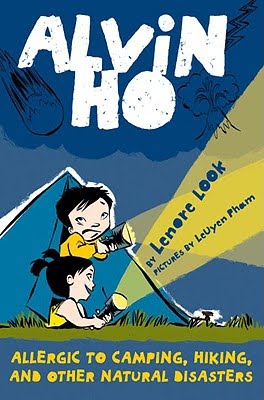
Alvin Ho: Allergic to Camping, Hiking and Other Natural Disasters

by Lenore Look/Illustrations by LeUyen Pham
ages: 7-10
First sentence: “You will know some things about Me if you have read a book called Alvin Ho: Allergic to Girls, School, and Other Scary Things.”
Support your local independent bookstore: buy it there!

Is it too much to say that I still adore Alvin?

One of the tricky things about sequels, I think, is getting it right the second time. Writing a book that is just as adorable, just as funny, just as interesting as the first one? Not an easy task. And yet, Lenore Look (with much help from LeUyen Pham) does. Alvin is spot-on, hilarious, adorable, fun, sweet, and plain great to read.

This time, Alvin’s dad decides that he hasn’t done a great job of instilling a love of nature in Alvin (spurred by a time-traveling adventure of Alvin’s with Henry David Thoreau), and plans a camping trip. As you can imagine (well, if you haven’t read the first one, you can’t), this does not bode well with Alvin. Camping is bad. There are natural disasters. Bears. Sleeping outside. Germs. Trees. Inside is a good place to be.

And yet, after some wonderful mishaps at school (oh, how the recess camping “game” made me laugh…), Alvin and his little sister, Anibelly, go camping with their dad. After some prepping by older brother Calvin and getting Uncle Dennis’s super-duper awesome Batman ring, Alvin’s still not quite ready…but ends up going anyway. And,well, has an Alvin-tastic time: aliens, thunderstorms, bear traps, and best of all, sleeping out under the stars.

That doesn’t mean it was “fun” for Alvin. For me, though, it was a blast. (Maybe it’s because I didn’t actually go camping?)

(Just for the record: because this is a Cybils nominee, I’ve been asked to make sure y’all know this is my opinion only, and not that of the panel.)
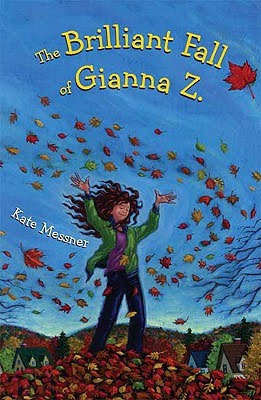
The Brilliant Fall of Gianna Z

by Kate Messner
ages: 10-13
First sentence: “Forty one minutes to cross-country practice.”
I received the ARC from Bloomsbury.
Support your local independent bookstore: buy it there!

Seventh grader Gianna Zales loves art and running, especially cross-country. However, she’s not so good at deadlines, and her spot at cross-country sectionals is in jeopardy: if she doesn’t get her science project — collecting and cataloging 25 different leaves — completed and in on time, then her spot is going to go to arrogant, popular Bianca. Which Gianna doesn’t like, because in her own words: sparkly girls don’t run. Runners do.

Over the course of a week, her best friend Zig tries to keep her focused and spending time searching for leaves, except it’s not as easy as it sounds. A funny thing called life keeps getting in the way, whether it’s her father’s job — he runs a mortuary — or her beloved Nonna’s increasingly alarming inability to remember things, or her mother’s rising stress level and denial about Nonna’s problems.

It’s a quiet book, funny at times, as Gianna struggles to not only complete her leaf project in time but to deal with the impending change with Nonna. What Messner does best with the book is give a sense of place: the sights, sounds, smells and feel of a Vermont fall literally popped off the page. Messner also helps by intertwining Robert Frost poems amid the science and running: it broadens the scope of the book and grounds it in ways that it wouldn’t be without the poetry connection.

The only real complaint is the stereotypical plot: Gianna is neither popular or unpopular, in spite of her running prowess, and has to waffle between being friends or not with the two outcast girls, Ellen and Ruby; the friendship-but-is-there-more with Zig; the overbearing and irritating mom; the popular versus nerdy conflict with Bianca (two guesses who gets to go to sectionals; it’s not difficult to figure out).

Still, even though it was pretty predictable, it is an enjoyable read. Enough so, that I’m looking forward to what Messner has to offer in the future.

(Just for the record: because this is a Cybils nominee, I’ve been asked to make sure y’all know this is my opinion only, and not that of the panel.)
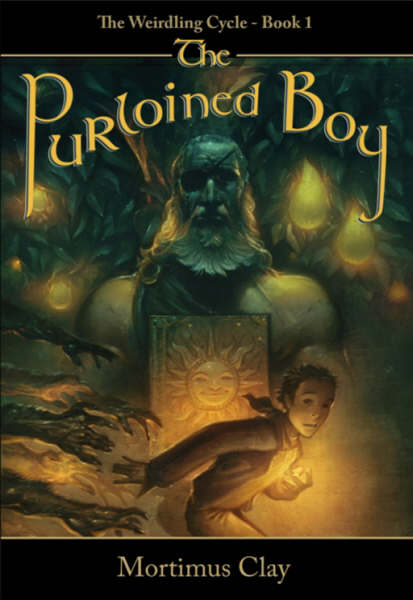
The Purloined Boy

by Mortimus Clay
ages: 9-12
First sentence: “All the doors were locked, all the windows were latched, and everything was perfectly secure the night the bogeyman came.”

The premise for this book is an interesting one: a boy, Trevor, lives in a world where bogeymen are real. They are your friends, they know what’s best for you. Except Trevor keeps having dreams about a time before, a time when he had parents, when he was truly happy. One day, he mentions this in class, and suddenly his world changes: he’s whisked away, and in order to avoid Certain Doom, he must find a way to escape.

And it sounded like it would have a Lemony Snicket feel to it, since the author — one Mortimus Clay — is “the most prolific author writing posthumously in the world today. The modest Clay is not given to sweeping generalizations, but he has this on the highest authority.” A dead author writing kids books? What’s not to love?

Well… lots.

I tried to read it. Really, I did. Picked it up and put it down at least a half-dozen times. And every time, I would look at the words, I would try to get into the story, but it eluded me. I tried to get past the stilted dialogue and the clunky sentences, and find the good story in there, but it eluded me, too.

So, about 100 pages into the nearly 250 page book, when nothing remarkable had happened (and yet, I was left with a feeling — that did not elude me — that something remarkable *should* have happened), I bailed.

Hopefully, since the author is dead, he won’t mind the negative review.

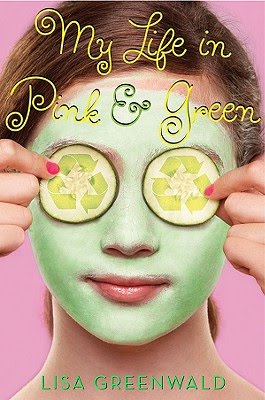
My Life in Pink and Green

by Lisa Greenwald
ages: 10+
First sentence: “Things can always be worse.”

This looks like a very girly book. Pink background, face mask (or is it masque?), cucumber slices: you think it’s going to be frills and parties and giggles.

Except, it’s not.

Sure, Lucy Desberg loves makeup, and wants to be the next Laura Mercier (who, thanks to Google, I found out is a real person), but she’s no girly girl. She’s a smart 12-year-old who loves to help out at her family’s pharmacy — which is slowly failing due to a myriad of factors — and who becomes interested in going green. Sure, there’s seventh grade stuff: her best friend develops a crush on a boy and gets all weird about it, but really it’s about Lucy’s business sense and the fact that kids can Do Things To.

If only the stupid grownups will stop shouting at each other and listen to her.

It’s a cute enough plot, and Lucy and her friends are a likable enough characters (the book falls into the “parents are idiots” trap, which was distracting). Combining saving a business and saving the earth with makeup and beauty tips is a unique idea, though it kind of screamed: “Hey girls! You can be environmentally aware AND cute at the same time! See how easy it is?!” Overlying message: you CAN be smart, aware, AND be into makeup. They are not mutually exclusive. Which, I suppose, is a halfway decent message.

However, one does have to wonder how good a book really is if the favorite thing, when all is said and done, are the beauty and business tips at the beginning of each chapter. Those, I really liked (found myself wanting to write a couple down; what does this say about me?). Even though there wasn’t anything that really grabbed me about the book, it was a good debut novel. And I’m sure there are smart girls out there who are just dying to know that its okay to like makeup. (And vice versa.)

Okay, then. Off to paint my toenails.