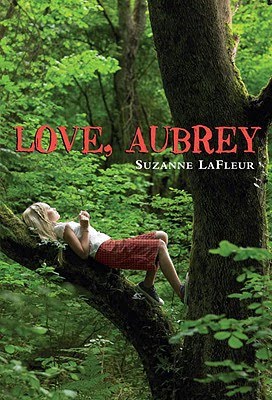
Love, Aubrey

by Suzanne LaFleur
ages: 10+
First sentence: “It was fun at first, playing house.”
Support your local independent bookstore, buy it there!

I’ve read about a lot of grief, trials, abandonment, and loss in the books this year for the Cybils. But few have touched me like Love, Aubrey did. Eleven-year-old Aubrey has suffered quite a bit in the past few months: her father and younger sister Savannah died in a car crash that left Aubrey and her mother alive, but scarred. And when, on a hot August day, her mother takes off and just doesn’t come back, Aubrey feels like it’s probably for the best. After all, if everyone’s going to leave, who needs them? Only, when her Grams comes — out of concern, since Aubrey’s not answering the phone — and discovers the situation, she whisks Aubrey back to Vermont, to real life, to friendship, to love, and eventually to the path of healing.

On the back of my copy there’s a quote by Sarah Weeks, author of So B. It, that says, “LaFleur has a rare gift — an authentic middle grade voice.” I have to completely agree. The dialogue doesn’t seem affected. The narrative — which is punctuated by heartfelt letters from Aubrey to various people — flows seamlessly. Aubrey grabs your attention in a way that’s unique and heart rendering. The pain she feels — at the loss of her beloved father and sister, and at the abandonment of her mother — is palpable. It’s a beautiful book.

But, it’s not a sad one. Yes, it deals with death and abandonment, but most of all it’s about love and healing and hope. Which is difficult for an author to get across without being preachy. LaFleur does so admirably: the adult characters — aside from the mother, which becomes forgivable, or at least understandable, by the end of the book — are present, anchors in Aubrey’s world, and yet it’s Aubrey who is propelling the action of the story, pulling the readers into her world.

In short: a perfect gem.

(Just for the record: because this is a Cybils nominee, I’ve been asked to make sure y’all know this is my opinion only, and not that of the panel.)
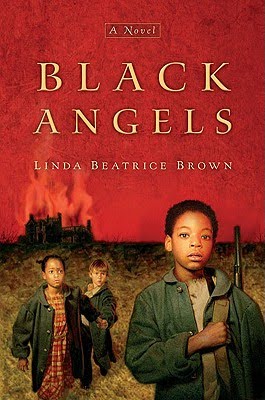
The Best Bad Luck I Ever Had

by Kristin Levine
ages: 10+
First sentence: “I’ve been wrong before.”
Support your local independent bookstore, buy it there!

It’s 1917, Moundville, Alabama and Dit is not quite 13 years old. He’s also the sixth of ten children, and tends to get lost in the crowd. All Dit wants to do is play baseball and earn enough money for the Fourth Hunt and do well at both, so his Daddy will notice him and not think he’s just another one of the kids. Then Emma moves in next door — her father’s the new postmaster — and Dit’s life completely changes. Emma’s the opposite of Dit: smart, bookish, an only child, and African-American. And yet, the two of them form a friendship that will last.

It’s a remarkable book, from the voice — Levine gets the Southern drawl without using dialect, and Dit’s voice is so spot-on I could just picture him in my mind — to the tackling of issues — in this case race and racism in the South during the Jim Crow days — without being heavy handed. The characters were incredibly sympathetic, from Dit’s desire to just be noticed and Emma’s desire to just be accepted in this backwater Southern town. It feels like a series of vignettes, though they are sewn together in a way that works toward a plot. And Levine wrote Dit’s growth and acceptance of Emma as a friend, and the conflict that their friendship makes in this small town, in such a way to keep the reader involved and interested. There’s also a sub-plot, again involving the conflict between black and white, which does get a bit melodramatic towards the end, but not so much that it derails the book. And, I have to admit, the end made me tear up.

Because, in the end, it’s all about friendship and how — no matter how different we seem — friends make our lives better. And what can be better than that?

(Just for the record: because this is a Cybils nominee, I’ve been asked to make sure y’all know this is my opinion only, and not that of the panel.)
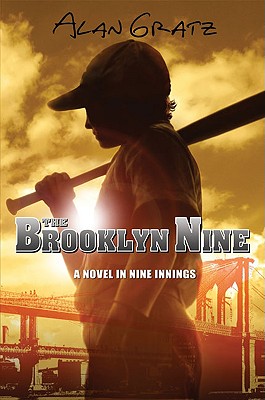
Black Angels

by Linda Beatrice Brown
ages: 10+
First sentence: “Luke took the key out of the sideboard drawer in the dining room, took a rifle and put the key back very carefully.”
Review copy provided by the publisher.
Support your local independent bookstore, buy it there!

Fiction about children during wartime is pretty overdone, in my humble opinion. Do we really need another book that illustrates the horrors of war, the trials that the children go through, the pain of separation? Probably not. But in this case, I’ll make an exception: Brown’s book takes the generic child-in-war story and moves it beyond the cliche to something else. Something more gripping, more lyrical, more — dare I say it? — poignant.

Luke is twelve years old. He hates his master, he hats the South, and he is running away to join the Union and fight to end slavery and free his people. Daylily is ten. She’s been freed by her master, but in the journey north with her Gramma and Buttercup (whom we never really find out much about), the two are brutally murdered. We’re never quite sure if they’re murdered by Union or Confederate soldiers, but the fact of their murder renders Daylily silent and bruised. She’s lucky to be left with her life, and she knows it. Caswell is seven, and he’s the son of a wealthy landowner who’s off fighting for the Confederacy. He’s lost in the woods, trying to find a neighbor’s house and his Mamadear who was carted away in the night because she was in labor.

The three manage to meet in the woods, going north, and make an unlikely trio. Yet dire circumstances make strange bedfellows. And when they meet Betty Strong Feet, things get even more unusual. The three children learn about survival, and working together, but most of all about love and friendship in the face of adversity.

The plot arc is huge: not only do we follow the children through the few months during their time in the woods and with Betty, but we follow their paths for the ten years after they got separated. This didn’t quite work for me: I felt that the book got preachy and too altruistic near the end; on the one hand, it was important to see how the children had changed because of their experiences together, but — on the other hand — perhaps it would have been nice to leave that to the imagination.

Minor quibble with the ending aside, the book was lyrical, descriptive and quite powerful. A fresh look at a overdone subject.

(Just for the record: because this is a Cybils nominee, I’ve been asked to make sure y’all know this is my opinion only, and not that of the panel.)
The Brooklyn Nine

by Alan Gratz
ages: 10+
First sentence: “Nine months ago, Felix Schneider was the fastest boy in Bremen, Germany.”
Support your local independent bookstore: buy it there!

This book is one of the more unique ones I’ve read recently. It’s not that it’s tackling something different or controversial. Rather, it’s quite the opposite: it’s a sweeping portrait of a family, a game, a nation. Quiet in its execution, yet grand in its ambition, Gratz pulls off something I didn’t think was possible: this book is a slice of Americana through and through.

The format is clever, too: it’s a series of short stories, told in nine “innings”, that travel through the years. Beginning in 1845, with a German immigrant, Felix Schneider, and going until present, the stories offer up a picture of how baseball — and America — has evolved over the last 160 years. Gratz touches on all the major highlights of Americana: there’s a Civil War soldier, Vaudeville, gangsters, racism and the Negro League, the All-American Girls Baseball league, and the Cold War. As in the case of all short story collections, some of the stories work better than others: in my case, the further back in time, the better the story; the final two more modern stories felt a bit cliched to me. But, even with its unevenness, it’s a fabulous undertaking. This is probably sounding like a sports book, and in some ways it is — I think there are many baseball-minded boys out there who would love the book — but, it’s so grounded in history and in family that baseball becomes more a character in the story than just a game that people played. That, and the stories — and especially the authors notes in the back, which I flipped to and read after every chapter — make the game itself sound quite fascinating.

At one point, I thought that it would have been nice to read these stories backward, beginning with the present day, and working back to 1840s. But, that’s just me being particular. This book really is a wonderful little story.

(Just for the record: because this is a Cybils nominee, I’ve been asked to make sure y’all know this is my opinion only, and not that of the panel.)
Wild Things

by Clay Carmichael
ages: 10+
First sentence: “Humans were diggers and buriers, the cat thought, like dogs.”
Review copy provided by the publisher.
Support your local independent bookstore: buy it there!

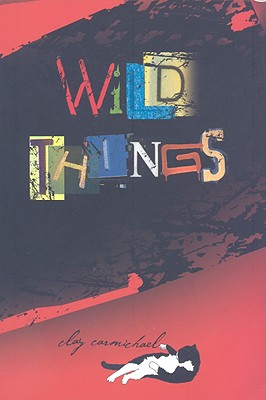
It’s a familiar story: girl — who has been forced, because of a crazy and neglectful mother, to mostly raise herself — finds, after her mother’s untimely death, herself under the guardianship of her odd, reclusive uncle. It’s an uneasy relationship; neither girl or uncle, for their own reasons, are quite ready for other people in their lives. Over the short months in the book, they grow, they stretch and yes, they change.

But as Fuse #8 pointed out in her review, this is not a coming-of-age story. It’s a story of wildness and freedom. Of love and trust. Of art and beauty. And about finding everything in a broken life.

And familiar though it is, Carmichael makes this story soar.

One of the reasons that this books works so well, is because, although it’s familiar, it’s not stereotypical. It’s not the Carmichael makes them do the unexpected, it’s that she breathes life into the familiarity and makes the characters real. Perhaps it’s the chapters from the cat’s perspective that makes it unusual enough, or perhaps it’s because there’s so many characters to love: from Zoe, wise beyond her years, but a total spitfire about it; her Uncle Henry, who reminded me strongly of a good friend, cranky, disillusioned, yet with great capacity to love; to Bessie, broken in the heart, but is not defined by her illness; and the Padre, the local priest with a loving and tolerant heart. Or the minor characters, who had me giggling and and smiling and loving every minute of it.

The other reason is that Carmichael holds the book together with a motif — something that could backfire, if she had gotten preachy about it. Too often, it’s easy to fall into the mundane with something as familiar as love, or the affairs of the heart. But, while the motif there and, yes, it’s obvious, it doesn’t overwhelm the plot or the characters or the simple beauty of the writing. Carmichael takes the motif, weaves it into the book and makes it work with the story instead of letting it overwhelm it.

It’s not much to hang a book on: familiar characters and plot and a motif, but it’s genuine and heartfelt. A book very much worth reading.

(Just for the record: because this is a Cybils nominee, I’ve been asked to make sure y’all know this is my opinion only, and not that of the panel.)
Also Known as Harper

by Ann Haywood Leal
ages: 10+
First sentence: “Winnie Rae Early followed ten steps behind me the entire way home from school.”
Support your local independent bookstore: buy it there!

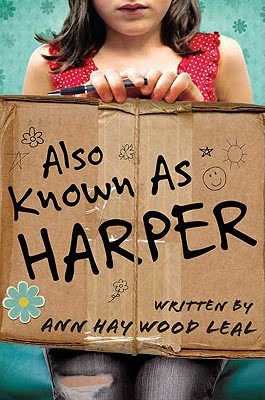
Eleven-year-old Harper Lee Morgan loves to write poetry. It’s possibly fate — her mother named her after the author, after all — but she thinks it’s more that she just has words bubbling up inside her that need to come out. And come out they do: her short, observant, often touching poems are interspersed throughout the book.

Some people like things shiny and crisp
But I tend to like the things with the scraped up edges.
That way I can tell other people have liked them too.
They’ve torn them and spilled on them
or broken off a corner or two
As they went about the important business
Of their day.
Something smooth and straight and new
Has an emptiness about it
Because it hasn’t been important
To anyone yet.

Because her life is full of fodder for poems. See, her Daddy took to drinking and eventually took off for good, leaving her Mamma, herself, and her little brother Hemingway with too many bills and too little money. Eventually, the family gets evicted from their home, and things go from bad to worse, as the family moves to a motel and eventually is kicked out on to the streets.

The word is overused, but this really is a poignant little book: Haper’s full of spunk and spittle, anger and love, hope and disillusionment. The world that she and Hemingway encounter is a harsh one, but it’s not black and white: Leal paints a gray picture. No one is “good”, no one is “bad”, and even the looming idea of social workers coming after them because they aren’t in school isn’t inherently evil. It’s a world where no one is exactly what they seem — whether it be someone who appears to be homeless, or the next door neighbor girl who is as mean as they come. It’s a world where literature — To Kill a Mockingbird, specifically — provides hope, escape and a place of refuge.

It also provides a glimpse into the plight of the homeless, but does so without being preachy, which isn’t an easy balance to achieve. Above all, it’s a good story about a girl — a family — just trying to find a way to make it all work.

(Just for the record: because this is a Cybils nominee, I’ve been asked to make sure y’all know this is my opinion only, and not that of the panel.)
A Season of Gifts

by Richard Peck
ages: 9-12
First sentence: “You could see from here the house was haunted.”
Support your local independent bookstore: buy it there!

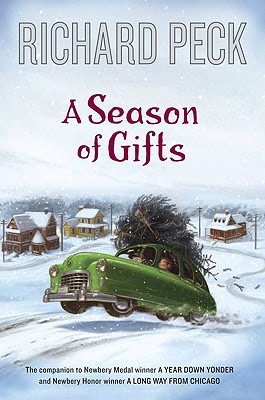
I’m not a big Richard Peck fan. Sure, I’ve read his other Grandma Dowdel books, but while I think I found them charming, I think that’s about all I found them to be. Not exactly thrilling or touching or even memorable.

That said, I really wanted to love this one. Perhaps it’s because it’s that time of year, and it’s vaguely a Christmas book. Perhaps it’s because I’ve heard so much good about Peck over the years that I wanted to see if I could figure out what I was missing.

It was a good book: charming, like I remember the others being; funny at times, poignant at others. It’s full of fun and interesting and mildly skanky characters; historical details from the 1950s, from Elvis going into the Army to the Russian scare. There’s a lovely, hilarious Christmas program and an overall moral to the story. There’s bullies and new friends, there’s adjusting to small town life by our narrator, Bobby, one of the new Methodist parson’s kids. Yet — like so often when you have expectations from a book — there was something missing. Something to make the book soar. Becky has more thoughts on that — and she hit upon much of what I was feeling.

Perhaps some of Peck’s other books are better?

(Just for the record: because this is a Cybils nominee, I’ve been asked to make sure y’all know this is my opinion only, and not that of the panel.)
Models Don’t Eat Chocolate Cookies

by Erin Dionne
ages: 10-13
First sentence: “‘No way,’ I hissed through the slatted dressing room door.”
Support your local independent bookstore: buy it there!

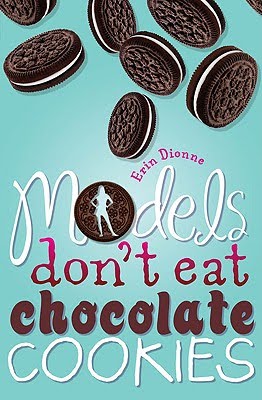
Celeste has never really worried about her weight. That’s not to say she was super-skinny: she’s not. But, she’s comfortable in her track pants and hoodie, and she likes her chips, soda and cookies. It’s not bothered her, and she’s never really thought about it.

Until her cousin Kathleen chooses the Peach Monstrosity for her bridesmaids’ dresses (of which Celeste is one). And then her mom and her Aunt Doreen conspire to enter Celeste into a HuskyPeach — that’s a clothing line for “plus sized girls” — modeling competition. Suddenly, the idea of being a HuskyPeach is too much for Celeste. But how to get out of it? By losing the competition, of course: if she’s too thin, she can’t win. So, Celeste makes the life-altering decision to alter her lifestyle. And with it comes some unexpected consequences.

This book has an interesting balance, walking the line between “fat is okay” and “losing weight will get you what you want.” On the one hand, Celeste isn’t really that obsessed with eating, and her parents aren’t really that hard on her eating habits. What bothers her more is that she’s incessantly teased by the (stereotypical) pretty, mean girl at school. Perhaps it’s just Celeste living up to expectations, because even though she has friends, she schlumps through each school day. On the other hand, once she starts the modeling competition, she’s given role models (no pun intended!) of confident, healthy, pretty overweight girls and women, and she can see her potential. She decides to start keeping a food journal, as part of trying to lose the competition, and she realizes that being healthy is better. She gains confidence, in part through the competition and in part from being healthier, and she’s able to conquer her demons and assert herself in ways she didn’t before.

The writing was a bit clunky, and the characters are overly cliched, but overall, a good book.

(Just for the record: because this is a Cybils nominee, I’ve been asked to make sure y’all know this is my opinion only, and not that of the panel.)
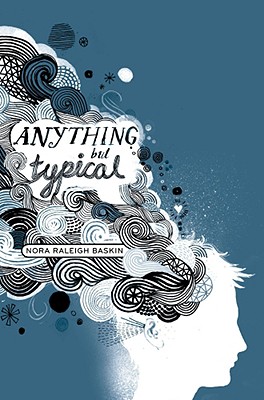
Anything But Typical

by Nora Raleigh Baskin
ages: 9-12
First sentence: “Most people like to talk in their own language.”
Support your local independent bookstore: buy it there!

Sherry at Semicolon captured my thoughts on this one just perfectly. This book takes you away, makes you think about your perceptions of people, makes you think about language, actions, reactions, and how we treat others.

It also made me cry. (Which is a rare and unusual thing, and also mildly embarrassing, since I was reading this while sitting in the salon waiting for M to get her hair cut…)

Twelve-year-old Jason is autistic. He’s full of labels and letters — ADOS, LD, HFA, PDD-NOS, NT — and yet, those labels and letters and names don’t define him. Or, at least, he tries not to be defined by them. Yes, getting through the day is difficult, and any little thing can set him off, often beyond his control. But, what he really wants to be seen as, defined by, is his ability to write stories.

(As an aside, I loved this quote:
“But really, if you ask me, there is only one kind of plot.
One.
Stuff happens.
That’s it.”
So true.)

He posts his stories on a fanfiction website, Storyboard, and one of them got a comment from PhoenixBird — who happens to be a girl. Jason and PhoenixBird seem to connect; at one point, he tells people that she’s his “girlfriend”. Then, there’s a Storyboard convention, and it turns out that PhoenixBird will be there. Jason — because of past experiences, because he knows how people react to him when meeting him for the first time — is anxious about going.

I don’t want to give much more than that away. I’ve read books about autistic kids before, but never have I felt so involved in the life of one. Baskin stuck us, as readers, inside Jason’s head — and sometimes he was an unreliable narrator because his interpretation of events didn’t always match up with what “actually” happened — and let us live through his triumphs, pains, anxiety, hopes, fears, love. It’s a beautifully written book; not because the language is poetic, though sometimes it is, but because it’s spare enough, tight enough, there are no wasted words, no wasted pages.

Perfect.

(Just for the record: because this is a Cybils nominee, I’ve been asked to make sure y’all know this is my opinion only, and not that of the panel.)

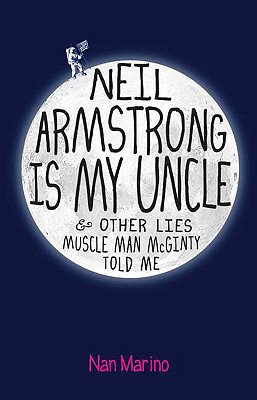
Neil Armstrong is My Uncle

and Other Lies Muscle Man McGinty Told Me
by Nan Marino
ages: 9-12
First sentence: “Muscle Man McGinty is a squirrelly runt, a lying snake, and a pitiful excuse for a ten-year-old.”
Support your local independent bookstore: buy it there!

Not quite sure where to start on this one.

On the one hand: it was an interesting story of loss and tension and dealing with differences. Tamara’s best friend, Kebsie, has just moved out of her foster house and back in with her mother. Without saying goodbye to Tamara. In her place, Tamara has Muscle Man McGinty, who loves (loves!) to tell stories.

On the other hand: in a book that is so thoroughly driven by the main character, it helps if that character is sympathetic. I understand that she was hurting. I understand that she was resentful. I understand that she had annoying, stupid, bad parents. But. I. Hated. Tamara. Wanted to smack her upside the head and tell her to get a better attitude.

On the one hand: it captures the essence of a 1960s summer, from endless games of kickball, to the anticipation of the first moonwalk, to the tension about the Vietnam War, to the joys of sitting on a roof and howling at the moon.

On the other hand: I thought Marino could have been better with the middle one — it was a small undercurrent that swelled in the last few pages. It was unevenly paced: I wanted more oomph, more tension, more — oh, more like Shooting the Moon, which I thought captured much of these same themes but did it better.

On the one hand: It’s a quick read. And some kids will really like both Tamara and Muscle Man’s stories.

On the other hand: that kid is not me.

(Just for the record: because this is a Cybils nominee, I’ve been asked to make sure y’all know this is my opinion only, and not that of the panel.)