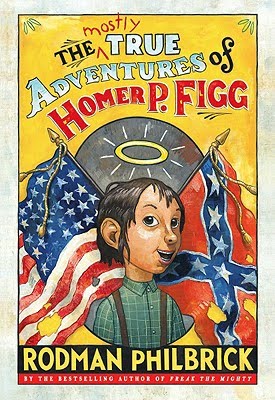
The Mostly True Adventures of Homer P. Figg

by Rodman Philbrick
ages: 9+
First sentence: “My name is Homer P. Figg, and these are my true adventures.”
Review copy provided by the publisher.
Support your local independent bookstore: buy it there!

Life is not good for Homer P. Figg. His father was felled by a tree. His Dear Mother passed away, leaving Homer and his other brother, Harold, in the care of their uncle, Squint, who — to write an enormous understatement — doesn’t treat them well. Now Squint has illegally sold Harold to the Union Army, and it’s up to Homer to find him and bring him home.

These are his adventures. (Mostly true, anyway.)

And, boy are they adventures.

From getting caught by a couple of slave hunters (in Maine, of all places), and rescued by a Quaker to becoming a part of a traveling circus, this is one a rip-roaring adventure. Sure, it’s a Civil War book; there’s the same old Civil War themes of slavery, fighting, traitors, and death. But it didn’t feel like a Civil War book; instead, it’s more of an adventure story with a Civil War backdrop. (Bonus plus: Joshua Chamberlin, my absolute favorite Civil War character, made an appearance!) But, more than the unusual take on the war, the best part of the book was Homer. He’s is not only a winning character, he’s a wonderful narrator, even if he is (admittedly) a bit of a liar. It’s not a lying book like, say, Justine Larbalestier’s Liar is: the lying is more for comic effect, something which adds to the unique charm of Homer’s character. But, it was that dash of comedy (and, yes, lying) that made the pages just fly by.

And it was Homer’s charm that completely won me over. The cadence of the sentences, the word choices all lend itself to the whole charming tale. I’m not often a visual reader, but while reading this I had a definite picture of Homer. And I could totally wrap him up — spite, spit, dirt and all — and stick him in my pocket.

Which means that this one is a keeper.

(Just for the record: because this is a Cybils nominee, I’ve been asked to make sure y’all know this is my opinion only, and not that of the panel.)
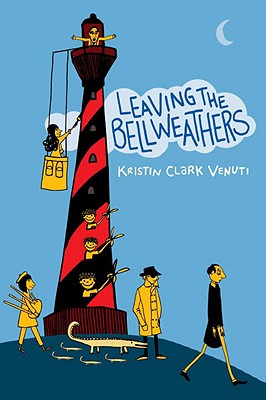
Leaving the Bellweathers

by Kristin Clark Venuti
ages: 10+
First sentence: “It is nighttime in the village of Eel-Smack-by-the-Bay.”
Review copy provided by the publisher.
Support your local independent bookstore: buy it there!

File this one under delightfully odd.

The Bellweathers are a family that leave in the Lighthouse on the Hill by Eel-Smack-by-the-Bay. There’s dad, Dr. Bellweather, an inventor who has a habit of unleashing his “peculiar sense of humor.” There’s mom, Lillian, who loves to paint… the house. Over and over and over and over again. Then, there’s the kids. Spider, age 14, whose interest tends toward the violent animals, and who is determined to set up the first Endangered Albino Alligator refuge. Second in line is 13-year-old Ninda, Determined to help the Oppressed and Exploited. And will go to any lengths to do so. And, as if that weren’t enough, there’s the 9 year old triplets: Brick, Spike and Sassy. Always Up to No Good and determined to be artists, saying they are a handful is a massive understatement.

Keeping this, um, unique family together is their trusty butler, Tristan Benway. Except, he’s there only because his ancestor, 200 years ago, made an oath of fealty to the Bellweather family. There’s only 8 weeks, 2 hours and 27 minutes until GLOAT (Glorious Liberation and Oath Abandonment Time) and it’s everything Benway can do to keep it together until he can leave and get a cottage Far, Far Away.

While it wasn’t a consistent thing, there were parts of this book that had me in stitches. From Benway’s deadpan observations (he’s the one who calls Dr. Bellweather’s temper a “peculiar sense of humor”) to the occasional footnotes, to the absurd plot, I found myself either smiling, chuckling or snorting out loud. I haven’t read this book that was so… well… unusual, in a long, long time.

That’s not to say it’s for everyone: I’ve said it before, I’ll say it again: humor is a tricky thing. But, this one tickled my funny bone just right.

Good thing, too.

(Just for the record: because this is a Cybils nominee, I’ve been asked to make sure y’all know this is my opinion only, and not that of the panel.)

The Ship of Lost Souls

by Rachelle Delaney
ages: 9+
First sentence: “‘You there!'”
Review copy provided by the publisher.
Support your local independent bookstore, buy it there!

Think of a book that’s one part Treasure Island, one part Pirates of the Caribbean, one part Peter Pan, and you’ve pretty much got an idea of the feel of this book.

Scarlet McCray is the captain of the Margaret’s Hop (the e fell off years ago), a ship haven for lost or abandoned children. Their ship is surrounded and protected with a ghost-ship legend that Scarlet and her crew of 8 to 13 year olds use to their full advantage. They pillage, they raid, they essentially have a grand time out from under the thumb of obnoxious adults.

Jem Fitzgerald, the nephew of a moderately famous botanist, is in the area with siad uncle in search of a treasure. There’s a legend that’s been floating around for years of an island that has a treasure that will bring one who finds it peace. And Jem’s uncle knows where it is. (There’s a map and everything.)

Except Jem and his uncle are kidnapped by dread pirates, who then kill Jem’s uncle. Enter Scarlet and the Lost Souls: they rescue Jem, make him a part of their crew, and go on search for the treasure. There’s growing up, adventures, revelations, and a mutiny attempt in the process of looking for the treasure.

It’s a great world that Delaney has created — safe and predictable, yet with a sense of adventure on the side; realistic, with just the right touch of whimsy. It’s a fun little book.

(Just for the record: because this is a Cybils nominee, I’ve been asked to make sure y’all know this is my opinion only, and not that of the panel.)
Year of the Bomb

by Ronald Kidd
ages: 10+
First sentence: “There were Martians in the backyard.”
Review copy provided by the publisher.
Support your local independent bookstore, buy it there!

It’s 1955. It’s the middle of the Cold War. There are frightening things all around, from the threat of nuclear war, to McCarthy’s Communist hunting, to the monsters in the movies.

And in Sierra Madre, California, Paul and his friends — Arnie, Crank and Oz — are in the thick of it all. Especially when the filming of the greatest B movie of them all — Invasion of the Body Snatchers — comes to their hometown. Being movie buffs, they are drawn to the set, which, in turn, opens up a whole can of worms: espionage, scientists, blacklisting, movie magic. You name it, it’s probably in there.

This book is wild and fun. It feels like a B movie: a bit cheezy, a bit over-the-top, but in the end, quite lovable. Kidd’s writing style flows — even if sometimes the narrative time line gets a little bit fuzzy, flipping between movies, real time and flashbacks — and Paul is a winner of a character. He’s concerned about his friends, he wants everyone to get along, and yet he’s not willing to give in to all the conspiracy theories and fear that are all around him.

There’s nothing really deep or life-changing about the book. It’s mostly just fun times and monster movies. Which is really just fine.

(Just for the record: because this is a Cybils nominee, I’ve been asked to make sure y’all know this is my opinion only, and not that of the panel.)

Bull Rider

by Suzanne Morgan Williams
ages: 12+
First sentence: “Folks in Salt Lick say I couldn’t shake bull riding if I tried.”
Review copy provided by the publisher.
Support your local independent bookstore: buy it there!

Cam doesn’t want any part of his family’s obsession with bull riding. As far as he’s concerned, that’s his Grandpa Roy’s, Dad’s and older brother Ben’s territory. Even if he is in northern Nevada, in a piddly little town just outside of Winnemucca, and lives on a cattle ranch, he’s a skateboarder, not a bull rider.

Then, Ben joins the Marines and gets shipped to Iraq, and a year later comes home seriously injured. And (of course), Cam’s life drastically changes. Not only does he have more chores to do around the ranch, but his grades tank because of the stress, and inevitably, he finds that there is less time to board. And that it’s less important to him. Especially once he visits the bull ring again, and gets goaded into riding. He finds that he’s actually good at it, and when Ben seems to be stuck in a permanent funk, Cam makes a deal: if he can ride the biggest, meanest bull around — Ugly’s his name — then Ben has to try harder at getting better.

The question is: how’s Cam going to do that?

It’s an interesting tale, that of Cam and his adapting to the changes in his life. It’s also almost more a story of the changes a soldier’s injury brings to both his and his family’s life. Williams is brilliant at showing how everyone is affected by it, from Cam and Ben to their parents and grandparents, to the community as a whole. There’s a lot of teenage angst — Cam’s 14, which (IMHO) puts this at the upper end of middle grade books — a lot of lying, and a lot of sneaking around. Cam’s mother bans him from bull riding — it’s a dangerous, if exciting, sport — because she can’t handle the idea of two sons being seriously injured. So, Cam resorts to sneaking around behind her back, which is easier than would be expected, since she’s so preoccupied with Ben and his recovery.

Cam’s a sympathetic character, though, and Williams makes his pain and discomfort and unease palpable. As a reader, you find yourself rooting for everyone: for Cam to make the ride, for Ben to get better, for everyone to get past the pain. It sounds like it would be a hopeless book, a depressing book, but Williams infuses it with a spirit of hope, of promise, that even though the end is not tidy, everything feels like it’s going to work out.

And that’s a good thing.

(Just for the record: because this is a Cybils nominee, I’ve been asked to make sure y’all know this is my opinion only, and not that of the panel.)

The Small Adventure of Popeye and Elvis

by Barbara O’Connor
ages: 9+
First sentence: “DRIP.”
Support your local independent bookstore, buy it there!

This book is about boredom. About finding something to do, something unusual, something small, something… well adventurous. I’d like to hand it to all the plugged-in kids and say, “Here! Read. Be inspired. Go out and have a small adventure. You might find it changes things, even if it doesn’t really change things.”

Popeye — formerly Henry until his Uncle Dooley accidentally shot his eye out when he was three — is bored. There is absolutely nothing to do in Fayette, South Carolina except sit and listen to Velma — that’s his grandma — recite the kings of England (in order) and write down her vocabulary words in chalk on the porch. Until one day an RV, a Holiday Rambler, full of a family with rambunctious kids, gets stuck in the mud by Popeye’s house. The oldest is Elvis, and Popeye is immediately entranced. Elvis is everything Popeye is not: loud, rowdy, the Royal Rule Breaker, someone who can say “So what?” and actually mean it. And so, when Elvis suggests that he and Popeye have an adventure, Popeye can’t help but go along with it.

Remember, now, that the title is “Small Adventure”. There is no grand discovery, even if there’s a bit of a mystery. There is no angst. There is no death (though there is missing parents; thankfully, it’s just accepted as a fact and not something that Popeye has to Deal With). There is no drama, though there is wrath. What there is, is a perfectly simple, small adventure that changes one boy’s life.

And was something that completely mesmerized and entranced me.

(Just for the record: because this is a Cybils nominee, I’ve been asked to make sure y’all know this is my opinion only, and not that of the panel.)

The Girl Who Threw Butterflies

by Mick Cochrane
ages: 9+
First sentence: “On Monday, after band rehearsal and intramurals, when Molly got home from school, her mother was sitting at the kitchen table going through the day’s mail.”
Support your local independent bookstore: buy it there!

Molly loves baseball. It’s a holdover from when her father — who died six months ago in a freak car accident — was alive, but it’s the only thread of connection she has to his memory. It’s not just watching baseball, though, or even playing catch that Molly likes. No, she wants to play, really play, the game. Her father taught her how to throw that most unpredictable of all pitches, the knuckleball, and Molly knows she can compete with the boys. So, she tries out for the baseball team.

This story is a quiet one, a meditation on loss, on baseball, on healing and moving on. It’s not flashy, it’s not over-the-top: not for a minute do you disbelieve Molly’s ability to throw a good game. Cochrane gives us both Molly’s ups — the perfect pitch, the game won — as well as her many downs — for, as he writes at one point, baseball is a game of failures. There’s a softness, a gentleness to the story, for even though there is conflicts — with her mother, with teammates who don’t like the idea of a girl on the team — the tension never reaches a boiling point. There’s a lot of musing going on, a lot of reflection, a lot of thought.

Which isn’t to say that it’s a boring book: it’s not. Cochrane is a good enough writer that he can pull off a book where the action is mostly internal and keep one turning pages. It’s a good book, an interesting story, and as far as books about girls doing boy things go, it’s worth reading.

(Just for the record: because this is a Cybils nominee, I’ve been asked to make sure y’all know this is my opinion only, and not that of the panel.)

Heart of a Shepherd

by Rosanne Parry
ages: 10+
First sentence: “Grandpa frowns when he plays chess, like he does when he prays.”
Support your local independent bookstore: buy it there!

There are obviously powerful books, books about Problems or Trials or Oppression, books where the main character has something obviously Moving happen to them. And then there are books that are quietly powerful. Ones that seem simple on the surface, but then work their way under your skin and move you in ways that you totally didn’t expect.

This is one of those books.

Twelve-year-old Ignatius — Brother to everyone, since he has four older brothers — part of the east Oregon ranching community. Even though he’s small, and he doesn’t like killing the animals, he — along with his father, grandfather and brothers — does the work: take the cows to the mountains, raise and shear the sheep, mend and tend the ranch. Except, all the brothers are away, at school, in the army. And then, when Brother’s dad’s National Guard gets called up for a fourteen-month tour in Iraq, Brother is left with Grandpa to manage the the ranch by themselves. It’s up to him to prove that he can be what he doesn’t think he can: a rancher. Except, over the course of the year that his father is gone, that’s not what Brother finds out, about himself or his family.

It’s a deeply religious book — Brother and his family are Irish Catholics, though his Grandpa is a Quaker — but not overly preachy. There’s a lot of references to God and His will, but it’s a quiet religion, one that’s open, accepting and fluid in ways that are unexpected and ultimately beautiful and movie. It’s a harsh reality, east Oregon ranching life, but Parry writes about it in ways that will keep you thinking about Brother and his family long after you close the book.

(Just for the record: because this is a Cybils nominee, I’ve been asked to make sure y’all know this is my opinion only, and not that of the panel.)
Captain Nobody

by Dean Pitchford
ages: 9-13
First sentence: “Uh-oh.”
Support your local independent bookstore: buy it there!

The first reaction I had to this book was, “Oh my gosh! FINALLY, a normal kid with a normal family.” Seriously, folks, too many of the books I’ve read are about damaged kids with damaged families, and while it’s all interesting and poignant and challenging and all that, sometimes I just wish for a normal kid with a normal(ish) family, having normal(ish) problems.

And, with this book, I got that. With a dose of humor and superheros on the side.

See, Newt Newman (yes, his parents named him Newton, poor kid) is the ten-year-old brother of Chris Newman, high school football star. Newt manages the house — making breakfast for his busy, and slightly absent-minded parents — gets good grades, and has a couple of great friends in JJ (she’s a girl) and Cecil even though he’s a tad bit shy, but is basically ignored by everybody. (“I didn’t know Chris Newman had a brother!” is a common reaction of most people.) Until, that is, a combination of events occur: Halloween, and the Big Game where Chris gets knocked out and put into a coma. And out of these disasters (well, Halloween’s only a disaster because Newt couldn’t find a decent costume) was born Captain Nobody. Newt — in his costume, made from Chris’s old clothes — suddenly finds that he’s a different person when wearing Captain Nobody. Stronger, more outgoing, more able to handle… well, everything that’s thrown his way.

And things do get thrown his way. It’s nothing out of the comic books, but Newt does happen to be in the right place at the right time to be the cause of some pretty remarkable happenings. It’s not outrageous: nothing Newt does is out of the ordinary. He’s just, well, himself. And by being himself — enhanced by the Captain Nobody costume and a frame of mind — he manages to do some small, yet pretty heroic things.

And, I have to admit, it kind of made me want to be a superhero, too.

(Just for the record: because this is a Cybils nominee, I’ve been asked to make sure y’all know this is my opinion only, and not that of the panel.)
Two Books about Loss and Healing

All the Broken Pieces
by Ann Berg
ages: 10+
First sentence:
“My name is Matt Pin
and her name, I remember,
is Phang My.”
Support your local independent bookstore: buy it there!

This one is set right after the Vietnam War, and deals with the tensions — both in Vietnam and in America — brought on because of that war. Matt Pin is a 12 year old Vietnamese boy who was airlifted out of Vietnam two years ago — his mother sent him away — and adopted by a nice American family. He’s dealing with a lot of things: guilt (for leaving his mother and younger brother in Vietnam among other things), loneliness, hatred, uncertainty. The novel follows his growth — though baseball, through meetings with Vietnam vets, through piano lessons — to acceptance of his past and of his present.

Told through spare but lovely verse, this novel is haunting at times, yet ultimately hopeful.

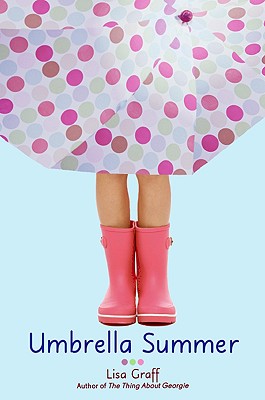
Umbrella Summer
by Lisa Graff
ages: 9+
First sentence: “If you started to squeeze your brakes right in the middle of heading down Maple Hill, just as you were passing old Mr. Normore’s mailbox, you could coast into the bike rack in front of Lippy’s Market without making a single tire squeak.”
Support your local independent bookstore: buy it there!

Annie believes you can never be too careful. She’s determined that while there are lots and lots of dangerous things you can do — like fly or drive — it’s not those things that you need to worry about. No, it’s the little things that can kill you — like the undetected heart defect that killed her not-quite-12 year old brother, Jared. So, Annie has determined that if she stays perfectly, totally, completely safe then nothing bad will ever happen to her.

It’s only through a fight with her friend, and the interference of a new neighbor, who is suffering from her own loss, that Annie begins to come out of her shell — out from underneath the umbrella of her sadness — and learns how to live again.

It’s a cute book — I know that sounds weird in conjunction with the subject matter, but cute is really the first word that comes to mind — that manages to never feel either overwhelmingly sad or callous in its treatment of the death of a loved one.

(Just for the record: because these are Cybils nominees, I’ve been asked to make sure y’all know this is my opinion only, and not that of the panel.)