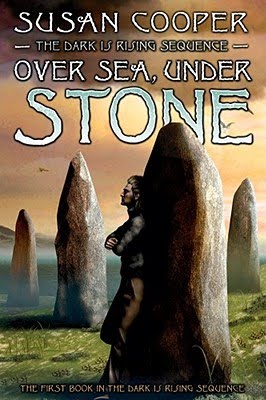
Over Sea, Under Stone

by Susan Cooper
ages: 9+
First sentence: “Where is he?”
Support your local independent bookstore: buy it there!

I’ve been trying to remember when I first read these books. It wasn’t when I was a kid, even though I would have loved them had I come across them. I’m thinking it was about the time that I rediscovered kidlit, about 15 years ago. I don’t remember what I thought about this particular book — I do love the next one in the series, The Dark is Rising — but I did find I remembered elements of the plot.

Simon, Jane and Barney Drew are on vacation in Cornwall with their family and their Great-Uncle Merry. On their second day there, they’re exploring the old house that “Gumerry” rented for them and discover an old map. It turns out that the map is written in old English and Latin; it’s a guide of some sort leading to the Holy Grail. It’s up to the kids to figure it out and find the grail… before the “other” side does. There’s a bit of adventure, some kind of tense moments, and it’s truly a middle grade book: except for a bit at the end, it’s a straight-up mystery that’s solved by Simon, Jane and Barney working together.

All that said, it’s really kind of a silly little book. Aside from introducing us to Merry (Merriman Lyon, who shows up in the other books. He’s actually Merlin…) and the Drew kids (they do make a reappearance), I’m not quite sure what purpose this book serves to the whole of the series. (Maybe it’ll become clearer as I read more.) You could honestly not read this book and not be missing much of anything. The writing’s not even as evocative as I remember some of the other books in the series being.

It’s a good thing I don’t judge series by the first book.
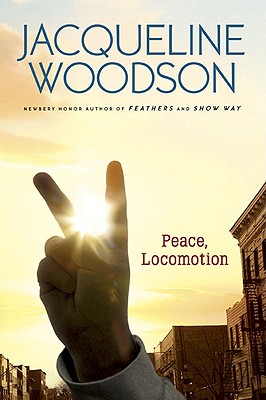
Peace, Locomotion

by Jacqueline Woodson
ages: 9+
First sentence: “Dear Lili, As you know, in a few days I’m going to be twelve.”
Support your local independent bookstore: buy it there!
Review copy sent to me by the publisher for the Cybils.

This book was about second chances for me. I read one Jacqueline Woodson book a long time ago (at least 10 years) and I had a bad experience with it. I don’t know why it’s taken me so long to pick another one up, because I know she’s quite respected.

Whatever it was, I’m duly chastised: this was a lovely little book, beautiful in its simplicity, it’s a book full of characters and themes that I will be thinking about for a long time.

It’s a sequel, but it works quite well on its own. The book is a series of letters from Lonnie — aka Locomotion — to his younger sister Lili. They’ve been put in different foster homes after a fire killed their parents. The loss is still there, at least for Locomotion, and he’s made it his “job” to help Lili not forget his parents. But, that’s not all in his life. He likes his foster mother and one of his foster brothers. His other foster brother, whom he’s never met, is away in the Army, fighting. It’s a nondescript war — it could be either Vietnam or Iraq; one of the things that really stood out was how timeless this book was — but the fact that this boy, someone who didn’t like fighting at all when he was younger, was away doing things struck Locomotion as really unfair. And, after talking, he decides to pray for peace. But then, he realizes that peace isn’t just something big, something grand: it’s in the little things as well.

It’s a book full of simple things, everyday things — like crocuses and good home cooked meals and solving a math problem — but in those things happiness, peace is found. Woodson is a powerful writer, evoking images with the barest of words. She captures Locomotion’s voice perfectly, but she does more than that: Even though we rarely “heard” them, I feel like I knew the other characters in the book, from his sister Lili through to his older foster brothers Rodney and Jenkins. It’s a perfect example of showing: there was very little descriptions, and yet I had a perfect picture of everyone.

Masterful.

The Lost Conspiracy

by Frances Hardinge
ages: 11+
First sentence: “It was a burnished, cloudless day with a tug-of-war wind, a fine day for flying.”
Support your local independent bookstore: buy it there!

This book is much like that proverbial boulder: it takes a while to get going, but once it gets started, it rolls down the hill until it crashes to a stop, leaving you breathless.

It’s the story of an island where there’s tension between the colonists and the native peoples, the Lace. There are people — Lost, they call them — who can spend time outside of their bodies. The island needs them — it’s how they communicate over vast differences — but doesn’t exactly trust them. And when all of them, except for one Lace Lost, Arilou, suddenly die, an investigation starts. And sends Arilou and her sister, the unobtrusive Hathin, on the run for their lives.

It sounds pedantic, and for the first 200 pages or so, it is. Hardinge is a gifted writer, one of the least clunky similie and metaphor writers that I’ve ever read. They roll of the page effortlessly, drawing the reader in, rather then putting them off. But even her gifted writing couldn’t keep the first part from dragging a bit. Which is sad, because many people (like M) will give up before the book really gets exciting. Because, right around the 1/3 mark, it does. Hardinge starts weaving in folk tales and traditions, giving life and personality to volcanoes, and turns the book into a bit of an adventure story and mystery. There are twists and turns, help from unexpected sources, and a bad guy who is scary because he’s so reasonable and so wrong at the same time.

And all of that adds together to make this book a true pleasure to read.

A Wind in the Door

by Madeline L’Engle
ages: 9+
First sentence: “There are dragons in the twins’ vegetable garden.”
Support your local independent bookstore: buy it there!

I always remembered this one, from when I read it as a kid, as my “favorite”. Though, if you had asked me, I don’t think I could have pinpointed why. So, I was quite curious to reread the book: maybe I would love it as much as I remembered loving it. And maybe I could finally pinpoint the elusive why.

So. Charles Wallace is having problems. He’s not adapting to school particularly well, which shouldn’t be surprising considering the precocious child that he is. On top of that, something more fundamental is wrong: he’s sick, down in his very cells. Meg, Calvin and Mr. Jenkins (the school principal) together with the cheribum Proginoskes have to work together to battle the evil that’s invading the world and save Charles.

Honestly? I liked the book well enough, but I couldn’t pinpoint why it was my favorite. It was less overtly religious than Wrinkle in Time was, but there were still overtones of the Ultimate Battle. There was a lot about Hate and war and instant gratification versus Doing Ones’ Duty. Maybe that was it: the fact that Duty wins out over Fun and Frivolity. Perhaps I just wanted justification for my innate personality quirks?

I was disappointed in Meg; while she was still the heroine and she still did the most work, she just wasn’t as engaging a character as I felt she was in Wrinkle. That, and I just didn’t get much out of the plot: it seemed to be spinning in circles. Perhaps it was me, but I felt it just had too much narration and not enough action.

Then again, I may just be nitpicking. My 11-year-old self adored this book. And I might just be content to let it stay that way.

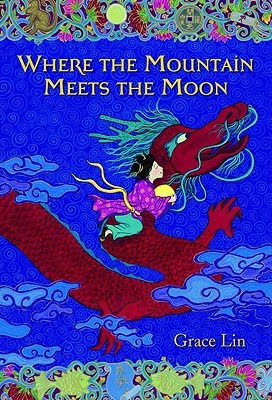
Where the Mountain Meets the Moon

by Grace Lin
ages: 10+
First sentence: “Far away from here, following the Jade River, there was once a black mountain that cut into the sky like a jagged piece of rough metal.”
Support your local independent bookstore: buy it there!

Sometimes, what you really need in life is good traditional fairy tale. No bells and whistles, nothing super-fantabulous-exciting. Just a quiet, original fairy tale with all the traditional elements: a good-hearted (but not flawless) heroine, an adventure, a budding friendship, a lesson learned. Stick it in China, and you’ve got something magical.

Minli and her family live in the valley of the Fruitless Mountain, working hard every day to scrape by. Her mother is disgruntled, especially when Minli’s father spends the evenings telling her stories about the Jade Dragon and the Old Man of the Moon. Then one day, Minli discovers that the stories may not be impossible after all, and sets out to ask the Old Man of the Moon how her family can make their fortune. Along the way, she will have adventures, make friends (with a dragon, among others), and learn a few things about herself.

The charm in this book is really in its simplicity. On the one hand, there’s nothing grandiose and it’s very traditional to the point of being predictable. But on the other hand, there were no wasted words, and the plot clipped along at a very quick pace. I realized at one point that this book would make an excellent read aloud: the words just cried out to be spoken aloud. That, and I think the pacing of the book works better as a story told rather than read. Not that I didn’t enjoy reading it — it wasn’t edge-of-the-seat gripping, but it was charming, and I did want to know what happened next. But, to read it aloud to my girls, to give it that added suspension of seeing what will happen next, tomorrow night? I think that would have added a lot to the book.

As it was, though, it’s a story well worth reading.

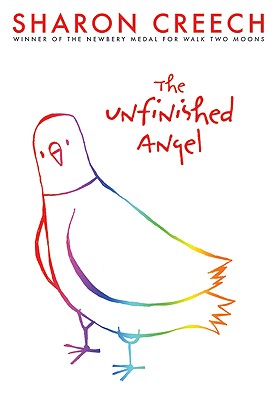
Unfinished Angel

by Sharon Creech
ages: 8+
First sentence: “Peoples are strange!”
Support your local independent bookstore: buy it there!

Some books stick in your mind because they have a brilliant plot. Some because they have created a fabulous world. Others because they have great characters, ones that you want to take home to your mother.

And others, still, because the voice — the way the narrator speaks to you, as a reader — is so unique, so endearing, that you can’t help but love the book.

The voice of Angel, the title character in this sweet little book, is wonderful. It’s not just the word choices that Creech uses, though that is a lot of it. Some of the words that just endeared me to Angel: peoplealities, surprisements, mishmaseroni, glompsing (I really love this one!), struddles. How can you not love a character who uses words like that? But if it was just a sprinkling of fun words throughout the book, it probably would have been more annoying than endearing. No, it was everything about Angel: from his/her irritation with yet love for the people in her (I’m not sure if it was a his or a her, but it felt like a her to me…) Swiss/Italian village, to Angel’s gradual acceptance of the crazy American girl — Zola, who is just extramarkable — and the village’s slow awakening to the sense of community.

Sure, I got all of that out of this as an adult, but I think what kids will see, and probably come to love, is Angel. It’s such an endearing character, and a captivating voice that it will keep practically anyone turning pages. The rest is just frosting.

A Wrinkle in Time

by Madeline L’Engle
ages: 9+
First sentence: “It was a dark and stormy night.”
Support your local independent bookstore: buy it there!

I thought, as I started this deceptively small novel, what was it that captivated me about this book when I was a child? See, I have the copy I originally got — was it a gift? did I buy it with my own money? — and it’s well-loved. I remember reading it over and over again, though I stopped sometime in high school, and honestly haven’t picked it up (or thought much about it) before I cracked it open last week.

When I finished, though, I knew exactly what I loved about it. See, I was Meg. I was geeky, awkward, kind of smart (but not in everything), and felt I was unable to quite fit in. The idea that someone like me — that Meg, of all the characters — would be the one to save the day, would be the one with the answers, and (most importantly to my 11 year old self) would be the one to find love, gave me immense hope.

Going back to this book as an adult, one thing really surprised me: it’s an incredibly religious work. Not in the same way that, say, Narnia is — it’s more blatant than that. There’s the good-versus-evil element, of course, though L’Engle’s vision of evil is more subtle than I remembered (Evil is sameness? I can see that…), but it’s also the the references to Mrs. Whatsit, Mrs. Who and Mrs. Which as Guardian Angels. It’s sometimes small little things throughout, but it’s also the big things, like this quote from Mrs. Who:

The foolishness of God is wiser than men; and the weakness of God is stronger than men. For ye see your calling, brethren, how that not many wise men after the flesh, not many mighty, not many noble, are called, but God hath chosen the foolish things of the world to confound the wise; and God has chosen the weak things of the world to confound the things which are mighty. And base things of the world, and things which are despised, hath God chosen, yea, and things which are not, to bring naught things that are.

Religious aspects aside, I still love the story. It’s Meg’s story, of course, and her growth and coming into her own. That still captivated me. I loved the Mrs.es, adored Charles Wallace, and enjoyed the story, though it wasn’t as unputdownable as I remember it being when I was a child. Still, I’m glad I took the time to revisit the world and the Murrys.

Odd and the Frost Giants

by Neil Gaiman

ages: 8-12

First sentence: “There was a boy called Odd, and there was nothing strange or unusual about that, not in that time or place.”

Support your local independent bookstore: buy it there!

Let me just get this off my chest: I have learned, over the past couple of years, to adore Neil Gaiman. Really. The more I read by this man, the more I love his writing.

If you’re looking for a good place to start reading some of his work, Odd and the Frost Giants is really about as accessible as Gaiman gets. Funny, yet slightly (but not too much), well, odd, there’s a little bit of everything for everyone: some honest-to-goodness coming of age in there, a bit of mythology, a bit of adventure. In short, it’s everything Gaiman usually delivers, just this time in a slim 117-page packet.

Odd is a boy who’s a bit down on his luck. His father died trying to save a pony after a Viking raid. Odd tried to fill his place, but a tree fell on his leg, smashing it to where it was nearly unusable. His mother eventually remarried, but his step-father (who already has a bundle of kids of his own) isn’t very kind to Odd. Then, the winter that doesn’t want to let go, Odd decides to leave. Once he reaches the forest, he meets a fox, who leads him to a bear and an eagle — strange companions, sure, but with an even stranger story.

That’s when Odd finds himself on a journey he never expected to take: a journey to save Asgard, city of the gods, from the Frost Giants. There’s no doubt that he’ll succeed, but how he succeeds is ultimately quite surprising. (And satisfying.)

I couldn’t put the book down, and when I closed it, my first thought was, “That was just about perfect.” And, really, you can’t say much more than that.

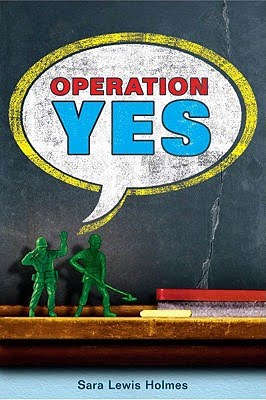
Operation Yes

by Sarah Lewis Holmes
ages: 9+
First sentence: “
Review copy provided by publisher.
Support your local independent bookstore: buy it there!

Over the past two months, I have read a lot of books about war, death, loss, and kids dealing with all of that. Some of have been moving and made me cry, some have been irritating and made me annoyed. Few, however, have hit me just right. Operation Yes, though, is one of those few.

Bo is the son of an Air Force Colonel, living on base in Reform, North Carolina. They’ve moved a lot, of course, and he’s not had a good track record with school. That is, until sixth grade and his new teacher, Miss Loupe. Miss Loupe is one of those teachers — may we all be blessed enough to have one — who makes learning exciting. Oh, how I wanted to be a part of her class. She’s dynamic, she’s thrilling, and she has Bo totally and completely engaged. That is, until Gari — short for Garrison — shows up.

Gari is Bo’s cousin, and she’s (yes, that’s not a typo) come to stay with Bo and his family for a year while her mom, an Army nurse, is deployed to Iraq. To say that Gari is not happy about this, is to be wildly understating it. Gari is bitter, angry, and troublesome. And because Bo has the father he does, he gets blamed for much of the trouble that Gari brings. That is, until Miss Loupe’s brother, Marc, goes missing in Afghanistan, and Bo, Gari and a couple other classmates hatch a plan that will bring hope to everyone.

The book, from the first page, gave me a sense of what it means to work together toward a common goal. To deal with the loss of someone, both through distance and injury. To hope in spite of mounting evidence to the contrary. To dream. To walk to a different drummer. And it made me want to stand up and cheer. Everything about it, from the writing and characters down to the plot had me hooked from page one. I couldn’t put it down; I didn’t want to put it down. And I didn’t want it to end, even though the ending is supremely perfect.

If you have to read one book about War and Loss (and even if you don’t), pick this one. You won’t regret it.

(Just for the record: because this is a Cybils nominee, I’ve been asked to make sure y’all know this is my opinion only, and not that of the panel.)

Positively

by Courtney Sheinmel
ages: 10+
First sentence: “
Review copy provided by the publisher.
Support your local independent bookstore: buy it there!

There are some books that quietly creep under your skin and stick there. Sure, you know up front that they are issue books, that the sole purpose of the story is to raise awareness on something or other — in this case, AIDS, especially in children — that the author particularly cares about. But, for many reasons, the story sticks with you.

The story in this case follows thirteen-year-old Emerson — Emmy — Price. She’s HIV-positive, and her mother — who had AIDS — has recently passed away. Emmy’s dealing with a lot of change (she’s moved in with her dad and his new wife, who is expecting), a lot of pain, a lot of heartbreak, and it’s almost too much for her to bear. She wants to give it all up: it’s hard being different, taking meds all the time, and she misses her mom desperately. Then her dad sends her away to Camp Positive, a camp exclusively for HIV-positive kids. Over the course of the summer, Emmy learns to accept what has happened and move on.

It’s an issue book, definitely: the authors note on the end was almost more moving than the story itself. The fact that the author cares about the subject, and wants to address issues surrounding AIDS and HIV. But, she gave us a character we could care about (and get irritated with; I spent a good half of the book annoyed with her) and care about the journey of. It’s a touching book, it’s a caring book. And so, it surpasses the issue-ness and becomes a genuinely good book.

(Just for the record: because this is a Cybils nominee, I’ve been asked to make sure y’all know this is my opinion only, and not that of the panel.)