The Youngest Templar: Trail of Fate

by Michael P. Spradlin
ages: 10+
First sentence: “The room was full of bright light with a glare so intense that I closed my eyes.”
Support your local independent bookstore: buy it there!
Review copy sent to me (ages ago) by the publisher.

Dear authors of a series:

I enjoy a series as much as the next person. Really I do. There are characters I love that I want to spend more time with. And if you’d like to keep writing books about these characters, I won’t mind.

But, honestly: as much as I love these characters, and as fun and interesting and gripping your story is, I do have a problem. See, even if Tristan and Robard and Maryam (I didn’t get it until this book: it’s Robin and Marian!) are bouncing around France in the 12th century (was it called France in the 12th century?) I’d like the book to actually end by the ending. I was enjoying the book — sure it was a bit heavy-handed, but I figured, hey, it’s campy Robin Hood, I can handle that — and then, wham, the three words I hate most: TO BE CONTINUED.

Seriously?

Seriously? It’s an intense climax, a showdown at noon, a holdup, and you give us TO BE CONTINUED?

My first reaction is that you totally want to sell the next book. That you’re not confident enough with the story to give us an ending, trusting that we’ll want to visit with the characters in the next book. There is no call for TO BE CONTINUED in a series. It’s a cop out. A wimpy strategy. It is possible to give us an ending for the book, and still have us wanting to come back for more.

And honestly, I prefer it that way.

Thanks.
Melissa
The Red Pyramid

The Kane Chronicles, Book One
by Rick Riordan
ages: 10+
First sentence: “We only have a few hours, so listen carefully.”
Support your local independent bookstore: buy it there!

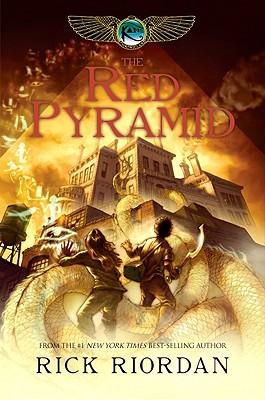
On the one hand: it’s everything we’ve come to expect in a Rick Riordan book: fast-paced, witty, engaging, and an interesting overarching theme to tie a series together. He tackles Egyptian mythology this time, creating a world in which the gods exist, where there is magic, and the balance between chaos and order is failing.

We follow the adventures of the Kane siblings: 14-year-old Carter and 12-year-old (almost 13!) Sadie as they are thrust into this world of good and evil, gods and goddesses, magic and magicians. They’ve been living apart for the past six years, ever since their mother died. Carter’s been traveling the world with their archeologist father, and Sadie’s been parked in London with their grandparents. However, things are heating up, and on one Christmas Eve, their father decides to do the unthinkable: raise the gods in order to bring his wife back from the dead. Unfortunately, things don’t go as planned, and he releases all five of the major Egypitian gods: Osiris, Horus, Isis, Nephthys and the big bad guy Set, who plans to take over the world.

Of course it’s up to our heroes to figure out how to swim in this big, scary stream and figure out how to stop Set. And, of course they manage it (with a few bumps and bruises along the way).

On the other hand, though, it was just more of the same. I couldn’t help but compare this series to the Percy Jackson one, and while I enjoyed reading this, I felt that the Percy books were tighter, that the mythology was better used. The magic in this one almost seemed like cheating, instead of a natural outgrowth of the character’s situation. And while I usually enjoy Riordan’s silly asides, this time — he had the characters trade off chapters and whenever they switched, there would be some sort of snide comment — it interrupted the flow of the story. Sure, they were funny at first, but after a while they grated.

Granted, those are only two quibbles in a more than 500 page book (well, there are three: Percy felt tighter because it was shorter; did we really need to go 500 pages to tell this story?). It really is a fun read. Not as good as Percy, but good.

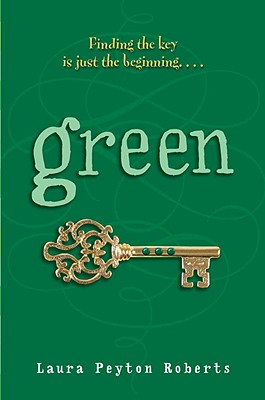
Green

by Larua Peyton Roberts
ages: 10+
First sentence: “Four or five things arrived for me on my thirteenth birthday.”
Support your local independent bookstore, buy it there!

Lily hates moving. She hates adjusting to a new home, making new friends. And it’s been especially hard in the last two years since her favorite grandmother, Gigi, has died. And yet, here she is, in another town, on the eve of her thirteenth birthday, trying to fit in, trying to make friends.

And then a package arrives for her — addressed to her in her full name, Lilybet, which no one EVER uses — and blows up, causing a mild concussion. So, admittedly, when she starts seeing little Green men — leprechauns from the Green clan — she wonders if it’s real or if it’s just her head playing tricks on her. But, once she gets to the Meadow (kidnapped would be the word for it), and is told that she either passes three tests to become the clan’s keeper of the gold, or she’ll lose all memories of her grandmother, she decides that it is very real indeed.

We follow Lily through her three tests, each more difficult than the other, as she learns to accept the reality of the leprechauns and learns to love them as her grandmother did. There are some ups and downs, some easy outs and not-that-great moments, but overall it’s a fun little take on a bit of folklore.

How to Survive Middle School

by Donna Gephart
ages: 10+
First sentence: “The first day of summer vacation is important, because what you do that day sets the tone for the rest of summer.”
Support your local independent bookstore: buy it there!
Review copy sent to me by the author.

David Greenberg loves making movies: short little funny vids that kind-of riff on The Daily Show. He makes them with his best friend, Elliot, and yeah, they just upload them to YouTube, but it’s the making them together that’s the fun part.

Or so David thought. That was before the summer before sixth grade, and Elliot decides that what they really need to go is go to the mall and scope out girls. David, however, disagrees, and the friendship is on the rocks. Right before middle school.

Unfortunately — and in a very stereotypical turn; do all middle schools have to have the bully who is less-than-smart, smokes, and flushes heads in toilets? — Elliot partners up with the school bully, and they gang up on David. Now, on top of still trying to adjust to his Mom’s leaving two years earlier, David has to deal with a best friend-turned-traitor. And this leads to all kinds of trouble: suspensions, detentions, fights… On the other hand, it also leads him to be friends with Sophie, bright, formerly homeschooled, and, interestingly enough, amazingly connected. She finds David’s videos hilarious and emails a link to some friends. The link passes around and the video goes viral. David’s an internet star!

Now, to just reconcile his popularity on the internet with his increasing loser status in real life.

It was a clever concept, contrasting real life with virtual life, and I think Gephart managed that fairly well. It’s a timeless story, adjusting to new situations, trying to make new friends, and what to do when your anchor leaves you. But, sometimes I couldn’t help wondering: how relevant will all this be in five, ten years? Will we even know (or care) who Jon Stewart is? Don’t get me wrong: I love the show. It’s just using pop culture references in a book automatically makes it less timeless than those where the story stands more on its own.

That said, David is a great character, and his trials and tribulations will be real to the age group this is intended for. So it’s a bit pop culture-heavy, and a bit too stereotypical. There’s a singing hamster and an 11-year-old who gets to be famous for 15 minutes. It’s fun. And sometimes that’s all you can ask for out of a book.

A Mango Shaped Space

by Wendy Mass
ages: 10+
First sentence: “Freak.
Support your local independent bookstore: buy it there!

Mia doesn’t quite know how to deal with her world. She seems normal from the outside, possibly the most normal in her family. She likes to paint, she has been best friends with Jenna since forever, and she does okay at school. Except she has a secret: sounds, numbers and letters have a color for her. You wouldn’t think this was a big deal, but back in third grade, when she tried to tell people, everyone — adults and kids alike — thought she was making things up. So, she stopped telling people, quietly bearing the burden of being a… freak.

Then she hits eighth grade and things start to fall apart for her. She finally admits the color “thing” to her parents, they take her to a series of doctors, finally diagnosing her with synesthesia. On the one hand, this is good: Mia is no longer a freak, or alone in dealing with the challenges that synesthesia brings. On the other hand, Mia delves into an intense regimen of self-discovery, inadvertently shutting out her family, her friends, her schoolwork, and (perhaps most of all) her cat, Mango.

It’s an interesting growing up story; Mia has so much to deal with on her plate — from the usual teenage stuff, to sibling stuff, not to mention all the colors which color her life — that there’s just so much to juggle. On the one hand, it’s a very teenagery book, and because of that, Mia was a bit much to handle. There were some issues that never got resolved for me (as a parent, admittedly), and the story just didn’t quite gel as well as I wanted or hoped. On the other hand, the descriptions of what Mia sees was so vivid, so amazing that it almost made me jealous I can’t see the world that way. My “normal” world seems so boring in comparison.

Which is one of the reasons I like Wendy Mass so much: she takes something not-quite-mainstream — like synesthesia or astronomy — and weaves a story around it in such a way that makes you want to have a similar experience, even if the story isn’t all that great.

Which is why I keep reading her books.

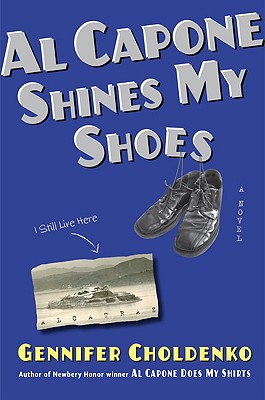
Al Capone Shines My shoes

by Gennifer Choldenko
ages: 10+
First sentence: “Nothing is the way it’s supposed to be when you live on an island with a billion birds, a ton of bird crap, a few dozen rifles, machine guns, and automatics, and 278 of America’s worst criminals — “the cream of the criminal crop” as one of our felons likes to say.”
Support your local independent bookstore: buy it there!
Review copy sent to me by the publisher

Perhaps it’s just been too long since I read Al Capone Does My Shirts, because I just didn’t find this one nearly as charming as I did that one. It’s not that I didn’t enjoy reading it; Choldenko still captures the mid-1930s very well, and the characters are still just as interesting as before. It’s just that this one is missing the novelty, the endearing charm, that made the first book so enjoyable to read.

The book picks up right where the first left off: Natalie is off to her special school; Moose is still trying to figure out inter-personal relationships, especially between his on-island friends and off-island friends, not to mention what to do with girls; there’s tension between the convicts and the guards and their families. The main source of conflict in this story isn’t with Natalie and her disability, however. It’s with Moose’s choice to get Al Capone to help Natalie getting into her school. There’s a lot of lying and covering up of the truth, not to mention sneaking around, in this book, which makes things more than slightly uncomfortable.

It is an interesting journey for Moose as he figures out that trying to handle things on his own doesn’t always work. In addition, there’s more middle school awkwardness, and a bit of a romance as well. However, the tough lesson he has to learn is that he can’t please everyone all the time, and that attempting to has dire consequences. It’s not a pretty lesson, either.

The ending was a bit overly dramatic for my tastes, however: it involved an escape attempt on the part of the convicts and Natalie using her quirkiness with her autism to save the day. It wasn’t bad, per se, just, well, more action-movie than middle grade book.

I guess you can’t win them all.

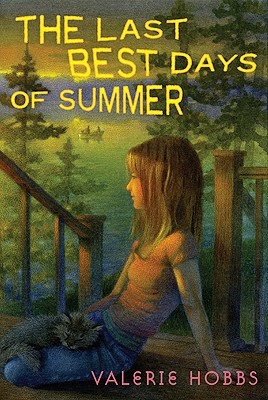
The Last Best Days of Summer

by Valerie Hobbs
ages: 10+
First sentence: “Lucy sat on the porch steps with her arms hugging her legs and a big black bag over her head.”
Support your local independent bookstore: buy it there!

Shall we talk titles for a bit? Because I love the title of this book. It’s the sole reason I picked it up. It evokes so much: the lazy, fun summer days, hanging out at the pool or just being slow and bordering on bored. But there’s a bittersweet element to it, too: summer’s finally coming to a close, the magical time where everything is hot and sultry and lazy will give way to the scheduled and the rigid and, eventually, the cold. How can you not love a title that makes you think of so much?

Then again, maybe loving the title of the book — it is only the title after all — sets up the book for a fall. (Not necessarily, but in this case it did.) Our twelve-year-old protagonist, Lucy, is riddled with all kinds of doubt and confusion: she wants to be popular like her best friend, Megan (or does she?). She is embarrassed by Eddie, the 13-year-old boy with Down Syndrome, with whom she’s developed a friendship of sorts (or is she really his friend? She is getting paid to play with him, after all.) She longs to spend time with her Grams out at the lake, expecting everything to be perfect (or will it be?). She hates her parents, especially her overprotective mom, who just doesn’t understand (or does she?). This last, best week of summer is Lucy trying to figure out being twelve.

Except it all came off much like an after-school special. I’m not sure if it was too much tell and not enough show (Lucy felt angry. Lucy felt disappointed. Lucy sulked. Lucy wanted to go home. Yeah, yeah, yeah), or if it was the saccharine nature of the story (accept yourself for who you are, and accept others for who they are. Oh, yeah: and being popular is overrated), but it just fell flat on its face. Which is really too bad: Hobbs is dealing with some good subject matter here. There’s disabilities, there’s early-onset dementia in a loved one, there’s the awkwardness of moving from a child to a teenager. But it didn’t work — in a big way — for me.

But isn’t that title lovely?

The Strange Case of Origami Yoda

by Tom Angleberger
ages: 9+
First sentence: “The big question: Is Origami Yoda real?”
Support your local independent bookstore: buy it there!

Two quick things about this book before I get started: 1) I cannot spell origami right to save my life (thank heavens for spell check!). And 2) I have not seen a more cleverly designed book in a long, long time. All the way through, from the cover to the end pages, it’s just a delight to look at. The only thing that would have made it better was if the little drawings on the bottom corners would have been a flip drawing. That would have been really cool.

Sixth-grader Tommy has a problem: see, Dwight — the really uncool kid who’s only saving grace is that he’s good at origami — has made this Origami Yoda that’s been giving advice out. And, interestingly enough it’s really good advice, even though Dwight is horribly annoying and not at all someone you want to take advice from. So, Tommy has asked Origami Yoda a question about a girl he’s had a crush on the entire year, and it’s imperative — mostly so he won’t make a complete fool of himself — that he figure out if Origami Yoda is really real or if he’s just a hoax. In a series of “interviews” and “testimonies” the story of Origami Yoda comes out, and if you’re not believing in the power of the Yoda by the end, then you’re completely heartless. (Yes, I still believe in the magic of Santa. Why do you ask?)

It’s an interesting concept, and as an adult there was much to think about, especially with Dwight: does he have aspergers? (He’s good at math, but nothing else; he has a hard time in social situations; he’s always acting up weirdly.) Or is it just an 11-year-old misfit’s way of trying to fit in? It’s difficult to tell because it’s told through the point of view of an outsider — which was brilliant, by the way: it added to the mystique of Origami Yoda — but there’s some intriguing questions there. Other than that, aside from Tommy, most of the characters are very… 11-year-old boy. Which keeps the book real, I think. And the characters are almost beside the point: it’s really about Origami Yoda and making things work out for the best.

It’s also got kid appeal, as well: C really liked it; she thought it was fun and interesting. And that’s what really matters, in the end.

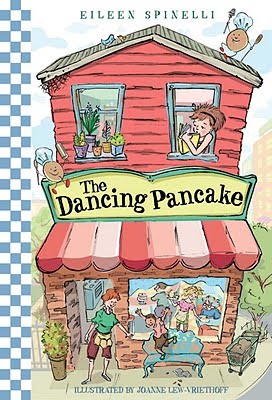
The Dancing Pancake

by Eileen Spinelli
ages: 9+
First sentence: “I am on the front lawn making snow angels with Albert Poole.”
Support your local independent bookstore: buy it there.

This is a sweet little novel in verse. Although it addresses some deep issues: parents separating, homelessness, friendship, it does so in a very unassuming way. It’s hardly angst-ridden, or even very sad; it’s very much the way you assume it will be from the cover and title: it’s a world where everything will work out, if you just give it time.

The winter Bindi is eleven, her father leaves. She doesn’t think much of it, until her mom and aunt and uncle start saying things like “he’s not coming back” and “we need time apart”. Then her mom sells the house and opens a restaurant, moving them into the apartment above. None of this meets with Bindi’s approval, and she spends the bulk of the story just learning to accept her new life without being a complete grump about it.

There really isn’t much else to say about this. It was nice. The illustrations, I felt, were almost superfluous, and distracting: I had a picture of Bindi in my mind and the illustrations kept distracting me from it. I’m not sure if there was a moral — perhaps just hang on through the tough times? — but it felt like the sort of book that wanted to have one. The characters were nice, but not really gripping. The situations were fun, but not really moving. And so, in the end, it was just kind of nice and sweet but not quite much else. (Kind of like pancakes, huh?)

The Incorrigible Children of Ashton Place

Book One: The Mysterious Howling
by Maryrose Wood
ages: 9+
First sentence: “I was not Miss Penelope Lumley’s first journey on a train, but it was the first one she had taken alone.”
Support your local independent bookstore: buy it there!

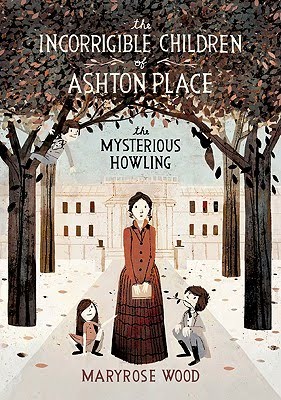
This one had me charmed at the first sentence. By the end of the first chapter, I was reading passages aloud, telling my girls that I should probably just buy this book. It’s a very, very charming book: funny, quaint, and with an interesting story.

That said, by the time I finished it, I wasn’t so sure about it. Yes, it’s the first in the series, but I felt there were too many questions raised and not enough answers given.

Penelope Lumley is a 15-year-old graduate of the Swanburne Academy for Poor Bright Females, and her first job is as a governess for three children at the estate of Lord and Lady Ashton. Once Penelope gets there, she realizes that this will not be any ordinary governessing job: the three children — whom Lord Ashton has christened Alexander, Beowulf, and Cassiopeia — were found in the woods and are more canine than human. This doesn’t really bother Penelope: she’s always had a soft spot for animals, and she figures — thanks to the nuggets of wisdom of Swanburne’s founder, Agatha Swanburne (like: “There is noEx alarm clock like embarrassment.”) — that she should just make the best of the situation.

The best part, incidentally, is the asides. I adored the asides, because they were just so funny. Like this one:

Extraordinarily busy places are often compared to beehives, and if you have ever seen the inside of a beehive, you already know why this is so.

(It is not necessary to actually set foot inside of a beehive to confirm this, by the way. They are too small and too full of bees for in-person tours to be truly convenient. But there are alternatives: One could peer inside using some sort of periscopelike magnifying device, for example. Or one could simply accept that beehives are busy and get on with it. This second option is called “suspending one’s disbelief” and it is by far the easiest row to hoe, now and at other times, too.)

The book is mostly Penelope’s experiences in reteaching the children, but there’s also an air of mystery surrounding it: how did the children end up in the forest? What is Lord Ashton’s “business” and club that he’s always spending time with? And what’s the deal with Old Timothy, the coachman? Why is he always lurking around?

The problem is that none of the questions are ever answered. As I said before, I know it’s the first in a series, but I found the lack of resolution highly annoying. (That, and the “to be continued” at the end of the book. Really? How trite.) It’s a quibble, and a bit of a major one for me, but it did serve it’s purpose: I need to read the next book and find out if there are any answers. Though, I do hope that Wood doesn’t drag it out: enough “to be continued”s and I lose interest.

Which would be too bad, because this book really is quite charming.