Belly Up

by Stuart Gibbs
ages: 10+
First sentence: “I’d just been busted for giving the chimpanzees water balloons when I first heard something was wrong at Hippo River.”
Support your local independent bookstore: buy it there!

Teddy Fitzroy has had a charmed life. The son of a gorilla researcher and a nature photographer, he’s spent most of his life surrounded by animals in the Congo.

Now, at age 12, he’s found himself smack in the middle of the Texas Hill Country, at FunJungle, the worlds biggest, best, and newest zoo. It’s supposed to be state-of-the art, best researchers, finest environments for the animals, a whole safari experience without having to go to Africa. Except, Henry the Hippo — the mascot, and a huge, ornery, animal — has turned up (literally) dead. It looks like natural causes at first, but upon a closer look, it turns out that Henry was murdered. And it seems it’s up to Teddy (and his new friend, Summer, who is also the daughter of the park owner) to figure out who did it and why.

There’s adventure as Teddy and Summer try to unravel the mystery before them, with some close scrapes. It’s not so hard of a mystery that the reader can’t at least try to figure it out, but not so easy as to be predictable. It’s entertaining, and yet with all the animals, it kind of feels (I’m hoping it is at least) a little educational. If anything, it has a fabulous balance to it: well-written and engaging plus entertaining and kid-friendly.

Quite enjoyable, in other words.

(Just for the record: because this is a Cybils nominee, I’ve been asked to make sure y’all know this is my opinion only, and not that of the panel.)
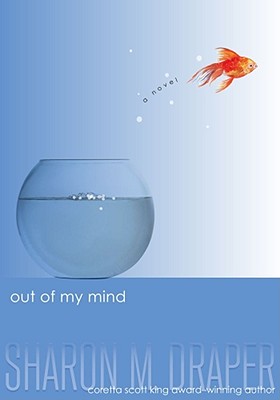
Out of My Mind

by Sharon M. Draper
ages: 10+
First sentence: “Words.”
Support your local independent bookstore: buy it there!

Melody is very, very smart. She’s known words and ideas and concepts since she was very little. She loves music, and can see colors when it plays. But, she has no way to tell anyone any of this. Melody has cerebral palsey, and while she can hear and understand, she just can’t communicate. Which is incredibly frustrating to her.

She’s got her parents and her neighbor, Mrs. V, on her side: encouraging her, teaching her, trying to communicate with her. The book recounts the ups and downs she’s experienced her whole life — from birth to the fifth grade — as she tries to figure out how to communicate. She can accept most of her limitations, but she needs a way to express the words in her head. It’s an intriguing process, frustrating and hopeful, as she goes through it all, trying to figure out where she fits in this world.

If this is ever a treatise of the hopelessness of doctors and school teachers (even if there is occasionally one that “gets” it), then I don’t know what is. But, it’s also a treatise on the determination of one girl (and her family) and what that can do. It is, in many ways, a “message” book: disabled people are NOT different than the rest of us, and just because they look or act different doesn’t mean they are not worth getting to know and understand.

But Draper presents this in such a way so that the book doesn’t feel like a heavy-handed message book. It’s heartfelt, and you end up both cheering for and crying with Melody as she recounts her experience. It’s wonderfully written, and yet simple enough to be accessible to middle graders. It’s a story worth telling, and definitely one worth reading.

(Just for the record: because this is a Cybils nominee, I’ve been asked to make sure y’all know this is my opinion only, and not that of the panel.)

Shooting Kabul

by N. H. Senzai
ages: 10+
First sentence: “It’s a perfect night to run away, thought Fadi, casting a brooding look at the bright sheen of the moon through the cracked backseat window.”
Support your local independent bookstore: buy it there!

The target age group for this book were barely born when 9/11 happened. They missed all the stress (though they live with the aftermath, not having any idea what it was all like before), the tension, the fear. I know C was barely 18 months when the Twin Towers went down, and was blissfully clueless about it all. Even M, who was five, only has a foggy memory of what it was like during those days.

Enter Shooting Kabul. Set in the time right around the attacks, it gives us a peek into what life was like in Afghanistan at that time. Fadi and his family are intellectuals; they had lived in the U.S. while his father got a PhD before returning to Kabul to help the Taliban (yes, you read that right) eradicate the poppy fields and convince farmers to actually plant food to feed the Afghani people. Unfortunately, as the Taliban became more and more extreme, Fadi’s family’s lives were in danger and they managed to escape. Except, in the desperate attempt to get out, somehow the Fadi’s little sister, Miriam, gets separated from the family and lost.

Fadi blames himself (as does the rest of the family), and in San Francisco he keeps trying to concoct ways to get back to Afghanistan and find Miriam. It’s heartbreaking to think about the weight this poor boy is carrying around. As weeks and months go by, it seems less and less likely that they will find her. Especially since his father hasn’t been able to take a teaching job, and is forced to drive taxis, which barely covers rent and food. Things are tough, and get tougher with the racism and fear after 9/11. So, Fadi enters a photography contest with the hopes of winning the grand prize — two tickets to India — so he can do his part to find Miriam.

First off: it does have a happy ending. Miriam is found, and the way it happens is quite surprising and actually very realistic, which I found wonderfully satisfying. As was the rest of the book; I liked the use of photography, how Fadi stood up to the bullies without using violence, and the glimpse into what the lives of Afghanis are like, both in Agfhanistan and in the U.S. It’s a good book to interest kids in the area, to give them a picture of what life was like nearly 10 years ago (and remind them that things aren’t that different now), and give them a good, engaging story on top of all that.

Excellent.

(Just for the record: because this is a Cybils nominee, I’ve been asked to make sure y’all know this is my opinion only, and not that of the panel.)
Milo: Sticky Notes and Brain Freeze

by Alan Silberberg
ages: 10+
First sentence: “Summer Goodman never knew what hit her.”
Support your local independent bookstore: buy it there!

This is not your average mom-is-dead book. Sure, Milo’s mom is dead; she passed away from cancer a couple years ago. But, Milo, now eleven and in his fifth house starting another new school, is determined to push past the fog and make a halfway decent go this time.

It’s not a deep book, plot-wise; it’s basically the tale of Milo putting one foot in front of the other. Sometimes he succeeds: he really likes his new best friend, Marshall; grateful for the fact that they can just hang out and drink Freezies, and that Marshall doesn’t really push or demand much. Sometimes he fails: his other neighbor, Hillary, tries to befriend Milo, but he’s so caught up in having a total and complete crush on Summer that he doesn’t notice Hillary (not in a romantic way) until it’s nearly too late. Underneath it all, though, is the pain of loss. He misses having his mother around, especially the little things.

Instead of just wallowing in the loss (well, they did that already; this book is about learning to move on), he not only figures out a way to mourn his mother, but to help his family understand and accept the loss that they all went through. And it’s done with humor, love, and some good friends. (The ending even made me cry; not the sad kind of cry, either.)

Very touching and sweet.

(Just for the record: because this is a Cybils nominee, I’ve been asked to make sure y’all know this is my opinion only, and not that of the panel.)

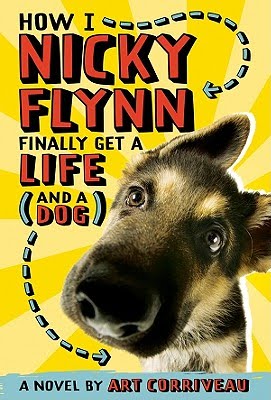
How I, Nicky Flynn, Finally Get a Life (And a Dog)

by Art Corriveau
ages: 11+
First sentence: “We have this dog now.”
Support your local independent bookstore: buy it there!

Nicky Flynn is not a happy camper. He’s not quite 12 years old, but his life the last few months has been turned completely and totally upside down. His parents split up, his mom dragged him away from his comfortable house, his good school, and landed in Charlestown, a not-so-prosperous area of Boston. She’s unreliable, completely worn out from her job as a secretary, and Nicky suspects that she’s not letting him see his dad. To top it off, on a whim she brought home this German Shepard, Reggie, who was a former seeing eye dog. Since his mother isn’t showing any interest in taking care of the dog, it’s just another thing Nicky has to do.

And yet, as Nicky starts walking Reggie around, he discovers that Reggie has a past, and that that past is as bit of a mystery, and through a lot of bumps and scrapes, figures out that maybe, just maybe, Reggie is the only living being he can count on in this life. Sometimes, really, the dog is your best friend. If you can only realize it in time.

It’s one of those books where the majority of adults are complete basket cases. Nicky’s not terribly sympathetic, either: he’s angry and has a temper as well as a bit of a lying problem. And yet, because the adults are so much worse, it’s quite easy to sympathize with Nicky: he is that way just because everything around him is falling apart. It’s a therapeutic book, one that looks at the aftermath of a messy divorce and sees not the roses but the thorns for most of the story. And yet, it’s depressing: there’s a lot of hope in the book (Hooray for a dog book where the dog doesn’t die!), and the relationship between Nicky and Reggie is quite wonderful (as far as dog-human relationships go).

In the end, in spite of the adults I wanted to scream at, an enjoyable book.

(Just for the record: because this is a Cybils nominee, I’ve been asked to make sure y’all know this is my opinion only, and not that of the panel.)

What Happened on Fox Street

by Tricia Springstubb
ages: 10+
First sentence: “Fox Street was a dead end.”
Support your local independent bookstore: buy it there!

Mo Wren loves her street. She’s lived there her whole life, and it’s her whole world. She has everything she needs: people to cut hair, tutor, watch after her and her little sister Dottie, her best friend comes to visit there every summer, and even the boy down the street is beginning to look interesting. Except things are starting to change. And Mo doesn’t like that.

First bad news is that her best friend, Mercedes, says that it might be her last summer on Fox Street since her mother’s marriage to a man who’s “comfortable” (ie, not rich, but much better off than they used to be) is changing things. They might also take Mercedes’ grandmother, Da, to come live with them, too. And Mo’s dad, who hates his job as a city water and sewer employee and has just been scraping by in the years since her mom’s sudden death, is thinking about selling out to a developer to go after his dream of owning a sports bar/restaurant. Her little sister, Dottie, is a wild child without discipline, taken to wandering the neighborhood adding to her bottle collection; what else can you expect from a girl without a mother?

Somehow, though this quiet (though sometimes tumultuous), yet heartfelt story, Mo figures out that not all change is bad, that she is strong enough to make the changes necessary. And that it will probably all work out for the best. A very hopeful, charming little book.

(Just for the record: because this is a Cybils nominee, I’ve been asked to make sure y’all know this is my opinion only, and not that of the panel.)

The Lost Hero

Heroes of Olympus, book 1
by Rick Riordan
ages: 10+
First sentence: “Even before he got electrocuted, Jason was having a rotten day.”
Support your local independent bookstore: buy it there!

I’m of two minds about this book. On the one hand, it’s not Percy Jackson. It wasn’t as funny (I missed the chapter titles!), it wasn’t as tight (I kept wondering: was all 553 pages necessary), it wasn’t as fun. I feel bad for Riordan, having everything being compared back to Percy. It’s just that those books are so good, so clever, so well done, that it’s hard to top them.

And yet.

We’re given a new trio of heroes to root for: Jason, son of Jupiter (aka Zeus), who doesn’t remember anything about where he came from or who he is, and why he ended up with these other guys; Leo, tinkerer, mechanic, builder, and fire-wielder, and he makes nice with a really cool mechanical dragon; and Piper, angst-ridden daughter of a movie star, who has a gift for convincing people to give her things. They’re an unlikely trio, and when they set off to free Hera, of all gods, from an unseen rising force, you wonder how it’s all going to turn out.

I don’t really want to give away much more than that, because, in spite of its length, Riordan has the gift for making you turn pages. You want to know what’s happening, you want to know how the puzzle pieces fit together, and yes, while he doesn’t end with “to be continued” he does give us a nice lead-in to the next book in the series. He keeps you wondering what’s going to happen next, and for that, we’ll give him enormous credit. He’s working his way through Greek mythology, weaving lesser-known stories (though there are a couple of well-known ones as well) through the book. It’s not deep, and yes it’s much of the same sort of clever that Riordan’s known for.

But you know what? It’s fun. And for this, that counts a whole lot.

Darius Bell and the Glitter Pool

by Odo Hirsch
ages: 10+
First sentence: “Darius Bell walked through the grass.”
Support your local independent bookstore: buy it there!
Review copy provided by the publisher.

The Bell ancestors were showered with gifts for various heroic (and other) deeds. In return, once a generation they are required to present the town with a Gift. It doesn’t have to be spectacular, but they always are: a statue, a fountain, stained glass. However, it’s time again, and this time the Bells are broke. See, after all the inheritance, no one bothered to work. And while they have a situation with their land and mansion — people who live there and agree to do some upkeep and housekeeping and cooking in exchange for room and board — they have no money left for a gift.

Enter Darius. He’s just a kid, and his parents and older brother seem to think that he really doesn’t need to be a part of the whole gift thing. But after a random earthquake, he discovers something wonderful (not useful or even worth anything) that would be absolutely perfect for the gift. And all it takes is a little coordination to get it done.

It’s a perfectly sweet little book. Nothing grand or great or horrid or earth shattering. It’s a pleasant story, in a pleasant little town, and although there are worries, they are Overcome in a pleasant little way. It’s a reminder to enjoy the simple things in life, and to look beyond the Grand and the Great. And that not-so-big people can do big things, too.

All served with a smile and a slice of cake.

(Just for the record: because this is a Cybils nominee, I’ve been asked to make sure y’all know this is my opinion only, and not that of the panel.)

Zora and Me

by Victoria Bond and T.R. Simon
ages: 11+
First sentence: “It’s funny how you can be in a story but not realize until the end you were in one.”
Support your local independent bookstore, buy it there!
Review copy sent to me by the publisher

It’s an interesting idea: take a famous, respected novelist — in this case, Zora Neale Hurston — who had a unique childhood — in this case, living in the all-black town of Eatonville, Florida in the early 1900s — and turn it into a middle grade mystery. The “me” part of the title, is one of Zora’s fictional friends, Carrie (the other being Tom) and we see Zora and the adventures through her eyes.

It all begins one night when Carrie and Zora see a giant alligator maul a local man. The alligator disappears, and Zora — who was always one to spin a story — decides that another man, this one a bit of a recluse — is actually the Gator King, half-man, half-alligator, and can morph between the two. It’s a bit far-fetched, but in pursuit of the story, they inadvertently stumble upon something deeper and darker in their town.

It’s a story about the power of stories, and belief in stories. But it’s also a story of race, and acceptance, and — to a much lesser extent — justice. As far as historical fiction goes, the book captures you and sweeps you away to a town where, on the surface, it doesn’t matter what color you are. But as the layers are peeled away, it’s much less rosy. My only real quibble comes with the use of the n-word: on the one hand, that it’s in the book at all speaks towards historical accuracy. It is the early 1900s, after all. But, the first time it was used, I did a double-take and chalked it up to historical fiction. The fourth and fifth times, however, I went searching for an authors note explaining the use. There was none. This really bothered me: I feel that that word, especially, should not be used lightly, or in passing, without some sort of explanation or disclaimer. I found it disturbing, and it took away from the enjoyment I had reading the book.

The mystery was interesting, the use of Zora Neale Hurston as a character was clever. The racial issues, however, overran the book, and while there was resolution at the end, there was a bitter taste left over. Perhaps this is what the authors intended when writing, or perhaps I’m overreacting. Either way, I was left torn: I liked the book, but I didn’t feel I could recommend it.

It’s amazing what one little word can do.

(Just for the record: because this is a Cybils nominee, I’ve been asked to make sure y’all know this is my opinion only, and not that of the panel.)
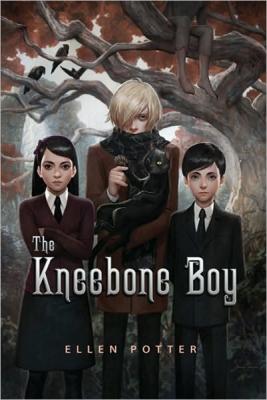
The Kneebone Boy

by Ellen Potter
ages: 10+
First sentence: “There were three of them.”
Support your local independent bookstore: buy it there!

To say that the Hardscrabble children — Otto, Lucia (Lu-CHEE-ah, thank you very much), and Max — are a bit odd, is an understatement. Max is one of those brilliant know-it-alls who drive people nuts, Lucia is hopelessly, shamelessly candid, and Otto hasn’t talked since their mom disappeared several years ago. They live in Little Tunks, which is about as exciting as its name, with their slightly absent-minded artist (he specializes in portraits of fallen royals) father.

Their existence is fairly boring, partially due to everyone in town avoiding them like the plague (and partially due to the fact that Little Trunks is just a boring place). And yet, one eventful afternoon, their father sends them down to London to stay with their aunt… who turns out isn’t there. (Gone on holiday to Germany, it seems.) Thus begins their adventure. There’s some mystery, a lot of close scrapes, some new friends, and a few new relations as well. At any rate, they become a lot less of whatever they were, and a lot more interesting.

The book reads much like a Lemony Snickett one — a comparison which is probably inevitable considering the cover — but without all the “oh, and what next?!?” feeling that went along with the adventures of the Baudelaire children. It helps that there’s a meta element going on here: often our narrator (whose identity isn’t revealed, but we are invited to guess at) pops out of the story to give us, as readers, asides about the action and plot, and pass along advice that their teacher, Mr. Dupuis, has give them in writing this. It’s not that the plot wasn’t enough to carry the book; the adventure of the Hardscrabble kids is actually quite interesting, especially with the mystery of their lost mother overshadowing it. But the asides add that little something that makes the book that much more fun.

It’s a dark little story, but with the right balance of dark and funny to make it truly enjoyable, and it’s fascinating how the mystery unravels at the end. Just about perfect, I would say. (But don’t tell the Hardscrabble kids that. They might not like it.)

(Just for the record: because this is a Cybils nominee, I’ve been asked to make sure y’all know this is my opinion only, and not that of the panel.)