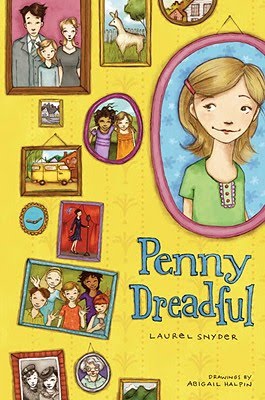
Penny Dreadful

by Laurel Snyder
ages: 10+
First sentence: “Penelope Grey knew she was lucky.”
Support your local independent bookstore: buy it there!

Charming.

I really don’t know if I was expecting anything different from this. It’s got the look of something that would be charming. And from the very first sentence, I knew I was going to like Penny.

Penelope Grey is the only daughter of The Greys: rich, well-connected, busy (you know the type: Dad always gone to work, Mom always gone to some society event or another). She’s home alone with the staff, schooled by tutors. Her friends are social climbers. The only thing Penelope really has in her life are her books. And her life is nothing like those in her books. One day, she decides, almost on a whim, that what she needs is a Big Change, like those in books. So, she wishes. And her dad quits his job. Unfortunately, that makes life worse, not better. So, Penelope wishes again, and her family inherits a house in the country. They move there, and while there are still challenges, Penelope — now Penny, because it seems to fit better — finds that happily ever after doesn’t necessarily mean perfect. And that’s just fine.

See? Charming.

It has much of the same feel as The Penderwicks: old-fashioned and modern all at the same time. It espouses many of the same ideals: that kids need a place to run, that living in a small town, knowing all of ones neighbors, and having friends and exploring with them is so much better than having money and all the stuff that comes along with it. It’s a humble little book: there isn’t much of a plot (just enough to carry the story), and while there’s conflict, it’s really a character-driven book. But it works, and it works well because Penny is so earnest, so sweet and so winning. And because Snyder’s writing is that perfect balance between elegant and accessible. It flows effortlessly off the page, engaging the reader, and making us want to get to know Penny and experience things with her. However, it is also a bookish book: Penny finds questions and answers and hope in the pages of her books, which helped endear her to me, particularly. Of course.

Wonderfully, perfectly charming.

(And as for all the “controversy” surrounding the gay characters that are married in the book… yes, I can see where you’re coming from, but on the other hand, I feel that it’s a bit silly. Use it as a discussion point, people. Don’t get all up in arms about it. And I really don’t see a need to ban the book. Please.)

(Just for the record: because this is a Cybils nominee, I’ve been asked to make sure y’all know this is my opinion only, and not that of the panel.)

Because of Mr. Terupt

by Rob Buyea
ages: 10+
First sentence: “It’s our bad luck to have teachers in this world, but since we’re stuck with them, the best we can do is hope to get a brand-new one instead of a mean old fart.”
Support your local independent bookstore, buy it there!

Ever have your life and perceptions completely changed by the influecne of one person?

Ever have a teacher that made school amazing, that you will always remember as completely wonderful, no matter what? (Hopefully, the answer is yes.)

Mr. Terupt, a fifth grade teacher, is one of those people. New at teaching, he is not only enthusiastic, but wise and inspiring. Told through the eyes of seven of his students — Jessica, Alexia, Peter, Luke, Danielle, Anna and Jeffrey –this is the story of the year they had with Mr. Terupt, and how his subtle influence changed their lives for the better.

It’s a quiet book, the life-changing accident notwithstanding. The impact is local, the challenges small. What really impresses about this book was that Buyea juggled seven different narrators, giving each one a unique voice and role in this story. I’m sure this particular story could have been told another way, but it wouldn’t have been nearly so effective. Because it’s a small story, it’s essential that the characters pull their weight, and Buyea makes sure that happens. It’s not anything major or flashy; the beauty lies in the simplicity of the tale. It’s accessible to kids, and yet packs a powerful punch for those older than fifth grade. There are things to think about, to talk about, to ponder on. But, perhaps best of all, it does all this without being preachy.

It’s an excellent book, and Buyea is definitely an author to keep an eye out for.

(Just for the record: because this is a Cybils nominee, I’ve been asked to make sure y’all know this is my opinion only, and not that of the panel.)

Wildfire Run

by Dee Garretson
ages: 10+
First sentence: “The roar came from deep in the earth, growing louder as it raced toward the surface.”
Support your independent bookstore: buy it there!
Review copy sent to me by the publisher.

Luke Brockett is the president’s son. It’s not too bad; he doesn’t get to see his dad much, but he has really cool Secret Service agents hanging around. Not to mention a pretty cool best friend, Theo, who loves to work on robots as much as Luke does. They’re up at Camp David, enjoying some quiet time, when an earthquake along the New Madrid fault wreaks havoc in much of Missouri.

They feel aftershocks in Maryland as well, and it’s those aftershocks (as well as some terrible coincidences) that start a wildfire in the forest surrounding Camp David. Soon, the situation is dire, and by another string of terrible coincidences, Luke, Theo and the daughter of one of the chefs, Callie, are stranded on their own, with the fire closing in, and their lives depend on figuring out how to get out of Camp David.

This book read like an action movie: fast paced, maybe a little bit predictable, and incredibly tense. There wasn’t much character development, though there was a bit for Luke; mostly it was the characters jumping through one hoop after another to solve the big problem of how to get to safety. Don’t get me wrong: it was both a gripping concept and fascinating to watch the three kids problem solve. I’m not sure how plausible it all is, but I’m also not sure it really mattered. Implausable? So what? It’s intense, it’s fun, it’s a page-turner.

Perfect for when you need something exciting.

(Just for the record: because this is a Cybils nominee, I’ve been asked to make sure y’all know this is my opinion only, and not that of the panel.)
Mockingbird

by Kathryn Erskine
ages: 10+
First sentence: “It looks like a one-winged bird crouching in the corner of our living room.”
Support your local independent bookstore: buy it there!

Caitlin is Working On Getting It. It’s a daily process for her, since she has Asperger’s syndrome, and certain things — like figuring out how others are feeling, or reading facial expressions — don’t come easily to her. It used to be that her older brother, Devon, would explain things for her and help her cope with the strange and the difficult. But now, because of a horrible tragedy at his middle school, Devon is no longer around. Caitlin’s father is a basket case, and the only person left to help Caitlin figure out everything — though what she’s looking for, mostly, is Closure — is the counselor at school, Mrs. Brook.

I’m not especially well read in books about the autism spectrum, but I have read a few, and Erskine captured the experience of a high functioning autistic child extremely well. Caitlin’s voice was the strongest thing about the book; in both her inner dialogue and experiences, as well as the way she related to other people, her personality and her challenges came through loud and clear. Erskine’s use of capitals and all caps particularly jumped out at me. Instead of being distracting, it added to Caitlin’s character.

If it were just that, I would have loved the book with absolutely no qualms. However — and kudos to Erskine for being up front about this — this is a book with a Message. Mind you, I don’t disagree with the message: I anti-violence, and I am all for understanding one another. That said, books that are so message heavy, whatever the message, don’t sit well with me. I was never able to get past the message hammer on my head: killing. people. ruins. lives. it’s. hard. to. cope. after. a. loved. one. dies. understanding. others. helps. Yes, we know, thank you very much. I understand the need for conflict; and even understand the need to talk about violent tragedies. But I felt like the message came first in this case, and the story was only a vehicle to getting that message across. I think the book would have sat better with me if those two things were reversed.

Aside from the message hammer, it was a good read. There’s a lot to think about, and I do hope that kids actually get around to picking this one up (and it’s not just one that adults read and love and give awards to, but kids never crack open). Even if it’s only to experience Caitlin as a character.

(Just for the record: because this is a Cybils nominee, I’ve been asked to make sure y’all know this is my opinion only, and not that of the panel.)
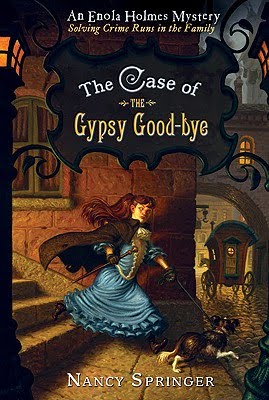
Enola Holmes: The Case of the Gypsy Goodbye

by Nancy Springer
ages: 11+
First sentence: “Mister Sherlock, I’m that glad to see you, I am, and that obliged.”
Support your local independent bookstore: buy it there!

I have heard of Enola for a while. I know Kerry at ShelfElf loves her, and has sung her praises often. I have meant to get to Enola before, even checked out previous books in the series once or twice, but I’ve never actually read any.

For the record: starting with the last book in the series is not suggested. That said, I adored Enola. The much younger sister of Mycroft and Sherlock Holmes, she’s as talented and brilliant in her deductive reasoning as they are. She’s 14 (nearly 15) years old, in hiding in London (from her brothers, especially Mycroft, who want to send her to a girls boarding school) since her mother disappeared a year ago. She finds missing persons, she’s brilliant at disguises, and she’s a winning character.

In this book, she takes on the case of the missing Lady Blanchefleur, who has suddenly disappeared. It turns out, however, that Sherlock is also working on this case, and after however long she’s been avoiding them, they actually confront each other. As a subplot, there’s a mysterious message from their mother, which Enola has to decipher. There’s adventure and suspense, humor and mystery , and a fitting ending for what I assume was a good series.

Now to go back and read the rest of them in the right order.

(Just for the record: because this is a Cybils nominee, I’ve been asked to make sure y’all know this is my opinion only, and not that of the panel.)

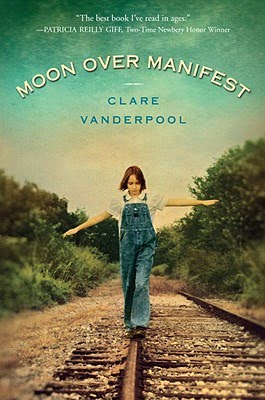
Moon Over Manifest

by Clare Vanderpool
ages: 11+
First sentence: “The movement of the train rocked me like a lullaby.”
Support your local independent bookstore: buy it there!

First off: I’ve got a local author! YAY! I really had no idea (honestly, I get the book notes from our local independent bookstore, but I’m not always the best about reading it thoroughly, so I missed it when they announced her) when I started the book, but it’s set in Southeast Kansas, so I flipped to the author blurb to see what credentials this author had for writing about Kansas. I was quite pleasantly surprised to find out that she’s here in Wichita. Pleasantly surprised is too mild. I was quite excited!

I do have to admit that I was a bit anxious as well: what if I didn’t like the book?

I shouldn’t have worried.

Alternating between two time periods, the Great Depression in 1936 and World War I in 1918, Vanderpool tells the story of the small fictional town of Manifest in southeastern Kansas. Nominally, it’s the story of 12-year-old Abilene Tucker who has spent her life traveling the rails with her father, Gideon. Then, soon after her 12th birthday, he up and sends her back to Manifest, a town he’s never talked about but has some connection with, to live with an old friend of his so he can go work in Nebraska. Feeling abandoned, Abilene decides what she needs to do is figure out what connection her dad has with this town, and why he’s sent her there. She ends up working for an old Hungarian fortune teller, and in return she tells Abilene stories, slowly unveiling the mystery of her father’s past. And, by digging up the past, Abilene manages to pull a town that was slowly falling apart back together.

It’s an excellent portrait of a time and a place, making Kansas come alive rather than just being an Everyplace like it usually is in novels. (We need someplace non committal. How about Kansas? ) I could tell that Vanderpool knows her stuff (well, she is a native Kansan; she says that this was based on memories of her grandparents), and loves the place and its small, rural towns. Additionally, she’s created some winning characters; Abilene is a smart, fiesty girl, one with a nose for adventure. But it’s not solely a “girl” book: the two main characters from 1918, Jinx and Ned, are just as engaging as the girls from 1936. Vanderpool manages to balance the two time periods, capturing the essence of each, and transitions seamlessly between them.

It’s a captivating read. I’m really looking forward to Vanderpool’s next work. And not just because she’s a local author.

(Just for the record: because this is a Cybils nominee, I’ve been asked to make sure y’all know this is my opinion only, and not that of the panel.)
Betti on the High Wire

by Lisa Railsback
ages: 10+
First sentence: “A bright light shines on the beautiful girl.”
Support your local independent bookstore: buy it there!

Babo is a leftover child. In her unnamed war-torn country — unnamed on purpose, to give her a sense of universality, which I found both interesting and disconcerting; I wanted something more concrete as a reader — she lives with other orphaned children in an abandoned circus camp. It’s not an easy life; there’s not much food, and there’s always the danger of soldiers and bombs. And yet, she’s happy. She tells stories to the other children, she pretends that her parents will come back and get her.

And then, one day, an American couple come to the camp and want to adopt Babo. Although she tries desperately to get them to change their mind, the next thing she knows her name is Betti and she is on a plane (with her friend and fellow leftover child, George) to America. The book is mostly about her struggles to, and against, adjusting to her new life.

It’s a heartbreaking story; Babo/Betti is a fighter and a survivor, and she feels guilty about having comforts when her friends are still stuck with a lousy life. She’s been struggling her whole life, and she’s afraid about what it might do to her. In a couple of very telling scenes — it’s one of the best books I’ve read lately that shows rather than tells — you get the sense of Babo/Betti’s desperation and fear. Her adoptive parents are complex as well; on the one hand, they’re overly generous and kind of clueless Americans, but there’s a real love for lost souls, and a genuine concern for Babo/Betti’s well-being. Railsback doesn’t paint everything in black and white, though Babo/Betti tries to make things that way, and as a result, the book is a complex, and yet accessible, look at war, refugees and adoption.

(Just for the record: because this is a Cybils nominee, I’ve been asked to make sure y’all know this is my opinion only, and not that of the panel.)

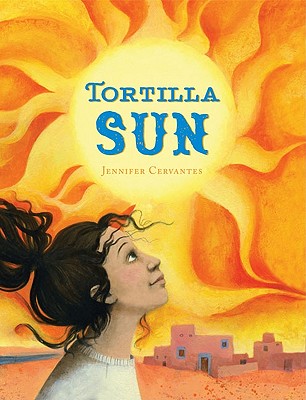
Tortilla Sun

by Jennifer Cervantes
ages: 10+
First sentence: “I stared at the glossy image.”
Support your local independent bookstore: buy it there!

Izzy has just moved, again, and is looking forward to a summer getting to know people in her neighborhood so she’s not the new kid at school. Again. But then her mom drops a bombshell: she’s off to Costa Rica to finish research for her dissertation, which means Izzy has to spend the summer with her Nana in a small village outside of Albuquerque. This is not what Izzy wants. At all.

And yet, once she’s there she discovers that learning her heritage is much more interesting than she gave it credit for. Her nana is interesting, fun, full of life. Her neighbor, Mateo, is intriguing. But more than that, she slowly learns the story of her father who died before she was born, something which her mother hasn’t been willing to share. And that may be the greatest gift of all.

It’s a sweet story, one that’s full of vibrant color and life. Even though it was a parent dying book — in fact, there was quite a bit of death and trauma in this book — much like Milo, it focused on healing and understanding and celebrating the life of the one who’s dead, rather than mourning. It felt natural and celebratory rather than depressing. There was a bit of magical realism, but only a touch and that added to the healing tone of the book. Yes, there was conflict, and Izzy needed to learn lessons and grow a bit (and there was a few tense moments near the end), but it was a happy book, one that celebrates life and family and traditions.

A great first novel; I’ll be quite interested to see what Cervantes comes up with next.

Crunch

by Leslie Connor
ages: 10+
First sentence: “I saw it like this: a single worker at some faraway oil refinery with his head tilted down, peering into a pipe, waiting for one more drop that never came.”
Support your local independent bookstore: buy it there!

The unthinkable has happened: we’ve run out of oil. It’s not because of anything really drastic: no catastrophic natural events or wars. There is simply no more oil. Which means no more gasoline.

This means that 14-year-old Dewey Marriss and his four siblings are home alone — their parents are stranded in Maine on vacation — for who knows how long. In addition, the little bike shop they own and run is suddenly no longer little. Bikes are the new transportation, and everyone needs theirs fixed. Now. It all starts out okay, but the longer the crunch goes one, the more stressed the siblings become. It doesn’t help that Dewey thinks parts are slowly going missing; can he figure out who the thief is before everything completely collapses.

It’s a vaguely dystopian premise, though an interesting one to explore: what would happen to society and the infrastructure if the oil — for whatever reason — ran out? The book doesn’t go as far as a dystopian does: it really is a story of how Dewey and his siblings deal with the crisis. And it’s fascinating how that happens. It helps a lot that Connor’s writing is incredibly engaging; she keeps it simple yet doesn’t talk down to her readers. The mystery element comes on slowly, and it’s not really a central aspect to the book, but it’s still interesting.

Most of all, though, it’s an immensely entertaining book, one that kept me turning pages.

(Just for the record: because this is a Cybils nominee, I’ve been asked to make sure y’all know this is my opinion only, and not that of the panel.)
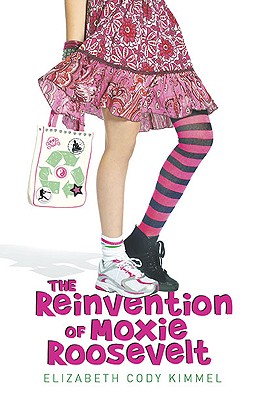
The Reinvention of Moxie Roosevelt

by Elizabeth Cody Kimmel
ages: 11+
First sentence: “What goes through people’s heads when they come up with names for their kids?”
Support your local independent bookstore: buy it there!

Moxie Roosevelt Kipper has spent the first 13 years of her life regretting her name. It’s such a big name to live up to, and she’s not been exactly anything more than ordinary in her small town. Now, going in to eighth grade (her small town school doesn’t go past seventh), she’s been accepted into a boarding school on a music scholarship, and she has a chance to become different.

To reinvent herself.

She goes about this by deciding, in some hilarious turns, to put on different personalities depending on the situation she’s in or person she’s with. This, predictably, causes problems: can you be a Detached, Unique, Coolly Knowing Individual (code name: DUCKI) with your uber-hip roommate, and a Mother Earth Goddess (code name: MEG) with the Buddhist ashram-raised girl across the hall and make it all work? Well, of course not. And things get sticky for Moxie before she figures out what she really wants to be.

It’s a cute book, if a bit precious with the whole boarding school setting. It taps into the insecurities of every tween/pre-teen/teen girl: how can I get people to like me? And what is my personality, really? And is it okay if I’m not just like everyone else? It’s a bit over-the-top with the lying and experimenting, but mostly with humorous results.

And in the end, it gets its point across: being yourself is just fine.

(Just for the record: because this is a Cybils nominee, I’ve been asked to make sure y’all know this is my opinion only, and not that of the panel.)