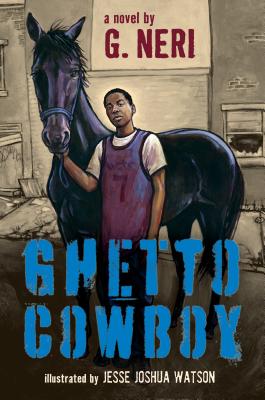
Ghetto Cowboy

by G. Neri/Illustrated by Jesse Joshua Watson
ages: 9+
First sentence: “We drivin’ into the sunset, the car burning up from the heat.”
Support your local independent bookstore: buy it there!

Living in Detroit, twelve-year-old Cole and his mom are scraping by. Sure, he doesn’t go to school that often, but he’s okay. Until the day he gets caught, his mom flips, and drives him to Philadelphia to live with a father Cole has never met.

Once he gets to Philly, angry about being abandoned (as he sees it), by his mom, he decides he will have nothing to do with his father, or the stables he runs in North Philly.

This is where you do a double take: horse stables, in the middle of the ghetto? Based on a true fact — there really are horses in inner-city Philadelphia — Ghetto Cowboy looks at how providing something for kids to do, something as simple as caring for an animal, can give that life a meaning. At the same time, it explores a blossoming relationship bewteen a boy and his father.

There are many good things about this book: that it’s a non-girly horse book; that it’s written in dialect, but not hard to read; that there are gorgeous illustrations. In many ways, it’s trite, yes: just how many stories of bad kid making good can we read? But, I love that there is something different — Cole’s connection not only with his father, but with his father’s livelihood as well — to make this one better than all the other inner-city bad kids books.

In other words: it’s worth picking up.

Warp Speed

by Lisa Yee
ages: 11+
First sentence: “Marley was dead, to begin with.”
Support your local independent bookstore: buy it there!

Marley Sandelski is invisible. No, not really: it’s a straight-up middle grade fiction book, not science fiction. But, that’s the way he feels. He plugs through middle school, getting beat up by the kids he calls the “Gorn” (Marley’s a huge Star Trek Original Series fan), getting mostly good grades (except for P.E.), and hanging out with his fellow geeky friends in AV Club (now a class called Technical Services). After school, he hangs out in the basement of the Rialto Theater, a historical landmark that specializes in old movies that his parents run. It’s not a great existence, but it is one.

Then things start to change. It’s a bumpy ride, but maybe… just maybe… things will change for the better?

The best thing about this book, I think, is that there is honest-to-goodness conflict in it. Marley is dealing with bullies — both physical and emotional. On top of that, he’s dealing with all the regular middle school boy stuff: trying to fit in, liking girls out of your league, not giving up on friends, being “cool”. It’s a good story, and you really root for Marley to make it all work out, and still not give up on who he really is.

My only complaint is that Lisa Yee, whose blog I adore, is not nearly as funny in book form as she is in blog form. But that’s a minor complaint in an otherwise good book.

Nerd Camp

by Elissa Brent Weissman
ages: 9+
First sentence: “It was so late that it was almost tomorrow.”
Support your local independent bookstore: buy it there!

Gabe is a nerd. Seriously. He’s smart, he loves math and poetry and reading, and he’s just been accepted into the Summer Center for Gifted Enrichment — a six-week sleepaway camp that you have to take a test to get into.

He’s okay with all this — well, in fact, it’s more than okay: he’s really, really excited — until he meets his soon-to-be stepbrother, Zach. Who is not a nerd. In fact, he is disdainful of all things nerdy. Gabe doesn’t quite know how to react to that: he really, really wants to get along with his new brother (he’s always longed for a sibling), but he doesn’t want to give up all the things he loves.

Thankfully, there’s SCGE camp to help him out: are the adventures he has over the course of the summer negated by their nerdiness, or cool in their own right?

I adored this book. Seriously. Perhaps it’s because I’m a mother of nerds, and one myself, but I thought Weissman just got the whole nerd kid culture — not  to mention that wonderful awkwardness of being 10-years-old — spot-on. Every little thing, from the awkwardness around new girls to the learning pi to the 20th digit, was adorable. (Perhaps I shouldn’t call a boy book adorable. It’d turn the boys off. But seriously, it was.) I loved Gabe from the get-go, and it didn’t take long for his camp friends Wesley and Nikhil to grow on me, either. I also really, really wanted to go to the camp. I’m not much into logic proofs, but Weissman made them seem really, really cool.

The only down side was that I felt Zach was a little shallow: all “cool” kids aren’t down on reading or horrible at spelling. (There’s also the side issue of why everything has to be either/or: do we really have to be smart OR cool? Maybe in 5th grade, yes…) But, because Zach was hardly a character, it didn’t bring the awesomeness level of this one down.

I suppose the question, in the end, is: will the boy nerds read this one? I hope so. Really.

The Great Wall of Lucy Wu

by Wendy Wan-Long Shang
ages: 10+
First sentence: “There is a Chinese story that goes like this:”
Support your local independent bookstore: buy it there!

Lucy is:

  • the youngest of three children in a Chinese-American family. 
  • almost twelve years old.
  • more American than Chinese, preferring lasagna to Chinese food.
  • fanatic about basketball, and pretty good too.
  • about to share her room with Yi Po, the long-lost sister of her recently deceased grandmother.

All Lucy wants is to have the best year ever, but that seems doomed not to happen, especially since Yi Po and her strange Chinese ways have moved in everything seems to be going wrong. Somehow, though, between Chinese school, a bully at school, and having to share a room, Lucy finds that maybe the year isn’t as bad as she thought it might be.

This was a good, solid, fun read. Nothing spectacular or earth-shattering, but I really enjoyed the time spent with Lucy and her struggles to find a balance between her wants and interests and her heritage. She’s an enjoyable character, and the time which we spend with her is fun and interesting. I liked the way Shang handled the Chinese language and culture, mixing a bit of history and folklore along with the food and traditions seamlessly into the novel. It gave the book some heart, and I felt like I was learning without being preached to.

A good book.

The Friendship Doll

by Kirby Larson
ages: 9+
First sentence: “The old doll-maker Tatsuhiko poured boiling water into the teapot with trembling hands and inhaled deeply.”
Support your local independent bookstore: buy it there!

It’s the 1920s, and Miss Kanagawa is a beautiful Japanese doll, sent to America with the mission of spreading friendship and unity between the two countries. In a series of four short stories that progress through time from 1927 to 1941, we follow Miss Kanagawa as she meets, and helps, four special girls in some of the most trying times that the U.S. has seen.

I’m not usually one for short stories, but I enjoyed these. Miss Kanagawa was a good linking device, making it seem more like a novel than separate short stories. Even though I wondered about the fantasy element at first — we hear the doll’s thoughts, and she seems to connect and influence the girls in the stories — I realized that it really wasn’t a fantasy book (the doll and the girls never actually talk to each other), but just a narrative device. One that worked for me, because not only did the girls grow and change and overcome, but the doll did as well.

Out of the four stories, my personal favorite was the third one, about Willie Mae. It took place in the heart of the Great Depression, in a small Kentucky town. Willie Mae was a “holler girl”, someone who grew up in the mountains, who loves to read and write. She doesn’t feel like her life will give her anything until she’s given the opportunity to go into town for a job reading to the town crank, Mrs. Wheldon. This simple thing changes everyone’s lives for the better. It’s sweet and sad and touching all at once.

Perhaps that’s the best thing about Kirby Larson’s book: she knows how to embody the past, and bring it forward so that we can understand and relate to these kids. And the part about the doll — the exchange is an actual historical event as well — is also fascinating.

It’s wonderful when an author can make history come alive.

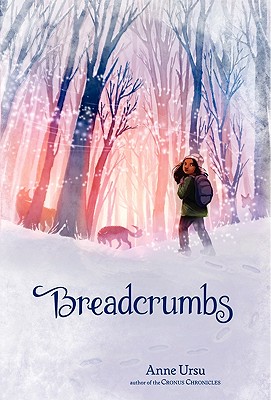
Breadcrumbs

by Anne Ursu
ages: 9+
First sentence: “It snowed right before Jack stopped talking to Hazel, fluffy white flakes big enough to show their crystal architecture, like perfect geometric poems.”
Support your local independent bookstore: buy it there!

Jack and Hazel fit together. Not like romantic-fit — they are in fifth grade, after all — but with Jack, Hazel — who is often the odd child, the imaginative child, the one who doesn’t quite fit in anywhere — belongs. Really belongs.

So, when Jack suddenly stops talking to her, she’s beyond hurt. She’s devastated. She wants to stop living. And yet, she’s the only one who can help Jack: his heart has been turned to ice by the Snow Queen (“Like in Narnia?” “No. Narnia is like her.”) and Hazel is the only one with enough imagination (and courage) who can go save him.

Hazel sets off, somewhat prepared, into the woods and the fairy tale. It’s a cross between Stephen Sondheim’s Into the Woods, and Neil Gaiman’s Instructions: Hazel finds herself not only in the tale in which she needs to confront and rescue her friend from the Snow Queen, but in various other tales as well. There’s an element of Wrinkle in Time, in that Hazel doesn’t quite fit in and yet she’s the only one who can Do what needs to be Done.

For some reason — it may just be where I was — I found this book beautiful, truly, honestly, and simply beautiful, and yet impossibly sad. I didn’t so much want to read an adventure about Hazel as hold her and help make her deeply-felt insecurity go away. There was hope in the end — there always is, in this kind of the story — but I still finished it feeling quite sad for Hazel.

Even so, it’s a wonderfully told fairy tale.

Jefferson’s Sons

by Kimberly Brubaker Bradly
ages: 10+
First sentence: “It was April and all Monticello was stirring, but in their cabin Mam had just put baby Maddy down to sleep and she told Beverly and Harriet to be still.”
Support your local independent bookstore: buy it there!

I’ll be up front from the start: some people will love this book. It will most likely win awards. But, it’s one of those books that’s full of Important Things, and that we Should Read because it will Enlighten us.

And I never got past that.

It’s basically the (admittedly very well-researched) story about slavery in the early 1800s. Told from the consecutive point of view of two of Sally Hemmings’ sons and one of their close friends, it shows what life was like for the slaves at Monticello. Granted, that’s a time period no one ever really talks about: slavery is for the Civil War, and we tend to brush over the fact that many of the Founding Fathers owned slaves. In fact the biggest thing I felt while reading this book was that it was a reminder (perhaps to those who Honor and Revere the Founding Fathers?) that Jefferson was anything but perfect. In fact, he was far from it. He spent money he didn’t have. He slept with one of his slaves (okay, not until after his wife died), and fathered children by them. And while he was better than many slave masters, he was still a slave owner.

Perhaps that was the problem I had, ultimately, with the book. (Not that I revere Jefferson.) It wasn’t really about the children, or even about Jefferson’s slaves, but more about Ideas — Freedom, Justice, Equality — and how they related to Jefferson. There was a lot of talk about Jefferson and the Declaration of Independence (“But it says all people are free,” Peter said. “Not all white people. Right?”), and the dichotomy between his writing that and the fact that he owned People.

It wasn’t a bad book, really. It was well-researched, it was a new take on an old subject. But I sat back and looked at it thinking, this is Interesting because it’s Supposed to Be. Not because it really was.

Dragon Castle

by Joseph Bruchac
ages: 12+
First sentence: “A monumental tapestry decorates the wide back wall of the Great Hall in Hladka Hvorka, my family’s large old castle.”
Support your local independent bookstore: buy it there!

Prince Rashko is convinced he’s the only intelligent one in his family. His parents are odd, always spouting proverbs, talking in obscure riddles, never quite making sense. His older brother, Paulek, has a knack with animals, but can’t seem to remember pertinent information. So, when his parents disappear and the evil Baron Temny his minions take up residence looking for something, though no one quite knows what, Rashko figures it’s up to him to save everyone from their foolishness, hopefully thwarting Temny’s plans.

It took a while to get into the story. Partially, because of the use of Slovak with an immediate English translation (ie, ” Ano. Yes.”) kept pulling me out of the story. What I really, really wanted was a pronunciation guide in the back. I found alternating between Rashko’s story and Pavol’s legend to be disconcerting at first, but after a while I figured out the purpose of it, and thus was better able to understand why the book was written that way.

I also figured out the “lesson” (and the trick) of the book fairly early on. I thought it would bother me more that I did, but after a while I realized that the reader was supposed to figure it out. In many ways, we were more informed and less judgmental of the situation than  Rashko was, something which added to the telling of the story in the end. It was a lot of set up, but it ultimately paid off: the ending was quite the battle scene, with a surprising climax.

Not a bad little fantasy.

Archer’s Quest

by Linda Sue Park
ages: 10+
First sentence: “Kevin ripped the page out of his notebook and crumpled it into a ball, making it as hard and tight as he could.”
Support your local independent bookstore: buy it there!

Kevin is in seventh grade, struggling to figure out where he fits in. He’s not a math genius like his dad. In fact, he’s not really good at school at all. He’s not good at sports. He’s not into his Korean heritage. He’s just kind of there.

Until one day, at home trying to figure out homework, his world changes. Out of nowhere, a man, called Skillful Archer, is a legendary ruler from ancient Korea. It’s up to Kevin to help him figure out how to get Archer back home. Before the end of the night, which signifies the end of the Tiger year on the Chinese calendar.

On the one hand, this is full of Korean history and tradition. It’s fascinating to learn about Archer — Chu-mong, a historical figure — as he and Kevin work together to return him to his time.

On the other hand, though, it’s quite simplistic, even for a middle grade novel. Archer comes, he teaches Kevin Valuable Lessons, and then he leaves. What really bothered me is that Kevin didn’t seem to do anything. Though perhaps that was the point: he didn’t do much but follow Archer around — though he did have to explain things like cars and computers — until the end, when he figured out how to be more proactive in his life. It didn’t make for a very interesting novel, but I suppose it was true to the character.

Not bad. Not great, but not bad either.

Tuesdays at the Castle

by Jessica Day George
ages: 9+
First sentence: “Whenever Castle Glower became bored, it would grow a new room or two.”
Support your local independent bookstore: buy it there!

Eleven-year-old Princess Cecilia — Celie to her family and friends — loves living in Castle Glower. She’s made it her job to know all the nooks and crannies and shortcuts, from the long-established ones, to the ones that crop up periodically. See, Castle Glower is definitely magical, and may be alive: it has opinions about the residents there (the state of your rooms is a definite indicator of its opinion of you), and chooses the person who would be best to rule the castle. Everything is grand at Castle Glower.

That is, until the King and Queen leave to pick up their oldest son from the Wizard College, leaving Celie and her two older siblings —  heir apparent Rolf, and sister Leliah — in the care of the castle. Unfortunately, the royals were attacked, and presumed dead. Suddenly, the council and neighboring countries are all over the Castle, supposedly “helping” Rolf take the throne. But the castle hasn’t changed the rooms; perhaps their parents aren’t dead after all? It’s a lot to take in, and that’s not even mentioning the creepy Vhervhish prince that is overstepping his boundaries. It’s up to Celie — and the castle — to stop what may have been a tragedy from becoming a calamity.

It’s a cute and clever little book; I think the premise is the strongest part of the book, though I really liked Celie as a character. Sure, the plot was a bit rushed, and I thought that maybe things wrapped up too tidily, especially since this is being hailed as a “start of a series.” But then, I’m not the target audience, and I’m sure that younger readers and fantasy lovers will really enjoy this one. (I’m planning on reading it to A as soon as we get done with our current reading.)