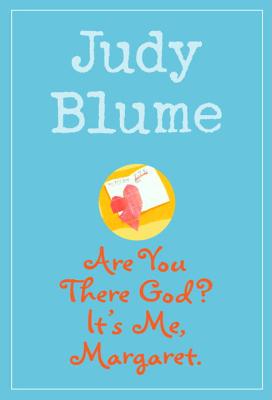
Are You There God? It’s Me, Margaret.

by Judy Blume
ages: 10+
First sentence: “Are you there God?”
Support your local independent bookstore, buy it there.

I read this one, as probably did most girls my age, when I was eleven years old. I have a vague memory of hiding it from my parents, some vague sense that they’d disapprove of this. I’m not sure if it was because there is God in the title, or because it was about things that a polite person just doesn’t talk about: periods, breasts, and growing up.

I’m not quite sure how I reacted to it. I wasn’t terribly interested in growing up (my mother dragged me kicking and screaming to buy my first bra), and so a whole book about girls obsessing about boys and breasts probably didn’t appeal to me. And I wasn’t exactly questioning my religion, either, so that part of the book probably bored me as well.

I don’t remember if M ever read it, but I know C did for a book group several months back (I skipped the book because I’d miss the discussion; it’s only fair that I got assigned this book to review now…), and she was put off by it. She though the girls were dumb and stupid for obsessing, and had to struggle to finish the book.

I’m not sure if that’s because of the type of person she is, or because of the way I’m raising her.

See: those subjects aren’t taboo in our house. Mostly because I have four daughters, they’re pretty common subjects. And I’d rather it be that way. I’d rather my girls come to me with their questions and problems, rather than trying to find solace and comfort in books. Because I do understand the need for this book (even today): it’s a place where tween girls can go to realize that they’re not alone, they really are normal in their questions and their concerns and their problems. And even if the book is a little dated (the sensibilities of the adults are really very early 1960s!), it’s still relevant.

Even if I still didn’t like it very much.

What Came From the Stars

by Gary D. Schmidt
ages: 11+
First sentence: “So the Valorim came to know that their last days were upon them.”
Support your local independent bookstore: buy it there!
Review copy snagged from the ARC pile at my place of employment.

Tommy is not a happy camper. His mother died recently, and his whole family (father, sister, him) are struggling to cope. It doesn’t help that his father is getting pressure from a local real estate agent to sell so she can develop Huge Seaside Condos. And it REALLY doesn’t help that he’s in seventh grade, turning 12, and his grandmother gave him the LAMEST present: an Ace Robotroid Adventure LUNCHBOX.

Except, after lunch, his whole world changes: he finds a chain in the lunchbox, puts it on, and becomes, well, greater than he was.

See, the chain holds all the art from the Valorim, a race that’s being conquered by the evil Lord Mondim and the O’Mondim in a world far away. They put all their knowledge in the chain and threw it out into space (at the speed of thought; I did wonder, initially, how all this was supposed to happen, since things don’t travel through space terribly fast, but Schmidt did account for it later in the book), and hoped for the best.  And Tommy was the best that he found.

I should stop here and say that I agree with Jen: the realistic parts of this book work great. Schmidt knows how to write boys in a way that’s both real and vulnerable. Tommy’s dealing with some heavy issues here, guilt and survival and worry, and Schmidt makes it all come alive. He’s got some good friends, he’s doing okay on the surface, but he’s struggling.

But, at least for much of the book, the fantasy element didn’t work for me. I appreciated the difference in tone between the Valorim and the realistic parts of the book (I also found it to be an interesting choice to se the Valorim parts in italics, which set it apart even more), but I kept coming back to the feeling that funny languages and epic histories does not a fantasy make. See: Tommy put on the chain and immediately began spouting weird words, and having new talents, and he never even questioned it. Never sat back and said, “Where the heck did this come from?” or “Why on earth do I know that?” And that really bothered me. I wanted some sort of internal struggle with Tommy, some way of him trying to figure out what was going on, trying to grasp at understanding of a situation that was so far outside of his realm of understanding, but I got none of that.

I could brush it off as it being an upper middle grade book, but I don’t really believe that; Schmidt is a better writer than that. No, I’m chalking this up to a lack of understanding of how fantasy works (though, I suppose, if you pin me down, I’m not quite sure how it works, either). It’s a good idea, and I do have to admit that by the end it was bothering me less; there’s some adventure, and a bit of a battle, and a very  sweet ending which almost made up for the initial bristle.

I just wish it could have been more than it was.

(Just for the record: because this is a Cybils nominee, I’ve been asked to make sure y’all know this is my opinion only, and not that of the panel.)

Palace of Stone

by Shannon Hale
ages: 10+
First sentence: “Miri woke to the insistent bleat of a goat.”
Support your local independent bookstore: buy it there!
Others in the series: Princess Academy

It’s a bit after the events of Princess Academy (six months, maybe?), and Miri has received a letter from the princess-to-be, Britta. Not only is she inviting all the former princess academy members down to Asland, the capitol city of their country, but she is offering Miri a once-in-a-lifetime chance to go to Queen’s Castle, the foremost school in the country.

Of course the girls from Mt. Eskel take the opportunity.

And, of course, things aren’t as wonderful in the lowlands as those up in Mt. Eskel have wanted to believe. There’s poverty, there’s corruption, there’s a revolution brewing, and Miri finds herself in the midst of it all.

I read this one without picking up Princess Academy first (no time!), and honestly, it worked for me.  Hale is a fabulous story teller, and her worlds are always well-developed and intricate. And she managed to give me enough reminders of the first one sprinkled throughout this book that I remembered what I needed to remember, without being heavy-handed.

Hale also explores some interesting ideas: the pull between forces, the choice between two goods, and the inevitable love triangle (the end decision of this one C would love, because she’s always choosing the safe, nice boy, and the girls never end up with the “right” one, in her opinion). There are politics and tough questions, and traitors (though she really didn’t do enough with Gummonth, in my opinion; I wanted him to be more like Grima Wormtongue in Lord of the Rings), and enough conflict to keep me interested through the end.

Miri, of course is a strong, quiet heroine, thinking and questioning and trying to do what she feels is right. And even though I felt Princess Academy was quite fine the way it was, I’m glad for this sequel; it allowed me to revisit a world that I remember loving, and reacquaint myself with characters I can’t help but be fond of.

(Just for the record: because this is a Cybils nominee, I’ve been asked to make sure y’all know this is my opinion only, and not that of the panel.) 

The Hero’s Guide to Saving Your Kingdom

by Christopher Healy
ages: 8+
First sentence: “Prince Charming is afraid of old ladies.”
Support your local independent bookstore: buy it there!

So, you think you know your fairy tales. How the same guy — Prince Charming (which is an adjective really, not a name) — manages to rescue Cinderella, Rapunzel, Sleeping Beauty AND Snow White? How is that possible?

Well, what if they were actually four guys: Frederic, Gustav, Liam, and Duncan. And they feel like they kind of got the short shrift in those stories. Maybe, just maybe, things aren’t exactly everything the stories said they were.

And, what would happen if Frederic (who really is quite afraid of the outdoors), and Gustav (who has impulse problems), Liam (whose ego could be taken down a notch or two) and Duncan (who’s just plain, well, unusual) stumble upon each other, and upon a sinister plot to take over all of their kingdoms, and just happen to figure out a way to stop it?

I’m not sure I’d call this book hilarious — no milk was ever snorted through my nose, a good benchmark, I think — but it was definitely amusing. From the chapter titles, all of which begin “Prince Charming…” (my favorite? “Prince Charming Walks into a Bar”. Sounds like a joke waiting to happen), to the silliness of the princes to the fact that it all just kinda sorta works out in the end, it was enough to keep a smile pasted on my face.

My only qualm: I have no idea if boys — the target audience, given the look of the Brave Guys on the cover — are going to want to read a silly book about fairy tale princes being lame until they learn not to be. Much like Adam Rex’s Cold Cereal, I am afraid this is a book without much of an audience. Which is too bad, because it’s really a delight.

(Just for the record: because this is a Cybils nominee, I’ve been asked to make sure y’all know this is my opinion only, and not that of the panel.) 

The Hundred Dresses

by Eleanor Estes
ages: 8-11
First sentence: “Today, Monday, Wanda Petronski was not in her seat.”
Support your local independent bookstore: buy it there!

I read this gook first when I was eight. I don’t remember what my exact thoughts were, but it made enough of an impression on me that I’ve read it again several times over the years (and this is from a person who doesn’t often reread). That is partially, I think, because it takes about a half hour to read from start to finish now. But it’s also because it’s a story that packs a punch, even in its simplicity. Make that because of its simplicity.

The story (if you don’t already know it) is this: Wanda Petronski is poor, Polish, and a bit of an outcast in a WASPish town. The girls, especially the popular ones like Peggy, don’t pay her much attention, until one day when they’re admiring a beautiful dress on another girl. Wanda, for whatever reason, speaks up and says she has 100 dresses hanging in her closet. This incites much astonishment and incredulity on the part of the other girls, and Peggy begins teasing her. Maddie, Peggy’s best friend, is a bit uncomfortable with this — she’s not exactly well off herself — but does nothing. Then two things happen: first, Wanda’s father moves the family to the big city to get away from the small-town racisim. And second, Wanda wins the drawing-contest. With her 100 dresses.

Yes, it’s a simple story. The language is simple. The girls are simple, caricatures really. Peggy is a bully, but a human, believable one. She doesn’t do anything that I couldn’t see myself as doing, if I were in the same situation; it’s human nature to pick apart people’s stories. That doesn’t mean it’s good. And Maddie is the poor girl who has managed to make it with the in-crowd, staying silent because she knows her popularity (which is more important than sticking up for some Polish girl) is on the line. There’s no delving into their psyches, no trying to understand the why behind the girls’ actions; there’s just the fact that they make fun of Wanda, who takes it.

The thing that has bothered me for years, and bothered me again on this rereading, is the end. (Sorry for the spoilers. You’ve all read it already, right?) When, after the contest, the girls in the class are allowed to take Wanda’s drawings home and Maddie and Peggy discover that theirs are pictures of them. Then this: “What did I say!” said Peggy. “She must have really liked us anyway.”  I’m not sure I understand what Estes was trying to get at. Why does Wanda do this? Did she think it would make the girls change their minds, help them act nicer to others? Does she actually really like them?

I don’t know if I’ll ever know. But I’ll still probably read this lovely, slim novel with the haunting watercolor illustrations over and over again.

Liar & Spy

by Rebecca Stead
ages: 10+
First sentence: “There’s this totally false map of the human tongue.”
Support your local independent bookstore: buy it there!

Seventh grade is a time of change, transition. For many, it no longer means elementary school and the predictability of one teacher. There’s adjusting to a more difficult schedule, different expectations, and, for many, different friends.

Georges (after Seurat, the painter) is in that position. Because his father has been laid off, they’ve had to move out of their Brooklyn home and into an apartment about a mile away. It doesn’t mean changing schools, but even so, leaving the familiar is always difficult. His mother — who works lots of double shifts at the hospital — bought him some America’s Funniest Home Movies in order to help him smile. It also doesn’t help that he’s being bullied at school: they make fun of his name, calling him Gorgeous, and his less-than-stellar performances. And that his former best friend, Jason, is gone over to the dark side.

Enter Safer, Georges’s new upstairs neighbor. He’s odd, with his stories of Mr. X and dead bodies, and his insistence that he’s a spy. But Georges rolls with it, and discovers something: he kind of likes being  a spy. And that Safer, and his sister Candy, are maybe even good friends, too.

While it’s not as gripping as I remembered When You Reach Me being, it’s a solid, excellent story of friendship, change, and making the most of your situation. And a middle grade book that can deliver that is always worth my time.

Two Middle Grade Audiobooks

As you will recall (or not), I was on vacation recently. One of the things I love to do (to stave off boredom and to curtail the number of DVDs watched) is take a pile of kid-friendly audiobooks to listen to. For some reason, this year we didn’t listen to nearly as many as I thought we would: we only got around to two books. But, both were excellent.

First up:

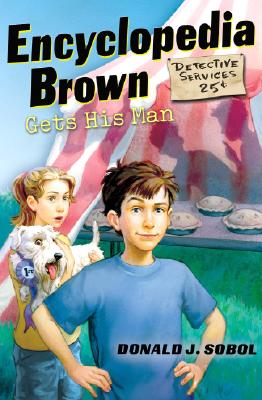
Encyclopedia Brown Gets His Man
by Donald J. Sobol
ages: 7+
Read by : Greg Steinbruner

I hate to admit it, but I’ve never read an Encyclopedia Brown book. No idea why. Hubby, on the other hand, remembers loving them from his childhood. He even convinced M to read a few when she was 8(ish). I picked this one up on a whim, figured maybe we’d get to it. However, it was the first one we plucked out of the pile.

And, we loved it. Every single one of us, from 6-year-old K to Hubby. The basic idea is this: it’s a series of short cases that genius whiz kid, Encyclopedia Brown, solves. Except you get to try and solve it before the final answer is revealed. (And yes, we did pause the disc every time, and we all guessed just to see. Sometimes we were right, sometimes were were way off base.)

The best things about it, I thought, were the names (I can’t recall them off the top of my head, and I didn’t write them down. Curses.), the fact that it was so 1950s (it was quite charming in it’s retro-ness), and the humor. I did write one line down, that had us howling: “All the murderers these days use silencers.” Steinbruner was an excellent reader, as well, keeping us engaged in the stories. (I swear, if you tune out for a second you lose a lot of information!)

Highly recommended.

And the second:

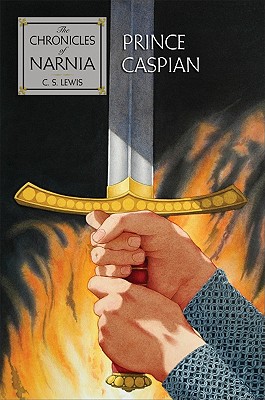
Prince Caspian
by C. S. Lewis
ages: 7+
Read by: Lyn Redgrave
Others in the series: The Lion, Witch and the Wardrobe

Last year, we tackled the first book in Narnia, so I figured why not do Prince Caspian? (I also got Voyage of the Dawn Treader, but as soon as we realized it was a “full cast production” we bailed. We don’t like those.)

Again, it was a great read; one of those where you don’t want to get out of the car because you have to figure out what’s going to happen next. 

The story, for those of you who don’t know it: Peter, Susan, Edmund and Lucy are dragged back into Narnia, only to find out that hundreds of years have passed in Narnia to their one year in England. Their castle is now in ruins, and Narnia is ruled by a wicked Telemain king. The rightful heir and prince is in exile, and forming an army against his uncle (the wicked king), and needs the help of High King Peter and the rest.

Just some brief thoughts: I enjoyed this one so much more than Lion, etc. While Lion is a good story, this one is a fun, engaging adventure without the didactic overtones that Lion has. I also liked Prince Caspian as a character better than the older Pevensie children (however, Edmund and Lucy are still delightful, as always), especially Susan in this one. More than once the girls would call out, “Susan is SUCH a wet blanket!” (or a variation on that…) And she was: she was the downer of the group, not really wanting to be there. No wonder she never came back for more adventures.

And Lyn Redgrave was a brilliant storyteller. She kept us all engaged (I think it helped that the story was a fun one, though it got bogged down in the history portion. K kept asking when they’d get back to the action.), and her voices for everyone were quite fun, and spot-on as well.

It’s been too long since I’ve visited Narnia, but I’m not sure I’m going to actually read them. I’m having way too much fun listening to the audiobooks.

Ghost Knight

by Cornelia Funke
ages: 9-12
First sentence: “I was eleven when my mother sent me to boarding school in Salisbury.”
Support your local independent bookstore: buy it there!

Jon Whitcroft, at war with his mother’s fiance (his father died years before), is sent away to boarding school. He feels it’s a punishment because his mother loves The Beard, as Jon has dubbed him, better. So, Jon expects to hate his time at school. But that was before he met Ella, made friends with Angus and Stu, and started seeing ghosts.

Turns out there’s a ghost of a old baron, Stourton, who has vowed to kill every Hartgill — Jon’s mother’s maiden name — who shows up at the school. And Jon’s his next target. The only way to stop him? William Longspee, bastard son of Richard the Lionheart, and sworn defender of those in need. Sure, he’s a ghost too, but since when has that ever stopped anyone?

This wasn’t a bad little ghost story. Which is to say that it wasn’t great, either. I think I’ve read a run of books that had telling vs. showing issues, and I have to admit that it’s driving me batty. Sure, this one was pitched as a man telling his reflections of a year at boarding school, and so maybe the telling can be forgiven. But, on the other hand, why tell it that way? Why give us the assurance that it would turn out all right? I think the tension, the story would have been greater if we didn’t know that the story would end happily, that perhaps Jon and his friends were in a danger that they couldn’t get out of. But Funke gave us that out, and I thought the book suffered for it.

Even so, it’s a decent walk through history, and I enjoyed Ella, Jon and Longspee as characters. It just wasn’t as great as I’d hoped it would be.

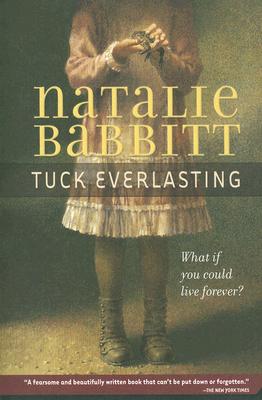
Tuck Everlasting

by Natalie Babbitt
ages: 10+
First sentence: “The first week of August hangs at the very top of summer, the top of the live-long year, like the highest seat of a Ferris wheel when it pauses in its turning.
Support your local independent bookstore: buy it there!

Once upon a time, there was a young girl named Winnie. She lived in a nondescript house next to a nondescript woods in a nondescript town. Then, one August day, she wanders into the woods and discovers a boy drinking from a spring. she wants to take a drink, too, which leads the boy to totally flip out. And then he, and his brother and mom, take her home with them.

To explain that the spring is really not good: it makes you live forever.

Let me stop there for a minute. I remember reading this, not as a child, but 10 or so years ago, when we got the 25th edition of the book. Hubby loved it, I read it and remember really enjoying it as well. Granted, M was only 4 at the time, and C was a baby.

This time, all I could think of was: what the heck! They KIDNAP her, she grows to LIKE THEM (Stockholm Syndrome, anyone?) and helps them escape. In what universe is this not a horror story???

I see the value of this book: there are a ton of ideas to talk about; C read it for her 6th grade language arts class last year, and I think it’d be a good book to teach. But as a story? I felt the writing was pedestrian, the characters unsympathetic, and the whole thing quite creepy.

But a classic?

I’m going to get creamed for this, but I don’t think it is. (Or maybe it is, if only for the themes.)

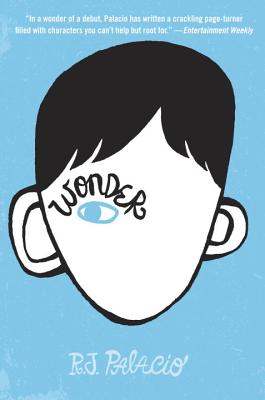
Wonder

by R. J. Palacio
ages: 9+
First sentence: “I know I’m not an ordinary ten-year-old kid.”
Support your local independent bookstore: buy it there!

I’ve seen this one around for months — it has been on the New York Times Bestselling list, after all; and that’s not mentioning all the blogs I’ve seen it at — but for some reason, I’ve just never felt compelled to read it before now. Perhaps it’s because I figured it was one of the “those books”, feel-good stories about kids with disabilities that are supposed to enlighten me while making me somehow grateful I don’t have to go through that.

And in many ways it was that book.

August is an ordinary kid in many ways: he likes Star Wars, he enjoys reading and hanging out with his friends. Sure, he’s been home schooled, but that’s because he’s had so many surgeries that going to school wouldn’t have been practical. See, he has a condition that isn’t one of those you can hide: it affects his face. So, first impressions are not good.

But, now he’s starting fifth grade, and in addition to all the ups and downs, conflicts and highlights that go with fifth grade, August has to deal with a whole new set of people seeing his face, and judging him before they even get a chance to know him.

Of course, there will be kids (and parents) who can’t get past August’s facial anomalies. Of course, there will be bullies and problems and Things To Overcome. And, of course, August will Rise Above It All.

But — and this surprised me — it was also not that book.

There was a matter of fact-ness to this book that helped surpass the whole agenda for me. August was clearly an amazing kid, not because he’s special but because he’s not. He faces the world as any other ten-year-old boy would, and it’s everyone else — from his parents to his sister to his friends — who endow him with difference. I appreciated having the book from August’s point of view, but I also liked the chapters where we got to see him through different eyes (for the most part; there were a couple of times when I wondered why Palacio chose a specific character to move the story along). It was in doing this that Palacio got her main point across: that we are all people, no matter what we look like.

As an interesting side note: A picked up this other book the other day, and even though it’s not usually what she reads, she began reading this. There’s a friend of hers at school who is like August (though it’s his hands and arms, not his face), and she was interested in the idea that something like what her friend has would make a good book. I’m looking forward to talking to her about it when she finishes.

And, perhaps, that’s the best thing that can be said about Wonder: it will inspire conversation and discussion among those who read it.