Chronicles of Egg: Deadweather and Sunrise

by Geoff Rodkey
ages: 9+
First sentence: “Nobody lived on Deadweather bu us and the pirates.”
Support your local independent bookstore: buy it there!
Review copy snagged from the ARC pile at work.

Eggbert is the youngest child of a farmer who lives on Deadweather island. It’s not a very nice place, Deadweather, and Eggbert’s family (especially his siblings) are not very nice people. It’s a bit cartoonish how awful they are: his brother, Adonis, beats on him continuously, and his sister, Venus, is always picking on him. His father, for whatever reason, doesn’t interfere, instead adding injury to insult with frequent whippings. Needless to say: Egbert is not an especially happy 13-year-old, but he has his books (that his slacker tutor has brought) and that helps.

Then one day, his Dad comes back with some parchment and says they’re setting off for Deadweather’s sister island, Sunrise, which is a rare treat. Once there, they meet Mr. Pembroke, who, for reasons unknown, is being really nice to the family. He takes them back to his mansion, and offers them a hot air balloon ride… Egg gets out, mostly because he’s infatuated with Millicent Pembroke, and voila! Egg’s barbaric family is gone.

For a while, living with the Pembroke’s seems like a dream: they’re nice, they feed him, he has access to the library, Millicent is charming… but then everything turns sinister and sour. Egg, after someone tries to kill him, is forced to run for his life. He smuggles away on a pirate ship, and finds that things at the ol’ hometsead aren’t all roses either. So, he does what any 13-year-old would do: he makes a stand.

Sure, this is all a little (!) far-fetched, but I enjoyed it anyway. Think of it as Pirates of the Carribean with a 13-year-old Will Turner. There’s a Jack Sparrow character in Egg’s friend Guts, and Millicent could be Elizabeth Swan. It all works out. And it’s got the pacing, humor, and adventure elements that kids (well, and I) have come to expect from pirate stories. Plus, even though they’re pirates, they’re not cretins: some of the most trustworthy characters in this world are pirates.

On top of all that, Rodkey does a great job of wrapping things up in this installment while setting up the Next Big Adventure. And since Egg and Guts are quite enjoyable characters to adventure with, I’ll be sure to check on them when they go on their next one.

The Voyage of Lucy P. Simmons

by Barbara Marionda
ages: 9+
First sentence: “
Support your local independent bookstore: buy it there!
Review copy picked up at KidlitCon.

Lucy was a happy girl, living in a huge house with her parents near the bay, until one fateful night when they were out on a schooner, and her father attempted to rescue a drowning man. The schooner was capsized and both of Lucy’s parents drowned.

Now Lucy has to do everything she can to keep the house — her beloved father’s “ship on shore” — out of the hands of her greedy Uncle Victor. It helps that she’s found a friend and mentor in the mysterious Marni, and that the house does weird things: sparkling mist, enchanted flutes, and expanding bookcases that help Lucy in her mission.

On the one hand, this book works as a straight-up orphan story. It has all the elements: a Greedy Uncle That Wants To Take Away The Thing Orphan Loves Most (though I was never sure just why he wanted to sell the house so badly); pathetic, abandoned children (mother died, father was a drunk); and a savior in a kind woman who takes everyone in.

What threw me, really, was the magic. It felt out of place, like it didn’t really need to be there. I kept getting the feeling that the magic was kind of superfluous, and not really integral to the story. By the end, I kind of understood where Mariconda was going with the both the magic thing and the whole voyage thing, but it was kind of off-putting that I spent most of the book wondering WHY everything was happening. Call me impatient, but I don’t get along well with books that are all questions and no answers.

Now that the set-up is out of the way, and there is actually a voyage happening, however, I probably will want to read the next book in the series.

(Just for the record: because this is a Cybils nominee, I’ve been asked to make sure y’all know this is my opinion only, and not that of the panel.) 

Renegade Magic

by Stephanie Burgis
ages: 10+
First sentence: “it was a truth universally acknowledged that my brother, Charles, was a hopeless gamester, a ridiculous oversleeper, and the one sibling too lazy to take part in any family arguments, no matter how exasperating our sisters might have been (and usually were).”
Support your local independent bookstore: buy it there!
Others in the series: Kat, Incorrigible

In the beginning, everything seems to be going well for Kat and her family: it’s her oldest sister’s wedding day, her other sister is on the verge of being engaged, her brother is managing to stay out of trouble, and Kat is going to be inducted into the Guardian Order.

Then Lady Fotherington — Kat’s deceased mother’s nemesis — butts in and ruins everything.  Aside from the wedding, everything is in shambles: the Stephenson’s reputation (which was precarious to start with), Angelica’s almost-engagement, and most relevant to Kat, her standing with the Guardians.

The only thing to do is go to Bath. (Of course!) Where the Stephensons barge in on some well-to-do second-cousins, make a spectacle of themselves, get involved in some nefarious pagan rituals, and somehow save England from traitors who were going to sell information to France (it’s the Napoleonic wars, after all). All in a week’s work.

All the set-up out of the way, this book was a lot more fast-paced than the first one in the series. Kat is still a heroine with a tendency to get into trouble, in spite of her stepmother’s attempts to make a lady out of her. Her father is still mostly absent, except for a tender moment near the end of the book. She makes a new friend out of her cousin, someone who is drawn to the unrespectable nature of being a witch. There’s a bit of a love story: her older sister manages, in the attempt to thwart their stepmother, to make a complete mess of the situation (there’s a nice undertone that 12 year olds are SO much smarter than their 16 year old sisters that I think that C would like).  And while I liked this one as much as the first, I found myself feeling (as I so often do with historical fiction these days) that Kat is very much a 21st century heroine. That, and I felt the whole pagan Minerva rituals to be a bit out of place. Not that it was bad, but that it just didn’t completely gel the way the first one did.

That said, I’ll keep reading the series, because it’s a lot of fun.

(Just for the record: because this is a Cybils nominee, I’ve been asked to make sure y’all know this is my opinion only, and not that of the panel.) 

The Spindlers

by Lauren Oliver
ages: 8+
First sentence: “One night when Liza went to bed, Patrick was her chubby, stubby, candy-grubbbing and  pancake-loving younger brother, who irritated her and amused her both, and the next morning, when she woke up, he was not.”
Support your local independent bookstore: buy it there!
Review copy picked up at KidlitCon

Who doesn’t love a Good Quest? One where the Heroine sets off on a Noble Errand, overcomes Incredible Odds, and Defeats the Greatest Evil while Learning a Valuable Lesson? (Labyrinth, anyone?)

The Spindlers is everything you want from a Good Quest Novel. Liza doesn’t really hate her younger brother Patrick, but he is, well, a boy, which means he’s irritating, annoying, and a thorn in her side. But he is her brother, and the morning he wakes up… different… she knows that his soul has been captured by the spindlers.

And it’s up to her to get him back.  (Since none of the adults in her life believe her, of course.)

She heads down in the basement, armed only with a broomstick; falls through a tunnel; and lands in the world Below. The best way to describe Below is this: it’s a cross between Roald Dahl and Lewis Carroll. It’s not quite as dark as Dahl, though it is dark, and it’s not quite as absurd as Carroll, through there are absurd moments. But it’s definitely as delightful as both.

I’m not going to fill you in on the details of Liza’s quest, because it’s best if you experience that for yourself along with her. I will tell you this: even though it’s a by-the-numbers quest, Oliver has a knack for writing characters that you grow to love, and building a world that’s at turns fascinating, scary and humorous.

I can just see kids wanting to read this one over and over again. (Shoot: I want to!)

(Just for the record: because this is a Cybils nominee, I’ve been asked to make sure y’all know this is my opinion only, and not that of the panel.)

Circus Galacticus

by Deva Fagan
ages: 11+
First sentence: “My parents always told me I was special.”
Support your local independent bookstore: buy it there!

Trix is a 15-year-old orphan girl  stuck as a scholarship student at the boarding school from hell. She’s resigned to spending the rest of her education there, hoping that a gymnastics scholarship will get her something different. Then she gets kicked off the team (for something she didn’t do), so the next best thing? Running away and joining the circus.

Except the Circus Galacticus is no ordinary circus.

It’s actually a spaceship, part of a galactic rebellion called the Tinkers that are working against both the government as well as the Mandate. It’s all a bit too complicated to go into here (and, to be honest, I’m not sure I got it all), but the basic gist is this: the Tinkers are okay with genetic mutation (like blue skin or turning into a porcupine boy or a questionable relationship with gravity) where as the government and the Mandate want to stamp them out. (It’s all very X-Men crossed with Star Wars.)

Trix is very unsure about how she fits into this universe: after all, she’s just a girl from earth who happens to have a bit of a meteorite that her parents left her. Except there’s this mandate thug out to get her. And weird things seem to be happening. And so, she settles in for the ride of her life, making new friends, enemies, and frenemies in this community of outcasts.

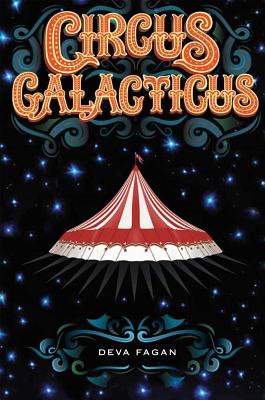
This was a quick, fun read. Nothing spectacular — though one has to admit that the idea of a flying circus tent is pretty cool, especially when it turns out that the flying circus tent is actually a somewhat sentient being — but nothing mundane either. Fagan does have a tendency to use the word ass (a lot!), which was kind of jarring (Really? Butt wouldn’t work?) in a middle grade book, but other than that, it was good, clean fun.

And, to be fair, I’m kind of getting tired of middle grade fantasy series, so to have one that works just fine as a stand alone is quite refreshing. (Please don’t write a sequel!)

(Just for the record: because this is a Cybils nominee, I’ve been asked to make sure y’all know this is my opinion only, and not that of the panel.) 

Wildwood

by Colin Meloy/Illustrated by Carson Ellis
agest: 10+
First sentence: “How five crows managed to lift a twenty-pound baby boy into the air was beyond Prue, but that was certainly the least of her worries.”
Support your local independent bookstore: buy it there!

What if, across the river from a small community outside of Portland lay an Impassable Wilderness? And what if, a 12-year-old girl, Prue, and her friend, Curtis, were able to get past into the Impassable Wilderness because that’s the direction they saw the crow’s fly with Prue’s baby brother? And what if, when they got into the Impassable Wilderness they discovered an entire community: one with talking animals, and Dowager Governesses and a civil war looming? And what if, they got caught in the middle of it?

What then?

On paper, this book has everything it needs to be a grand middle-grade fantasy. Talking animals both good an evil? Check. Bandits in the forest?  Check. An evil queen/governess who vaguely reminded me of the White Witch in Narnia? Check. Golden eagles big enough to carry a person? Check. A baby kidnapping, and a subsequent sacrifice for evil gain? Check. A winning hero and heroine who manage to Figure Things Out (and on the other hand, Completely Dopey Parents who are Utterly Clueless)? Check.

So, why didn’t I like this one more than I did?

I think it’s primarily because it was too. long. Unfortunately, a side effect of Harry Potter is that fantasy writers think they need 540 pages to tell a 250 page story. Really? I don’t need all the extra stuff: the inner monologues, the extended prison scenes, the tender asides. Perhaps the world was too big for one book (well, yeah: there’s a sequel), but even so, I think Meloy spent too much time on building the huge world and not enough on tightening up the plot to give me what I wanted — in this case, for Prue to rescue her brother — without all the extra stuff. (I really am spoiled when it comes to reading. I just don’t have the patience.)

That said, it definitely works as a “mood” book. I did feel like I was in Portland in the fall: it’s a rainy and dire world that the children have found their way into. The pen-and-ink illustrations reminded me of the ones Jon Klassen did for the Incorrigible Children of Ashton Place series, and they were scattered throughout the book providing a needed break from the endless prose.

I guess what I’m really saying is that I think this is one of those books that adults think kids should like. And maybe some will. But, as an adult, I sure didn’t like it all that much.

The Peculiar

by Stefan Bachmann
ages: 10+
First sentence: “Feathers fell from the sky.”
Support your local independent bookstore: buy it there!

Imagine a world in which faeries came through a portal, waging war against the humans, destroying most of England, including the entire city of Bath.

Imagine that the cost of this is that the faeries are trapped in our world, for hundreds of years.

Imagine a world in which half-breeds (half human, half faerie) are despised and hanged.

Imagine a half-breed boy, Bartholomew, who lives in hiding with his sister in the city of New Bath, scraping by an existence while his mother (his faerie father left years ago) tries to make ends meet.

Imagine a faerie so desperate to return to the “other world” that he’s willing to kill half-breeds to make it happen.

Imagine a man, without ambition or direction, who manages to get caught up in all this, and ends up hanging on for dear life.

And you will pretty much have imagined “The Peculiar.”

I have to admit that the cover was underwhelming. It kind of looks like clockwork chickens, or something of that sort. But a woman at work read it and liked it enough that I picked it up, just to see what it’s about. And honestly? Steampunk fairies equals win. You have traditional Victorian steampunk (hence the mechanical bird, which makes more sense after reading the book), crossed with some pretty spooky faerie stories; a hero that’s both accidental and intentional — he’s out to save his sister from her nasty fate; and a bumbling adult who’s more endearing than annoying. I couldn’t put this one down. Sure, the plot’s probably a bit confusing — especially near the end — and maybe even a bit predictable (okay, it’s not hard to figure out who the bad guy is), but there are some nice surprises, and an ending that both resolves the plot as well as leaving a thread for a sequel to follow.

I probably would have been turned off if I had read the author bio before reading the book: Bachmann is one of those wonderkids (he’s 18) who comes off as insufferably pretentious in his author bio. But, you know what? This worked. It’s an original idea (at least that I know of), and it’s a well-written story.

Which makes me wonder just what this kid will come out with next.

(Just for the record: because this is a Cybils nominee, I’ve been asked to make sure y’all know this is my opinion only, and not that of the panel.)  

The False Prince

by Jennifer A. Nielsen
ages: 10+
First sentence: “If I had to do it all over again, I would not have chosen this life.”
Support your local independent bookstore: buy it there!

Sage is a 15-year-old orphan in a small Carthyan city. He’s got a reputation for mischievousness, not to mention pickpocketing and general thievery, but generally he tries to fly under the radar.

That is until a minor noble, Bevin Conner, plucks him (along with three other boys) out of the mire and decides that one of them will be the one to put his Grand Plan in motion.

What is that Grand Plan, you say? Well, it turns out that someone has murdered the entire royal family, except for the prince — Jaron — who was killed by pirates four years before. What Conner wants to do is train these boys up and the put one of them on the throne as the False Prince: a puppet to fool the regency just long enough for Conner to be named the grand regent, and essentially take over.

Mwahahahaha.

I felt like doing that a lot while reading the book. It needed a good evil laugh to accompany all of Conner’s posturing. And he postured a LOT. Not that I didn’t enjoy the book well enough; there was much that I found enjoyable. Sage was a good thief/rogue-with-a-heart-of-gold character, one who was both winning and interesting. The plot was an interesting idea, rife with politics, murder, backstabbing, and a wee bit of romance (but not enough to turn off the romance-shy boys.)

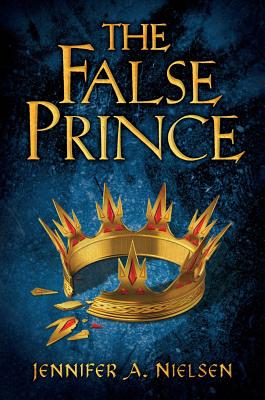
The problem is that it’s all been done before, and better. See, it’s a similar plot to Megan Whalen Turner’s The Thief, who did it all richer, grander, and, well, better. Sage is no Gen, and Nielsen doesn’t handle the twists and turns the plot demands nearly as elegantly as Turner does. That said, I think this will be an issue for only MWT fans, because on the surface False Prince is a lot of fun. There’s enough adventure, and the twist really is delightful (if you don’t see it coming), and there’s some nice retribution in the end. In addition, Nielsen wraps up this story quite well, while leaving things open for the sure-to-come sequels. (Which is always the best way to do a series, in my humble opinion.)

Bottom line: if you haven’t read The Thief (or didn’t like it all that much — I’m thinking of C here; she tried and just didn’t like it), then this one will be new and surprising and exciting.

(Just for the record: because this is a Cybils nominee, I’ve been asked to make sure y’all know this is my opinion only, and not that of the panel.) 

3 Below

by Patrick Carman
ages: 9+
First sentence: “Four blocks over and twenty-one blocks down from the Whippet Hotel, there was a crumbling neighborhood of mostly empty buildings.”
Support your local independent bookstore: buy it there!
Others in the series: Floors

It seems, to me at least, that Merganzer Whippet was not cut out to be a businessman. And that if he’s having 12 year old boys run his hotel for him, he really needs to have something checked. Granted, that hotel is a whimsical, fabulous place, but still.  Merganzer owes $7million in back taxes (the man needs an accountant!), and since his nemesis, Ms. Sparks, is still out there, desiring to turn the hotel into something, well, respectable and income-generating, Merganzer needs Leo and Remi to go down into the depths of the hotel (there are three sub-floors) to get what he needs in order to salvage the hotel.

Reading this, I was just “meh” about it. Sure,  it was fun and whimsical, but as I pointed out in my review for the first one: this really didn’t need to be written. The “universe” that Carman has created doesn’t really support extended stories, and while I didn’t mind Leo and Remi’s adventure the first time, it was kind of a stretch for me to care about them this time around.

Writing this up, I found myself asking questions like: Why does the kid of color have to be the pudgy one? How come the big baddie is a woman? Are boys the sole proprietors of whimsicalness? Sure, this is meant to be a book for boys, but still.  It seems that Carman has just come up with a formula, and is just plugging in the numbers, not really taking the time to develop characters or their motivations, but rather just going from cool room to cool room just because it sounded, well, cool.

And, while I think kids would like this, I would also like to think that maybe we can expect more from them and from the authors writing for this age group.

Is that too much to ask?

The Best Christmas Pageant Ever

by Barbara Robinson, Illustrated by Judith Gwyn Brown
ages: 7+
First sentence: “The Herdmans were absolutely the worst kids in the history of the world.”
Support your local independent bookstore: buy it there!

I know, I know: it’s October, and here I am, putting up a review of a Christmas book. I’m sorry. (At least it’s October and not July.)

I remember reading this one as a kid, and I think I thought it was kind of fun, but in no way did I think it was a classic. It was silly, I was voyeuristic about the Herdmans (I didn’t know ANYONE that Shocking. Piercing ears with an ice pick! Smoking cigars in the bathroom! Heathens!), but I really didn’t see any Deeper Meaning in it.

I really didn’t think it’d be one of those books that gets read every year, beloved among many.

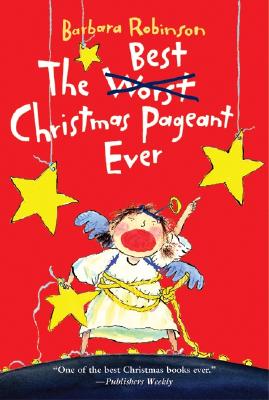
As an adult, I get the Deeper Meaning — and it’s a sweet message — but I still don’t see why it’s a classic. The writing is, well, simplistic, and the illustrations aren’t that great.  But it does have a great last line — “Hey! Unto you a child is born!”  — so maybe that’s why.

I can take it or leave it.