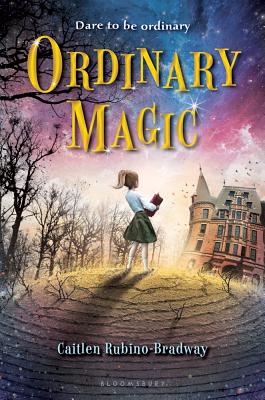
Ordinary Magic

by Caitlen Rubino-Bradway
ages: 10+
First sentence: “The day of my Judging dawned bright and clear and hot.”
Support your local independent bookstore: buy it there!
Review copy provided by the publisher.

Abby has grown up in a place, and a family, where having and doing magic is normal, every day, expected. So, of course on her 12th birthday, she has her Judging, when they determine not whether she has magic, but at what level she is. Except, it doesn’t go as planned: Abby has no magic. Is what they call an ord. Which means, generally speaking, her family and friends will shun her, she’ll get sold into slavery, and die an early death.

Except, Abby’s oldest sister, Alexa is working with the government and has set up a boarding school for ords to teach them how to live without magic. How to survive in a world where no one wants them. How to find a place where they are needed.  And Abby’s family is such that they’re not going to shun her, so she’s packed off to boarding school.

So far so good. I adore the reverse magic thing Rubino-Bradway has imagined, and I loved Abby’s family, and how they stood together. It’s so rare to have a fantastic family in kids books, I was just reveling in the fact that the parents were not idiots and the siblings all really adored each other and wanted to protect Abby.

But that’s also problematic: see a kid can’t have adventures with hovering parents. Boarding school is a good solution, but I do have a question: why do they all need to feel like we’ve gone through the whole school year? Can I blame that one on Harry Potter?

Because once Abby gets to the school, not much happens. (To be fair, not much happens in Harry Potter, either, but Rowling kind of makes us forget that.) They go to class. Abby ends up on kitchen duty. She makes friends. They have a spot of adventure at the Yule Fest, where Abby gets kidnapped, but then it’s back to, well regular school. She meets the king. And there’s a spot more of adventure, and the book ends.

It never really peaks climatically, and while it’s all very interesting, and charming, and I love Abby and her family, and I liked that Rubino-Bradway was dealing with prejudice, it just never really seemed to go anywhere. Which I found, ultimately, unsatisfying.

(Just for the record: because this is a Cybils nominee, I’ve been asked to make sure y’all know this is my opinion only, and not that of the panel.)

The Storm Makers

by Jennifer E. Smith
ages: 10+
First sentence: “Only Ruby knew about the stranger in the barn.”
Support your local independent bookstore: buy it there!

Twelve-year-old Ruby and her twin brother Simon are trying to get used to living on 10 acres in Wisconsin rather than a suburban Chicago home. Sure, it’s been a bit more than a year since they moved — in order for their parents to pursue their inventing/artistic dreams — but it still doesn’t really feel like home.  Especially this summer, when it’s so hot, without any rain, and the crops are withering. (Talk it the hand: I feel your pain! Summers in Kansas ain’t no picnic.)

Then Weird Stuff begins to happen to Simon. Or because of Simon: a rainstorm. A freak electrical shock. And a couple of strangers turn up (one nice, one not-so) to tell Simon that he has Special Powers, that he’s a part of an exclusive club: the Storm Makers.

So far, so good, right? I did like Smith’s play on the whole global warming/changing weather thing. And if you’ve been paying attention the past few years, she worked several major disasters into her story linnke, And I did like the neat twist near the end. But, overall, I didn’t feel this one held together. Mostly because it kind of felt like Savvy, but not as cool. And the “bad” guy was kind of wimpy; I never truly got the sense that he was All That and then some. Sure, yeah, I was told he was, but I just didn’t feel it. And while I liked Ruby — from whose point of view it was told — I never got a handle on Simon, either. Since he was half the whole twin thing, I felt like I should have gotten to know him at least a little better.

It wasn’t bad. But it wasn’t really great, either.

(Just for the record: because this is a Cybils nominee, I’ve been asked to make sure y’all know this is my opinion only, and not that of the panel.)

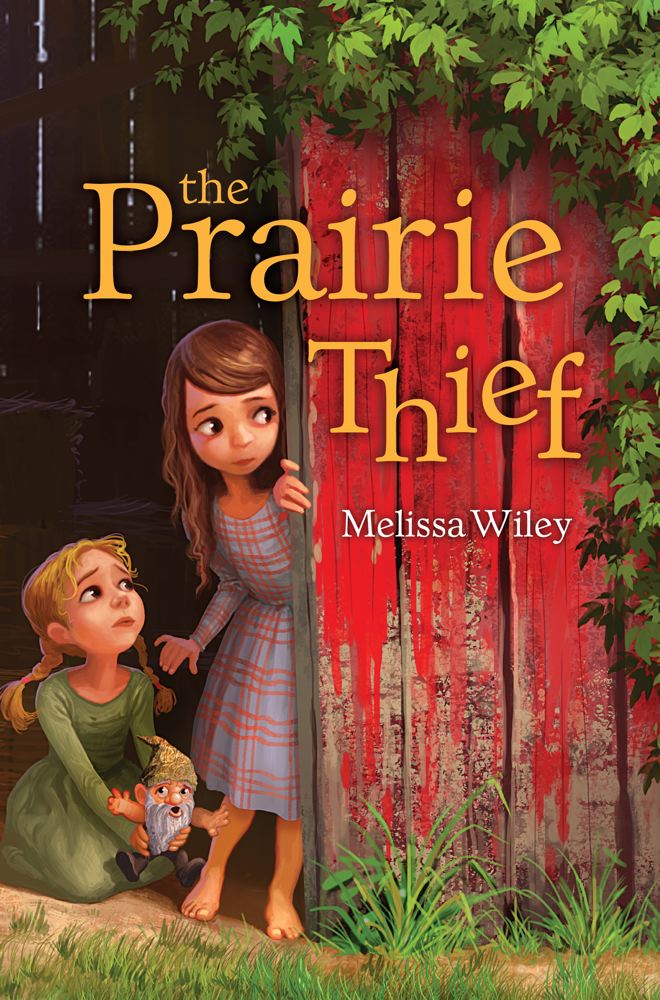
The Prairie Thief

by Melissa Wiley
ages: 8+
First sentence: “The Smirches took Louisa in when her Pa went to jail, but they weren’t happy about it.”
Support your local independent bookstore: buy it there!

It’s 1882 on the prairie (Kansas, most likely, since it mentions Topeka a few times), and Louisa Brody’s Pa has just been carted off to jail because several items belonging to their neighbors (the Smirches of the first sentence) have been found in a dugout belonging to the Brodys. The catch, though: the dugout hasn’t been used in years, but no one seems to believe them.

So, it’s up to Louisa to get to the bottom of this mystery. One that involves a smallish magical figure who was only pining for his wife who left him.

There’s really not much more to this little tale: it’s one of those delightfully written fairy stories, but that lacks a lot of substance. Sure, there’s the whole family angle: Louisa loves her Pa, and will do anything to keep him from getting hanged. But, more than that? Not really.

That’s not to say it’s not enjoyable: it is. Louisa’s a determined young girl, and the smallish magical figure is sufficiently adorably cranky. I’m going to probably order a couple for the store, because it’ll do well here in Wichita, with the Kansas angle.

But is it something that’s going to stick with me for a long time? Nope.

(Just for the record: because this is a Cybils nominee, I’ve been asked to make sure y’all know this is my opinion only, and not that of the panel.) 

The Seven Tales of Trinket

by Shelley Moore Thomas
ages: 9+ (read-aloud 6+)
First sentence: “My father was a teller of tales.”
Support your local independent store: buy it there!

Ever since her mother died, twelve-year-old Trinket has been on her own. Mostly: she has the pig boy Thomas to keep her company. And even though a kindly family offered to take her in, Trinket knew that her quest was to see the world, and to — hopefully, possibly — find her father who disappeared years before.

She and Thomas set off, and their adventures are told in a series of (this will come as no surprise) seven tales. It took me a little bit to get into the book, but by the second story I was hooked: the tales are retellings of Irish folk and fairy tales, and my Celtic-loving heart just ate that up.

The whole book is woven around the idea of storytelling, of bards and troubadours. The people and situations that Trinket and Thomas encounter are magical and mystical, and loosely tied together by her search to find her father.

In a wee bit of a spoiler (though, honestly: how could it have ended any other way?): Trinket does find her father. But he is not the same man who left the family all those years ago. There’s an underlying tale of forgiveness and love as well as the search for one’s purpose in life.

My only drawback on this one was the cover: it’s all shades of awful. Especially since these are the kind of tales that have universal appeal, it’s disappointing that this is the sort of cover that will turn boys off of this gem of a book. (Not that it needs to, mind you. It just will.)

Even so: I adored this one.

(Just for the record: because this is a Cybils nominee, I’ve been asked to make sure y’all know this is my opinion only, and not that of the panel.) 
Darkbeast

by Morgan Keyes
ages: 10+
First sentence: “The Travelers arrived in Silver Hollow a week before my twelfth nameday.”
Support your local independent bookstore: buy it there!
Review copy provided by the publisher.

Keara (two syllables, not three) is the youngest of three daughters of a widowed mother, and lives in a small village in the center of the country Duodecia. Nothing much has happened to her: she’s grown up, working alongside her mother who was trying to teach her how to be a good wife, waiting for her 12th nameday so she can become a woman.

Except that means she’ll have to kill her darkbeast, friend, and companion, the raven Caw.

See, in the religion of this country, each child is assigned a darkbeast — an animal companion to stay with them, and help take away their faults, sins, and vices — at birth. They grow up with them, and are (generally) supposed to hate the chain, and want to be free of it.

But, come Keara’s nameday, she finds she can’t kill her best friend. She lets him free, and becomes one of the Lost, the people who go against the religion. Which means the Inquisitors are going to get involved. (Nobody expects the Spanish Inquisition! Sorry. But, truthfully: it was kind of like that; one of my quibbles is that I felt Keyes was making some sort of commentary on religious extremists. But that may be me just reading things into it.) Which is something no one wants.

So, Keara goes on the run, joining with a group of Travelers — traveling actors — in order to hide from the Inquisitors. She finds a home there, and friends, including Vala and Goran. But, it’s also there that she finds out that life is not as simple as she was hoping it would be.

There was much to like about this one (as C, who read it first, was constantly telling me). I do have a soft spot for fantasy religions; I am always interested to see how the gods and goddesses fall out, how the religion is developed, and this one doesn’t disappoint in that regard. My quibbles (aside from the religious extremism one) fall on the characters: I didn’t like any of them. (Well, that’s not true: I liked Goran. But there wasn’t enough of him.) I felt Keara was a bit of a brat, and Vala was a bit too good to be true. It wasn’t until I was talking to C that I realized what Keyes did: she made a 12-year-old realistic. Especially one that’s a youngest child with two really accomplished older sisters.

Having realized that, I have a lot of respect for Darkbeast; it’s a solid coming of age novel, with some genuine conflict and heartfelt emotion.

(Just for the record: because this is a Cybils nominee, I’ve been asked to make sure y’all know this is my opinion only, and not that of the panel.)

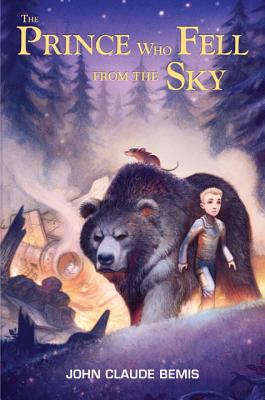
The Prince Who Fell From the Sky

by John Cladue Bemis
ages: 10+
First sentence: “The Forest was green with summer when the bear lumbered up from the creek bed where she had been cooling off.”
Support your local independent bookstore: buy it there!

I’ve read a lot of fantasy. Not as much as some, but definitely a lot. And so, especially this Cybils season, it takes something really unique to get my attention.

And, impressively, this one did.

I found myself marveling at the world that Bemis created; it’s one of the more unique ones that I’ve read.
in this distant future, the humans have disappeared (Died off? Destroyed? We never really find out), and the animals have basically taken over. Under the “leadership” of the Ogeema (he’s not very nice), the rest of the animals are managing okay. They have their clans — divided into predators and prey — and they basically have enough food. Our main character, a bear named Casseomae, is content. Until a pod crashes in Casseomae’s forest. Most of the Skinless Ones (her word for the humans) in it were killed, but a child survived. The coyotes want to kill the child, but Casseomae saves the child and adopts it as her own.

I should mention that even though the title says “prince” and the picture is of a boy, I never really felt like the child had a gender. Or that it was really of much importance to the story, which may bother some readers. But, I felt like it was the animals’ story more than it was the child’s. It’s the animals, after all, who are going on the journey and experiencing  hardships, and it’s their eyes that we see everything through.

Of course, Casseomae knows that in the forest the child, ‘s life is in danger. She she needs to take him someplace safer, someplace far away from the Ogeema’s domineering grasp. So, she takes the child out of the forest, heading toward a place called the Havenlands. Along the way, they meet a rat named Dumpster and a dog named Pang, talk to some vulture oracles.

If this is sounding a little weird, it’s because, well, it is. (Talking animals, in my opinion, are always a little weird.) And, truth be told: if it were told with humans, it would be your typical post-apocalyptic journey book, just a group of people running from an evil overlord, trying to make a new life for themselves.

But, with animals, it’s an amazing story. The way that Bemis writes about how the animals interact with the destroyed human world is completely fascinating. The rat, Dumpster, the Memory keeper (in other words: he knows all about humans and their stuff) for his mischief, helps the bear get along and make this perilous journey. And as they went along, I found myself time and time again being drawn into world — both familiar and strange — seeing through animal eyes. Additionally, Bemis wove together the classic animal stories — Watership Down and Jungle Book are two that come to mind — in with the post-apocalyptic setting, which gave what could have been a trite story added depth.

I do have to wonder about kid-appeal with this one, though: did I like this story so much just because of the world, or because, as a mother, I related to Casseomae’s fierce protective streak? Will kids actually wander through this world, and this adventure, and become as excited by it as I was?

I can only hope so.

(Just for the record: because this is a Cybils nominee, I’ve been asked to make sure y’all know this is my opinion only, and not that of the panel.)
The Icarus Project

by Laura Quimby
ages: 11+
First sentence: “The computer screen glowed in my dark bedroom like a moon.”
Support your local independent bookstore: buy it there!
Review copy provided by the publisher.

Maya is the daughter of two scientists: an archeologist mother, who is off at a site in Brazil; and a paleontologist father, whose specialty is wooly mammoths. Is it any wonder that Maya dreams of making a big scientific discovery of her own?

She has her chance when she’s allowed to go with her father on a dig — an eco-tourist company found some mammoth tusks in the Arctic ice, and have called in her father to supervise the dig.  Except, once they get there, they discover that the mammoth part was a hoax. What  they discovered was much, much more important.

Hmmm… should I tell you what they discover? I’m not sure, partially because I’m not really sure what it WAS that they discovered. It was a boy, yes (shades of Encino Man there) but it was also something… More.

I liked this one, partially for the science-y elements. Maya was really into research and science and discovery, and blending that with a bit of mystery worked quite well. Of course there was a sidekick in the son of another dig member, but thankfully that never really blossomed into a romance. *whew* It was a straight-forward Arctic dig book before it took a left turn into the mystical about halfway through. To be honest, even though it was kind of hokey, I didn’t really mind it. The whole There Is Something Out There (the Truth?) thing worked for me. And while it was probably highly implausible that Maya could pull off what she did in the end, by that point I was willing to go along with anything.

Granted, I may be alone here. But, I thought it was an enjoyable story.

(Just for the record: because this is a Cybils nominee, I’ve been asked to make sure y’all know this is my opinion only, and not that of the panel.) 

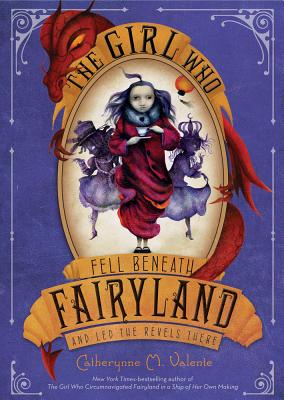
The Girl Who Fell Beneath Fairyland and Led the Revels There

by Catherynee M. Valente
age: 11+, good for read aloud 7+
First sentence: “Once upon a time, a girl named September had a secret.”
Support your local independent bookstore: buy it there!
Others in the series: The Girl Who Circumnavigated Fairyland in a Ship of Her Own Making

September is pining. Pining for Fairyland, for her adventures there because (and don’t we all know this) Real Life is So Boring. Then on her 13th birthday, she finds a way back… except it’s all Changed. Her shadow has become the Hallow Queen of the Fairyland Below, and is taking (well, encouraging strongly) all the shadows of Fairyland away to have their own party, to be free of doing Everything Their Person/Thing/Being does. Which, interestingly enough, means that the magic in Fairyland is fading. It’s up to September to convince — somehow — her shadow to give up her reign. Even if it means going to the very bottom of the world to wake up the Sleeping Prince.

In many ways, I knew what I was getting reading this one: it has the same tone, the same spirit, as the first one did. (Which, by the way, you don’t really *need* to read. This is a sequel, but it’s also a completely separate story.) But, in other ways, this one was… more than the first one. There was a darkness to it that I liked, and a maturity, too.  September isn’t the flighty thing she was in the first book; she has Responsibilities, and there are Consequences. And the humor isn’t as prevalent (read: I didn’t smile as much as I did the first time around). Which means, I’m not sure K (who mostly enjoyed hearing the first one read to her) would get it. On the other hand, nearly 13-year-old C would.

In all, it’s a solid second book. And it makes me wonder if September will have any more adventures. If she does, I’ll be sure to read them.

(Just for the record: because this is a Cybils nominee, I’ve been asked to make sure y’all know this is my opinion only, and not that of the panel.)

The Cabinet of Earths

by Anne Nesbet
ages: 10+
First sentence: “It was his own grandmother who fed Henri-Pierre to the Cabinet of Earths, long ago when he was only four.”
Support your local independent bookstore: buy it there!

Maya does not want to move to Paris. (Poor girl.) But, her mother has just made a spectacular recovery (mostly) from her battle with cancer, and she wants to live in Paris, so they go. After all, who is going to say no to the sick mom?

But when Maya and her family — mom, dad, little brother James — get to Paris, weird things start happening. First off, their cousin — well, she’s more like a great-aunt — Louise is mostly, well, not there. Invisible. And kids disappear from their neighborhood. Their cousin-uncle Henri is quite friendly, though is house is weird, and he’s got those creepy purple eyes. Not to mention the Dauphin at school and his unusually (read: creepy) young parents.

And then there’s the Cabinet of Earths. It holds the sands of time… literally. For whomever has their sands in the bottle, they will be immortal. And Maya has been chosen as the next Keeper.

It sounds ominous, and it is. But, a good kind of ominous. Creepy-cool ominous.

Which is one of the things I really liked about this one. There’s this aura of danger throughout, and Maya is dealing with things that no one else can see. Thankfully, she has Valko (whom I liked, even though I thought he was almost completely unnecessary, but a girl needs a sidekick, right?) who believes that what she’s seeing is Real. That, and Cousin Louise, who is really quite awesome.

The other really cool thing about this one (aside from Paris, which gets bonus points for just being there), is that Nesbet mixes science in with the magic and the supernatural. I’ve heard it said that magic is only things that science hasn’t proved yet, and Nesbet takes that literally. Not only is Maya’s dad scientist, Nesbit mixes in the beginning of chemistry with the magical history, weaving the science and magic together. I haven’t seen that before (maybe I ought to get out more?) and I thought it worked quite well.

I also liked that even thought there’s room for a sequel at the end, the book basically stands alone. And in this Cybils season, where I’m reading second, third, and fifth books in a series out of order, I thoroughly appreciate a stand-alone as a breath of fresh air.

In short: an excellent debut. I’ll be looking forward to seeing what Nesbit offers up next.

(Just for the record: because this is a Cybils nominee, I’ve been asked to make sure y’all know this is my opinion only, and not that of the panel.)

Small Medium at Large

by Joanne Levy
ages: 10+
First sentence: “Despite the suffocating mid-May heat and the nonbreathable fabric of my lavender polyester dress, it was shaping up to be a very good day.”
Support your local independent bookstore: buy it there!

Lilah bloom is an ordinary 12-year-old with ordinary problems: she’s got friend drama, she likes a boy but is afraid to tell him, her mother just got remarried and her dad’s a wee bit depressed… nothing out of the ordinary. Then she gets struck by lightning, survives, and… now can hear dead people.

Most particularly her very awesome (and Jewish) grandmother, Bubby Dora. Who is visiting primarily because she wants her son to get remarried, and Lilah’s help in achieving this goal. (Can you say awkward?) But, it’s not just Bubby Dora she hears: she becomes a bit of a clairvoyant, helping various people — from her band instructor to the mean girl in class — achieve a, well, happier state.

The best thing about this one? No magical, mystical adventures. No saving someone from a Dire Fate. No weird worlds with characters that have unpronounceable names. This one was a fun, fluffy middle grade novel where the main character just happens to hear ghosts — and to a good end, too. In short, in the midst of all the complicated high fantasy I’ve been reading lately for the Cybils (not that I mind), a nice, light one like this was a breath of fresh air.

(Just for the record: because this is a Cybils nominee, I’ve been asked to make sure y’all know this is my opinion only, and not that of the panel.)